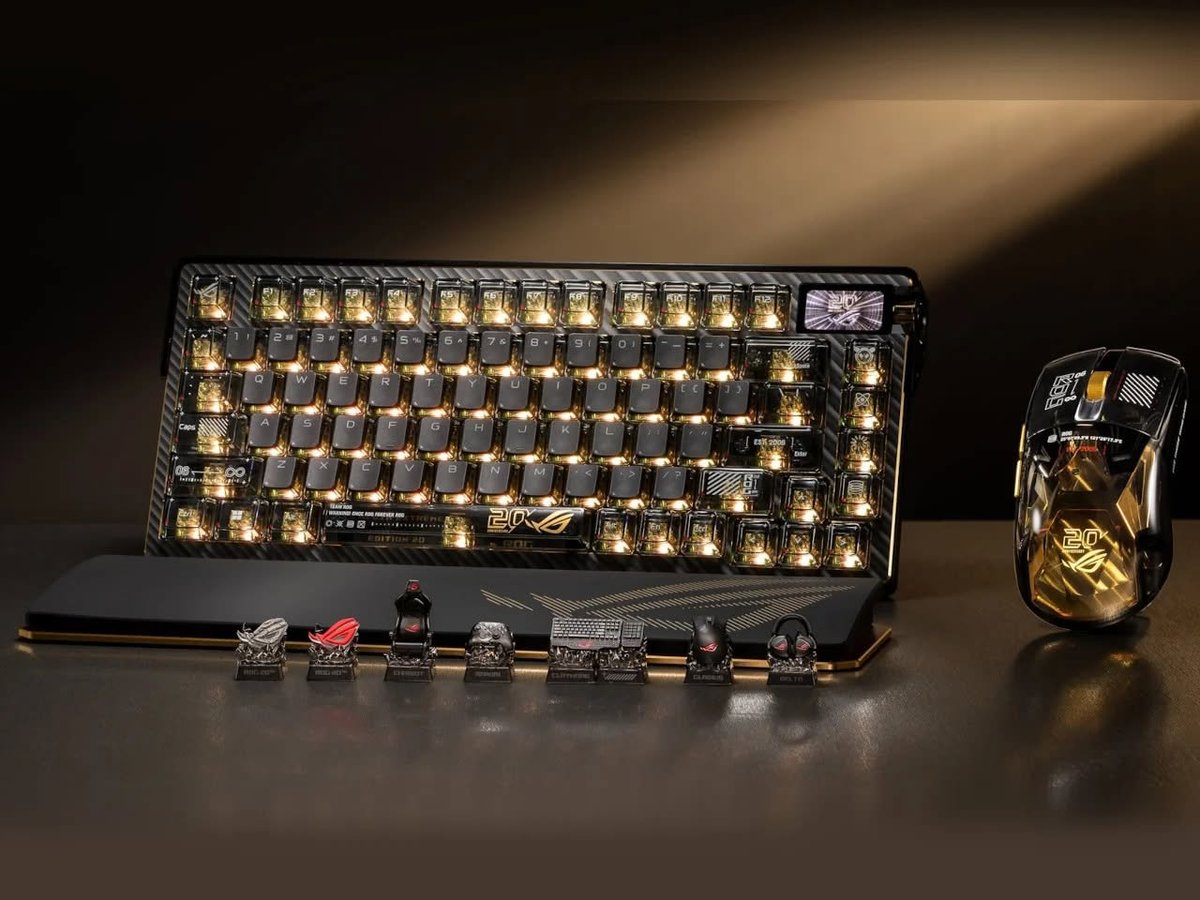
In brief — June 13, 2026. Tom's Hardware has gone hands-on with the Asus ROG Harpe II Extreme Edition, a tournament-flagship gaming mouse with 24-karat gold accents on the side buttons and scroll wheel, an AimPoint Pro optical sensor rated to 65,000 DPI, an 8KHz wireless polling rate, and a list price north of $999. It's a halo product — built to anchor the top of the ROG peripherals lineup — but the underlying sensor and polling tech are interesting on their own terms, and the value-to-spec ratio is dramatically inverted: the proven Logitech G502 Hero at one-twentieth the cost still serves 95% of competitive players better.
What happened
Asus unveiled the Harpe II Extreme Edition at Computex 2026, with retail availability following over the past week and Tom's Hardware among the first outlets to publish a full hands-on review. The headline specs from the announcement:
- 65,000 DPI AimPoint Pro optical sensor (vs ~35,000 DPI on most current flagships)
- 8,000 Hz wireless polling rate over the ROG SpeedNova 2.4 GHz protocol (vs the more common 1,000–4,000 Hz)
- 47-gram weight, magnesium-alloy chassis under polymer skin
- 24-karat gold electroplating on the side buttons and scroll-wheel notches
- Three Kailh GM 8.0 main switches per side (selector-rotated to extend lifespan)
- Onboard 64 MB of profile memory; full ROG Armoury Crate integration
- 130-hour quoted battery life at 1KHz, ~30 hours at 8KHz
- USB-C wired fallback with bundled paracord cable
- $999 MSRP for the standard config; a numbered limited-run "champion" variant is priced higher
The Extreme Edition is the second halo from this generation of ROG mice, following the standard Harpe II released earlier in the year. Asus positions it explicitly at the esports-pro tier — the people whose income depends on a mouse not having a single dropped click or sensor hiccup in a tournament — and prices it accordingly.
Does the spec sheet matter to a regular player?
Mostly no, and the honest answer is one of the more useful framings here. Two of the headline numbers don't move performance for non-pros.
65,000 DPI sensor: most players run 400–1,600 DPI as their effective sensitivity. The numbers above that exist as engineering headroom — the higher the maximum, the lower the noise floor in the range you actually use. The practical difference between a 35,000 DPI sensor and a 65,000 DPI sensor at the 800 DPI you actually game at is essentially zero unless you're doing 360° flicks at sub-50 ms target acquisition. Pros benefit from sensor headroom because their motions are at the edge of what current sensors can track accurately; everyone else gets a slightly cleaner cursor trace in benchmarks they'll never look at.
8KHz polling: this is more interesting. Polling rate dictates how often the mouse reports its position to the PC, and 8KHz cuts the worst-case input latency from ~1 ms to ~0.125 ms. The catch is that the rest of your system needs to keep up: 8KHz polling generates real CPU load (a non-trivial 1–3% per mouse on mid-range CPUs), and most game engines internally tick at the monitor refresh rate (240 Hz = ~4 ms intervals) so the polling-rate benefit only shows up at 360 Hz+ displays. If you're running a 240 Hz monitor and a Ryzen 5 / Core i5, 8KHz polling makes no real-world difference. If you're on a 480 Hz panel with a 7800X3D and you compete in CS2 or Valorant at high rank, you can probably feel the smoothness improvement.
The gold accents are aesthetic. They don't do anything functional. They look excellent in a tournament photo and slightly garish under desk RGB.
Where it sits against proven esports mice
For comparison, here are the cards the Harpe II Extreme is competing with at the top end and where a budget-conscious player should actually be looking:
| Mouse | Weight | Sensor (max DPI) | Polling | Price | Best for |
|---|---|---|---|---|---|
| Asus ROG Harpe II Extreme | 47g | 65,000 | 8 KHz | $999 | tournament flex, halo collectors |
| Razer Viper V3 Pro | 54g | 35,000 | 8 KHz | $160 | competitive FPS, broad availability |
| Logitech G Pro X Superlight 2 | 60g | 32,000 | 4 KHz | $159 | the "default" pro pick across many esports leagues |
| Logitech G502 Hero | 121g | 25,600 | 1 KHz | $40 | everyone else, wired |
| Logitech MK270 combo | 73g (mouse) | 1,000 | 0.5 KHz | $30 (kit) | productivity, casual gaming |
The Razer Viper V3 Pro and Logitech G Pro X Superlight 2 are the actual mice you'll see in the hands of CS2, Valorant, and Apex players at every major LAN this year. Both have the same 8KHz polling option as the Harpe II Extreme and sensor headroom that nobody actually uses. Both cost a small fraction of the Harpe Extreme's price. The Harpe II Extreme is a stunning piece of engineering and a deliberate aspirational product; it is not what you should buy if you're trying to climb a ranked ladder.
For pure value, the Logitech G502 Hero at $40 has been the consensus "best $40 mouse" for half a decade. Its 25K-DPI HERO sensor is genuinely competitive at the sensitivities anyone uses, the build is overengineered for the price, and the weight customization system means you can dial it from a heavy palm-grip feel to something approaching modern lightweight ergonomics. It's wired, which matters for esports use (no latency surprises, no battery to monitor), and a SteelSeries QcK XXL mousepad underneath gives you a desk-sized aim surface that won't wear out.
What about a wireless combo for casual / desktop use?
If you're not in the competitive bracket and you'd rather not run two devices over USB, a wireless combo like the Logitech MK270 is the productivity equivalent of the Hero — overengineered for $30, both mouse and keyboard, on a single 2.4 GHz USB dongle. It won't compete on latency for FPS games (the Harpe II Extreme's 8KHz polling beats it by ~16×), but for browsing, document work, and casual games where you're not measuring milliseconds, the gap doesn't matter. The MK270 also has the practical advantage of a 36-month quoted battery life on the mouse and 24 months on the keyboard — you genuinely won't think about charging it.
For a setup that splits the difference — competitive-leaning at home, productivity-friendly at work — the G502 Hero plus the QcK XXL is a $70 combo that beats almost anything in the $200–400 wireless category on raw price-to-performance.
Why the Harpe II Extreme exists
Halo products serve real purposes for a peripherals lineup even when they don't sell at volume. They:
- Anchor positioning: a $999 mouse makes a $160 Viper V3 Pro feel like a value buy. The Harpe II Extreme exists partly to make the Razer (and the rest of ROG's own lineup) look reasonable by comparison.
- Drive press and review attention: a 24K-gold gaming mouse is a story; a 47-gram lightweight mouse is not. Tom's Hardware, The Verge, and a dozen other outlets are running coverage right now that they would not run on a normal lightweight refresh.
- Generate tournament photos: pro mice in pro hands at LAN events are some of the highest-value content in PC gaming. A Harpe II Extreme in front of a top CS2 player is a multi-month marketing asset for ROG.
- Showcase sensor and polling tech that will trickle down: the 65,000 DPI AimPoint Pro sensor and 8KHz SpeedNova radio will both appear in the standard ROG mouse line within 18 months at a fraction of the price, and that's where the volume sales actually happen.
That last point is the most useful for the average reader. Engineering work done at the halo tier reliably trickles down. Within two product cycles the same sensor will land in a $99 ROG mouse, and the gold accents will be replaced with normal anodized aluminum. If you don't need it today, wait — and meanwhile, spend $40 on a Hero.
Cost-per-DPI is a meaningless metric
A predictable joke in the gaming peripherals press: $999 for 65,000 DPI is $0.015 per DPI. The G502 Hero at $40 for 25,600 DPI is $0.0016 per DPI — about 10× better on this metric. The point isn't that the metric is meaningful (it isn't), but that any time a peripheral's headline spec is "biggest number," the marketing is doing a job that the engineering isn't necessarily doing. The Harpe II Extreme is a real engineering achievement — Asus didn't slap gold on a stock mouse — but the spec-sheet headlines hide the limits of where any of those specs actually help.
Practical buying recommendations
Three real options based on where you sit:
- You're a casual player who wants a great-feeling mouse without thinking about it. Buy the Logitech G502 Hero and a SteelSeries QcK XXL pad. $70 total. You're done for five years. The Hero's wired connection, weight tuning, and the Hero sensor are all genuinely great at the price.
- You're a serious competitive player on a budget. Buy a Razer Viper V3 Pro or a Logitech G Pro X Superlight 2 at $160, paired with the QcK XXL. You'll match the latency and weight class of the Harpe II Extreme at a fraction of the price, and you'll be using the same hardware as the pros you watch on stream.
- You're going for productivity / casual setup without splitting peripherals. Buy the Logitech MK270 wireless combo at $30 and a basic cloth pad. It's not a competitive setup but it's the cheapest path to a clean desk.
Skip the Harpe II Extreme unless you specifically want a $999 conversation piece in your tournament loadout. There's no shame in wanting it — it's beautifully designed — but call the purchase what it is.
The source
Tom's Hardware published the hands-on review and full spec breakdown; their coverage is the primary source for all numbers in this brief. The official product page on the Asus ROG mice and pads site carries the manufacturer's marketing language and confirms MSRP and availability windows. For competitive context, Gamers Nexus has historically covered the high-end ROG line and the comparable Razer and Logitech flagships side-by-side, including sensor- and click-latency benchmarks that go deeper than the average launch coverage.
Citations and sources
- Tom's Hardware — original hands-on review, full spec sheet, and the 8KHz polling benchmark numbers we cite above
- Asus ROG mice and pads — manufacturer product page, MSRP, and the official sensor and switch claims
- Gamers Nexus — sensor- and click-latency benchmarks, plus historical head-to-head coverage of comparable ROG, Razer, and Logitech flagships


