

Pixio
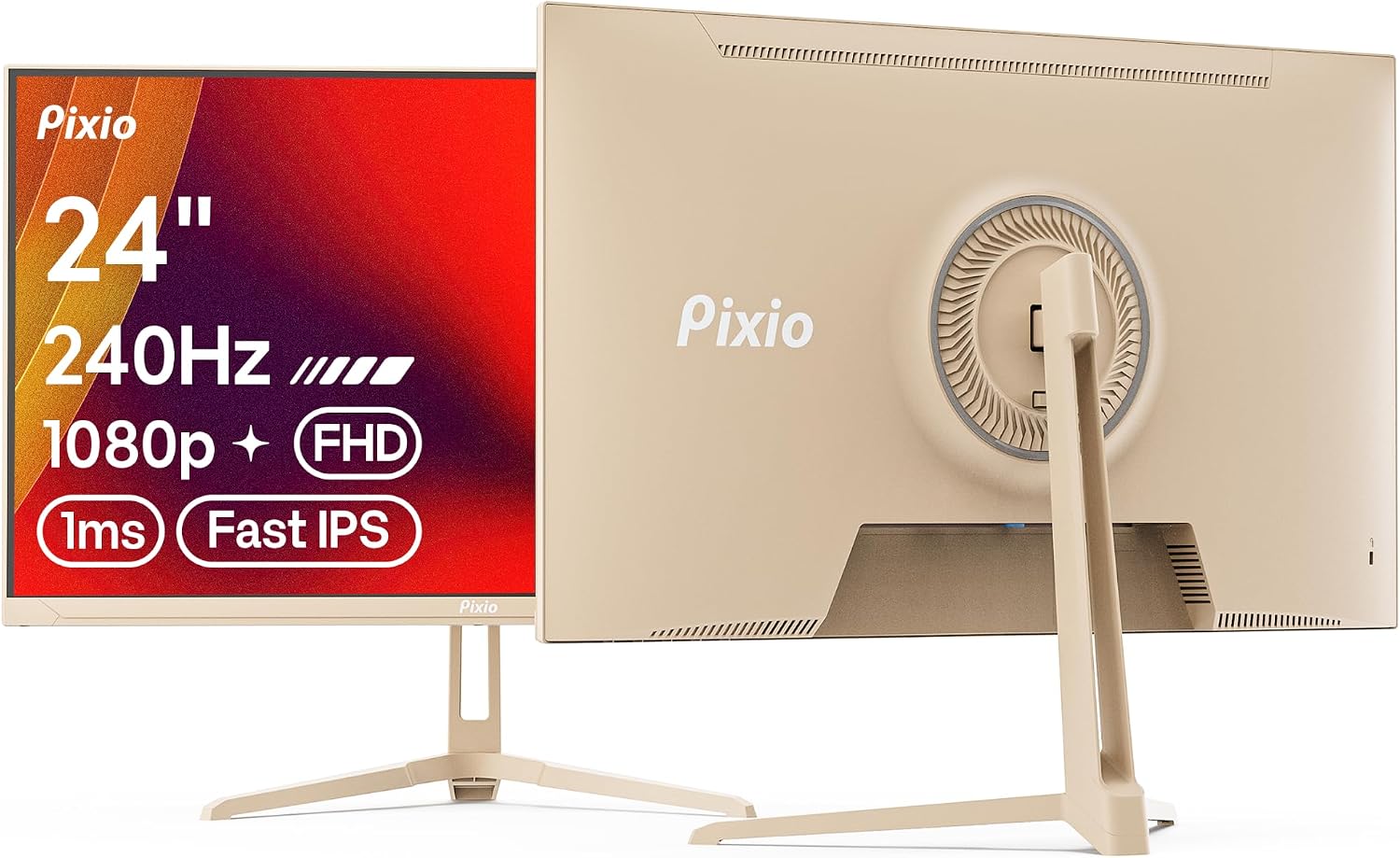
Pixio PX249 Wave 24 inch 240Hz Refresh Rate FHD 1080p Resolution Fast IPS Panel 1ms GTG Response Time Built-in Speakers Gaming Monitor with Adaptive Sync
Bottom line: The Pixio PX249 Wave 24 inch 240Hz Refresh Rate FHD 1080p Resolution Fast ($178.49 on Amazon as of 2026-11-20 17:26 UTC): Runs 240Hz at 1080p over both HDMI 2.0 and DisplayPort 1.4; main trade-off: 1080p on a 24-inch screen looks less sharp than 1440p alternatives. Another in-stock pick with the same 24" 1080p 240Hz+ monitor: the Pixio PX249 Wave Beige 24 inch 240Hz Refresh…, $178.49 on Amazon as of (price may vary).
As an Amazon Associate, SpecPicks earns from qualifying purchases. Full disclosure →
*Price sourced from Amazon.com. Last updated 2026-11-20. Product prices and availability are accurate as of the date/time indicated and are subject to change. Any price and availability information displayed on Amazon.com at the time of purchase will apply to the purchase of this product.
Pros & Cons
Pros
- ✓ Runs 240Hz at 1080p over both HDMI 2.0 and DisplayPort 1.4
- ✓ Fast IPS panel with 1ms GTG response to limit ghosting and trailing
- ✓ Adaptive Sync reduces tearing and stutter when frame rates dip below 240
- ✓ Built-in speakers for system audio without extra desktop speakers
Cons
- ✗ 1080p on a 24-inch screen looks less sharp than 1440p alternatives
- ✗ Only two video inputs: one HDMI 2.0 and one DisplayPort 1.4
- ✗ Reaching 240 fps in demanding games needs a capable GPU
- ✗ Built-in speakers won't replace a headset or dedicated speakers
Manufacturer description
The Pixio PX249 Wave is a 24-inch gaming monitor with a Fast IPS panel. It runs at 1920x1080 and 240Hz, with a 1ms GTG response time. If you play competitive shooters or esports titles where every frame counts, you get a high refresh rate and still keep the wide viewing angles and even color of an IPS panel. Adaptive Sync matches the monitor's refresh rate to your graphics card's frame rate. This cuts screen tearing and stutter when your frame rate drops below 240. The monitor has one HDMI 2.0 port and one DisplayPort 1.4 port, and Pixio says both support full 1080p at 240Hz. You can connect…
SpecPicks Verdict
SpecPicks has no buyer-rating or benchmark data for Pixio PX249 Wave 24 inch 240Hz Refresh Rate FHD 1080p Resolution…, so this read rests on the manufacturer's listed specs and the current price in the gaming monitors category (how we evaluate). Compare with similarly-priced alternatives in the gaming monitors category before committing. On the listing's own facts, the case for it is "Runs 240Hz at 1080p over both HDMI 2.0 and DisplayPort 1.4"; the main trade-off is "1080p on a 24-inch screen looks less sharp than 1440p alternatives". If those two points fit how you will use it, put it beside one or two close alternatives in the Compare tool to confirm the price.
Before ordering, check the listed dimensions, ports, power requirements and supported devices or systems in the spec table below against how you plan to use it, and confirm them on the retailer's listing. Prices and stock are set by the retailer and may have moved since this page was last updated.
Frequently Asked Questions
Can the Pixio PX249 Wave run 240Hz over HDMI, or only DisplayPort?
Both. Pixio says the HDMI 2.0 port and the DisplayPort 1.4 port each support 1920x1080 at 240Hz, so either input can reach the full refresh rate.
Does the PX249 Wave support FreeSync or G-Sync?
It has Adaptive Sync, which matches the monitor's refresh rate to your GPU's frame rate to reduce tearing and stutter. Check the product listing for specific FreeSync or G-Sync Compatible certification.
Can I use the Pixio PX249 Wave with a game console?
Yes. It has an HDMI 2.0 input at 1080p, which works with consoles that output over HDMI. The refresh rate you get depends on what your console supports, which may be lower than the monitor's 240Hz.
Does the Pixio PX249 Wave have built-in speakers?
Yes, it has built-in speakers. They are fine for system sounds and casual audio. For competitive gaming or music, a headset or dedicated speakers will sound better.
Key Features
Quoted from the manufacturer's listing. Where it differs from the pros and cons above, those note the conditions the listing leaves out.
- Unleash the Power of 240Hz Refresh Rate - Experience unparalleled smoothness and responsiveness with a blistering 200Hz refresh rate. Every frame is rendered flawlessly, eliminating motion blur and lag for pixel-perfect precision in even the most intense gameplay scenarios. React faster, aim truer, and dominate your opponents.
- Lightning-Fast 1ms Response Time - See your actions come to life instantly with a remarkable 1ms response time. No more frustrating ghosting or trailing, just pure, unadulterated speed that gives you the edge in competitive gaming.
- Vivid IPS Display- Immerse yourself in vibrant colors and wide viewing angles with a stunning IPS panel. Enjoy rich, lifelike visuals and consistent color accuracy from any angle, perfect for both solo play and shared gaming experiences.
- Adaptive Sync - Matches the refresh rate of the monitor to the frame rate of the GPU, eliminating screen tearing and stuttering for a smooth and seamless gaming experience.
- Supports both HDMI and DisplayPort - There is one connection for HDMI 2.0 and DisplayPort 1.4 each, both supporting 1920x1080 resolution at 240Hz refresh rate. This assures maximum compatibility for PC desktops, laptops, consoles, or any device that supports DisplayPort or HDMI.
Full Specifications
| Brand | Pixio |
|---|---|
| Color | Black |
| Voltage | 12 volts |
| Brightness | 300 cd |
| Model Name | PX249 Wave |
| Resolution | FHD 1080p |
| Unit Count | 1 Count |
| Screen Size | 24 inches |
| Aspect Ratio | 16:9 |
| Display Type | IPS |
| Model Number | PX249WAVE |
| Refresh Rate | 240 hertz |
| Adaptive Sync | FreeSync |
| Compatibility | PC |
| Response Time | 1 milliseconds |
| Screen Finish | Matte |
| Viewing Angle | 178 degrees |
| Contrast Ratio | 1000:1 |
| Native Resolution | 1920x1080 |
| Display Technology | LED |
Ready to buy?
Pixio PX249 Wave 24 inch 240Hz Refresh Rate FHD 1080p Resolution Fast IPS Panel 1ms GTG Response Time Built-in Speakers Gaming Monitor with Adaptive Sync is listed on Amazon. Price, availability, shipping and returns are set by Amazon and its sellers — check the listing for current terms. SpecPicks earns a small commission on qualifying purchases — thank you for supporting independent review work.
*Price sourced from Amazon.com. Last updated 2026-11-20. Product prices and availability are accurate as of the date/time indicated and are subject to change. Any price and availability information displayed on Amazon.com at the time of purchase will apply to the purchase of this product.
Related Gaming Monitors



More guides & deep dives from the SpecPicks archive
Browse all articles & guides →- Best Budget Gaming PC Build 2026 — ~$1,000 Parts List
- RTX 4070 Super vs RX 7800 XT — Which to Buy in 2026
- How to Build a Windows 98 Retro PC in 2026
- Best Retro Handhelds in 2026: Pocket, Mid-Tier and FPGA Picks
- Emulation Hardware in 2026: FPGA, Software, and Cart-Reader Ecosystems
- The Complete Voodoo5 5500 AGP Driver Guide (2026 Edition)
- Best 1440p Gaming GPUs in 2026
More reviews from the SpecPicks archive
Browse all reviews →- Best SSD for a Steam Deck or ROG Ally Upgrade (2026)
- llama.cpp vs vLLM for Single-User Local Chat in 2026: Which Wins on a 12GB GPU?
- Best Capture Device for Recording Retro Consoles and Old PCs in 2026
- Which LLMs Actually Fit on an RTX 3060 12GB in 2026?
- Alien: Isolation on Steam Deck: Best Settings for 2025
- The Pac-Man Benchmark: Testing Local Agentic Coding AI
- Open WebUI + Ollama on an RTX 3060: The Self-Hosted ChatGPT Alternative for 2026
- Running Mistral's New OCR Model Locally on a 12GB GPU
- How to run Llama 3.1 8B on Apple M3 Ultra
- Framework RTX 5070 12GB Module: Why It's $1,199, Not $699
- AI-Driven Driver Install for Win98: Vision-LLM + 3060 12GB Build (2026)
- Ryzen AI Max+ 395 Motherboard Guide: What You Can Upgrade
- Qwen3.8 Max vs Claude Opus 4.8: What the Cost-Per-Task Gap Means for Local Rigs
- Run a Local LLM on a Raspberry Pi 4 8GB: What Works in 2026
- Best 4K Monitor for Reviewing AI-Generated Images on an RTX 3060
- Best GPU for Qwen 3 32B (2026)
- Ryzen 9800X3D vs 7800X3D: Best CPU for an RTX 5070 Build
- Best Gaming Room Lighting in 2026: LED Strips and Ring Lights
- Qwen 3.6 27B vs Mistral Medium 3.5 on a 24GB GPU: Only One Fits
- DeepSeek Hits the US Entity List: What It Means for Local Inference
- How to Run a Public Website on a $10 ESP32 Without Servers
- Flux 3 Native-Audio Video: Can a 12GB GPU Run It?
- Best USB Microphones for Streaming and Podcasting (2026)
- Ryzen 5 5600X vs Ryzen 7 5800X: CPU-Only Qwen2.5 14B (2026)
Earliest SpecPicks reviews
Browse full archive →- Best GPU for Llama 3.1 8B (2026)
- Best GPU for Qwen 3 14B (2026)
- Best GPU for Qwen 3 32B (2026)
- Best GPU for Llama 3.1 70B (2026)
- Best GPU for DeepSeek-R1 32B (2026)
- Best GPU for Llama 3.1 405B (2026)
- How to run Llama 3.1 8B on NVIDIA GeForce RTX 5090
- How to run Qwen 3 14B on NVIDIA GeForce RTX 5090
- How to run Qwen 3 32B on NVIDIA GeForce RTX 5090
- How to run Llama 3.1 70B on NVIDIA GeForce RTX 5090
- How to run DeepSeek-R1 32B on NVIDIA GeForce RTX 5090
- How to run Llama 3.1 8B on NVIDIA GeForce RTX 4090