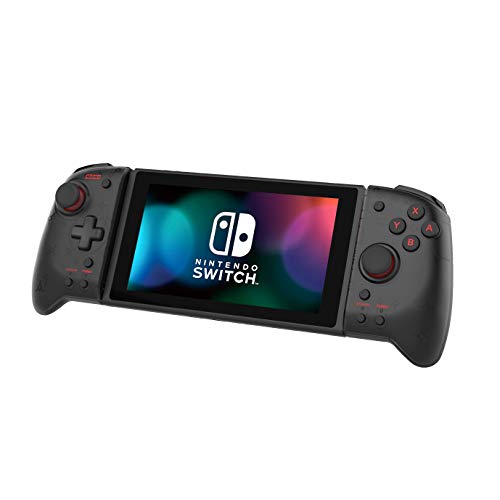
Buy a grip first. The Hori Split Pad Pro replaces both Joy-Con with full-size sticks and a real D-pad for about $50, and it is the only accessory on this list that changes how the console feels in your hands. Everything after it is audio, docking and storage — cheaper, and easier to get right.
What the Switch actually needs
The Switch has been on the market long enough that the accessory aisle is mostly noise: skins, screen protectors, carry cases in nine colors, and a hundred docks that all claim the same thing. None of that changes what the machine does. Four things do — how it feels in handheld mode, how you get sound out of it, what happens when you put it on a desk, and where the cartridges live once you own more than a dozen games.
This guide is for handheld-first players. If your Switch spends most of its life undocked on a couch or a train, the ergonomics of the stock Joy-Con are your single biggest complaint, and they are the cheapest thing to fix. Joy-Con are small because they have to detach and work as standalone controllers; that constraint gives you thumb-cramping sticks, a four-button "D-pad" that is really four separate buttons on the left Joy-Con, and shoulder buttons the width of a matchstick.
The console's audio situation is better than most people assume. There is a 3.5 mm headphone jack on the top edge, so any wired headset works with no pairing and no latency negotiation. Since system version 13.0.0 the Switch also supports Bluetooth audio natively, which Nintendo documents with three specific limits: only two controllers can stay connected wirelessly while Bluetooth audio is active, Bluetooth microphones are not supported at all, and Bluetooth audio cannot be used during local wireless play (Nintendo Support). Those are not deal-breakers, but they decide which side of the wired-versus-wireless question you land on.
Docking is where third-party accessories get genuinely risky, and where you should read the manufacturer's compatibility list rather than the marketplace listing title. Storage is the opposite: a cartridge case is a $21 problem you solve once.
Every product below is a live catalog listing with current pricing, from $21 to $50. The whole set costs less than one first-party Pro Controller plus a game.
The picks at a glance
| Pick | Best For | Key Spec | Price | Verdict |
|---|---|---|---|---|
| Hori Split Pad Pro | Best overall | Full-size sticks, real D-pad, assignable rear triggers, wired | ~$50 | The only accessory that changes how the console feels |
| Turtle Beach Recon 50 | Best value | 40 mm neodymium drivers, 3.5 mm wired, multiplatform | ~$28 | Zero pairing, zero latency, keeps all four controller slots free |
| TAGRY True Wireless Earbuds | Best for travel | True wireless, 60 h total playback via charging case | ~$26 | Right answer when the cable is the problem — accept the two-controller cap |
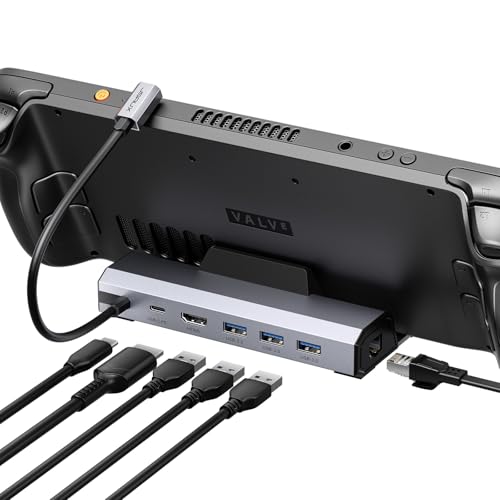
| JSAUX 6-in-1 Docking Station | Best for docked play | HDMI + gigabit Ethernet + 3× USB-A + PD passthrough | ~$36 | Excellent hub — verify your console is on the supported list first |
| sisma 64 Game Case | Budget pick | 64 cartridge slots, rigid shell | ~$21 | Solves cartridge sprawl permanently for the price of half a game |
Top picks
🏆 Best Overall: Hori Split Pad Pro
Verdict: Full-size controller ergonomics in handheld mode for about $50, at the cost of every motion feature.
✅ Full-size analog sticks and a true eight-way D-pad, not the four discrete buttons on a left Joy-Con ✅ Two assignable rear triggers plus turbo, which is a genuinely rare feature at this price ✅ Officially licensed by Nintendo, so the rail fit and firmware handshake are not a gamble ✅ Wired through the console's side rails — no battery, no charging, no pairing, no drift from wireless stick calibration
❌ Handheld only. It draws power and signal through the rails and stops working the instant the console goes into the dock ❌ No motion controls, no HD rumble, no NFC (so no amiibo), no IR camera
The Split Pad Pro is the clearest upgrade on this list because it fixes a problem the console cannot fix in software. Hori's design brief was simple: take the grip geometry from a full-size controller and split it into two rail-mounted halves. You get sticks with real travel, shoulder buttons you can find without looking, and a D-pad that registers diagonals — which matters the moment you play anything 2D, from a Mega Man collection to Hollow Knight.
What you give up is the entire motion-and-rumble feature set. Hori lists the omissions plainly: no motion controls, no HD rumble, no NFC and no IR camera (HORI USA). That is not a rounding error. Gyro aiming in Splatoon or Breath of the Wild is a real skill advantage, and if you use it, this controller regresses your play. Ring Fit and 1-2-Switch simply do not work. Amiibo scanning moves to whichever Joy-Con you kept in the drawer.
The handheld-only limitation is the other thing to internalize before buying. This is not a controller you use on a TV. Owners who play both ways keep the stock Joy-Con attached to the console for docked sessions and swap the Split Pad Pro on when they undock — a five-second operation, but one you will do every day.
See price & specs · price shown is the current catalog listing and moves frequently. See full details →
💰 Best Value: Turtle Beach Recon 50
Verdict: A $28 wired headset that works identically in handheld and docked mode and costs you nothing in controller slots.
✅ 40 mm neodymium drivers — full-range, and larger than the 30 mm units common at this price ✅ 3.5 mm analog connection: plug in, get sound, no pairing screen and no codec negotiation ✅ Adjustable high-sensitivity flip-style mic for the handful of Switch titles that use voice ✅ Multiplatform by design — the same headset works on a PC, a PS5 and an Xbox without a dongle
❌ A cable, which is exactly the wrong thing on a crowded train ❌ Plastic-heavy build; this is a $28 headset and it does not pretend otherwise
The Recon 50's whole argument is that the Switch has a headphone jack and analog audio has no latency. Turtle Beach specifies 40 mm neodymium drivers across the Recon 50 line, tuned for full-range output rather than a bass-forward gaming curve (Turtle Beach). At this price the driver size is the spec that separates a usable headset from a toy — 30 mm drivers in a $20 unit run out of low end immediately.
The strategic reason to buy wired on a Switch specifically is the controller math. Bluetooth audio caps you at two wirelessly connected controllers. A wired headset does not touch that budget at all, so four-player local Mario Kart on a docked console still works while you are wearing it. If your Switch is a party machine as often as a solo one, this is the correct pick and the earbuds below are not.
The mic is genuinely useful in a narrow set of cases — Fortnite, Splatoon voice chat through a phone app, Discord on a docked setup routed through a PC — and irrelevant everywhere else. Do not pay extra for a mic on a Switch headset; take it as a free extra, which is what it is here.
See price & specs · See full details →
🎯 Best for Travel: TAGRY True Wireless Earbuds
Verdict: Pair straight to the console over native Bluetooth audio, with 60 hours of total playback and three documented Nintendo caveats.
✅ True wireless with a charging case rated for 60 hours of total playback — weeks of commute sessions between wall charges ✅ Pairs directly from System Settings → Bluetooth Audio; no dongle in the USB-C port ✅ LED power display on the case, so you know the reserve before you leave the house ✅ Works with everything else you own — phone, laptop, tablet — which a Switch-specific dongle does not
❌ Only two controllers can stay wirelessly connected while Bluetooth audio is active ❌ Bluetooth microphone input is not supported by the console at all ❌ Bluetooth audio is unavailable during local wireless play with nearby consoles ❌ Higher latency than the 3.5 mm jack, most noticeable in rhythm games and competitive shooters
Nintendo added Bluetooth audio in system version 13.0.0, and the feature works exactly as advertised — you pair from System Settings, the console remembers up to ten devices, and one is connected at a time. The caveats are the part buyers miss, and all three are documented rather than folklore: the two-controller cap, the total absence of Bluetooth mic support, and the local-wireless exclusion (Nintendo Support).
Read those against how you actually play. Solo handheld player on a commute? None of the three limits will ever fire. Person who hands a Joy-Con to two friends on the couch? The controller cap will bite you the first evening. Person who plays local-wireless Smash with a sibling in the same room? Bluetooth audio switches off for the session.
The 60-hour figure is a charging-case total, not a single-charge runtime — the buds themselves last a normal single-digit number of hours and the case refills them several times over. That is the right way to read every TWS spec sheet, and it is the number that matters for travel, because the case is what you carry.
See price & specs · See full details →
⚡ Best for Docked Play: JSAUX 6-in-1 Docking Station
Verdict: A genuinely good USB-C handheld dock — buy it for the port mix, and check the manufacturer's supported-device list against your console before you order.
✅ HDMI output plus gigabit Ethernet, three USB-A ports and USB-C power passthrough in one 6-in-1 unit ✅ Wired Ethernet is the single biggest online-latency upgrade available to any handheld console ✅ Cheaper than most first-party docks while adding ports a first-party dock does not have ✅ Compact enough to live in a bag rather than bolted to one desk
❌ JSAUX lists this model (HB0603) for the Steam Deck, ROG Ally X and Legion Go S — confirm your specific console appears on the current compatibility page before buying ❌ Third-party USB-C docks have a history of Power Delivery negotiation problems on handhelds; buy from a vendor that publishes PD behavior
Be precise about what this dock is. It is a DisplayPort alt-mode USB-C hub aimed at the handheld PC category, and the model name itself lists Steam Deck, ROG Ally X and Legion Go S. If you are docking one of those, this is an easy recommendation and the Ethernet port alone justifies it. If you are docking a Switch, treat the manufacturer's compatibility page as the source of truth rather than a marketplace listing title, and confirm the model is listed for your console before ordering.
That caution is not theoretical. The reputational damage third-party Switch docks took years ago came from units that mishandled USB-C Power Delivery negotiation, not from docking as a concept. The safe purchasing rule has not changed since: buy from a vendor that publishes PD wattage and an explicit device list, keep the official power adapter in the chain rather than a random charger, and skip anything whose entire compatibility claim is the phrase "USB-C hub."
What you get when it does match your hardware is the thing a stock dock cannot do — wired gigabit Ethernet. On any console, moving from Wi-Fi to wired removes an entire class of latency variance, and it is the upgrade competitive players notice within one session.
See price & specs · See full details →
🧪 Budget Pick: sisma 64 Game Case
Verdict: Sixty-four cartridge slots for about $21, which is the cheapest permanent fix on this list.
✅ 64 slots — deliberate overkill for a normal collection, which is the point ✅ Rigid shell protects carts and microSD cards far better than the paper sleeves games ship in ✅ Compatible with Switch, 3DS and DS cartridges, so an older handheld library consolidates into the same case ✅ Costs less than half a new game
❌ Not a console case — it stores cartridges only, and does not carry the Switch itself ❌ At 64 slots it is larger than a pocket; this rides in a bag
Cartridge sprawl is a slow problem. You buy physical because it is cheaper and resellable, then the carts migrate to a nightstand, a couch cushion and the bottom of a bag, and eventually one goes missing and costs $40 to replace. Most players cross that threshold somewhere between fifteen and twenty physical titles.
Sixty-four slots is more than almost anyone needs today, and buying that capacity at $21 is the correct move precisely because it absorbs several years of purchases without a second buy. The DS and 3DS compatibility is the quiet bonus — if you have a 3DS library in a drawer, it consolidates into the same case rather than needing its own.
See price & specs · See full details →
What to look for in Switch accessories
Handheld-only grips vs wireless controllers
Rail-mounted grips like the Split Pad Pro trade features for ergonomics. Because they are wired through the rails, they need no battery and cannot drift, but they only work undocked and they drop motion controls, HD rumble, NFC and IR. A wireless Pro-style controller keeps all of those and works docked, at roughly double the price and with a battery to manage. Decide which mode you actually spend hours in; that answers the question by itself.
Wired 3.5 mm vs Bluetooth audio latency
The console's 3.5 mm jack has no pairing step, no codec negotiation and no meaningful latency. Bluetooth adds convenience and subtracts all three of those properties, plus it costs you two of your four wireless controller slots. Rhythm games and competitive shooters are where the difference becomes visible rather than theoretical; a single-player RPG on a plane is where it never matters.
Dock compatibility, DP alt-mode and PD wattage
A handheld dock is doing two separate jobs: carrying a DisplayPort alt-mode video signal over USB-C, and passing power through to charge the console while it drives a display. A dock can be fine at one and bad at the other. The specs that predict a good experience are a published PD wattage, an explicit list of supported consoles, and a stated HDMI output mode. The specs that predict a bad one are a generic "USB-C compatible" claim and no device list at all.
Build materials and drift-resistance claims
Every controller sold today advertises anti-drift design. The claim that means something is a stated sensor technology — Hall-effect or TMR magnetic sensors have no wiper to wear out, which is the actual failure mechanism behind potentiometer stick drift. A controller that says only "durable" or "high precision" without naming the sensor type is using a potentiometer. That is not automatically disqualifying at $50, but it should be priced in.
Storage capacity vs cartridge count
Buy roughly triple your current cartridge count. Cases are cheap, you will keep buying games, and the second purchase costs more in annoyance than the first cost in dollars. Check whether the case also holds microSD cards — most do, and that is where the truly small, truly losable item lives.
Real-world numbers
| Spec | Stock Joy-Con pair | Hori Split Pad Pro |
|---|---|---|
| Stick type | Miniature, offset | Full-size, symmetric |
| D-pad | Four discrete buttons (left Joy-Con) | Eight-way D-pad |
| Rear buttons | None | Two assignable |
| Turbo | No | Yes |
| Motion controls | Yes | No |
| HD rumble | Yes | No |
| NFC / amiibo | Yes (right Joy-Con) | No |
| Works docked | Yes (detached) | No |
| Battery | ~20 h per Joy-Con | None — powered by rails |
| Audio path | Pairing step | Added latency | Controller slots used | Mic support |
|---|---|---|---|---|
| 3.5 mm wired (Recon 50) | None | None | 0 | Yes |
| Bluetooth (TAGRY) | Once, in System Settings | Codec-dependent | 2 of 4 | No |
Common pitfalls
Buying a grip when you play docked. The single most common return on this category. The Split Pad Pro is excellent and completely inert on a TV. If more than half your play is docked, buy a wireless Pro-style controller instead and skip this list's top entry entirely.
Assuming Bluetooth earbuds give you a mic. They do not, on this console. Nintendo does not support Bluetooth microphone input, so the mic on your earbuds is dead weight while connected to a Switch. Voice chat on Switch still routes through a phone app or a wired headset.
Buying a dock on the listing title. Marketplace titles are written for search, not accuracy. The compatibility statement that counts is on the manufacturer's own product page, and it is worth the ninety seconds it takes to check.
Using a third-party charger with a third-party dock. Stacking two unknowns in the same power chain is how the old dock horror stories happened. Keep the official adapter in the loop and you have removed the larger of the two variables.
Sizing a cartridge case to today's collection. A 12-slot case is full within a year and then the overflow carts go straight back to the nightstand, which was the original problem.
When not to buy any of this
If you play docked with a Pro Controller and buy every game digitally, none of the five picks here does anything for you. The grip does not work docked, the cartridge case has nothing to hold, and you already own a controller with a real D-pad and motion support. In that configuration the only accessory worth money is storage — a larger microSD card — and that is a different guide.
Likewise, if you are one system update away from replacing the console entirely, buy the transferable items only. Audio and cartridge storage carry forward. Rail-mounted grips are dimensionally locked to current Switch hardware and have no guaranteed path to a successor.
Related guides
- Best Steam Deck Accessories in 2026: Docks, Audio, Controllers, and Storage
- Best Controller for PC Emulation and Retro Gaming in 2026
- Best Wired Gaming Headset Under $50 for PC and Console in 2026
- Best Plug-and-Play Retro Gaming Consoles in 2026: 5 Picks
Citations and sources
- Nintendo Support — How to Pair and Manage Bluetooth Audio Devices on Nintendo Switch — accessed 28 August 2026. Source for the system 13.0.0 requirement, the two-controller cap, the absence of Bluetooth microphone support, and the local-wireless exclusion.
- HORI USA — Switch Split Pad Pro (Black) — accessed 28 August 2026. Source for the wired handheld-only design, assignable rear triggers, turbo, and the omission of motion controls, HD rumble, NFC and the IR camera.
- Turtle Beach — Recon 50 Gaming Headset — accessed 28 August 2026. Source for the 40 mm neodymium drivers, 3.5 mm connection and multiplatform compatibility.
Prices quoted are SpecPicks catalog listings as of 28 August 2026 and move frequently; check the live listing before purchase. This piece is editorial synthesis based on publicly available manufacturer documentation and specifications. No independent first-party benchmarking is reported.
— Mike Perry · Last verified 28 August 2026