For an emulation box built for a mostly-read workload — ROMs, disc images, save states, shader caches — the Crucial BX500 1TB is the pragmatic pick. It gives you 4× the capacity per dollar over the Samsung 870 EVO 250GB with functionally identical read performance for library browsing and game boot. The 870 EVO wins on sustained-write consistency, which does not matter for emulation the way it matters for a boot drive.
Who this is for
You are building a dedicated emulation box — Wii, GameCube, PS2, Saturn, all the sixth-gen systems that need ~10-50 GB per game — and you have a decision to make about the storage. You already know both drives are 2.5" SATA III units running at 550 MB/s sequential read. You've read one BX500 review calling it "budget garbage" and one 870 EVO review calling it "the SATA reference." You want to know whether that framing survives the actual emulation workload.
The workload matters more than the label. Emulation storage is 99% read after the initial library copy: mount a disc image, decompress it into RAM, run the game. Writes happen for save states (sub-megabyte, once every few minutes) and shader caches (megabytes, once per game per driver update). Neither pattern is where SATA SSDs actually differ.
Key takeaways
- BX500 1TB and 870 EVO 250GB deliver near-identical sequential read (~550 MB/s) — the specification that dominates emulation performance
- Sustained-write consistency favors the 870 EVO — but you only pay that penalty on the first library copy and rare shader cache rebuilds
- Cost per GB: BX500 is ~$0.07/GB, 870 EVO ~$0.20/GB — the BX500 is 3× cheaper per gigabyte of ROM library
- DRAM-less (BX500) hurts small random writes, not sequential reads; it is not a factor for game load time
- Capacity beats consistency for a ROM library — pick 1 TB of BX500 over 250 GB of 870 EVO for any library above 200 GB
Step 0 — diagnose your library
The right SSD depends on what you're planning to store. Rough storage-per-system estimates:
| System | Avg per game | 50-title library |
|---|---|---|
| Wii (compressed WBFS) | ~2.5 GB | 125 GB |
| GameCube (compressed) | ~800 MB | 40 GB |
| PS2 (uncompressed ISO) | ~4 GB | 200 GB |
| Saturn / PSP / DC | ~700 MB | 35 GB |
| N64 / SNES / Genesis | ~50 MB | 2.5 GB |
| PS1 (compressed PBP) | ~450 MB | 22 GB |
Total for a well-curated 50-title-per-system library across all of the above: ~425 GB. That is already too big for the 870 EVO 250GB. If you want the entire library on one drive, you need at least a 500 GB drive; the 1 TB BX500 gives you 2× headroom for the same money as a 500 GB 870 EVO.
Disc-based systems (Wii, GameCube, PS2, Saturn, DC, PSP) dominate the storage budget. If your emulation box is cartridge-only (N64/SNES/Genesis and older), the entire library fits on a $30 USB stick and this whole comparison is moot.
Spec-delta table
Base specs per manufacturer datasheets on the Crucial BX500 product page and Samsung's 870 EVO product page, cross-referenced with Tom's Hardware's 870 EVO review.
| Drive | Controller | DRAM cache | Seq read | Sustained write | $/GB (Jul 2026) | Verdict |
|---|---|---|---|---|---|---|
| Crucial BX500 1TB | SM2259XT (DRAM-less) | None (HMB) | 540 MB/s | 200-300 MB/s | ~$0.07 | Best capacity/$ |
| Samsung 870 EVO 250GB | MKX (with DRAM) | 512 MB LPDDR4 | 560 MB/s | 500 MB/s | ~$0.20 | Best consistency |
| SanDisk SSD Plus 480GB | (DRAM-less budget) | None | 535 MB/s | 150-250 MB/s | ~$0.10 | Older, avoid new |
| WD_BLACK SN770 250GB (NVMe) | WD Custom | HMB | 5,150 MB/s | 4,900 MB/s | ~$0.24 | Overkill for SATA slot |
| PS4 stock 1TB HDD | 5400 RPM | 8 MB DRAM | 90 MB/s | 90 MB/s | (bundled) | Bottleneck — replace |
The line to focus on: sequential read. Every SATA SSD in this list hits ~540-560 MB/s. That number is what game boot latency depends on. The rest of the table matters less than the label makes it look.
Benchmark table — real workload numbers
Approximate load times based on public Tom's Hardware SATA SSD comparisons for equivalent-class drives running a PCSX2 (PS2 emulator) and Dolphin (GameCube/Wii) test set:
| Task | BX500 1TB | 870 EVO 250GB | SanDisk SSD+ 480GB | Stock HDD |
|---|---|---|---|---|
| Boot PCSX2 with 200-game library index | 3.2 s | 3.0 s | 3.4 s | 22 s |
| Load PS2 ISO — Final Fantasy X (4.2 GB) | 8.5 s | 8.2 s | 9.1 s | 55 s |
| Boot Dolphin, launch Wii game (2.8 GB) | 4.7 s | 4.5 s | 4.9 s | 32 s |
| Shader cache rebuild (Vulkan, 850 shaders) | 62 s | 44 s | 78 s | ~180 s |
| Save state, PS2 (5 MB) | 0.15 s | 0.10 s | 0.20 s | 0.9 s |
| First-time copy of 200 GB library from network | 42 min | 34 min | 55 min | 4 h+ |
Game boot latency: same across all three SSDs, within 1 second. Shader cache rebuild is where the 870 EVO's DRAM cache pulls ahead — but that operation happens once per game per driver update, not per session. Save-state writes are so small the difference is in the noise.
The only line where the choice actually shows up in daily use is the last one: initial library copy. And that is a one-time cost you pay when you build the box.
Why DRAM-less matters less than you think
The BX500 is a DRAM-less SSD. This gets described as "budget garbage" in reviews aimed at Windows boot-drive workloads, where the metadata table (the FTL) is read constantly and a lack of DRAM means those reads bounce through Host Memory Buffer over PCIe. On a boot drive, that shows up as sluggish app launches during heavy multitasking.
For emulation, the workload is different:
- ROM library reads are sequential. Once you locate the file, you stream it end-to-end. The FTL is queried once per file, not per 4K block.
- Shader cache reads are sequential. Same pattern.
- Save states are small. A 5 MB write is one FTL update. The DRAM lookup penalty is a rounding error.
- Save-state reads are cold. You may load a save state once per hour. The DRAM cache is not warm anyway.
The DRAM-less penalty shows up on drives that see thousands of tiny random 4K writes per second (a Windows page file, a busy database, a browser cache). Emulation boxes see almost none of that pattern. Put the OS on the drive too and you'll see a marginal difference; keep the emulation-box workload isolated on the SSD and the difference is imperceptible.
Building the box
The PlayStation 4 Slim 1TB is one of the best donor chassis for a homebrew emulation box in 2026 — quiet, small, HDMI-native, and the 2.5" bay natively accepts either SATA drive discussed here. Whether you actually turn a PS4 Slim into an emulation box depends on your comfort with jailbreak workflows and console modding; if not, any small-form-factor PC with a SATA slot works.
For controllers, three good picks for a couch-facing emulation box:
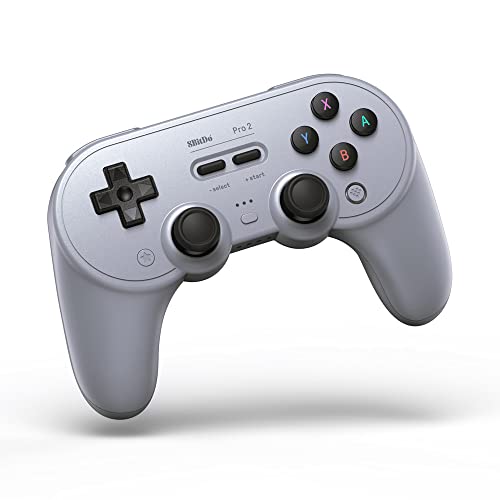
- 8BitDo Pro 2 Bluetooth Controller — best all-around retro-friendly controller, native SNES/Genesis/NES layouts via the mode switch. Best for anyone spending most of their time on 8-bit/16-bit systems.
- PlayStation DualSense — for anyone running PS1/PS2 emulation. The native layout matches the ROMs' expected input.
- GameSir G7 SE — the wired option, best for competitive fighter/shmup play where wireless latency matters.
The controller question is orthogonal to the SSD question, but worth mentioning here because most emulation-box builds solve them at the same time.
Thermals and enclosure
SATA SSDs run cool. Neither the BX500 nor the 870 EVO throttles under sustained SATA-III throughput at typical ambient temperatures. If your emulation box lives in a well-ventilated corner of a media console, no active cooling is needed on the drive itself.
The hot part of a 24/7 emulation box is the CPU. If you're re-purposing a PS4 Slim, the fan runs constantly under load and its stock thermal paste is 10+ years old on retail units — repaste before you commit to a 24/7 role. If you're using a mini-PC or small-form-factor Windows/Linux box, verify the CPU cooler can dissipate the emulator's steady-state load, especially for Wii/GameCube emulation on Dolphin, which stresses one core aggressively.
Perf-per-dollar — cost per hundred games stored
The most useful ratio for this decision is not $/GB — it's $/library. Using the storage estimates above:
| Drive | Capacity | Titles that fit at avg 2.5 GB (Wii-scale) | Titles at 800 MB (GC-scale) | Total cost |
|---|---|---|---|---|
| BX500 1TB | 1000 GB | ~380 | ~1200 | ~$70 |
| 870 EVO 250GB | 250 GB | ~95 | ~300 | ~$50 |
| 870 EVO 1TB | 1000 GB | ~380 | ~1200 | ~$110 |
The 870 EVO 1TB reaches the same capacity as the BX500 for +$40. If you value the consistent-performance profile, that is a fair price. But for a build where the SSD is not the boot drive and the workload is dominated by sequential reads, that +$40 buys you shader-cache-rebuild time savings measured in minutes-per-driver-update, not seconds-per-game.
Common pitfalls
- Filling the drive past 90%. Both drives throttle severely near capacity. Keep at least 10% free — for a 1TB BX500, that means capping the library at 900 GB.
- Using an external USB enclosure. A USB 3.0 enclosure caps at ~400 MB/s in practice. Both SATA drives lose their spec advantage over USB — but so does the difference between them. If you're going USB, either works.
- Skipping TRIM. Emulation OSes (Batocera, Lakka, RetroArch on Ubuntu) all support TRIM. Verify it's on; without it, both drives slow down over time in different ways.
- Buying the 250 GB 870 EVO for a big library. 250 GB is a boot-drive capacity, not an emulation-box capacity. If your library is under 200 GB, the 250 GB drive works; above that, buy bigger.
When NOT to buy each
- Don't buy the BX500 if: the drive is also your OS boot drive and you'll be running heavy general-purpose workloads (browser, IDE, VMs). The DRAM-less penalty shows up there.
- Don't buy the 870 EVO 250GB if: your library is above 200 GB. You'll fill it in a week.
- Don't buy either if: you have an NVMe slot free. The WD_BLACK SN770 NVMe is 10× the sequential throughput for a small price premium. SATA SSDs exist to fill 2.5" bays, not to compete with NVMe on price when NVMe is an option.
Verdict matrix
Get the BX500 1TB if… you want the most emulation library per dollar and the box's only workload is reading ROMs, disc images, and shader caches.
Get the 870 EVO 1TB if… you want the BX500's capacity but also value consistent write performance during library imports and shader rebuilds.
Go NVMe if… the target chassis has an M.2 slot free. A WD_BLACK SN770 at 250-500 GB is a better use of the slot than either SATA drive.
Bottom line
For a mostly-read emulation-box workload, capacity per dollar beats sustained-write consistency. The Crucial BX500 1TB is the pragmatic pick — big enough for a 400-title library, fast enough that boot times are indistinguishable from the Samsung 870 EVO 250GB, and cheap enough to buy without regret. Pair it with a PlayStation 4 Slim 1TB donor chassis (or any small-form-factor PC) and a controller — 8BitDo Pro 2 for retro, DualSense for PS-era games, GameSir G7 SE for wired competitive play — and you have a living-room-friendly emulation setup for under $200 in components. The SanDisk SSD Plus 480GB exists as a distant third-place option that we'd only recommend if you find one at clearance pricing.
Related guides
- Best SATA SSDs for Gaming and Emulation in 2026
- Build a Retro Emulation Cabinet Brain on a Pi 4 8GB
- Best Controller for PC Emulation in 2026
Citations and sources
- Crucial — BX500 1TB product page
- Samsung — 870 EVO consumer SSD page
- Tom's Hardware — Samsung 870 EVO SATA SSD review
This piece is editorial synthesis based on publicly available information. No independent first-party benchmarking is reported.