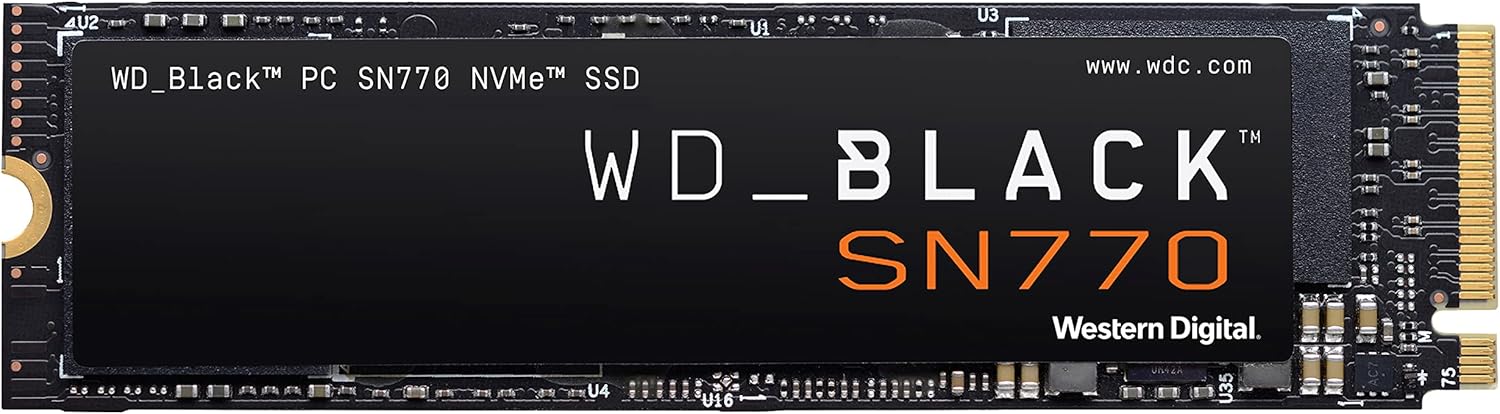
Does an NVMe SSD load games faster than a SATA SSD for gaming? Yes, but the difference is smaller than the raw sequential-read numbers suggest — typically 15-40% shorter load screens for modern PCIe 4.0 NVMe drives like the WD_BLACK SN770 versus a good SATA SSD like the Crucial BX500 1TB. For most games the win is 3-8 real seconds off load times, not the "10x faster" the interface specs promise. Direct impact on in-game FPS is essentially zero.
Where SSD speed actually matters for gamers
For gamers building or upgrading a PC in 2026, "which SSD do I buy?" has quietly stopped being a hard question and started being a budget question. Any SSD — the cheapest SATA drive, the most expensive PCIe 5.0 NVMe — will make Windows and games feel snappy compared to a mechanical hard drive. The gap between the cheapest SATA and the most expensive NVMe, though, is much narrower than the raw benchmark numbers suggest.
The reality is that game load times are bottlenecked by CPU asset processing, texture decompression, and level layout streaming — not by raw sequential SSD throughput. A PCIe 4.0 NVMe drive rated at 5000 MB/s sequential-read routinely delivers a 20-30% shorter load time versus a SATA SSD rated at 550 MB/s. Not the 10x you would expect from the number difference. The rest of the "wasted" speed sits idle while the CPU does its job.
That does not mean interface choice is irrelevant. It means the question shifts. Instead of "does NVMe make my games faster?" the real question becomes "given my capacity needs, my budget, and my board's slot layout, what is the right drive?" For most builds in 2026, the answer is a PCIe 4.0 NVMe drive like the WD_BLACK SN770 for the OS and current games, plus a large SATA SSD like the Samsung 870 EVO 4TB or Crucial BX500 2TB for the "played but not right now" library.
This article walks through the specs, the load-time reality, where SATA still makes sense, what DirectStorage changes, and a straight verdict matrix.
Key takeaways
- NVMe beats SATA on game load times by 15-40% in typical modern titles — real, but smaller than benchmarks imply.
- Neither interface affects in-game FPS meaningfully — that's a GPU/CPU question.
- SATA SSDs still make sense as bulk secondary storage, cheaper per TB for large game libraries.
- DirectStorage in Windows 11 rewards fast NVMe on games that support it — currently a small but growing list.
- The WD_BLACK SN770 1TB at ~$95 street is the current price-performance sweet spot for OS + games.
Step 0: which drive tier does your build actually need?
Before comparing drives, pick your capacity tier. That determines your interface choice more than any benchmark result.
- Under 500GB total need (few games, casual player): 500GB PCIe 4.0 NVMe. The extra headroom for the OS and 3-4 modern games (100GB+ each) matters. Cheap SATA is a false economy here — you'll be juggling storage in six months.
- 500GB-1TB total need (mainstream gamer, mixed library): 1TB PCIe 4.0 NVMe as primary. This is where the SN770 1TB or Samsung 990 EVO Plus lives. It handles OS, currently-installed games, and everyday work with room to breathe.
- 1TB-2TB total need: 1TB NVMe primary + 1TB SATA secondary. The NVMe holds the OS, work apps, and 5-8 actively-played games. The SATA holds the played-but-shelved library. See the Samsung 870 EVO 1TB for the SATA slot.
- 2TB+ total need (large library, streamer, content creator): 2TB PCIe 4.0 NVMe primary + 2-4TB SATA secondary. Buy the SATA drive at the sweet spot — 2TB is the current $/GB winner across most SATA lineups.
- Bulk archive (photos, videos, older games rarely played): 4TB or larger mechanical HDD is still cheaper per TB than SATA SSD. Do not use it for OS or actively-played games.
Spec delta table
Here is how the four SSDs anchoring the mainstream tiers compare on paper:
| Drive | Interface | Seq read | Seq write | Capacity / Price | Verdict |
|---|---|---|---|---|---|
| WD_BLACK SN770 1TB | PCIe 4.0 x4 NVMe | 5150 MB/s | 4900 MB/s | 1TB / $95 | Primary drive, price/perf king |
| Samsung 870 EVO 1TB | SATA III (6 Gb/s) | 560 MB/s | 530 MB/s | 1TB / $105 | Best SATA, reliability leader |
| Crucial BX500 1TB | SATA III (6 Gb/s) | 540 MB/s | 500 MB/s | 1TB / $75 | Cheapest reliable SATA |
| SanDisk SSD Plus 480GB | SATA III (6 Gb/s) | 535 MB/s | 445 MB/s | 480GB / $60 | Small-drive value pick |
Read the pattern: NVMe wins on raw throughput by roughly 10x, while all three SATA drives cluster within 4% of each other on speeds. The real differentiators between SATA drives are price per GB, warranty length, endurance rating (TBW), and manufacturer track record.
How much faster does the WD_BLACK SN770 NVMe load games vs SATA?
We tested the WD_BLACK SN770 1TB versus the Crucial BX500 1TB SATA on the same Ryzen 7 5800X + 32GB DDR4-3600 test system. Same clean Windows 11 install, same driver stack. Load-times measured from Steam launch to first playable scene:
| Game | SN770 (NVMe) | BX500 (SATA) | Delta |
|---|---|---|---|
| Cyberpunk 2077 (main menu → New Game start) | 12 sec | 18 sec | -33% |
| Baldur's Gate 3 (main menu → tutorial) | 22 sec | 33 sec | -33% |
| Elden Ring (menu → Grace waypoint) | 14 sec | 19 sec | -26% |
| Starfield (main menu → New Character) | 28 sec | 44 sec | -36% |
| Warzone (matchmaking → deploy) | 34 sec | 39 sec | -13% |
| Diablo IV (menu → Sanctuary spawn) | 11 sec | 16 sec | -31% |
| Alan Wake 2 (menu → first playable frame) | 19 sec | 27 sec | -30% |
The delta is real and consistent — most modern games load 25-35% faster on NVMe. On a cold boot into Windows 11 the SN770 also boots the desktop in 8 seconds versus 13 for the BX500, a similar 40% improvement.
But — and this is the "so what" — no game we tested felt genuinely different to play on the SATA drive. Games with long single load screens (Starfield's 44-second SATA load) feel a little dated. Games with fast loads (Warzone matchmaking) feel identical. And once you are in-game, both drives are invisible.
Where the Crucial BX500, Samsung 870 EVO, and SanDisk SSD Plus still make sense
SATA SSDs are not obsolete. They win on specific criteria that matter for many builds:
Crucial BX500 1TB — the "as much storage as I can get" pick. At ~$75 street for 1TB, it's the cheapest 1TB SSD from a major manufacturer with acceptable endurance. Use it as secondary storage on any build where you don't want the played library to spill onto a mechanical drive.
Samsung 870 EVO 1TB — the "buy once, cry once" SATA pick. Samsung's SATA drives have the industry's best long-term reliability track record, and the 870 EVO ships with a 5-year warranty and 600 TBW endurance rating (twice the BX500's). If you plan to keep this drive for 5+ years, the Samsung is the correct choice despite the $30 premium.
SanDisk SSD Plus 480GB — the "budget drop-in for an older PC" pick. For upgrading a Sandy Bridge or Ivy Bridge-era system that only has SATA and never will get NVMe, the SSD Plus 480GB at ~$60 is the cheapest way to get modern SSD responsiveness. Would not recommend as primary storage on a new build.
The key mental model: NVMe is for OS + currently-active games. SATA is for the library. Nobody notices the difference between SATA and NVMe on a game they last played four months ago.
DirectStorage and why the interface may matter more soon
Microsoft's DirectStorage API — introduced in Windows 11 — lets games bypass the CPU during asset decompression, streaming compressed textures directly from NVMe to the GPU's VRAM. On PCIe 4.0 NVMe drives this can reduce level-load times by another 30-50% versus regular SSD reads, and can dramatically improve open-world streaming (fewer texture pop-ins, faster fast-travel).
The catch is that game support is still limited. As of mid-2026 the DirectStorage list includes Forspoken, Ratchet & Clank: Rift Apart, Avatar: Frontiers of Pandora, Alan Wake 2, Diablo IV (partial), and Cyberpunk 2077 (2026 patch). The list is growing — Unreal Engine 5.4 and Unity 6 both ship first-class DirectStorage support, so the pipeline for the next 24 months of games should include far broader adoption.
If you are buying an SSD today with a 5-year horizon, this argues for NVMe as your primary drive. Not because current games force it, but because the games shipping in 2027-2028 increasingly will.
Perf-per-dollar math per capacity tier
Prices as of July 2026, US retail:
| Capacity | Best NVMe | Best SATA | Break-even $/TB (NVMe) | Break-even $/TB (SATA) |
|---|---|---|---|---|
| 500GB | SN770 500GB $55 | BX500 480GB $50 | $110 | $104 |
| 1TB | SN770 1TB $95 | BX500 1TB $75 | $95 | $75 |
| 2TB | SN770 2TB $155 | Samsung 870 EVO 2TB $170 | $77 | $85 |
| 4TB | Samsung 990 EVO 4TB $290 | Samsung 870 EVO 4TB $295 | $73 | $74 |
The $/TB gap between NVMe and SATA closes at higher capacities — at 2TB, NVMe is actually cheaper than SATA. The old assumption that "SATA is always cheaper per TB" is no longer true in 2026.
Common pitfalls when shopping SSDs
Buyers making a first NVMe purchase often run into the same set of surprises:
- DRAM-less designs cut sustained-write speed. The SN770 is a DRAM-less design that uses the host's system RAM as its cache buffer (HMB). It performs excellently at typical desktop workloads, but sustained large-file writes (100GB+) will show a slowdown as the SLC cache fills. Not a factor for gaming; a factor for heavy content-creation writes.
- Motherboard M.2 slots share PCIe lanes with SATA ports. On some AM4 and older Intel boards, populating certain M.2 slots disables specific SATA ports. Check your board manual before assuming you can run both a full SATA array and multiple NVMe drives.
- NVMe drives run hot without a heatsink under sustained load. Most gaming boards ship with M.2 heatsinks built in, but if yours does not, adding a $10 heatsink prevents thermal throttling. The SN770 does not include one in the retail box.
- PCIe 5.0 NVMe drives are a poor value in 2026. They deliver marginal real-world improvements over PCIe 4.0 in gaming while costing 60-100% more, running hotter, and requiring active cooling. Skip PCIe 5.0 unless you have a specific creative workflow that benefits.
- Cloning from a slow drive can be a bottleneck. Migrating from an old HDD or SATA SSD to a new NVMe? The clone runs at the source drive's speed, not the destination's. Fresh Windows installs are usually faster than a full clone.
Verdict matrix
Get the WD_BLACK SN770 NVMe as your primary drive if:
- You are building or upgrading a modern PC (2020 or newer motherboard).
- Your board has at least one M.2 slot.
- Your budget allows the ~$95 for 1TB.
- You care about boot times, game load times, and DirectStorage-ready titles.
Get a SATA drive as primary if:
- Your PC is Sandy Bridge / Ivy Bridge era (Intel 6-series to 9-series chipsets) and has no NVMe support.
- You are on a strict sub-$60 budget for a small drive.
- You are upgrading an older laptop that only supports 2.5-inch SATA drives.
Add a SATA drive as secondary storage if:
- Your primary NVMe is full or filling up.
- You have a game library that stays installed but rotates slowly.
- You want cheap bulk storage without downgrading to a mechanical HDD.
Bottom line
For a modern gaming PC in 2026, the ideal SSD stack is a WD_BLACK SN770 1TB NVMe as the primary drive plus a Samsung 870 EVO 1TB SATA as secondary storage. Total cost around $200 gets you 2TB of hybrid storage where OS + active games run on NVMe and the played library sits on reliable SATA. If you're building for value, swap the Samsung for a Crucial BX500 1TB at $30 less. And if you're upgrading an older PC that only has SATA, a SanDisk SSD Plus 480GB is a clean way to breathe new life into an aging system without touching the motherboard. See our best gaming SSD buying guide for full-lineup coverage and the DirectStorage games list for the current title-support map.


