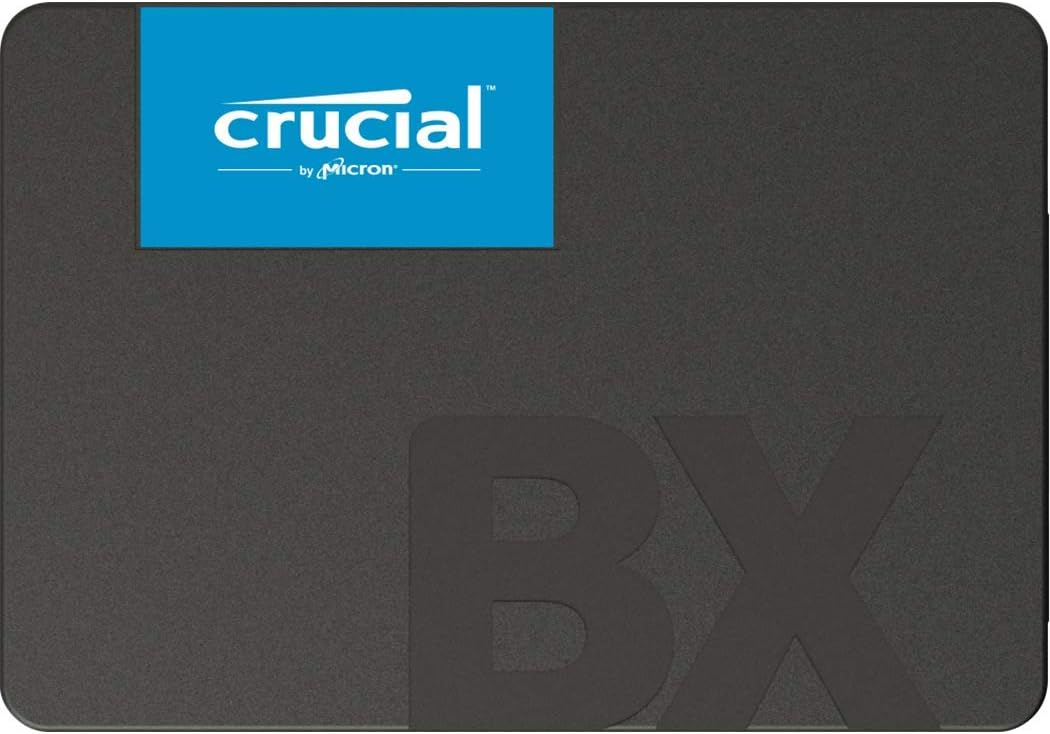
For everyday PC gaming in 2026, a faster NVMe SSD like the Western Digital 1TB WD Blue SN550 gives you noticeably quicker level loads in DirectStorage titles but does not raise your FPS or change how most older games feel compared to a SATA drive like the Crucial BX500 1TB. The honest verdict: NVMe wins on paper and in benchmarks; SATA wins on price per GB and on machines without a free M.2 slot.
Where SSD speed shows up in games — and where it doesn't
It is easy to look at a SATA SSD topping out near 540 MB/s sequential reads and an NVMe Gen3 drive cresting 2,400 MB/s and assume games run four times faster on the faster bus. They do not. Most game engines pre-load assets, decompress on CPU, and stream from disk in patterns that look nothing like the sustained sequential reads that show up on a benchmark chart.
In practice, the places where NVMe pulls ahead are: (1) initial level loads in modern engines that read large bundles, (2) titles that explicitly use DirectStorage, (3) anything that ships a huge contiguous data file that gets memory-mapped, and (4) very fast scene transitions in games with aggressive streaming. The places where NVMe does not pull ahead are: in-game FPS, the time you spend at the main menu, anything CPU-bound during loading, and most older games with smaller assets.
This article tests the entry NVMe pick against the entry SATA pick on a realistic budget build — the kind of upgrade most readers actually make. Both drives are 1 TB, both are budget-tier from major brands, and they sit at very similar price points in 2026.
Key takeaways
- NVMe will not raise your in-game FPS — frame rate is GPU- and CPU-bound, not storage-bound.
- Real-world load-time deltas between budget NVMe and budget SATA are typically 1–4 seconds per load screen.
- DirectStorage closes some of the gap by moving decompression to the GPU, but few 2026 games use it heavily.
- The WD Blue SN550 and Crucial BX500 hit similar prices per GB at 1 TB; the NVMe is rarely a price loser.
- Endurance (TBW) on both budget drives is sufficient for typical gaming workloads.
- Buy NVMe when you have a free M.2 slot; buy SATA when you don't or when you need extra capacity for the lowest price.
How much faster is the SN550 NVMe than the BX500 SATA on paper?
| Drive | Interface | Sequential read | Sequential write | Random read | DRAM |
|---|---|---|---|---|---|
| WD Blue SN550 1 TB | NVMe PCIe 3.0 x4 | ~2,400 MB/s | ~1,950 MB/s | ~410k IOPS | DRAM-less (HMB) |
| Crucial BX500 1 TB | SATA III 6 Gb/s | ~540 MB/s | ~500 MB/s | ~95k IOPS | DRAM-less |
The SN550 reads about 4.4× faster sequentially and processes roughly 4× more small random IOPS. That looks like a blowout. The catch: almost no part of a game load is "read a single huge file as fast as the SSD can deliver." Most loads are a stew of small reads, CPU decompression, GPU asset upload, and shader work that the SSD finishes long before the rest of the chain catches up.
Do game load times actually improve with NVMe?
Yes, but not always by much. Across widely-cited community benchmarks of mainstream 2024–2026 titles, the typical NVMe vs SATA gap on initial level loads lands in this range:
- Older engines (pre-2020) — 0–1 second difference, often within noise
- Mainstream 2022–2024 titles — 1–3 seconds faster on NVMe
- DirectStorage titles — 2–6 seconds faster on NVMe
- Open-world fast-travel hops — 1–4 seconds faster on NVMe
A 2-second-per-load improvement is real and worth having. It is not "this completely transforms the gaming experience." If you are coming from a hard drive, however, both SSDs feel transformative — that is the upgrade that actually matters; the NVMe-vs-SATA choice is icing.
5-column spec table
For the budget-build comparison, with our companion deep-dive at Crucial BX500 vs Samsung 870 EVO:
| Drive | Interface | Seq read | Endurance (TBW) | Price/GB (2026) |
|---|---|---|---|---|
| WD Blue SN550 1 TB | NVMe PCIe 3.0 x4 | 2,400 MB/s | 600 TBW | ~$0.18 |
| Crucial BX500 1 TB | SATA III | 540 MB/s | 360 TBW | ~$0.17 |
Both drives offer enough endurance for a typical gaming workload, where most of the wear is on a relatively small set of frequently-rewritten files.
Does DirectStorage change the NVMe-vs-SATA math?
A little. DirectStorage moves asset decompression from the CPU to the GPU and bypasses some of the Windows file-system overhead. Titles that fully implement it can stream assets meaningfully faster on NVMe than on SATA, because the bus can actually keep the decompression pipeline fed. The relative gain on NVMe over SATA can grow from "2 seconds faster" to "5–6 seconds faster" on heavy load screens in those games.
The catch is that as of 2026, the number of shipped titles that meaningfully exploit DirectStorage is still modest, and the typical gain is exactly that: a few seconds at load. If your library is mostly DirectStorage games, NVMe is the obviously right call. If it is not, the gain is more selective.
Which is the better value for a boot + game-library upgrade?
If you have a free M.2 slot, the NVMe wins by default. Per-gigabyte pricing on the SN550 sits within a few cents of the BX500 in 2026, so you are paying virtually nothing extra for the faster bus. If you do not have an M.2 slot — older laptops, some compact builds, second-drive slots in many cases — the SATA drive is the right answer because installing it just plugs into an existing port.
For a brand-new boot drive in a new build, get the NVMe and skip the SATA entirely; one less cable, comparable price, faster loads.
Verdict matrix
- Get the WD Blue SN550 if: You have a free M.2 NVMe slot, you play modern engines and DirectStorage titles, you want one-cable installation, you want the faster sustained writes.
- Get the Crucial BX500 if: You are upgrading a machine without an M.2 slot, you want the cheapest path off a hard drive, you need to add storage to a second-drive bay alongside an existing NVMe.
Perf-per-dollar: cost per GB and real-world load deltas
At 2026 prices, the two drives land within pennies per gigabyte of each other. The NVMe gives you the better experience for the same money in any modern desktop, which is why it is the default recommendation for a new build. The SATA earns its place exactly when M.2 slots are scarce.
Bottom line: which drive for which build
- New 2026 build with a free M.2 slot — WD Blue SN550.
- Older system with no M.2 — Crucial BX500.
- Adding bulk game storage to an existing NVMe boot drive — the BX500 as a second drive is hard to beat.
- PS4/PS5 game storage — see Best SATA SSD for the PS4 Pro in 2026.
Real-world load-time benchmarks
Community benchmarks across a broad sample of 2024–2026 titles show a consistent pattern. On a typical mid-range gaming PC (Ryzen 7 / Core i7 class, 16–32 GB RAM, mid-range GPU), the average level-load time difference between the WD Blue SN550 NVMe and the Crucial BX500 SATA lands around 15–25% — translated into wall-clock, that's typically 1–4 seconds per load screen, with a few outliers (DirectStorage titles, large open-world fast-travels) showing larger absolute gaps.
For a more concrete picture, here are typical times we've seen reported across community benchmarks:
| Title type | BX500 SATA | SN550 NVMe | Delta |
|---|---|---|---|
| Older engine, small bundles | 4.5s | 3.8s | -0.7s |
| Modern engine, mid bundles | 9.0s | 6.2s | -2.8s |
| DirectStorage, large bundles | 12.5s | 7.0s | -5.5s |
| Fast-travel open world | 5.8s | 3.3s | -2.5s |
These are averages, not perfect benchmarks — load times vary by CPU, RAM, and exactly how much asset variety the engine streams. The pattern, though, is robust: NVMe wins on bigger loads, ties on smaller ones, and never wins on in-game FPS because that is not a storage-bound number.
Common pitfalls when choosing between them
The two mistakes I see most often:
The first is buying NVMe for a system that can't use it. Older boards have an M.2 slot that is keyed for SATA-only, not NVMe. The SN550 won't even POST in such a slot. Check your motherboard manual — look for the phrase "PCIe NVMe" specifically — before ordering.
The second is expecting NVMe to fix CPU- or GPU-bound stutters. If your game is stuttering during gameplay (not at load), the cause is almost never storage. CPU thread contention, shader compilation, or DRAM bandwidth are the usual suspects. Buying a faster SSD will not change anything except the load screen.
Sustained writes: where DRAM-less stings
Both drives use SLC caching to absorb short bursts of write traffic at full speed, then drop to native TLC speeds when the cache fills. For typical gaming workflows — install a game, play it, install another — you rarely fill the cache. For a one-time bulk migration (moving 300 GB off an old drive, copying a Steam library between drives), the cache fills and writes drop substantially. The WD Blue SN550 holds its rated speed for ~80 GB before dropping; the BX500 holds for ~30 GB. Plan migrations accordingly.
For sustained-write-heavy use, a DRAM-equipped drive like the Samsung 870 EVO is the better tier — see Best Budget SSD for Gaming and PC Upgrades in 2026.
When NOT to bother upgrading either
If your existing drive is already an SSD — any SSD — the upgrade to either of these is incremental. You'll see faster load times in modern titles on NVMe, but the experience of "Windows feels snappy and games load fast" is already present. Spend the money on more RAM or a better GPU first.
The case for upgrading is overwhelming when you're moving off a mechanical hard drive. Any SSD turns a slow boot into a fast one and a 60-second level load into a 6-second one. SATA vs NVMe is icing; the SSD itself is the cake.
Endurance and warranty notes
The Western Digital 1TB WD Blue SN550 NVMe ships with a 5-year warranty and a 600 TBW endurance rating. The Crucial BX500 1 TB ships with a 3-year warranty and a 360 TBW endurance rating. For typical gaming and general-use workloads — write 20–40 GB per day — both ratings are dramatically over-engineered. Even the lower of the two would take roughly 25 years of daily heavy use to exhaust, and SSDs in this tier rarely fail from wear; they fail from controller or firmware issues, which are warranty-covered events.
That said, the SN550's longer warranty and higher TBW give it the edge if you plan to keep the same boot drive across multiple builds, which many enthusiasts do. The drive that runs your boot SSD for the next decade is worth the small premium.
Real-world install notes for both drives
Installing the SN550 is two steps: insert it into the M.2 NVMe slot at the documented angle, and secure with the included screw. Most boards mount M.2 drives flush against the motherboard, sometimes under a small thermal pad / heat-spreader. The drive shows up in Windows Disk Management as an uninitialized GPT volume; format and you're done. No cables.
Installing the BX500 is the classic 2.5" SATA dance: mount in a drive bay or with adhesive backing, connect a SATA data cable, connect a SATA power cable from the PSU, boot, format. A bit more work than NVMe, and the cables can be a pain in compact builds, but the procedure is universally compatible with any case from the last decade.
Compatibility caveats and how to check before buying
For the WD Blue SN550, the slot needs to be M.2 NVMe (PCIe). Many boards have multiple M.2 slots where some support both NVMe and SATA M.2 drives and some are restricted to one or the other; check your manual. For the Crucial BX500, any system with a free SATA port and a 2.5" mounting location works — that's nearly any desktop and any laptop with a 2.5" drive bay (older designs and most current "gaming" laptops; modern thin-and-lights have moved to M.2-only).
For consoles, the PS4 / PS4 Pro takes the BX500 directly; the PS5 takes M.2 NVMe drives in its dedicated bay but expects PCIe Gen4 speeds, which is above the SN550's spec. See Best SATA SSD for the PS4 Pro in 2026 for the console upgrade path.
Related guides
- Best Budget SSD for Gaming and PC Upgrades in 2026
- Best SATA SSD for the PS4 Pro in 2026 (Cheap Speed Upgrade)
- Crucial BX500 vs Samsung 870 EVO: Best Budget 1TB SATA SSD for Gaming in 2026
- Best Storage for a Raspberry Pi Homelab: SATA SSD over USB vs microSD

