Introduction
This is the decision a lot of AM4 owners are sitting on in 2026: there is already an 8-core Ryzen 7 5800X in the box, RAM is not the constraint, and the only question is whether $480 of graphics card actually buys anything that free system memory does not.
The honest answer comes out of one number. Per NVIDIA's 30-series specifications, the RTX 3060 12GB pairs 12 GB of GDDR6 with a 192-bit interface; at the 15 Gbps memory speed the retail cards ship with, that works out to roughly 360 GB/s of memory bandwidth, which is the figure TechPowerUp's database lists for the part. The Ryzen 7 5800X, per AMD's own product page, is an 8-core/16-thread part with a 105 W default TDP and DDR4 support "up to 3200 MT/s". Two channels of DDR4-3200 is 51.2 GB/s of theoretical bandwidth.
Token generation in a dense transformer is a memory-bandwidth problem: every token read pulls the whole active weight set through memory once. A 7× bandwidth gap is therefore, to a first approximation, a 7× token-rate gap — before accounting for the fact that the CPU also has to do the arithmetic with far fewer effective FLOPS. That ratio sets the ceiling on everything below.
This synthesis compares the two configurations on the numbers that are actually published: quantized file sizes, KV-cache growth derived from the released model configuration, measured generation rates on the card, and the sustained power each side draws.
Key Takeaways
- Gemma 3 12B is 12,187,325,040 parameters in BF16 per the Hugging Face model index, which is 23.54 GB as a BF16 GGUF and 7.30 GB at Q4_K_M (bartowski).
- Expect 28-29 tok/s from 12B-class models at Q4_K_M on the 12 GB card, using about 8.1-8.2 GB of VRAM (llmrun.dev).
- The 3060's memory bandwidth advantage is roughly 7× — 360 GB/s (TechPowerUp) against 51.2 GB/s from dual-channel DDR4-3200 (AMD).
- Gemma 3's sliding-window attention is why long context is affordable here. The released configuration interleaves five 1024-token local layers per global layer, which caps KV growth at about 64 KB per token instead of 384 KB.
- The card draws 170 W, and NVIDIA specifies a 550 W system supply for it (NVIDIA); the 5800X adds 105 W of CPU TDP on top.
- Prefill is where CPU offload actually breaks, not generation — a long prompt is arithmetic-bound, and that is the side of the split where a GPU's shader count matters most.
Does Gemma 3 12B fit in 12 GB of VRAM?
At every quant a sane person would use, yes — with room left over. These are the published GGUF file sizes from the bartowski Gemma 3 12B IT repository, read directly off the repository file listing.
| Quant | File size | Fits in 12 GB? | Practical note |
|---|---|---|---|
| Q2_K | 4.77 GB | Yes, easily | Measurable quality loss; rarely worth it at this size class |
| Q3_K_M | 6.01 GB | Yes | Usable, but Q4 is only 1.3 GB more |
| IQ4_XS | 6.55 GB | Yes | Slightly smaller than Q4_K_M at similar quality |
| Q4_0 | 6.91 GB | Yes | Legacy quant; superseded by the K-quants |
| Q4_K_M | 7.30 GB | Yes — the default pick | Leaves ~4 GB for KV cache, context and the desktop |
| Q5_K_M | 8.44 GB | Yes | Tight once a display is attached to the same card |
| Q6_K | 9.66 GB | Yes, barely | Little headroom left for context |
| Q8_0 | 12.51 GB | No | Exceeds the card's 12 GB |
| BF16 | 23.54 GB | No | Needs a 24 GB card |
Two details that get missed. First, Gemma 3 is multimodal, and the vision tower ships as a separate mmproj file — 0.85 GB at BF16/F16 in the same repository. Load images and that comes out of the same 12 GB budget. Second, if a monitor is plugged into the card, the desktop compositor is holding 0.5-1 GB before the model loads at all.
Q4_K_M at 7.30 GB is the pick. Q5_K_M at 8.44 GB works for headless boxes with modest context.
How fast is Gemma 3 12B on an RTX 3060 12GB?
There is no shortage of published 12B-class measurements for this card. llmrun.dev's RTX 3060 12GB page lists Q4_K_M results with VRAM figures:
| Model | Params | Quant | VRAM used | Generation |
|---|---|---|---|---|
| Gemma 4 12B IT | 12.0B | Q4_K_M | 8.2 GB | 28.4 tok/s |
| Mistral Nemo Instruct 2407 | 12.2B | Q4_K_M | 8.1 GB | 29.0 tok/s |
| Llama 2 13B Chat | 13.0B | Q4_K_M | 8.6 GB | 27.2 tok/s |
| Phi-4 | 14.0B | Q4_K_M | 9.5 GB | 24.6 tok/s |
The pattern is tight: everything in the 12-14B band at Q4_K_M lands between 24 and 29 tok/s on this card, and consumes 8.1-9.5 GB. Gemma 3 12B's 7.30 GB of weights sit at the light end of that band, so the low-to-high-20s tok/s range is the reasonable expectation.
For context scaling, Hardware Corner's RTX 3060 12GB benchmark page publishes a Qwen3 8B Q4_K curve on the same card that shows how generation decays as the window grows: 55.2 tok/s at 4K, 42.0 at 16K, and 31.9 at 32K. That is a 42% drop from 4K to 32K — the same shape any model on this card will follow.
The two cards most readers will actually find in stock are the MSI Gaming GeForce RTX 3060 12GB and the ZOTAC Gaming GeForce RTX 3060 Twin Edge OC 12GB. Both carry the same GA106 silicon, the same 12 GB of GDDR6 and the same 192-bit bus, so the throughput difference between them is a cooler-design question, not a silicon one. The MSI's triple-slot Torx cooler runs quieter under a flat multi-hour load; the ZOTAC's Twin Edge is the more compact card. Card-to-card comparison lives in ZOTAC Twin Edge vs MSI Ventus 3X on the RTX 3060 12GB.
How fast is the same model with CPU offload on a Ryzen 7 5800X?
Start from the bandwidth arithmetic, because it sets a hard ceiling that no amount of thread tuning gets past.
Per AMD, the 5800X is an 8-core/16-thread TSMC 7nm part with DDR4 support up to 3200 MT/s. A dual-channel DDR4-3200 configuration moves 3200 MT/s × 8 bytes × 2 channels = 51.2 GB/s in theory, and real-world sustained read bandwidth on AM4 lands meaningfully below that.
A 7.30 GB Q4_K_M model has to be read once per generated token. Divide 51.2 GB/s by 7.30 GB and the theoretical ceiling is about 7 tokens per second — before overhead, before the KV cache competes for the same bus, and before the arithmetic itself is accounted for. Measured CPU-only rates on a 12B model land well below that ceiling.
Two useful anchors for how low a memory-bound 8B-class model goes on constrained hardware: Jeff Geerling's ai-benchmarks issue #7 records Llama 3.1 8B Q4_K_M at 1.99 tok/s on an 8 GB Raspberry Pi 5 and 2.17 tok/s on the 16 GB board, both CPU-only. A desktop 5800X on dual-channel DDR4 is several times quicker than that, and still an order of magnitude behind the card.
Thread count is not the lever people hope it is. Once the memory controller is saturated, adding threads stops helping and starts costing — the practical sweet spot on an 8-core AM4 part is around the physical core count, not the thread count.
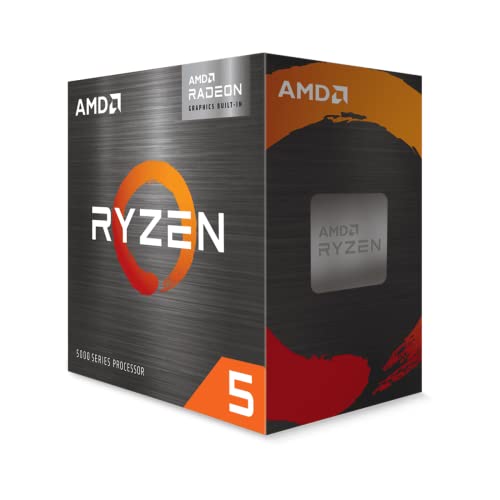
The cheaper host option is the AMD Ryzen 5 5600G at $199.99 against the AMD Ryzen 7 5800X at $254.90 in the SpecPicks catalog as of 2026-09-16. That $55 delta buys two cores and a much higher power ceiling — and for GPU-resident inference, where the CPU only stages tokens, it buys almost nothing. For CPU-offload work it buys 33% more cores against the same dual-channel memory bus, which is the wrong axis to be adding on.
Prefill vs generation: which side of the split hurts more?
These are two different workloads with two different bottlenecks, and conflating them is the most common mistake in this comparison.
Generation is memory-bound. One token out means one full pass over the active weights. Bandwidth is the whole story, which is why the 7× ratio above predicts the outcome so well.
Prefill — processing the prompt you just pasted in — is arithmetic-bound. The whole prompt is processed as a batch, weights get reused across many tokens at once, and the limiting factor becomes raw FLOPS. Here the RTX 3060's 3,584 CUDA cores (NVIDIA) are not 7× a desktop CPU; they are far more than that.
Hardware Corner's prefill column on this card shows 1,696.8 tok/s at 4K context, 1,119.2 at 16K and 764.7 at 32K for an 8B model. Pasting a 16,000-token document into a card-resident model costs about fourteen seconds of prefill. The same paste on a CPU-offloaded setup is where minutes go.
The practical rule: CPU offload is survivable for short chat turns where prompts are a few hundred tokens. It collapses the moment the workflow involves pasting documents, code files, or long conversation histories — which is most of what people actually want a 12B model for.
What does a 16K and 32K context window cost in VRAM?
Gemma 3's architecture is the reason this table is unusually friendly. The released configuration (48 layers, 8 key-value heads, head dimension 256) also specifies sliding_window: 1024 and sliding_window_pattern: 6, meaning five of every six layers attend only to a 1,024-token local window and just eight layers attend globally.
That changes KV growth from linear across all 48 layers to linear across eight, plus a fixed cost for the local layers:
| Context | KV cache (FP16) | + Q4_K_M weights | Total | Fits in 12 GB? |
|---|---|---|---|---|
| 4,096 | ~0.56 GB | 7.30 GB | ~7.9 GB | Yes, comfortably |
| 8,192 | ~0.81 GB | 7.30 GB | ~8.1 GB | Yes |
| 16,384 | ~1.31 GB | 7.30 GB | ~8.6 GB | Yes |
| 32,768 | ~2.31 GB | 7.30 GB | ~9.6 GB | Yes |
| 65,536 | ~4.31 GB | 7.30 GB | ~11.6 GB | Only headless |
| 131,072 | ~8.31 GB | 7.30 GB | ~15.6 GB | No |
The figures derive from the published Gemma 3 12B configuration mirrored at unsloth/gemma-3-12b-it: 8 global layers × 2 tensors × 8 KV heads × 256 head dim × 2 bytes ≈ 64 KB per token, plus a fixed ~320 MB from the 40 local layers capped at their 1,024-token window.
Without sliding-window attention, all 48 layers would cost ~384 KB per token, and 32K context alone would be 12 GB of KV cache. Quantizing the KV cache to 8-bit roughly halves every row above, which is how 64K becomes practical on a card that also drives a display. Broader treatment of the quantization trade-offs: LLM quantization on a 12 GB GPU.
Spec delta
Prices are SpecPicks catalog values as of 2026-09-16 and move frequently; check the live listing before buying.
| Part | Memory / bandwidth | 12B Q4_K_M generation | Sustained power | Catalog price |
|---|---|---|---|---|
| MSI RTX 3060 12GB | 12 GB GDDR6 / ~360 GB/s | 28-29 tok/s | 170 W board power | $479.99 |
| ZOTAC RTX 3060 Twin Edge OC 12GB | 12 GB GDDR6 / ~360 GB/s | 28-29 tok/s | 170 W board power | $499.99 |
| Ryzen 7 5800X (CPU offload) | System DDR4-3200 / 51.2 GB/s | Low single digits | 105 W TDP | $254.90 |
| Ryzen 5 5600G (CPU offload) | System DDR4-3200 / 51.2 GB/s | Low single digits | 65 W TDP | $199.99 |
Bandwidth figures: TechPowerUp for the card, derived from AMD's DDR4-3200 specification for the CPUs. Generation rates from llmrun.dev.
Does the model library fit?
A single Q4_K_M copy of Gemma 3 12B is 7.30 GB. Nobody keeps one copy. A realistic working set — Q4_K_M and Q5_K_M of the 12B, the 0.85 GB vision projector, a 4B for fast tasks, a coding model, and whatever else gets pulled in during a week of experimenting — clears 50 GB without effort, and a serious library runs into the hundreds.
This is the cheap half of the build. The Crucial BX500 1TB is a SATA drive, and SATA is the correct call here: storage speed affects first-load time only. Once weights are resident in VRAM, the drive is idle. NVMe shortens the wait between ollama run and the first token; it does not add a single token per second afterward. The full argument is in NVMe vs SATA SSD for a local LLM model library.
Performance per dollar and per watt
Using the 28.4 tok/s Gemma 4 12B Q4_K_M figure from llmrun.dev as the 12B-class stand-in, and the catalog prices above:
| Configuration | tok/s | $ per tok/s | Sustained W | tok/s per watt |
|---|---|---|---|---|
| MSI RTX 3060 12GB | 28.4 | $16.90 | 170 W | 0.167 |
| ZOTAC RTX 3060 Twin Edge OC | 28.4 | $17.61 | 170 W | 0.167 |
| Ryzen 7 5800X, CPU offload | low single digits | far worse | 105 W | far worse |
The CPU row is deliberately not given a precise number, because a precise number would imply a measurement this synthesis does not have for this exact model. What the bandwidth arithmetic supports is the direction and the rough magnitude: several times worse on both axes.
One caveat worth stating plainly. If the 5800X is already in the machine, its marginal cost is zero, and zero-dollar inference at 3 tok/s beats $480 inference at 28 tok/s on any per-dollar metric. Per-dollar is the wrong lens when one side of the comparison is already paid for. The right question is whether 3 tok/s is fast enough to use, and for interactive work it is not.
Verdict matrix
Get the RTX 3060 12GB if the model is used interactively, prompts routinely exceed a few hundred tokens, a 12-14B model at Q4_K_M is the target, or the box will also do Stable Diffusion, video encoding or gaming. It is the cheapest 12 GB of consumer VRAM, and 12 GB is the threshold where 12-14B models stop needing compromises.
Stay on 5800X CPU offload if inference is batch work that runs unattended, the models in play are 3B and smaller where CPU rates are tolerable, the budget is genuinely zero, or the box cannot take a 170 W card on a 550 W supply.
Buy neither and wait if the real requirement is a 27B-class model, 64K-plus context with a display attached, or serving more than one user at a time. All three break a 12 GB budget no matter how the model is quantized, and paying twice — 12 GB now, 24 GB in six months — costs more than waiting. See best 12 GB GPU for local LLMs for where the tier boundaries sit.
The recommended pick
The MSI Gaming GeForce RTX 3060 12GB paired with the existing 5800X host is the configuration this synthesis lands on. Gemma 3 12B at Q4_K_M occupies 7.30 GB, leaving roughly 4 GB for a 32K window on a card whose sliding-window-friendly architecture makes that window cheap, at 28-29 tok/s for 12B-class models.
The condition that flips it: if the workload is overnight batch processing with no human waiting, keep the money. Bandwidth-bound generation still finishes the job by morning, and the 105 W CPU is already installed and paid for.
Bottom line
A 12 GB card and an 8-core AM4 CPU are not two answers to the same question. The CPU is the machine that keeps working when the card is absent; the card is the machine that makes a 12B model feel like a tool instead of a demo. Anyone who intends to sit in front of the model and type at it should buy the card. Anyone whose work runs while they sleep already owns everything they need.
Related guides
- Best 12 GB GPU for local LLMs in 2026
- LLM quantization on a 12 GB GPU
- Ryzen 7 5800X CPU LLM inference vs a 12 GB GPU
- RTX 3060 12GB complete local LLM guide
- RTX 3060 12GB vs RTX 4060 Ti 16GB for Gemma 3 12B — if the choice is between two cards rather than card vs CPU
- RTX 3060 benchmark data
Live price check
Both sides of this comparison carry live pricing and full Product schema on their SpecPicks detail pages: the MSI Gaming GeForce RTX 3060 12GB and the AMD Ryzen 7 5800X. Prices on both change frequently — the figures quoted throughout this piece are catalog snapshots taken 2026-09-16.
Citations and sources
- Hugging Face — google/gemma-3-12b-it model index — parameter count (accessed 2026-09-16)
- Hugging Face — google/gemma-3-12b-it model card (accessed 2026-09-16)
- Hugging Face — bartowski/google_gemma-3-12b-it-GGUF — published quantized file sizes (accessed 2026-09-16)
- Hugging Face — unsloth/gemma-3-12b-it configuration — layer count, KV heads, sliding-window pattern (accessed 2026-09-16)
- NVIDIA — GeForce RTX 3060 / 3060 Ti specifications — CUDA cores, memory config, 170 W board power, 550 W system requirement (accessed 2026-09-16)
- TechPowerUp — GeForce RTX 3060 12 GB database entry — memory bandwidth (accessed 2026-09-16)
- AMD — Ryzen 7 5800X product specifications — cores, TDP, DDR4-3200 support (accessed 2026-09-16)
- llmrun.dev — RTX 3060 12GB model database — 12B-class Q4_K_M generation rates and VRAM use (accessed 2026-09-16)
- Hardware Corner — RTX 3060 12GB LLM benchmarks and context scaling — prefill and generation across 4K/16K/32K (accessed 2026-09-16)
- Jeff Geerling — ai-benchmarks issue #7 — CPU-only 8B generation rates and power draw (accessed 2026-09-16)
This piece is editorial synthesis based on publicly available information. No independent first-party benchmarking is reported.
As an Amazon Associate, SpecPicks earns from qualifying purchases. Prices shown are catalog snapshots taken 2026-09-16 and may vary.