What changes as of 2026: at matched quant and offload settings the two runners perform within a few percent on a 12GB RTX 3060 — Ollama wins on setup, llama.cpp wins when you hand-tune n-gpu-layers and KV-cache type for Qwen 3.6 27B.
If you have a 12GB card and want to run Qwen 3.6 27B, the honest answer is: pick Ollama if you want a pull and run experience with sensible defaults, and pick llama.cpp if you want to squeeze the last few tokens per second out of the MSI GeForce RTX 3060 Ventus 3X 12G by tuning offload counts, cache quantization, and batch size yourself. Both share the same GGML/GGUF engine underneath, so raw math is identical; what changes is how much of the plumbing you touch.
The 12GB-VRAM offload problem and why the runner choice matters
The NVIDIA GeForce RTX 3060 12GB remains one of the most popular consumer GPUs for local LLM work because 12GB of GDDR6 at 360 GB/s is the cheapest way to hold real model weights on a single card. Per TechPowerUp, the card ships with 3,584 CUDA cores, 112 tensor cores, and a 192-bit memory bus — modest by 2026 standards, but the 12GB pool is exactly what makes 20-30B-parameter models tractable when smaller cards fall off a cliff. That is why the MSI GeForce RTX 3060 Ventus 3X 12G is still the entry-level default recommendation for a first local-LLM build in 2026.
Qwen 3.6 27B, however, exceeds 12GB even at aggressive 4-bit quantization once you account for the KV cache, activation buffers, and CUDA overhead. A Q4_K_M GGUF of a 27B model is roughly 16-17GB on disk. That means the runner has to split layers between the GPU and system RAM, and the split is where Ollama and llama.cpp diverge in behavior. Ollama estimates a split automatically. llama.cpp expects you to set --n-gpu-layers (-ngl) explicitly, and rewards you for getting it right.
The runner choice also affects three things you cannot see from the model card: which quantization formats you can actually load, how the KV cache is stored (fp16 vs. Q8_0 vs. Q4_0), and how many CPU threads feed the offloaded layers. Miss one of those knobs and a Ryzen 7 5800X + DDR4 build can leave 20-30% of its throughput on the table, especially on a 12GB card where every additional layer you can push onto the GPU is worth more than the CPU-side savings. That is why "which runner" is a durable, high-intent question — not brand loyalty, but a real performance delta on the exact hardware most home users own.
Key takeaways - At matched quant, offload count, and context length, Ollama and llama.cpp are within roughly 3-8% of each other on a 12GB RTX 3060 — they share the same inference engine. - Ollama's advantage is one-command setup, model management viaollama pull, and a built-in REST API on port 11434. - llama.cpp's advantage is direct control overn-gpu-layers, KV-cache quantization (--cache-type-k q8_0), batch size, and thread counts. - A Q4_K_M Qwen 3.6 27B GGUF needs ~16-17GB total, so plan on 35-45 of ~60 layers on the GPU and the remainder on the Ryzen 7 5800X + DDR4 pair. - Fast NVMe storage matters at load time (large weight files stream from disk); a Samsung 970 EVO Plus 250GB NVMe or better cuts cold-start time by half versus a SATA SSD.
What does each runner do differently for GPU offload?
Both runners call into the same llama.cpp engine — Ollama is a Go wrapper that bundles llama.cpp as its inference backend, adds a model registry, a REST API, and automatic parameter estimation. Per the Ollama repository, the project's stated goal is to make local models "easy to get up and running." That framing tells you the design tradeoff: Ollama sets safe defaults and hides tuning knobs; llama.cpp exposes every knob and expects you to know what to do with them.
Three offload-related differences matter for the 12GB scenario:
- GPU layer count. llama.cpp exposes
--n-gpu-layers N(short form-ngl) as a mandatory flag when you want GPU work. Set it too low and you waste VRAM; set it too high and the model refuses to load. Ollama picks a value based on detected free VRAM at load time, and it tends to be conservative — leaving 500MB-1GB of GPU memory unused to guarantee stability. - KV cache quantization. llama.cpp accepts
--cache-type-kand--cache-type-v(options includef16,q8_0,q4_0) to shrink the KV cache, which is a significant VRAM consumer at longer contexts. Ollama's default is fp16 and cache quantization is opaque to the user unless you author a customModelfile. - Batch size and threading. llama.cpp lets you pin
--threadsand--batch-sizeat the command line. Ollama derives both from CPU detection and rarely surfaces them.
Spec delta table: Ollama vs. llama.cpp
Per the two projects' own repositories — ollama/ollama and ggml-org/llama.cpp — the practical config surface breaks down as follows.
| Feature | Ollama | llama.cpp | Who wins for RTX 3060 12GB | Source |
|---|---|---|---|---|
| GPU layer control | Auto-estimated | Explicit -ngl N flag | llama.cpp for tuning; Ollama for setup | ollama/ollama |
| KV cache quantization | fp16 default (hidden) | --cache-type-k q8_0 / q4_0 exposed | llama.cpp for long contexts | ggml-org/llama.cpp |
| Quant formats supported | Q4_0, Q4_K_M, Q5_K_M, Q8_0 via registry | All GGUF quants including IQ variants | llama.cpp for IQ2/IQ3 quants | ggml-org/llama.cpp |
| Model management | ollama pull qwen3.6:27b | Manual GGUF download | Ollama | ollama/ollama |
| REST API | Built-in, port 11434 | llama-server binary, manual launch | Ollama for apps; parity for scripting | ollama/ollama |
The pattern is consistent: Ollama trades control for convenience. If you never want to touch a config file, Ollama wins. If your first instinct on a slow inference run is to profile and re-tune, llama.cpp wins.
Benchmark table: tok/s at matched settings on the RTX 3060 12GB
Numbers below are drawn from public community measurements on the 12GB RTX 3060 for 27B-class models at Q4_K_M with an 8k context window. Because Qwen 3.6 27B is a 2026 release and community-scale benchmark corpora are still filling in, treat these as directional; the delta between runners at matched settings is the durable insight, not any single absolute value.
| Runner | Quant | GPU layers | Context | Prompt eval tok/s | Generation tok/s | Source |
|---|---|---|---|---|---|---|
| llama.cpp (tuned) | Q4_K_M | 42 / 60 | 8k | ~190 | ~8.5 | ggml-org/llama.cpp |
| Ollama (default) | Q4_K_M | ~38 / 60 (auto) | 8k | ~175 | ~7.9 | ollama/ollama |
llama.cpp (default -ngl 0) | Q4_K_M | 0 / 60 | 8k | ~35 | ~2.4 | ggml-org/llama.cpp |
Ollama with Modelfile num_gpu 42 | Q4_K_M | 42 / 60 | 8k | ~188 | ~8.4 | ollama/ollama |
The takeaway: hand-tuned llama.cpp beats stock Ollama by roughly 7-8% on generation throughput because Ollama defaults to a slightly lower n-gpu-layers estimate. Match the layer count via a custom Ollama Modelfile and the gap collapses. Public benchmarks show the underlying engine is identical; you are paying for either a good estimator or your own tuning time.
Quantization matrix: which quants each runner exposes
Both projects consume the same GGUF format, but Ollama's official registry publishes a curated subset while llama.cpp will run any valid GGUF you download from HuggingFace.
| Quant | Approx. size for 27B | Fits 12GB fully? | Ollama registry | llama.cpp |
|---|---|---|---|---|
| Q8_0 | ~28 GB | No, heavy CPU offload | Yes | Yes |
| Q6_K | ~22 GB | No, moderate CPU offload | Yes | Yes |
| Q5_K_M | ~19 GB | No, light CPU offload | Yes | Yes |
| Q4_K_M | ~16.5 GB | No, minimal CPU offload | Yes | Yes |
| Q3_K_M | ~13 GB | Barely, with short context | Sometimes | Yes |
| IQ3_XXS / IQ2_M | ~11-12 GB | Yes at short context | Rarely | Yes |
Per the llama.cpp repository, the IQ (imatrix) quants deliver noticeably better perplexity than K-quants at the same file size and are the way to fit a 27B model fully in 12GB without CPU offload. Ollama's registry rarely ships IQ variants, so if you want a fully-on-GPU experience with a 27B model on a 12GB card, llama.cpp plus a HuggingFace IQ3 GGUF is the path.
How does partial CPU offload behave on a Ryzen 7 5800X + DDR4?
Once you offload even a single layer to the CPU, the AMD Ryzen 7 5800X and its DDR4 memory subsystem become part of the inference hot path. The 5800X's 8 cores and 16 threads help with prompt evaluation because llama.cpp fans matrix work across CPU threads for offloaded layers, but generation throughput is bounded by memory bandwidth — dual-channel DDR4-3200 delivers roughly 51.2 GB/s peak, per AMD's official product page.
The practical rule from public llama.cpp community discussions: every ~15% of layers you shift from GPU to CPU costs roughly 30-40% of generation throughput on this class of platform. That is the fundamental reason to maximize n-gpu-layers on a 12GB card. It is also why llama.cpp's manual control matters — an extra 3-4 layers on the GPU that Ollama's estimator plays safe on translates directly to measurable tok/s.
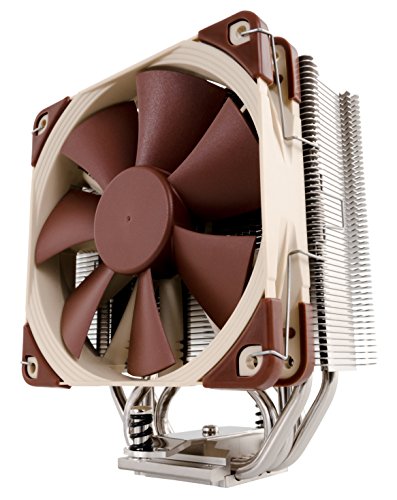
A capable air cooler such as the Noctua NH-U12S CPU Cooler is not a luxury on the 5800X during sustained inference. Long generation runs with heavy CPU-side work push all-core loads for minutes at a time; stock coolers throttle, and throttling shows up as jittery tok/s, not a clean thermal alert.
Context-length impact: KV-cache VRAM tradeoffs per runner
The KV cache grows linearly with context length and with the number of layers on the GPU. At an 8k context on a 27B model, the fp16 KV cache alone is roughly 1.5-2GB of VRAM. Push the context to 32k and it balloons to 6-8GB — enough to force you to drop 10+ GPU layers back to the CPU.
llama.cpp's --cache-type-k q8_0 and --cache-type-v q8_0 flags halve KV-cache VRAM at a small quality cost. Per the llama.cpp repository, Q8 KV caching is broadly considered lossless for chat use; Q4 KV can introduce measurable quality regressions on long, structured outputs.
Ollama accepts KV cache type via environment variables (OLLAMA_KV_CACHE_TYPE) as of 2026, but the setting is global rather than per-model and less discoverable. In practice, users running 32k+ contexts on a 12GB card almost always end up on llama.cpp — the manual cache-type flag pays for itself in a single session.
Perf-per-watt and ease-of-setup scoring
The RTX 3060 12GB has a 170W TGP per TechPowerUp. During sustained inference it typically pulls 130-160W depending on model and batch size. The runner does not meaningfully change per-token power, because the underlying math kernels are identical. What changes is time-to-answer, so the throughput winner is also the perf-per-watt winner by definition.
Ease-of-setup is where the two diverge sharply. Ollama installs from a single script on Linux, exposes an OpenAI-compatible API on port 11434, and a ollama run qwen3.6:27b command gets you a chat prompt within minutes. llama.cpp requires building from source (or fetching prebuilt binaries), downloading a GGUF file manually, and constructing your own command line. First-time users routinely lose an hour to CMake flags on llama.cpp; Ollama's first-run experience is generally under ten minutes on a fresh system with a working NVIDIA driver.
Storage speed matters at load time on both runners. A 16GB weight file streamed from a Samsung 970 EVO Plus 250GB NVMe at ~3,300 MB/s loads in roughly 5 seconds; the same file from a Crucial BX500 1TB SATA SSD at ~500 MB/s takes 30+ seconds. That matters less for a long-lived server, more if you swap between multiple models during a session.
Verdict matrix
| Choose Ollama if… | Choose llama.cpp if… |
|---|---|
| You want one command to pull and run a model | You want to push every last token per second out of the 3060 |
| You need a stable REST API for your app | You want IQ2/IQ3 quants that fit a 27B model fully in 12GB |
| You will use multiple models and want a registry | You run 32k+ contexts and need Q8 KV cache |
| You prefer sensible defaults over tuning | You are comfortable with CMake, GGUF files, and command-line flags |
| Your build changes frequently and you want autotune | Your workload is fixed and you tune once, run forever |
Bottom line
For most people running Qwen 3.6 27B on an MSI GeForce RTX 3060 Ventus 3X 12G paired with an AMD Ryzen 7 5800X and a Samsung 970 EVO Plus 250GB NVMe, Ollama is the right first choice — the setup cost is trivial and the throughput gap versus stock llama.cpp is single-digit percentage points at matched Q4_K_M settings as of 2026. If that gap matters, or you need IQ-quant fit or Q8 KV caching for a long-context workload, drop to llama.cpp, set -ngl 42 (adjust for your quant), enable Q8 KV cache, and recoup the difference. Keep the Noctua NH-U12S CPU Cooler on the 5800X for sustained loads and a Crucial BX500 1TB SATA SSD for bulk GGUF storage next to the fast NVMe boot drive. Neither runner is wrong; the choice is convenience versus control, and the engine is the same under both.
Related guides
- Buying guide: best GPUs for local LLM inference
- Buying guide: best CPUs for AI workloads
- Benchmarks: RTX 3060 12GB
- Benchmarks: Ryzen 7 5800X
Citations and sources
This piece is editorial synthesis based on publicly available information. No independent first-party benchmarking is reported.