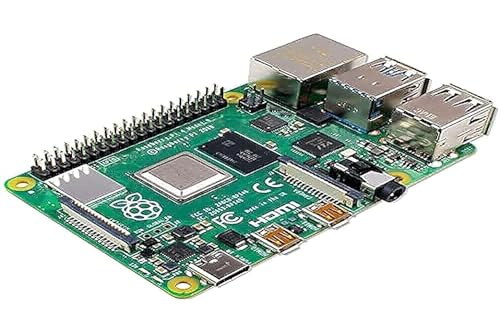
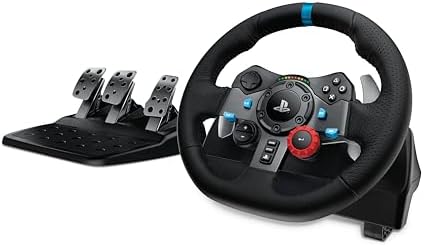
Yes. A Raspberry Pi 4 Model B runs a SimHub dashboard well, because it is not doing the hard work — the gaming PC reads the sim's telemetry and serves a rendered dash layout over the local network, and the Pi is a display client. Budget a Pi 4, a 7-10 inch panel, and a wired Ethernet run, and the whole build lands well under the price of a commercial dash.
Why sim racers want telemetry off the main screen
Every sim shows you a dash. The problem is where it shows it. In-game dashes live inside the cockpit model, which means they sit at whatever position and angle the car's designer chose, they scale with your FOV, and on a triple-screen or ultrawide setup they are frequently the least readable element on the display. Shift lights are the worst case: you need them in peripheral vision while your eyes are on the apex, and a texture painted on a virtual dashboard 1.2 metres into the scene is not peripheral vision, it is a place you have to look.
A dedicated dash screen fixes the geometry. You mount it above the wheel, at the sight-line you actually use, at a size you actually chose, showing exactly the four or five values you care about — gear, RPM with a shift indicator, speed, lap delta, fuel or tyre temps depending on discipline.
The reason a spare single-board computer beats the two obvious alternatives is boring and practical. A second monitor output from the gaming PC means the game has to cope with an extra display in its window management, and it means a full-size panel and a long video cable stretching across a cockpit. A tablet works right up until the moment it is on the charger, has updated overnight, or has decided to sleep mid-session. A dedicated Raspberry Pi 4 Model B that boots into the dash and does nothing else has no such failure modes — power it with the rig, and it is showing telemetry by the time the sim finishes loading.
This is also, in 2026, the cheapest meaningful upgrade a Logitech G29 owner can make after adding a shifter. The G29's rim has a small set of LEDs and no screen; the dash is the part the budget wheel does not include.
Key takeaways
- The PC computes, the Pi displays. SimHub reads game telemetry on the Windows machine and serves the dash layout; the Pi renders it as a client. That split is why a Pi 4 is sufficient.
- Wired Ethernet is the single most-skipped step. Wi-Fi contention shows up as stutter in the RPM bar at exactly the wrong moment.
- 7-10 inches is the useful screen range for cockpit-distance readability without blocking the main display.
- Power draw is trivial — a few watts idle, comfortably under about 7 W in this role per published Pi 4 measurements.
- Any wheel works. Telemetry comes from the game, not the wheelbase.
Step 0: do you actually need a dash?
Before spending anything, work out which of three groups you are in.
You do not need this if you drive with a chase camera or a bonnet camera in arcade-leaning titles, or if your discipline does not reward precise shift points. A visual dash solves a problem you do not have.
Wheel-rim LEDs are enough if you drive one or two cars in one title, always at the same shift point, and only want the shift indicator. Many wheels expose rim LEDs through the same software stack for free. Turn them on first and see whether the itch goes away.
You want the dash if you race multiple cars or multiple disciplines, run endurance stints where fuel and tyre state matter, do league racing where lap delta is decision-making information rather than trivia, or run a wheel like the G29 whose rim gives you very little. That is the group this build is for.
How the split works
The mechanics are worth stating precisely, because the confusion about it is the reason people over-buy hardware.
The sim exposes telemetry — shared memory, UDP packets, or an API depending on the title. SimHub runs on the same Windows machine as the game, reads that telemetry stream, and maps values into a dash layout. It then serves that layout over the local network. The Pi runs a client — in the common configuration, a browser in kiosk mode pointed at the PC's dash endpoint — and draws what it receives.
Everything computational happens on the gaming PC. The Pi is compositing a page that updates many times a second. That is a display workload, not a compute one.
Which means the hardware conclusion is: the Pi 4 Model B is sufficient, and a Pi 5 buys you close to nothing in this specific role. Per the Raspberry Pi Foundation's Pi 4 Model B specification, the board pairs a quad-core Cortex-A72 with 2, 4, or 8GB of LPDDR4, true Gigabit Ethernet, USB 3.0, and dual micro-HDMI outputs capable of 4Kp60. For rendering a telemetry page on a 7-inch panel, that is comprehensively more than the job requires — the Gigabit Ethernet is arguably the most relevant spec on the list. Tom's Hardware's Pi 4 review covers the generational jump in I/O and networking that made the 4 the first Pi genuinely suited to always-on networked display duty.
Take the 4GB model if you are buying new. 2GB works; 8GB is money spent on a workload that will never use it.
What you'll need
| Item | Why | Notes |
|---|---|---|
| Raspberry Pi 4 Model B (4GB) | The display client | 2GB is adequate; 8GB is overkill for this role |
| Official USB-C power supply | Stability | Under-powered supplies cause undervoltage warnings and random reboots |
| Boot media | OS | A quality card works; a USB-attached SSD is more durable — see below |
| 7-10 inch panel | The dash itself | HDMI or the official DSI touchscreen both work |
| Ethernet cable | The network path | The most important item in this table |
| Mount | Sight-line placement | Desk clamp, VESA arm, or cockpit bracket |
| Your existing wheelbase | Telemetry source | No requirement beyond the game supporting a telemetry feed |
On boot media: for a display-only client the read/write performance difference during a session is negligible. Boot reliability is not. Always-on, frequently power-cycled Pi builds are hard on flash cards, and card failure is the single most common way a Pi project dies quietly six months in. A USB-attached SATA drive such as a Kingston A400 960GB removes that failure mode for a modest cost. If you already have a good card in a drawer, start there and migrate later — the build works either way, and our Kingston A400 vs Crucial BX500 comparison covers the SATA options if you are buying one specifically.
Spec-delta table: Pi 4 vs the alternatives
| Option | Rough cost | Latency path | Power draw | Mounting | Verdict |
|---|---|---|---|---|---|
| Raspberry Pi 4 + 7-10" panel | $120-200 | LAN to client render | ~3-7 W | Excellent — small, VESA-friendly | Best fit |
| Spare laptop | $0 if owned | LAN to browser | 20-45 W | Poor — hinge angle fights the sight-line | Works, ugly |
| Tablet | $0 if owned | Wi-Fi to browser | ~5-10 W | Good with a clamp | Fine until it sleeps or updates |
| Second monitor from the PC | $80-200 | Direct video out | 15-30 W | Bulky at cockpit distance | Simplest, least tidy |
| Commercial dash unit | $250-600 | Vendor firmware | ~5 W | Purpose-built | Best finish, worst value |
The Pi wins on the two axes that matter for a permanent cockpit fixture: physical footprint and dedicated-ness. It is small enough to cable-tie behind the panel, and it does one thing, so it is never mid-update when you sit down to race.
Does the wheel matter?
Not for telemetry, and this is the most common misconception about the build.
The dash values come out of the game. The G29 is a belt-and-gear force feedback wheel with 900 degrees of rotation, per Logitech G's product page, and the sim reports gear, speed, RPM, and fuel through the same telemetry channel regardless of what is plugged in. A direct-drive base costs more and feels dramatically better; it does not report more telemetry.
Where the wheel does matter is in what the dash has to make up for. A rim with no shift lights and no display — which describes both the G29 and the HORI Racing Wheel Overdrive, an Xbox-licensed wheel without force feedback — leaves the shift indicator entirely to the external dash. That raises the dash from "nice" to "the reason your upshifts are consistent." If you have already read our G29 vs HORI Racing Wheel Overdrive comparison, the dash is the accessory that narrows the gap between either of those and something much more expensive.
A shifter changes what you put on the dash rather than whether you need one. Add a Thrustmaster TH8A — an H-pattern and sequential add-on — and the gear indicator stops being decorative, because in H-pattern you genuinely can lose track of which gear you are in mid-corner in a way you cannot with paddles. A large, high-contrast gear number becomes the most-used element on the screen. Our TH8A vs the G29 stock shifter piece covers that upgrade on its own terms.
Latency and refresh: what network rendering actually costs
The honest answer is: a small, fixed amount on wired Ethernet, and an unpredictable amount on Wi-Fi.
On a wired Gigabit link between the PC and the Pi, the update path — telemetry read, layout update, transmit, client render — adds a delay small enough that it is not the limiting factor in your reaction to a shift light. Your own reaction time is roughly an order of magnitude larger. The dash feels attached to the car.
On Wi-Fi, the average is similar and the distribution is the problem. Telemetry dashes update many times per second, and shared-medium contention on a busy home network produces occasional multi-frame gaps. The subjective experience is that the RPM bar hitches, and because you spend the most attention on it approaching the shift point, that is exactly where you notice. It reads as "the Pi is too slow." It is not; the network is.
Run a cable. It is the cheapest item in the build and the one that determines whether the result feels professional or janky. If the rig genuinely cannot be cabled, powerline or MoCA adapters are a better fallback than Wi-Fi, because they at least remove the contention.
Two smaller settings worth getting right: run the browser client in kiosk mode so nothing can steal focus, and disable screen blanking on the Pi — a dash that sleeps during a caution period is worse than no dash.
Mounting and ergonomics
Placement is the difference between a dash you use and a screen you have.
Height. The top edge of the panel should sit just below your sight-line to the corner you are approaching, so glancing at the gear number is an eye movement rather than a head movement. In practice that puts it above the wheel and slightly below the bottom edge of the main display.
Distance. Cockpit distance is about 50-70 cm on most rigs. At that range a 7-inch panel with a large gear digit is readable in peripheral vision. Smaller than 7 inches and the gear indicator stops being glanceable; larger than 10 inches and the dash starts eating the bottom of the main display or forces an awkward high mount.
Angle. Tilt the panel toward your eyes, not vertical. A vertical screen at wheel height is being viewed at a sharp angle, which costs contrast on exactly the type of panel most people use for this.
Cabling. On a desk-clamp setup, run the HDMI, power, and Ethernet down the clamp arm and sleeve them together — three cables to the wheel area is where a tidy desk goes wrong. On an aluminium profile cockpit, the extrusion channels take the cables and the Pi mounts directly to a profile bracket behind the panel.
Where this build disappoints
- Wireless-only setups. Covered above. If you cannot cable it and cannot use powerline, expect intermittent stutter you cannot tune away.
- Games without a telemetry feed. Not every title exposes one, particularly arcade-leaning console ports. Check your specific game before buying hardware.
- Anyone who wanted a second game view. This is a data readout, not a rear-view or a second camera angle. The Pi is not rendering the game.
- Touch-first expectations. You can use a touchscreen, but touching a screen mounted above a wheel mid-session is not a real workflow. Configure the layout on the PC and treat the dash as output only.
- Undervoltage. A generic phone charger on a Pi 4 driving a display produces intermittent reboots that look like software faults. Use a supply rated for the board.
Cost math
| Line item | Typical cost | Notes |
|---|---|---|
| Raspberry Pi 4 Model B (4GB) | $55-125 | Street pricing varies with supply |
| Power supply | $8-12 | Do not skip the rated unit |
| 7-inch HDMI panel | $45-80 | 10-inch runs $70-120 |
| Boot media (card) | $10-15 | Or a SATA SSD at $50-70 for durability |
| Ethernet cable + mount hardware | $15-30 | Clamp or profile bracket |
| Total | $135-260 | Against $250-600 for a commercial dash |
Running cost is negligible. At a few watts idle and under about 7 W in this role, a Pi that is powered whenever the rig is powered adds a rounding error to a season's electricity — less than the wheelbase's own idle draw, and dramatically less than leaving the gaming PC's second monitor on to do the same job.
The build pays for itself against a commercial unit on the first purchase, and the parts are re-purposable afterwards in a way a vendor-locked dash is not.
Bottom line
Build it this weekend if you race multiple cars or disciplines, run a rim without shift lights, and can get a network cable to the rig. The Pi 4 is the right board — cheap, small, dedicated, and comfortably over-specified for a display client — and the total spend lands under half of a commercial dash.
Skip it if your wheel already has usable rim LEDs and you drive one car in one title, or if your rig cannot be cabled. Turn on the rim LEDs, drive for a month, and see whether the dash is still on your list.
Related guides
- Logitech G29 vs HORI Racing Wheel Overdrive
- Thrustmaster TH8A vs the G29 stock shifter
- Best sim racing wheel and controller for PC
- Genesis Mini vs SNES Classic vs Raspberry Pi 4 for a retro setup
- Raspberry Pi USB mic bird-song logger
Citations and sources
- Raspberry Pi — Raspberry Pi 4 Model B product page — board specification: quad-core Cortex-A72, LPDDR4 memory options, Gigabit Ethernet, USB 3.0, dual micro-HDMI output. Accessed 2026-08-28.
- Tom's Hardware — Raspberry Pi 4 Model B review — generational I/O, networking, and power-consumption context for the always-on display-client role. Accessed 2026-08-28.
- Logitech G — Driving Force G29 product page — wheel specification including 900-degree rotation and force feedback implementation. Accessed 2026-08-28.
- SimHub — official project site — the dash software's role as the telemetry reader and layout server on the Windows host. Accessed 2026-08-28.
Prices and availability change frequently; figures quoted are indicative and may vary. As an Amazon Associate, SpecPicks earns from qualifying purchases.
This piece is editorial synthesis based on publicly available information. No independent first-party benchmarking is reported.