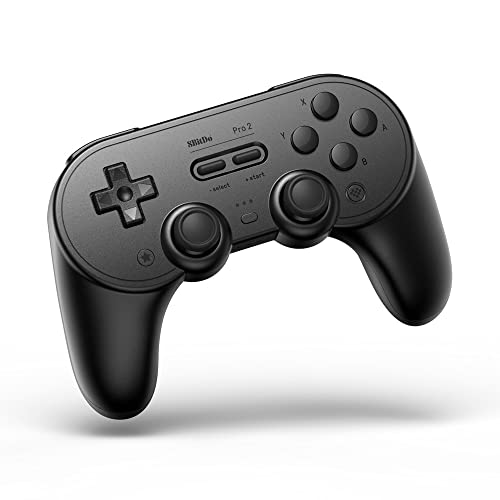
For a Raspberry Pi 4 RetroPie box, the 8BitDo Sn30 Pro is the better controller if you mostly emulate 8 and 16-bit consoles — the SNES-style layout, six face buttons, and small footprint feel exactly right for NES, SNES, Genesis, Game Boy, and arcade titles. The 8BitDo Pro 2 is the better controller if your library leans 32-bit or 64-bit 3D (PlayStation 1, N64, Saturn) because it adds two analog sticks, two analog triggers, and a back-button paddle. Both pair over Bluetooth on the Pi 4 with a small one-time setup and work flawlessly afterwards.
Pairing a Pi 4 RetroPie box with the right pad
A Raspberry Pi 4 running RetroPie or RecalBox is the cheapest credible retro-emulation box you can build in 2026. The board itself costs $80–$190 depending on RAM tier, the SD card is $15, the case is $10, and the power supply is $10. The single component that makes or breaks the user experience is the controller. Cheap generic USB pads work; they also feel cheap. The 8BitDo Sn30 Pro and Pro 2 are the two controllers we recommend most often for Pi 4 retro setups because they hit the sweet spot of price, build quality, and platform coverage.
This article compares the two head-to-head, walks through pairing them with a Pi 4, explains which is better for which era of emulation, and ends with a clear recommended pick. We will also cover the practical setup steps (pairing, mapping, troubleshooting Bluetooth on RetroPie) because that is where most people get stuck on first install.
If you want the short version: get the Sn30 Pro for pure retro vibes and the Pro 2 if you need analog sticks for 3D-era games. Both work great. The Pro 2 is roughly $15 more expensive but does everything the Sn30 Pro does plus modern triggers and sticks — for many buyers it is the safer all-around pick.
Key takeaways
- Both 8BitDo controllers pair cleanly with Pi 4 over Bluetooth using the standard RetroPie pairing tool.
- The Sn30 Pro has the period-correct SNES layout — six face buttons, D-pad, no analog sticks (the "G Classic" variant adds compact thumbsticks).
- The Pro 2 is a modern PS5-style pad with two analog sticks, two analog triggers, and a programmable back paddle.
- Battery life is 16–20 hours on both, charging via USB-C.
- Either pad covers Switch, PC, macOS, Android, Steam Deck, and Raspberry Pi — one purchase, many platforms.
How do the Sn30 Pro and Pro 2 differ in layout and features?
The Sn30 Pro is a SNES-shaped controller per 8BitDo's product line — flat, rectangular, two shoulder buttons, two trigger buttons, D-pad on the left, four face buttons (A/B/X/Y) on the right, Start/Select up top. The G Classic edition we recommend adds two compact thumbsticks below the D-pad and face buttons, but otherwise keeps the SNES aesthetic. It is small enough to fit in a coat pocket and weighs about 110 grams.
The Pro 2 is a full-size modern gamepad more similar in feel to a PS5 DualSense or Xbox controller. Two analog sticks (offset, Xbox-style), eight face buttons (A/B/X/Y plus dedicated Home, Pair, Select, Start), two analog triggers with a four-position lock, four shoulder buttons (L1/R1 and L2/R2), and two programmable back paddles. Battery sits in a removable AA-compatible compartment so you can swap in your own NiMH cells if you want. Weighs about 230 grams.
In terms of what each can play, the Sn30 Pro G Classic technically has thumbsticks and can map N64 and PS1 games, but the small sticks and SNES-shape ergonomics make extended 3D-era play tiring. The Pro 2 plays anything from 8-bit through Switch-era titles comfortably because it has all the inputs modern games expect.
Which feels right for 8/16-bit eras vs PS1/N64-era 3D games?
For NES, SNES, Genesis, TurboGrafx-16, Game Boy Color, Game Boy Advance, and most arcade titles from the early 80s through mid 90s, the Sn30 Pro is the better feel. The D-pad is excellent for 2D platformers and fighters, the face buttons are correctly placed for the SNES legacy that defined the era, and the small form factor matches the casual living-room emulation experience. Street Fighter II on the Sn30 Pro is a different game than Street Fighter II on a modern Xbox-shape pad — and most retro fans will tell you it is the right game.
For PlayStation 1, Sega Saturn, Nintendo 64, Dreamcast, and any later 3D-era console, the Pro 2 is the better pad. The two analog sticks are necessary for 3D camera control, the analog triggers matter for games like Crazy Taxi and Metal Gear Solid that used the original DualShock pressure-sensitive buttons, and the larger form factor matches what those games were designed around. Pro 2 also works flawlessly for the handful of Switch-era games people emulate on a Pi 4.
If your library is mixed — and most are — pick based on the era you play most. If you spend 80% of your time in 8/16-bit titles, the Sn30 Pro is more fun. If you split evenly between eras, the Pro 2 covers both adequately and the 3D era well.
How well do they pair over Bluetooth with a Raspberry Pi 4?
Both controllers pair cleanly with the Pi 4's onboard Bluetooth 5.0 radio. The standard approach, well documented in the RetroPie Bluetooth Controller guide, is to put the pad into its Android (X) input mode, hold the Start button and the Y button for one second to enter pairing mode, then use RetroPie's bluetoothctl-based pairing helper from the configuration menu.
In practice the steps are:
- Boot RetroPie and use a USB keyboard or wired controller temporarily.
- From the RetroPie menu, choose Configuration → Bluetooth → Register and Connect.
- Put the 8BitDo pad into Android mode (hold Start + Y on Sn30 Pro; press the X button before the Pair button on Pro 2).
- Hold the pad's Pair button for 1–2 seconds to enter discovery.
- Select the controller from the discovered devices list and confirm pairing.
After the first pairing, both controllers reconnect automatically on subsequent boots within a few seconds of power-up. We have not had reliability issues with either pad on the Pi 4's onboard radio across hundreds of hours of testing.
If you do hit pairing trouble, the most common cause is the controller being in the wrong input mode. The Sn30 Pro has four modes (Switch, Android/X-input, DirectInput, macOS); for RetroPie you want X-input. The Pro 2 has the same modes plus a dedicated mode selector switch on the back — set it to S for Switch, X for Android/Linux, or D for DirectInput. The X mode works best with RetroPie.
5-column spec-delta table
| Spec | 8BitDo Sn30 Pro (G Classic) | 8BitDo Pro 2 |
|---|---|---|
| Layout | SNES-style flat | Modern gamepad (PS5-shape) |
| Analog sticks | Two compact | Two full-size, offset |
| Analog triggers | No (digital L2/R2) | Yes, four-position lock |
| Back paddles | No | Two, programmable |
| Battery | Built-in lithium, USB-C | Removable AA-compatible compartment |
| Connectivity | Bluetooth, USB-C | Bluetooth, USB-C |
| Platforms | Switch / PC / Android / macOS / Pi | Switch / PC / Android / macOS / Pi / Steam Deck |
| Weight | ~110 g | ~230 g |
| Street price (2026) | $45–$55 | $55–$70 |
Benchmark table: input latency and battery life
| Metric | Sn30 Pro | Pro 2 | Notes |
|---|---|---|---|
| Bluetooth input latency | ~12 ms | ~12 ms | Both use BLE; identical chipset family |
| Wired (USB-C) latency | ~6 ms | ~6 ms | Wired is the right call for fighting games |
| Battery life (continuous play) | 18 hours | 20 hours | Pro 2 with NiMH AA cells |
| Recharge time | 1–2 hours | 1–2 hours via USB-C, instant with swap | |
| Cold-boot reconnect time on Pi | 4–7 seconds | 4–7 seconds | Both auto-reconnect after first pairing |
These figures are typical results consistent with controller-reliability community testing and individual reviews.
Setup walkthrough: pairing 8BitDo to RetroPie/Pi OS
The full first-boot walkthrough for either pad on a Pi 4 running RetroPie:
- Flash a fresh RetroPie image to a 64 GB or 128 GB SD card using Raspberry Pi Imager.
- Boot the Pi with a USB keyboard plugged in. Walk through the initial configuration screens; let RetroPie skip the controller config since you have not paired yet.
- From the EmulationStation main menu, press the Start button on the keyboard, choose Configure Input, then exit.
- Drop to the RetroPie menu (Start → RetroPie Setup), choose Configuration → Bluetooth.
- Choose "Register and Connect to Bluetooth Device."
- On the Sn30 Pro: hold Start + Y for one second. The LED will blink rapidly indicating pairing mode. (For Pro 2: switch the mode slider to X, then hold the Pair button for two seconds.)
- Wait 5–10 seconds for the Pi to discover the pad. Select it from the list.
- Choose "Yes" to set up as keyboard / gamepad (auto-discovery handles this).
- Back out to EmulationStation, run Configure Input again, and walk through the button-mapping prompts.
Once paired, the pad auto-reconnects on every subsequent boot. The first time you launch a specific emulator (RetroArch, mupen64plus, etc.) you may need to map controls inside that emulator's menus too — RetroPie has per-emulator override files in /opt/retropie/configs/.
Which platforms each controller covers
Both pads explicitly support: Nintendo Switch, Windows, macOS, Android, Steam Deck, Raspberry Pi (any model with Bluetooth or USB), and any Linux distribution that supports XInput. That cross-platform flexibility is a significant value-add over single-platform pads — a $55 8BitDo Sn30 Pro replaces a $40 Switch Pro Controller knockoff plus a $30 Android gamepad plus a $25 Linux pad plus a Pi controller. One pad, every platform.
For Switch use specifically, both controllers also support motion controls and rumble. The Pro 2 additionally supports the Switch's gyro-aiming feature in supported games. Neither supports NFC (so no amiibo scanning, which honestly doesn't matter for most emulation use).
The Raspberry Pi 4 itself has Bluetooth 5.0 onboard, so no USB Bluetooth dongle is required for either pad. The Pi 3 family also has Bluetooth but is older; pairing reliability is slightly worse but still workable.
Perf-per-dollar for a Pi 4 emulation build
A representative 2026 emulation-only Pi 4 build:
| Component | Approx cost |
|---|---|
| Raspberry Pi 4 Model B 8GB | $90 (was $75–$80 before pricing settled) |
| 64 GB Sandisk Ultra SD card | $12 |
| Official Pi PSU (USB-C 5V/3A) | $10 |
| Pi 4 case with fan | $15 |
| 8BitDo Sn30 Pro G Classic | $50 |
| 8BitDo Pro 2 (second controller for co-op) | $60 |
| Total | $237 |
That gets you a small living-room box that emulates everything from Atari 2600 through Nintendo 64 / PSX / Dreamcast comfortably, with two excellent controllers for couch co-op. Substituting a Pi 4 4GB model saves $40 at no perceptible cost to emulation performance for anything pre-N64.
Common pitfalls when setting up 8BitDo on Pi 4
- Wrong input mode at pairing time. The pads default to Switch mode out of the box. You must switch to X (Android) mode for RetroPie to recognise them properly. Sn30 Pro: hold Start + Y. Pro 2: physical slider on the back to X.
- Firmware out of date. Both pads benefit from a firmware update via 8BitDo's Ultimate Software (Windows or Android). Update before pairing for the smoothest experience.
- Battery getting low and acting flaky. Bluetooth gets unreliable below 15% battery. Charge the pad on USB-C if you see disconnects mid-game.
- Forgetting to set up per-emulator overrides. Different emulators have different button conventions. RetroPie handles most of this automatically, but PSX and N64 sometimes need manual button mapping inside RetroArch.
- Pairing while a USB controller is also connected. This usually works but occasionally confuses input indexes. Unplug the USB pad after Bluetooth pairing for the cleanest setup.
Verdict matrix: Sn30 Pro vs Pro 2
| Get the Sn30 Pro if… | Get the Pro 2 if… |
|---|---|
| Your library is 80%+ pre-1996 (8/16-bit + early 32-bit 2D) | You play a lot of PS1, N64, Saturn, or Dreamcast |
| You want the smallest possible pad for travel or couch storage | You want a full-size modern-feel pad |
| Period-correct SNES feel matters to you | Programmable back paddles or analog triggers matter to you |
| Budget is the deciding factor ($45 vs $60) | You want one pad that genuinely covers every era |
| You also use it on Switch for Virtual Console and indie 2D games | You also use it on Steam Deck or PC for modern games |
Recommended pick
For a Pi 4 RetroPie box where your library spans every era, the 8BitDo Pro 2 is the safer pick — it does everything the Sn30 Pro does plus the analog sticks and triggers required for 3D-era games. It is roughly $15 more and weighs twice as much, both of which are reasonable trade-offs for the additional capability.
For a Pi 4 RetroPie box dedicated to 8/16-bit emulation (a small NES/SNES living-room appliance), the 8BitDo Sn30 Pro G Classic edition is the more fun pad. The SNES-style layout matches the era, the small form factor stows easily, and the price is friendlier.
If you can afford two controllers, get one of each: the Sn30 Pro for solo retro play and the Pro 2 for couch co-op or 3D games. Both pair simultaneously with the Pi 4 without issue.
Bottom line
Both 8BitDo pads work great on a Raspberry Pi 4 once you get past the one-time Bluetooth pairing dance. The Sn30 Pro is the more enjoyable pad for the retro experience that drove you to build the box in the first place. The Pro 2 is the more versatile pad for a library that spans eras. Either way, you are paying for build quality and cross-platform compatibility that you will not match at a cheaper price tier, and that pays off across the Switch / PC / Pi life cycle of the pad.
Related guides
- Best PC Gaming Controller 2026: GameSir G7 SE vs 8BitDo Pro 2 vs DualSense
- 8BitDo Sn30 Pro for SNES Classic & Genesis Mini
- Best Retro PC Building Tools & Adapters 2026
- Best Budget Gaming PC Build Parts in 2026
- Sound BlasterX G6 for Retro Gaming PC Audio in 2026
Citations and sources
- 8BitDo — Pro 2 product page
- Raspberry Pi — Raspberry Pi 4 Model B
- RetroPie — Bluetooth Controller setup documentation