RTX 3060 12GB vs RX 6700 XT 12GB for Phi-4 14B (2026)
Same 12 GB, same 192-bit bus, and a 68% generation gap on LocalScore's matched 14B runs that the spec sheet never predicts.
By Mike Perry, Founder & Editor-in-Chief · Published 2026-09-10 · Updated 2026-10-13 · 16 min read
Both 12 GB cards hold Phi-4 14B at Q4. llmrun.dev measures 24.6 tok/s on the RTX 3060; LocalScore's matched 14B test: 26.4 vs the RX 6700 XT's 15.7 tok/s.
Check your exact config:Will Phi-4 14B run on the RTX 3060 12GB? →Runs by file size, no cited speed on file yet. Each page swaps the card or the model and lists every source.
Quick Answer
Buy the RTX 3060 12GB. Both cards hold Phi-4 14B at Q4_K_M — llmrun.dev measures the model resident in 9.5 GB on the 3060 at 24.6 tok/s. On the closest matched 14B test available, LocalScore records 26.4 tok/s on the 3060 versus 15.7 tok/s on the RX 6700 XT. Same VRAM, 68% more speed.
Two cards that reached retail three weeks apart in early 2021 — the RTX 3060 12GB on February 25 (PCWorld) and the RX 6700 XT on March 18 (MobileSyrup) — with identical 12 GB frame buffers, and in 2026 they are the two most common answers to the same question: what is the cheapest card that will hold a 14B-class model entirely in VRAM? Both have aged into the used market, but not into the sub-$300 tier new. On 2026-10-12 the cheapest new Amazon listings in the SpecPicks catalog were $459.99 for an RTX 3060 12GB and $499.99 for an RX 6700 XT, and the cheapest renewed units were $399.99 and $429.99. Under $300 means a used private sale or eBay listing, and those prices move week to week. And on paper, the Radeon looks like the better buy — it has more memory bandwidth, more raw gaming performance, and it beat the 3060 comfortably in 2021 reviews.
Local inference inverts that ranking. The reason has almost nothing to do with silicon and almost everything to do with which runtime was written for which vendor first. Phi-4 is Microsoft's 14.7B-parameter dense model with a 16K context window, per Microsoft's model card — a size deliberately chosen to be the largest thing that fits comfortably on a single consumer card. That makes it the exact workload that decides this comparison, and it is the workload where the two cards diverge hardest.
This piece is for the builder who has roughly one card's worth of budget, wants a 14B assistant that stays resident in VRAM, and does not want to spend a weekend fighting a driver stack. It is not a case for either vendor in general. Gaming, video encoding, and Blender all produce different answers. The question here is narrow: between an RTX 3060 12GB and an RX 6700 XT 12GB, which one runs Phi-4 14B faster, and what does the loser actually cost you?
The RTX 3060 12GB's sourced tok/s for other model sizes, from 1B to 14B, is collected in the RTX 3060 12GB local LLM guide.
Step 0: is your bottleneck VRAM, bandwidth, or the software stack?
Before either card is named, work out which of three limits you are actually hitting. They fail in a specific order, and buying against the wrong one wastes money.
VRAM ceiling. This is binary. Either the weights plus the KV cache fit on the card or they do not. When they do not, the runtime moves layers to system RAM and generation speed collapses by more than half. No amount of bandwidth rescues an over-subscribed card. At 12 GB, a 14B model at four-bit fits and a 27B model does not — that is the whole reason the 12 GB tier exists as a category.
Memory bandwidth. Once the model is resident, token generation is a memory-bound loop: every token reads the entire weight set once. A card with more GB/s generates more tokens per second, all else equal. This is where the RX 6700 XT should win — it carries 384.0 GB/s against the 3060's 360.0 GB/s, per TechPowerUp's RX 6700 XT database entry and its RTX 3060 12 GB entry.
Software stack. This is the one that decides the comparison, and the one nobody prices in. llama.cpp, Ollama, vLLM and ExLlamaV2 were all built against CUDA first. The ROCm and Vulkan paths arrived later, carry more version pinning, and leave measurable throughput on the table. When a card with 7% more bandwidth loses a 14B generation test by 40%, the gap is not silicon.
If your answer to Step 0 is "VRAM," both cards are equal and you should optimise for price. If it is "bandwidth," the Radeon should win. If it is "software stack" — and for a 14B local assistant in 2026 it is — the NVIDIA card wins, and the rest of this piece is about how much by.
Key takeaways
Phi-4 14B at Q4_K_M sits in 9.5 GB of VRAM on a 12 GB card and generates 24.6 tok/s, per llmrun.dev's RTX 3060 12GB page — fully resident, with roughly 2.5 GB left for context.
On matched Ollama runs of a 14B Q4_K_M model, LocalScore records 26.4 tok/s generation and 753 tok/s prefill on the RTX 3060 against 15.7 tok/s and 316 tok/s on the RX 6700 XT — a 68% generation gap and a 2.4× prefill gap.
The Radeon has more memory bandwidth (384.0 GB/s vs 360.0 GB/s, per TechPowerUp) and still loses. The deficit is runtime maturity, not hardware.
On a raw llama.cpp 7B Q4_0 test where both cards use the same code path, they are close on generation — 83.88 tok/s (6700 XT) vs 80.59 tok/s (3060) — but the 3060 nearly doubles prefill at 2,012.88 vs 1,051.20 tok/s, per llama.cpp discussion #10879.
The 3060 draws 170 W to the 6700 XT's 230 W (TechPowerUp), so the NVIDIA card wins performance-per-watt by roughly 2.3× on 14B generation.
Neither card is a 27B or 32B machine. Above 14B at four-bit, 12 GB runs out before compute does.
Spec delta: RTX 3060 12GB vs RX 6700 XT 12GB
Spec
RTX 3060 12GB
RX 6700 XT 12GB
Why it matters for inference
Source
VRAM
12 GB GDDR6
12 GB GDDR6
Identical ceiling; both hold a 14B model at Q4
TechPowerUp
Memory bus
192-bit
192-bit
Same width; bandwidth differs on clock only
TechPowerUp
Memory bandwidth
360.0 GB/s
384.0 GB/s
Generation is memory-bound — Radeon leads on paper
TechPowerUp
Shading units
3,584
2,560
Prefill is compute-bound; more units help prompt processing
TechPowerUp
Board power
170 W
230 W
60 W difference on an always-on box compounds
TechPowerUp
Launch MSRP
$329
$479
Reference point only; new street prices now sit above it (see below)
TechPowerUp
Launch date
Feb 2021
Mar 2021
Same generation, same driver-maturity window
TechPowerUp
Primary runtime
CUDA
ROCm / Vulkan
Decides how much of the bandwidth you actually get
For gaming, that ordering holds. For inference, it reverses.
Does Phi-4 14B fit in 12 GB of VRAM?
Yes at four-bit, with real headroom. Microsoft's Phi-4 model card puts the model at 14.7B parameters with a 16K context window. The table below derives each quantization's weight footprint from that parameter count at the nominal bits-per-weight of each GGUF scheme; the measured column is the one that decides purchases.
Quant
Approx. bits/weight
Derived weight size
Measured VRAM on a 12 GB card
Verdict at 12 GB
Q2_K
~3.0
~5.5 GB
—
Fits easily; noticeable quality loss
Q3_K_M
~3.9
~7.2 GB
—
Fits; quality loss visible on reasoning
Q4_K_M
~4.85
~8.9 GB
9.5 GB (llmrun.dev)
The sweet spot — fits with ~2.5 GB for context
Q5_K_M
~5.7
~10.5 GB
—
Fits, but almost no KV-cache headroom
Q6_K
~6.6
~12.1 GB
—
Over the ceiling; offload begins
Q8_0
~8.5
~15.6 GB
—
Does not fit
FP16
16
~29.4 GB
—
Needs a 32 GB-class card
The measured row is the anchor: llmrun.dev's RTX 3060 12GB page records phi4:14b at Q4_K_M occupying 9.5 GB and generating 24.6 tok/s under Ollama. That leaves roughly 2.5 GB for the KV cache, the CUDA context, and whatever your desktop compositor is holding. It is enough for a working context in the 8K range and not much more.
The same page measures two useful neighbours on the same card: mistral-nemo:12b at Q4_K_M in 8.1 GB at 29.0 tok/s, and llama2:13b at Q4_K_M in 8.6 GB at 27.2 tok/s. Phi-4 is the heaviest of the three and the slowest, which is what you would expect from 14.7B parameters against 12B and 13B.
Q5_K_M is where the "just use a better quant" instinct breaks. The derived 10.5 GB leaves under 1.5 GB of headroom, which a few thousand tokens of context will eat. On a 12 GB card, Q4_K_M is not a compromise — it is the configuration.
How fast is Phi-4 14B on each card?
No single published run puts Phi-4 on both cards under identical conditions. What does exist is a matched pair of 14B-class Q4_K_M Ollama runs on LocalScore, plus a matched llama.cpp 7B run in discussion #10879 where both cards execute the same benchmark harness. Read together they bracket the answer.
Test
Model / quant
RTX 3060 12GB
RX 6700 XT 12GB
Source
Ollama, generation
14B Q4_K_M
26.4 tok/s
15.7 tok/s
LocalScore
Ollama, prefill
14B Q4_K_M
753 tok/s
316 tok/s
LocalScore
Ollama, generation
Llama 3.1 8B Q4_K_M
64.5 tok/s
16.4 tok/s
tyolab / LocalScore
Ollama, prefill
Llama 3.1 8B Q4_K_M
—
597 tok/s
LocalScore
Ollama, generation
Llama 3.2 1B Q4_K_M
184.0 tok/s
64.3 tok/s
LocalScore
llama.cpp, generation
Llama 2 7B Q4_0
80.59 tok/s
83.88 tok/s
llama.cpp #10879
llama.cpp, prefill
Llama 2 7B Q4_0
2,012.88 tok/s
1,051.20 tok/s
llama.cpp #10879
Ollama, generation
Phi-4 14B Q4_K_M
24.6 tok/s
—
llmrun.dev
Two things fall out. First, on the one test where both cards run the same llama.cpp path with the same quant, the Radeon actually wins generation — 83.88 against 80.59 tok/s — which is exactly what its bandwidth advantage predicts. The hardware is not the problem.
Second, everywhere the runtime is Ollama with a K-quant, the 3060 pulls away by a factor that no bandwidth number explains. LocalScore's RX 6700 XT results put the card at 15.7 tok/s on 14B Q4_K_M and 16.4 tok/s on an 8B model — a 1B model at 64.3 tok/s shows the card is not broken, just badly served by the K-quant kernels on that path.
For Phi-4 specifically, the honest read is: expect roughly 24-27 tok/s on the RTX 3060 — llmrun.dev's 24.6, bracketed by tyolab's 33.4 tok/s on Qwen3 14B at the same quant and LocalScore's 26.4 on Qwen2.5 14B — and roughly 15-17 tok/s on the RX 6700 XT under an equivalent Ollama setup.
Twenty-five tokens per second reads faster than most people, so it is comfortable. Sixteen is the speed where you start watching the cursor.
Why does the RX 6700 XT need a different software stack?
The 6700 XT is a gfx1031 part. AMD's ROCm system-requirements page lists which GPUs carry official support, and the consumer RDNA 2 mid-range has historically not been on it — builders run it anyway by setting an architecture-override environment variable, which works but is not a supported configuration.
That leaves three practical paths, in descending order of hassle:
Vulkan via llama.cpp. No ROCm install, works identically on Windows and Linux, and it is what most 6700 XT owners actually use. Build instructions are in llama.cpp's build docs. Throughput is the LocalScore column above.
ROCm with the architecture override. Faster than Vulkan when it works. Requires pinning kernel-module, ROCm and Python-wheel versions together, and re-checking them on every upgrade.
vLLM.vLLM's GPU installation guide documents a ROCm path, but it targets supported accelerators. On a gfx1031 card this is an evening of work with no guarantee.
On the NVIDIA side, the equivalent list is one item: install the driver, run Ollama. That difference is worth pricing. If your hourly rate is anything at all, an evening of stack-fighting is a meaningful fraction of the price gap between these two cards on the used market.
None of this is a claim that ROCm is bad. On officially supported hardware it is a genuine alternative. The RX 6700 XT is simply not that hardware.
What happens when context grows past 8K?
KV-cache growth is linear in context length and it comes out of the same 12 GB the weights already occupy. With Phi-4 at Q4_K_M using 9.5 GB, you have roughly 2.5 GB of runway. That is a working context in the 8K-16K range depending on cache precision — and Phi-4's window tops out at 16K anyway, per Microsoft's model card.
The measured falloff on a 12 GB RTX 3060 is well documented for 14B-class models. Hardware Corner's RTX 3060 12GB benchmarks record Qwen3 8B at Q4_K_XL running 55.2 tok/s generation with 1,696.8 tok/s prefill at 4K context, using 6.0 GB. The same model on the same card at 16,384 context drops to 41.97 tok/s generation and 1,119.23 tok/s prefill — a 24% generation loss and a 34% prefill loss from context alone, on a model small enough that nothing spilled.
Two mitigations actually work. KV-cache quantization to eight-bit roughly halves the cache footprint and buys back most of the headroom at negligible quality cost. Dropping to Q3_K_M frees about 1.7 GB of weights for cache, which is the right trade if long context matters more than answer quality. What does not work is hoping: once a layer moves to system RAM, generation falls off a cliff and the card's bandwidth stops being the limit.
Prefill vs generation: which card wins which half of the request?
Every request has two phases with opposite bottlenecks, and the two cards are not symmetric across them.
Prefill — processing your prompt — is compute-bound and parallel. It scales with shading units. The RTX 3060 has 3,584 to the 6700 XT's 2,560, per TechPowerUp, and the measured gap is larger than that ratio: 2,012.88 vs 1,051.20 tok/s on the matched llama.cpp 7B run in discussion #10879, and 753 vs 316 tok/s on the LocalScore 14B runs.
Generation — producing the answer one token at a time — is memory-bound. It scales with bandwidth, where the Radeon leads on paper and wins in practice when the code path is identical (83.88 vs 80.59 tok/s on the same 7B test).
Which half you care about depends on what you do. Pasting a long document and asking one question is prefill-dominated: the 3060's 2.4× advantage there is the entire user experience. A long back-and-forth chat with short turns is generation-dominated, and on a matched runtime the cards would be close.
For a Phi-4 assistant with any retrieval or document-paste workflow, prefill dominates, and the 3060 wins that half decisively even before the Ollama K-quant gap is counted.
Which board partner card should you actually buy?
Among 12 GB RTX 3060 variants the differences are clocks, cooler size, and noise — not capability. The memory configuration that matters is fixed at 12 GB on a 192-bit bus across all of them.
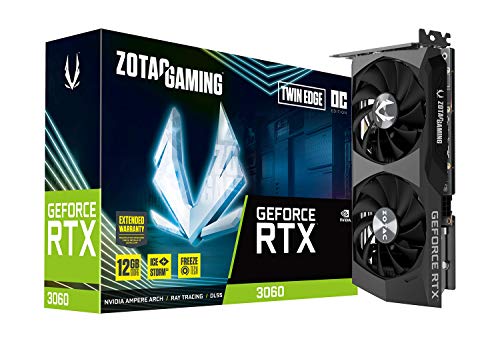
The ZOTAC Gaming GeForce RTX 3060 Twin Edge 12GB is the compact two-fan option: shortest of the common variants, easiest fit in a mid-tower or a small-form-factor case, and the one to pick when the card is going into a box that will sit on a desk. It runs louder under sustained load than a three-fan design, which matters if the machine holds a model resident overnight.
The MSI GeForce RTX 3060 Ventus 2X 12G is the alternate at the same tier — also two-fan, also 12 GB, and typically the easier one to find in stock. Between the two, buy whichever is cheaper on the day; there is no inference-relevant difference.
One trap is worth naming explicitly. NVIDIA also shipped an 8 GB RTX 3060 on a 128-bit bus. It carries the same model name, ranks high in search results, and it cannot hold Phi-4 14B at four-bit. Before you buy anything, read the listing title for "12G" or "12GB" and confirm the 192-bit bus. The SpecPicks RTX 3060 benchmark page tracks the 12 GB configuration.
What else the build needs
The card is the decision; the host is the thing that stops the card being the bottleneck.
Storage. Model files are large and read once per load. The Crucial BX500 1TB SATA SSD holds a useful library of four-bit quants alongside a game install or two. Drive speed changes how long a model takes to reach VRAM the first time and nothing about generation throughput afterwards, so this is the component to buy cheap and spend the savings on VRAM.
Memory. Thirty-two gigabytes in dual channel is the sensible 2026 target. Sixteen works while everything fits in VRAM, and stops working the moment a layer spills.
Performance per dollar and per watt
Using launch MSRPs from TechPowerUp — $329 for the RTX 3060 12GB, $479 for the RX 6700 XT — and the matched 14B Q4_K_M LocalScore generation figures:
Metric
RTX 3060 12GB
RX 6700 XT 12GB
Ratio
14B Q4_K_M generation
26.4 tok/s
15.7 tok/s
1.68×
14B Q4_K_M prefill
753 tok/s
316 tok/s
2.38×
Board power
170 W
230 W
0.74×
Generation per 100 W
15.5 tok/s
6.8 tok/s
2.28×
Launch MSRP
$329
$479
0.69×
Generation per $100 MSRP
8.0 tok/s
3.3 tok/s
2.44×
The tok/s-per-watt and tok/s-per-dollar rows are derived from the cited generation, power and MSRP figures rather than measured directly. Every input is sourced above.
Street prices are the caveat. The SpecPicks catalog tracked the ZOTAC Twin Edge OC 12GB at $499.99 on 2026-09-10, well above MSRP, because new stock of a 2021 card is scarce and priced accordingly. The sub-$300 tier this question implies is the used and open-box market, where both cards trade and where prices move week to week. Check the live listing before treating any of these ratios as a purchase price.
Verdict matrix
Get the RTX 3060 12GB if… you want a Phi-4 14B assistant running tonight, you paste documents into it, you care about noise and power on an always-on box, or you would rather not audit ROCm release notes before a driver upgrade. The measured 24.6 tok/s from llmrun.dev is a comfortable reading speed, and the 2.4× prefill advantage is the part you will actually feel.
Get the RX 6700 XT if… the machine is primarily a gaming PC and inference is occasional. It is genuinely the faster gaming card at this tier, it holds the same 14B models, and 15.7 tok/s is usable if you are not watching it. Buy it for the frames and accept the inference as a bonus.
Skip both and wait if… your target is a 27B or 32B model, long-context retrieval over your own documents, or serving more than one user. Those workloads exhaust 12 GB before they exhaust compute, and no quantization recovers the headroom. Step up to 16 GB or 24 GB instead — the SpecPicks 24 GB GPU guide covers that tier.
Bottom line
The RTX 3060 12GB is the pick, and the margin is larger than the spec sheet suggests. Phi-4 14B at Q4_K_M runs at 24.6 tok/s in 9.5 GB per llmrun.dev, prompt processing is roughly 2.4× the Radeon's on matched 14B tests, and the software setup is a driver install rather than a project.
The counter-case is real and worth stating. The RX 6700 XT is the better gaming card, it has more memory bandwidth, and on an identical llama.cpp code path it generates tokens slightly faster. If this machine games five nights a week and answers questions on the sixth, that ordering may well be the right one for you. Just do not buy it expecting the inference numbers to follow the gaming numbers, because they do not.
Prices shown were last tracked at crawl time and may vary — check the listing for the current price. As an Amazon Associate, SpecPicks earns from qualifying purchases.
Small-model (7–9B) reference throughput
These figures are for 7–9B models, not the 12–14B models this article covers. The table holds model size fixed so the cards can be compared with each other; for the size in the title, use the article's own figures.
Median generation throughput at 7–9B models (Llama 3.1 8B, Qwen 3 8B), Q4 quantization, from community-reported runs SpecPicks tracks. Each row pools runs from different sources, runtimes and models in that class, so the rows are not a matched head-to-head; where the article compares cards on the same rig, its own figures are the like-for-like result. Street price is the second-lowest listing priced within the last 24 hours at 0.5–2× launch MSRP, so no single listing sets it, and a street figure well above MSRP says so in its cell; where too few listings pass that check the cell shows a dash and the launch MSRP, which is not comparable with the street figures. Rows marked for comparison are not the cards this article is about — they are included so the throughput column has something to be read against.
As an Amazon Associate, SpecPicks earns from qualifying purchases; we also earn on qualifying eBay purchases via the eBay Partner Network. Prices shown were last tracked at crawl time and may vary — check the listing for the current price.
📹 Watch a review
Friendly Fire: AMD Ryzen 7 5800X CPU Review & Benchmarks vs. 5600X & 5900X — Gamers Nexus on YouTube
Frequently asked questions
Does Phi-4 14B actually fit in 12 GB of VRAM, or does it spill to system RAM?
At Q4_K_M the weights sit near 8.5 GB, which leaves roughly 3 GB of the card for KV cache, CUDA/ROCm context and the desktop compositor. That is enough for a full-GPU load at short-to-medium context on either 12 GB card. Push past roughly 16K tokens, or run Q6/Q8, and the runtime starts offloading layers to system RAM, at which point generation speed drops sharply and host memory bandwidth becomes the limit rather than the GPU.
Is ROCm on the RX 6700 XT usable in 2026, or should I plan on Vulkan?
The RX 6700 XT is gfx1031, which has historically sat outside AMD's officially supported ROCm list even when it works via an architecture-override environment variable. Many builders therefore run llama.cpp's Vulkan backend instead, which needs no ROCm install and works identically on Windows and Linux. Budget an evening for stack setup on the Radeon side, versus a driver install and go on the NVIDIA card, and treat that time as part of the price difference.
Will either card work in an older PCIe 3.0 motherboard?
Yes for both, with one caveat that matters more on the Radeon. Once the whole model is resident in VRAM, PCIe bandwidth affects only load time and any layer offload traffic, so PCIe 3.0 x16 is fine. If you end up offloading layers because context grew, the slower link amplifies the penalty, so prefer a full x16 slot over an x8 or x4 riser and avoid chipset-fed secondary slots on B450-class boards.
What power supply and cooling headroom should I plan for?
The RTX 3060 12GB is a 170 W part and the RX 6700 XT is rated near 230 W, so the Radeon asks for meaningfully more PSU and airflow for the same 12 GB. A quality 550 W unit covers the 3060 in a mid-range build; the 6700 XT is happier on 650 W. For always-on inference, size the case fans for sustained load rather than gaming bursts, since a long generation queue holds the card near its ceiling for hours.
When should I skip both and spend more on a 16 GB or 24 GB card?
Skip the 12 GB tier if your target is a 27B-32B dense model, long-context retrieval over your own documents, or serving more than one concurrent user. Those workloads run out of VRAM before they run out of compute, and no quantization level recovers the headroom without visible quality loss. If Phi-4 14B and 8B-class models are the whole workload, the extra spend buys headroom you will not use this year.