Yes, with one hard constraint: the RTX 3060 12GB has 12 GB of GDDR6 total, and a 7–8B model at Q4_K_M parks roughly 5–6 GB of it before your game asks for anything. That leaves 6–7 GB — enough for 1080p high, tight at 1440p high, and not enough for 1440p ultra. Above 13B, the answer becomes no.
Who this is for
You have one desk, one GPU and two jobs for it. During the day the machine runs an always-on local assistant — Ollama sitting in the background, answering a coding question or summarizing a document on demand. In the evening it is a gaming PC. NVIDIA specifies the RTX 3060 with 3,584 CUDA cores, a 1.78 GHz boost clock and 12 GB of GDDR6 on a 192-bit interface at 170 W (NVIDIA). That 12 GB is generous for the price tier and is the entire reason this configuration is even worth attempting — an 8 GB card in the same performance class cannot do both at once in any useful configuration.
The failure you hit is specific and confusing the first time. You launch a game with the model still loaded and the game does not crash. It stutters. Textures pop in late. Every twenty seconds the frame time spikes into visible hitching, and nothing in either application tells you why. Meanwhile your assistant's tokens-per-second quietly collapses. There is no error dialog because nothing errored — the driver is doing exactly what it is designed to do, which is evict memory rather than fail.
This guide is about doing the arithmetic before you hit that. The numbers below are derived from published VRAM capacity, model parameter counts and quantization bit-widths — they are budget math, not measured benchmarks. The point is to tell you which combinations fit and which do not, before you spend an evening tuning something that was never going to work.
Diagnose before you tune
Two measurements, five minutes, and they replace all guesswork.
Measure resting VRAM with the model idle. With Ollama loaded and the model resident but no request in flight, read GPU memory usage. On a Linux or Windows host nvidia-smi reports it directly, and NVIDIA documents the tool's memory-reporting fields in the System Management Interface documentation (NVIDIA docs). Write the number down.
Measure it again with the model unloaded. Stop the runtime or force an unload, wait for the memory to release, and read again.
The delta between the two is your real model footprint including the runtime's own overhead and the KV cache — not the file size on disk, which is smaller. Subtract that delta from 12 GB and you have your actual game budget. Every recommendation below is a way of moving that one number.
Key takeaways
- The RTX 3060 12GB's ceiling is 12 GB, full stop. Every allocation below competes inside it.
- A 7–8B model at Q4_K_M is roughly 4.2–4.8 GB of weights, plus KV cache and runtime overhead — call it 5–6 GB resident.
- Ollama's default
keep_aliveis 5 minutes;0unloads immediately and-1keeps the model loaded indefinitely. - Exceeding 12 GB does not crash — it produces frame-time spikes from PCIe eviction and a silent tokens-per-second collapse.
- KV cache scales with context: a GQA 8B model costs roughly 0.5 GB per 4k tokens of context at fp16.
- Above 13B at Q4_K_M you are out of headroom for anything but the lightest 1080p titles.
What actually happens when both want VRAM
Neither the game nor the inference runtime knows the other exists. Each asks the driver for memory, and the driver arbitrates. When the sum of requests exceeds physical VRAM, modern drivers do not return an out-of-memory error to a well-behaved application — they demote allocations to system RAM and page them across PCIe on demand.
PCIe is the bottleneck in that arrangement. A PCIe 4.0 x16 link moves on the order of 32 GB/s in ideal conditions; the card's own memory bus moves roughly 360 GB/s at 15 Gbps across 192 bits. That is an order of magnitude, and it is why the symptom is a hitch rather than a slowdown: when the renderer needs a texture that now lives in system RAM, the frame waits.
The inference side degrades differently. Ollama loads a model entirely onto a single GPU when it fits there, and spreads it across GPUs when it does not (Ollama). On a single-GPU machine with insufficient free VRAM, the practical result is partial CPU offload — some layers execute on the processor — and throughput falls hard with no message explaining it.
So the two failure modes are asymmetric. The game tells you something is wrong by stuttering. The model tells you nothing at all; it just gets slower.
VRAM budget: what fits inside 12 GB
Model weight figures below are computed from parameter count and the effective bits-per-weight of each quantization, which is how you should estimate any model you have not yet downloaded. Q4_K_M averages roughly 4.8 bits per weight.
| Model size | Weights at Q4_K_M | + KV cache & overhead | Resident total | Free of 12 GB |
|---|---|---|---|---|
| 3B | ~1.8 GB | ~0.5 GB | ~2.3 GB | ~9.7 GB |
| 7B | ~4.2 GB | ~1.0 GB | ~5.2 GB | ~6.8 GB |
| 8B | ~4.8 GB | ~1.0 GB | ~5.8 GB | ~6.2 GB |
| 13B | ~7.8 GB | ~1.3 GB | ~9.1 GB | ~2.9 GB |
| 14B | ~8.4 GB | ~1.3 GB | ~9.7 GB | ~2.3 GB |
| 27B | ~16.2 GB | ~2.0 GB | ~18.2 GB | does not fit |
| 32B | ~19.2 GB | ~2.0 GB | ~21.2 GB | does not fit |
Now the other side of the ledger. Game VRAM demand varies enormously by title, but these are the working ranges to plan against:
| Game target | Typical VRAM demand | Works with 3B | Works with 7–8B | Works with 13–14B |
|---|---|---|---|---|
| 1080p high, esports title | 3–5 GB | Yes | Yes | Tight |
| 1080p high, modern AAA | 5–7 GB | Yes | Tight | No |
| 1440p high | 6–8 GB | Yes | Tight | No |
| 1440p ultra, AAA | 8–10 GB | Tight | No | No |
| 1440p ultra + ray tracing | 10–12 GB | No | No | No |
The pattern is clean: a 3B assistant coexists with almost anything, a 7–8B assistant coexists with 1080p and struggles at 1440p ultra, and a 13B-or-larger assistant leaves you a gaming budget too small to be useful.
Quantization: which quant leaves room for a game
For a 7B model, here is what each quantization costs and buys. VRAM is derived from bits-per-weight; the throughput column is directional, reflecting the fact that smaller quants move less memory per token on a bandwidth-limited card.
| Quant | Bits/weight | 7B weights | Relative throughput | Quality cost |
|---|---|---|---|---|
| Q2_K | ~3.0 | ~2.6 GB | Highest | Substantial — noticeable reasoning degradation |
| Q3_K_M | ~3.9 | ~3.4 GB | Very high | Visible on complex tasks |
| Q4_K_M | ~4.8 | ~4.2 GB | High | Minimal — the default for good reason |
| Q5_K_M | ~5.7 | ~5.0 GB | Moderate | Near-negligible |
| Q6_K | ~6.6 | ~5.8 GB | Lower | Effectively none |
| Q8_0 | ~8.5 | ~7.4 GB | Low | None measurable |
| FP16 | 16.0 | ~14.0 GB | Does not fit | N/A on 12 GB |
Q4_K_M is the right default on a 12 GB card that also games, and the reason is the shape of the curve rather than any single row. Moving from Q4_K_M to Q5_K_M costs 0.8 GB — more than 10% of your remaining game budget — to buy a quality improvement most users cannot detect in practice. Moving down to Q3_K_M saves 0.8 GB but starts costing real reasoning quality.
The one case for going lower is a deliberately small assistant. A 3B model at Q4_K_M is under 2 GB and effectively free; if your use case is autocomplete, summarization or command lookup rather than reasoning, drop the parameter count instead of the precision. A 3B at Q4 beats a 7B at Q2 on both quality and footprint.
Prefill vs generation: why long prompts hurt more
Inference has two phases with very different memory behavior, and conflating them is why "it was fine yesterday" happens.
Prefill processes your entire prompt at once. It is compute-dense and parallel, it allocates KV cache for every input token simultaneously, and it saturates the GPU. If you paste a 12,000-token document into your assistant while a game is running, prefill is the moment your frame times spike.
Generation produces one token at a time. It is memory-bandwidth-bound rather than compute-bound, it adds one token's worth of KV cache per step, and it leaves far more GPU capacity to the renderer.
The practical consequence: a chatty back-and-forth with short prompts is nearly invisible to a running game, while a single large document paste is a visible hitch. If you must do long-context work, do it between matches rather than during one.
Ollama's FAQ also notes that parallel request processing multiplies the effective context size by the number of concurrent requests (Ollama). On a shared 12 GB card, running a single-concurrency configuration is not a limitation to work around — it is the correct setting.
Context length: the cost nobody budgets for
KV cache grows linearly with context length and it is the allocation people forget. For a modern 8B model using grouped-query attention with 32 layers and 8 KV heads at 128 dimensions, storing keys and values in fp16 costs about 128 KB per token.
| Context | KV cache (GQA 8B, fp16) | Running total with 8B Q4_K_M weights |
|---|---|---|
| 4k tokens | ~0.5 GB | ~5.3 GB |
| 8k tokens | ~1.0 GB | ~5.8 GB |
| 16k tokens | ~2.0 GB | ~6.8 GB |
| 32k tokens | ~4.0 GB | ~8.8 GB |
Note what happens at 32k: the same model that left you 6.2 GB at short context now leaves you 3.2 GB, which is below the floor for any modern game. Older multi-head-attention models without GQA are dramatically worse — four to eight times this cache size for the same context length.
The lever is simple and underused: set your context window to what you actually need. Configuring 32k because it was available, on a card you also game on, is the most expensive default in the stack.
The keep_alive lever
Ollama keeps a model resident for five minutes after the last request by default. The keep_alive parameter accepts a duration string like 10m or 24h, a plain number of seconds, -1 to hold the model indefinitely, or 0 to unload immediately after generating a response (Ollama).
For a machine that also games, keep_alive is the single highest-leverage setting you have:
| Setting | VRAM behavior | Latency cost | Best for |
|---|---|---|---|
-1 | Model never releases VRAM | None | A dedicated inference box |
24h / 10m | Held for the window, then released | Reload after idle | Heavy daytime use, evening gaming |
5m (default) | Released 5 min after last request | Reload after a short pause | Balanced general use |
0 | Released immediately every time | Reload on every request | Occasional queries on a gaming rig |
The cost of keep_alive: 0 is disk-to-VRAM reload latency on every single request, and that is where storage becomes part of this conversation. A Crucial BX500 1TB is a SATA drive rated up to 540 MB/s sequential read. A 4.8 GB Q4_K_M 8B model therefore takes roughly nine seconds to stream off that drive in the best case, plus filesystem and initialization overhead.
Nine seconds is completely fine for an assistant you consult a few times an evening. It is intolerable for anything you query in a loop. If your workflow swaps models constantly, the SATA drive is the wrong place for the model library and an NVMe drive — three to seven times the sequential throughput — pays for itself in patience. If you query occasionally, SATA is adequate and the money belongs elsewhere.
The middle setting is usually correct: a duration long enough to cover a working session, short enough that the model is gone by the time you launch a game an hour later.
Which RTX 3060 12GB do you actually want?
Both cards in this comparison carry the same GA106-class silicon and the same 12 GB across a 192-bit bus, so the VRAM arithmetic in this article does not change between board partners. What changes is thermal behavior under a load profile neither card was designed for: hours of concurrent rendering and inference rather than a two-hour gaming session.
| ZOTAC Twin Edge OC | MSI Ventus 3X 12G OC | |
|---|---|---|
| VRAM | 12 GB GDDR6, 192-bit, 15 Gbps | 12 GB GDDR6, 192-bit |
| Memory bandwidth | ~360 GB/s | ~360 GB/s |
| Cooler | Dual-fan, compact | Triple-fan, larger mass |
| Best fit | Small cases, tight clearance | Sustained dual load, better acoustics |
| Inference throughput | Identical | Identical |
Buy on cooling and case clearance, not on expected tokens per second. The two cards produce the same inference numbers; the triple-fan design simply holds clocks with less fan noise when the GPU never gets an idle period. If your rig lives on the desk beside you and runs a model all day, that acoustic difference is the thing you will notice every day. If it lives in a compact case, clearance decides for you.
Does the CPU rescue you?
Partially, and the trade is worth understanding precisely. Offloading transformer layers to system RAM frees VRAM for the renderer and moves the work onto CPU cores and system memory bandwidth. An AMD Ryzen 7 5800X with 8 cores and 16 threads has slack a saturated GPU does not.
Three costs come with it:
Throughput collapses. CPU-side generation on a consumer desktop typically lands in single-digit tokens per second against the tens or low hundreds a 12 GB GPU delivers on a small model. This is not a small penalty; it is an order of magnitude.
You contend with the game's render thread. Modern engines want cores. Handing four or six threads to an inference runtime while a game is trying to feed a draw-call thread trades a GPU problem for a CPU one, and on a 6-core part it is a bad trade. On an 8-core, 16-thread chip there is genuinely room, which is why the core count matters here more than the clock speed.
System RAM bandwidth becomes the ceiling. Generation is memory-bandwidth-bound. Dual-channel DDR4 delivers a fraction of what GDDR6 does, and that gap is most of the throughput loss.
The honest framing: CPU offload is for background and asynchronous work — a summarizer chewing through a queue, a batch job you are not waiting on. It is not for an interactive assistant you query mid-game.
Thermals and acoustics under a 24/7 dual load
An always-loaded model changes your cooling calculus even though the weights sit on the GPU. Two reasons.
First, the GPU stops having idle periods. A gaming rig's thermal design assumes bursts with long cool-downs; a background inference server removes the cool-downs. The card runs warmer at rest, the case air is warmer, and every other component in the case inherits that.
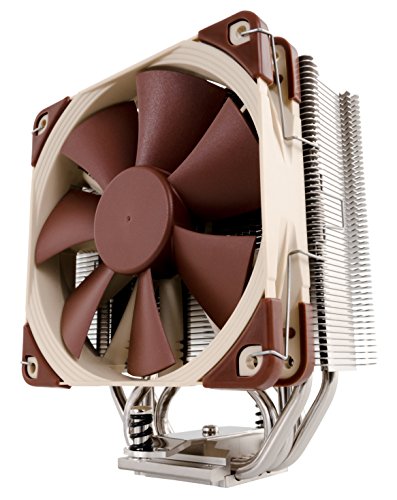
Second, if you take the CPU-offload route above, the processor is now the sustained-load component. A Ryzen 7 5800X under continuous multi-threaded load is a genuinely warm part, and stock coolers in this class are sized for bursts. A Noctua NH-U12S — a 158 mm single-tower with an NF-F12 120 mm fan — is the standard answer here, and the relevant property is not peak cooling capacity but the fan curve: a large tower holds the same temperature at far lower RPM than a compact cooler, which is what matters when the load never stops and the machine is on your desk.
Perf-per-watt is worth a moment too. Holding a model resident costs almost nothing in power — idle VRAM draws power whether occupied or not, and an idle model does no compute. The real power cost is the machine being on 24/7 at all, which is a separate decision. Do not use "it will cost me electricity" as an argument against keep_alive: -1; use VRAM contention, because that is the actual cost.
When this works and when it doesn't
It works for a 3B assistant behind a 1080p esports title. Total resident footprint under 2.5 GB, game demand under 5 GB, nine-plus gigabytes of headroom and no contention at all. This configuration is genuinely invisible.
It works for a 7–8B assistant behind a 1080p AAA game, provided you keep the context window at 8k or below and avoid long document pastes mid-session. You are running at roughly 11 of 12 GB, which is tight but stable.
It does not work for a 13B-or-larger model behind anything at 1440p. The arithmetic never closes: 9+ GB resident against a 6–8 GB game demand exceeds the card before you have tuned a single setting.
It does not work for a 27B model behind a 1440p ultra AAA title. That is not a tuning problem, it is a capacity problem — the model alone exceeds 12 GB.
It does not work at 32k context on any model above 3B while gaming. The KV cache alone eats the headroom you were counting on.
Verdict
Keep the model resident — keep_alive: -1 or a long duration — if you are running a 3B model, or a 7–8B model with a game that stays under 1080p high. The VRAM math closes with room, and you get instant responses with no reload penalty.
Use keep_alive: 0 or a short window if you run a 7–8B model and play at 1440p, or if you occasionally need 13B-class quality. You pay several seconds of reload latency per request in exchange for the game getting the full frame buffer, and on a SATA drive that latency is roughly nine seconds for a 5 GB model — which is the number that decides whether this is acceptable to you.
Move inference to the CPU or a second machine if you need a 13B-or-larger model available while gaming at 1440p or above. On a 12 GB card that is a capacity problem, and the correct answers are an 8-core CPU running background work at single-digit tokens per second, a cheap always-on second box, or accepting that the two activities do not overlap.
The one thing not to do is keep tuning. If the arithmetic in the tables above says a combination does not fit, no setting recovers it — you will just find slower ways to lose.
Related guides
- Can a 12GB RTX 3060 Still Run 2026's Local LLMs?
- Ollama on the RTX 3060 12GB: Model Sizes and tok/s for 2026
- Best SSD for Local LLM Model Storage in 2026: NVMe vs SATA
- Is 12GB VRAM Still Enough for Local LLMs in 2026?
Citations and sources
- NVIDIA — GeForce RTX 3060 family specifications — accessed 28 August 2026. Source for the 3,584 CUDA cores, 1.32/1.78 GHz clocks, 12 GB GDDR6 on a 192-bit interface, 170 W graphics card power and 550 W recommended system supply.
- TechPowerUp — GeForce RTX 3060 12 GB GPU database entry — accessed 28 August 2026. Source for the GA106 die configuration, memory bus width and board-level power specifications used in the bandwidth arithmetic.
- Ollama — FAQ — accessed 28 August 2026. Source for the five-minute default
keep_alive, the-1and0values, single-GPU model placement behavior, and the effect of parallel requests on effective context size. - NVIDIA — System Management Interface (nvidia-smi) documentation — accessed 28 August 2026. Source for the GPU memory-utilization reporting used in the diagnostic step.
VRAM figures in this article are arithmetic derived from published parameter counts, quantization bit-widths and attention-cache geometry — they are budget estimates, not measured allocations, and real footprints vary by runtime version and model architecture. Throughput characterizations are directional. Prices quoted are SpecPicks catalog listings as of 28 August 2026 and move frequently. This piece is editorial synthesis based on publicly available manufacturer and project documentation. No independent first-party benchmarking is reported.
— Mike Perry · Last verified 28 August 2026