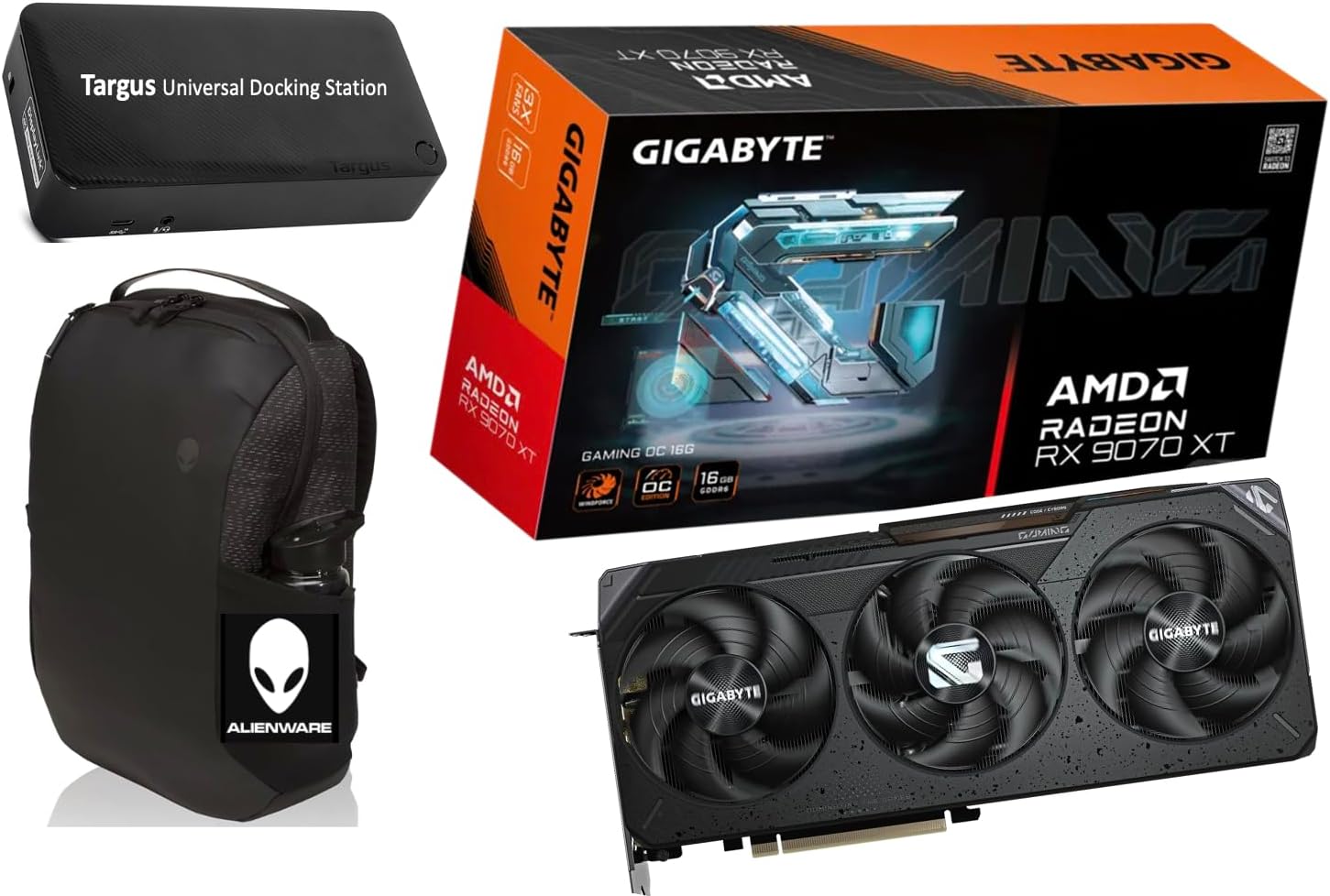
As of October 2026, the RX 9070 XT generates Qwen3-8B at Q4_K_M at 100.0 tok/s on llama.cpp's Vulkan backend, per a February 2026 RDNA4 benchmark write-up. The RTX 3060 12GB runs the same model and quant at 59.5 tok/s on llama.cpp, per TYO Lab's May 2026 RTX 3060 benchmark. That makes the AMD card about 1.7× faster. It also costs about twice as much: $814.99 for a Gigabyte RX 9070 XT Gaming OC against $409.97 for an MSI RTX 3060 12GB, per SpecPicks' tracked Amazon listings on October 12, 2026. The RTX 3060 12GB is still the cheaper card per token for 8–14B models, and its CUDA path carries less setup friction. The RX 9070 XT wins when you need 16GB to keep a 27B-class model resident on one card.
What changed — October 2026
- Current-generation model rows, each with a cited tok/s figure. The new current-generation table below covers Qwen3-8B, Qwen3.5-9B, Qwen3-14B, Gemma 4 12B and Qwen3.6-27B. Every row is checked against memory bandwidth ÷ the Hugging Face weight-file size. It replaces an uncited table whose RTX 3060 Llama 3.1 8B figure (~42 tok/s) sat well below the 64.5 tok/s TYO Lab measured. Sources: TYO Lab, Hardware Corner, vachsark.com, LocalAIMaster, hirokuze/local-llm-benchmark-rx9070xt, Lemmy LocalLLaMA.
- Prices re-based on dated listings. The earlier version quoted an uncited $629 RX 9070 XT and a $280 used RTX 3060. On October 12, 2026, SpecPicks' tracked Amazon listings showed $814.99 for the RX 9070 XT and $409.97 for a new RTX 3060 12GB. AMD's card launched at a $599 MSRP, per LocalAIMaster.
- Vulkan, not ROCm, is the faster AMD path. Per Phoronix's September 2025 testing, llama.cpp on RADV Vulkan outpaced the ROCm 6.4.3 back-end in every benchmark on the RX 9070 XT. A 2026 RDNA4 write-up measured Qwen3-8B at 100.0 tok/s on Vulkan versus 84.3 tok/s on llama.cpp HIP.
- Two dead citations fixed. The AMD product link returned a 404 and now points at AMD's current RX 9070 XT page: 304W typical board power, 750W minimum PSU, 16 GB GDDR6 on a 256-bit bus, up to 640 GB/s. The Phoronix link had resolved to the site's homepage. It now points at the RX 9070 XT ROCm-versus-Vulkan results.
Who is even cross-shopping these two cards
This is a narrow but real intersection. On one side: a tight-budget builder eyeing a new or used RTX 3060 12GB to host Llama 3.x 8B, Qwen 3 14B, or a quantised Gemma 4 31B for personal coding and chat. On the other: a builder looking at the RX 9070 XT at See price & specs, against a $599 launch MSRP per LocalAIMaster. That builder wants to know whether the extra 4GB and the newer RDNA4 architecture justify roughly 2× the $409.97 of a new RTX 3060 12GB.
Both cards are billed as "budget" by the local-LLM community in 2026 — that label has crept upward as 16GB has become the comfortable threshold for 14B-32B models. The 12GB RTX 3060 TechPowerUp catalogues at 192-bit / 360 GB/s is the most-deployed budget card in the local-LLM Reddit communities; the RX 9070 XT is the newest AMD entrant with first-party RDNA4 ROCm support, and a 304W typical board power that puts it in workstation rather than entry-level thermal territory.
Key takeaways
- VRAM headroom: 16GB vs 12GB matters at the 14B and 32B model tiers. Below that, both cards fit the model and throughput is what matters.
- Ecosystem maturity: CUDA is still the default runtime path. On the AMD card, Phoronix found llama.cpp's Vulkan back-end outpaced ROCm 6.4.3 in every test, so the fastest AMD path today often skips ROCm altogether.
- Perf-per-dollar today: at $409.97 vs $814.99 (tracked October 12, 2026), the RX 9070 XT costs 1.99× as much. On Qwen3-8B Q4_K_M it is 1.68× faster (100.0 vs 59.5 tok/s), so the RTX 3060 still buys more tokens per dollar, by about 15%.
- Quant ceiling: the 16GB card lets you keep one extra quant step (q5 vs q4, or q4 vs q3) on the same model, which is sometimes worth a couple of perplexity points.
How much VRAM do you actually need for 8B, 14B, and 32B models?
The rule of thumb that has held through 2024-2026 is: model weight bytes + KV cache bytes + ~1.5GB runtime overhead must fit in VRAM, or you spill into system RAM and lose 5-15x throughput.
| Model size | q4_K_M weights | KV cache @ 8K ctx | Total VRAM need | Fits 12GB? | Fits 16GB? |
|---|---|---|---|---|---|
| 7B (Llama 3.1 8B) | ~4.6 GB | ~1.0 GB | ~7.1 GB | Yes | Yes |
| 14B (Qwen 3 14B) | ~8.4 GB | ~1.6 GB | ~11.5 GB | Tight | Yes |
| 27B (Gemma 4 31B q3) | ~12.5 GB | ~2.0 GB | ~16.0 GB | No | Marginal |
| 32B (Qwen 3 32B q4) | ~18.5 GB | ~2.4 GB | ~22.4 GB | No | No (offload) |
Below ~14B both cards win, and you should let runtime support and price decide. Above ~14B the 16GB card pulls ahead, with the caveat that a 32B at q4 still spills off either GPU and benefits more from a second 12GB card than from a single 16GB card.
ROCm vs CUDA in 2026: which ecosystem hurts less?
CUDA wins on integration breadth. Ollama, LM Studio, llama.cpp, vLLM, ExLlama, MLC LLM and TabbyAPI all ship CUDA builds first, and the Blackwell/Ampere driver stack is one apt-get away on Linux or an installer on Windows.
ROCm on RDNA4 reached a workable state during 2025, but it is not the fastest way to run llama.cpp on this card. Phoronix's September 2025 tests on Ubuntu 24.04.3 with Linux 6.17 found llama.cpp with RADV Vulkan (Mesa 25.3-dev) outpaced the ROCm 6.4.3 back-end in all of its benchmarks on the RX 9070 XT, sometimes by a wide margin. A 2026 write-up on the same card measured Vulkan 20% faster than ROCm on Qwen3-8B. Ollama's ROCm build does run out of the box: the hirokuze benchmark repo used the ollama/ollama:rocm Docker image (Ollama v0.18.2) for its whole suite.
If you have shipped a CUDA box before, expect ROCm to feel like CUDA did in 2018: it works, the basics are well documented, and you will occasionally fight a driver mismatch that a CUDA user never sees.
Current-generation model rows — October 2026
Every figure below is single-stream decode (generation) speed from a linked public source. None is first-party. A sanity bound applies to each row: a dense model's decode speed cannot exceed memory bandwidth ÷ weight-file size. The RTX 3060 has 360 GB/s (1875 MHz GDDR6 on a 192-bit bus, per TechPowerUp). The RX 9070 XT has 644.6 GB/s (2518 MHz GDDR6 on a 256-bit bus, per TechPowerUp; AMD rounds it to 640 GB/s). File sizes are the Hugging Face GGUF weights.
| Model + quant (file size) | RTX 3060 12GB | RX 9070 XT 16GB | Bandwidth ceiling (3060 / 9070 XT) |
|---|---|---|---|
| Qwen3-8B Q4_K_M (5.03 GB) | 59.5 tok/s, llama.cpp CUDA (TYO Lab); 55.2 tok/s at 4K context (Hardware Corner) | 100.0 tok/s llama.cpp Vulkan; 84.3 tok/s llama.cpp HIP (vachsark.com) | 71.6 / 128.2 tok/s |
| Qwen3.5-9B Q4_K_M (5.68 GB) | 49.9 tok/s, llama.cpp (TYO Lab) | 92.3 tok/s Vulkan; 81.7 tok/s ROCm, llama.cpp b10068 on Windows (LocalAIMaster) | 63.4 / 113.5 tok/s |
| Qwen3-14B Q4_K_M (9.0 GB) | 33.4 tok/s, llama.cpp (TYO Lab); 31.2 tok/s at 4K context (Hardware Corner) | 52.2 tok/s, Ollama v0.18.2 ROCm, quant not stated (hirokuze) | 40.0 / 71.6 tok/s |
| Gemma 4 12B Q4_K_M (7.12 GB) | No measured public run found | 64.6 tok/s Vulkan; 54.5 tok/s ROCm (LocalAIMaster) | 50.6 / 90.5 tok/s |
| Qwen3.6-27B IQ3_M (14.12 GB) | Does not fit in 12GB | 25.88 tok/s, llama.cpp ROCm (Lemmy LocalLLaMA post) | — / 45.7 tok/s |
How to read the table:
- On the 8–9B tier the RX 9070 XT is about 1.7–1.85× faster. That holds on Qwen3-8B (100.0 vs 59.5 tok/s) and Qwen3.5-9B (92.3 vs 49.9 tok/s). The ratio tracks the 1.79× bandwidth gap between the two cards.
- Runtime choice on AMD moves the result by 13–20%. On the same card, Vulkan beat ROCm by 19% on Qwen3-8B (vachsark.com), 13% on Qwen3.5-9B and 19% on Gemma 4 12B (LocalAIMaster).
- The 27B row is the 16GB card's real argument. The 14.12 GB Qwen3.6-27B IQ3_M file cannot load on a 12GB card. On the RX 9070 XT it decodes at 25.88 tok/s. The same post reports 46.06 tok/s with MTP speculative decoding. That is above the 45.7 tok/s single-stream ceiling, which is possible only because speculative decoding verifies several drafted tokens per weight pass, so do not compare it with plain-decode rows. The model in that post is a community merge of Qwen3.6-27B ("Omnimerge-v4").
- Context length costs real throughput. On the RTX 3060, Qwen3-8B drops from 55.2 tok/s at 4K context to 42.0 at 16K and 31.9 at 32K, per Hardware Corner. On the RX 9070 XT, Qwen3-8B falls to 62.8 tok/s at 16K, per vachsark.com.
Quantization matrix: how each card handles every common quant
| Quant | Quality vs fp16 | 7B fits 12GB? | 14B fits 12GB? | 27B fits 16GB? |
|---|---|---|---|---|
| q2_K | -10% MMLU | Yes | Yes | Yes |
| q3_K_M | -5% MMLU | Yes | Yes | Yes |
| q4_K_M | -2% MMLU | Yes | Yes (tight) | Spillover |
| q5_K_M | -1% MMLU | Yes | Spillover | Spillover |
| q6_K | ~lossless | Yes | Spillover | Spillover |
| q8_0 | lossless | Tight | No | No |
| fp16 | reference | Spillover | No | No |
Practical takeaway: on the RTX 3060 12GB you live at q4 for 14B and below, and accept offload for anything bigger. On the RX 9070 XT you can run 14B at q5 or even q6 cleanly, and you keep 27B at q3 resident.
Prefill versus generation: how the wider 16GB buffer changes long-context behaviour
For chat-shape workloads (short prompt, long answer) both cards are dominated by token-generation throughput, where the RX 9070 XT's higher memory bandwidth (644.6 GB/s vs 360 GB/s, per TechPowerUp's RX 9070 XT and RTX 3060 entries) translates directly to faster output.
For code-assistant workloads (long prompt, short answer) prefill dominates wall time. Here the wider 256-bit GDDR6 bus on the RX 9070 XT and its larger L2 cache let it ingest 4-8K-token system prompts noticeably faster. No public same-model, same-runtime prefill comparison of the two cards was found, so treat the size of that edge as unmeasured.
If your workflow looks like an autocomplete agent that pages 6K of context every keystroke, the 9070 XT will feel meaningfully snappier. If it looks like a chatbot session that grows context slowly, the 3060 is fine.
Context-length impact: 4K vs 32K vs 128K KV-cache footprint
KV-cache memory scales linearly with context length and roughly with model size. On a 7B model the cache jumps from ~1GB at 4K context to ~8GB at 32K context to ~32GB at 128K context.
- 12GB RTX 3060 runs a 7B at 32K comfortably; 128K is impractical without quantised KV cache, and most runtimes do not yet expose that on this card.
- 16GB RX 9070 XT runs 7B at 32K comfortably and 7B at 64K with q8 KV-cache quant. 128K on a 7B is still tight; 128K on a 14B is not happening on either card.
For local-LLM agents that page large repositories, neither card is the right target — that is RTX 4090 / RTX 5090 / used RTX 3090 territory. For day-to-day chat and coding with 4-16K windows, both cards are comfortable.
Perf-per-dollar and perf-per-watt math
At the October 12, 2026 tracked prices ($814.99 vs $409.97), Qwen3-8B Q4_K_M works out to $8.15 per tok/s for the RX 9070 XT (100.0 tok/s, vachsark.com) versus $6.89 per tok/s for the RTX 3060 (59.5 tok/s, TYO Lab). The 3060 keeps a cost-per-token edge of about 15%, far smaller than the earlier version of this guide claimed. On Qwen3.5-9B, the gap narrows to $8.83 versus $8.22 per tok/s (92.3 tok/s, LocalAIMaster, against 49.9 tok/s, TYO Lab).
The 9070 XT recovers ground on:
- 14B and larger models that the 3060 cannot host resident,
- VRAM-constrained image/diffusion workloads,
- builds that combine LLM + diffusion in the same box.
Power: the RTX 3060 holds steady around 170W under llama.cpp load, while the RX 9070 XT pulls 270-300W. Over a 4-hour daily inference session at $0.15/kWh that is roughly $0.16/day vs $0.06/day in electricity — small in absolute dollars, larger if you are running a 24/7 home server.
Verdict matrix
Get the RX 9070 XT if:
- You want to run 27-32B models resident at usable quants.
- You expect to keep this card 3+ years and want RDNA4-era driver support through that life.
- You are also planning to push Stable Diffusion XL / FLUX through it.
- You have the PSU headroom (750W+) and case airflow for a 300W card.
Get the RTX 3060 12GB if:
- Your day-to-day model size is 7-14B and you mostly care about chat and coding.
- You want zero ROCm risk and a Linux box that just works.
- You are price-sensitive and the used market is healthy for you (~$240-$300 typical).
- You may add a second 3060 later for tensor-parallel 14B/32B work.
Bottom line — recommended pick by use case
| Use case | Pick |
|---|---|
| First local-LLM box, $300 budget, 7-14B chat | RTX 3060 12GB (used) |
| Coding agent with long context (~6K+) | RX 9070 XT |
| Daily-driver mixed LLM + diffusion | RX 9070 XT |
| Add a second card to an existing 3060 build | Second RTX 3060 12GB |
| 27-32B model needs to fit, single-card | RX 9070 XT |
Related guides on SpecPicks
- Best GPU for Local LLMs Under $300: Why the RTX 3060 12GB Still Wins
- RTX 3060 12GB vs RX 7600 XT for Local LLM in 2026
- Ollama vs llama.cpp vs vLLM on an RTX 3060
- Can a 12GB RTX 3060 Run Gemma 4 31B? Quantization & Tok/s Reality Check
- DDR5 System RAM vs RTX 3060 VRAM for Local LLM Offload in 2026
Common pitfalls when building around either card
Both budget GPUs come with footguns that bite first-time local-LLM builders. Watch for:
- Picking a 550W PSU for the RX 9070 XT. AMD's product page lists a 750W minimum, and that is not marketing padding — the 9070 XT's transient spikes routinely cross 400W during prompt prefill. A 650W gold unit might run it under chat load but trip the over-current protection on a longer batch job. Budget a 750W gold-rated PSU and stop worrying.
- Treating ROCm install on Windows as supported. AMD ships ROCm primarily on Linux. Windows users can run llama.cpp under Vulkan or wait for the still-experimental ROCm on Windows builds. If your daily-driver OS is Windows, factor in that you may end up dual-booting Linux specifically for inference.
- Buying a used RTX 3060 with no warranty paperwork. The 3060 launched in 2021 — most consumer cards sold on eBay are out of warranty. Mining-pulled cards are common; check the seller's history, look for "tested, no artifacts" language, and run furmark for 20 minutes before the 30-day return window closes.
- Stacking two 3060s without checking PCIe lane allocation. Many B450/B550 boards drop the second x16 slot to x4 when both slots are populated. PCIe Gen3 x4 still works for inference but reduces tensor-parallel scaling efficiency.
- Underestimating thermal output in a small case. A 304W RX 9070 XT in an ITX chassis without front intake fans will throttle within 10 minutes of sustained load. Either size the case for the card or step down to a 9070 (non-XT) at 220W.
Worked example — sizing a build around each card
~$1,485 build with an RX 9070 XT 16GB:
- AMD Ryzen 7 5700X 8-core: ~$170 (B09VCHQHZ6)
- B550 motherboard: ~$130
- 32GB DDR4-3600: ~$80
- WD Blue SN550 1TB NVMe: ~$90
- 750W gold PSU: ~$110
- Mid-tower case + 3 case fans: ~$90
- GPU: RX 9070 XT 16GB at $814.99 (tracked October 12, 2026)
- Total: ~$1,485
~$1,080 build with a new RTX 3060 12GB:
- AMD Ryzen 7 5800X 8-core: ~$190 (B0815XFSGK)
- B550 motherboard: ~$130
- 32GB DDR4-3600: ~$80
- WD Blue SN550 1TB NVMe: ~$90
- 650W gold PSU: ~$90
- Mid-tower case + 3 case fans: ~$90
- GPU: RTX 3060 12GB at $409.97 new (tracked October 12, 2026), or a used card for less
- Total: ~$1,080
The ~$405 saved on the 3060 build pays for a better CPU, more case fans, and an extra year of SSD warranty. If your workload tops out at 7-14B chat and coding, that is the smarter spend.
When NOT to buy either card
Skip both if:
- You need to run 70B-class models routinely. Neither fits resident at usable quants; pay up for a used RTX 3090 24GB ($620-$680) or accept multi-GPU complexity.
- You will fine-tune more often than inference. Fine-tuning even at LoRA needs 2-3x the VRAM of inference — go straight to 24GB.
- You want one card to also drive 4K gaming at 144Hz with ray-tracing on. Both are 1440p-class gaming cards; for 4K headroom, step up to an RTX 5070 Ti or RTX 5080.
Citations and sources
- AMD Radeon RX 9070 XT product page — 16 GB GDDR6, 256-bit, up to 640 GB/s, 304W typical board power, 750W minimum PSU.
- TechPowerUp — Radeon RX 9070 XT specs — Navi 48, 16 GB GDDR6 at 2518 MHz on a 256-bit bus (644.6 GB/s).
- TechPowerUp — GeForce RTX 3060 12 GB specs — GA106, 12 GB GDDR6 at 1875 MHz on a 192-bit bus (360 GB/s).
- Phoronix — llama.cpp ROCm vs. Vulkan on the Radeon RX 9070 XT (September 17, 2025) — Vulkan (Mesa 25.3-dev, Linux 6.17) outpaced ROCm 6.4.3 in all llama.cpp tests.
- vachsark.com — Vulkan Beats ROCm: +20% LLM Inference on RDNA 4 — RX 9070 XT Qwen3-8B: 100.0 tok/s Vulkan, 84.3 tok/s HIP, 62.8 tok/s at 16K context.
- TYO Lab — 64GB RAM, 12GB VRAM: the honest local LLM benchmark (May 2026) — RTX 3060 12GB, llama.cpp: Qwen3-8B 59.5, Qwen3.5-9B 49.9, Qwen3-14B 33.4, Llama 3.1 8B 64.5 tok/s.
- Hardware Corner — RTX 3060 12GB LLM benchmarks — Qwen3-8B 55.2 / 42.0 / 31.9 tok/s at 4K / 16K / 32K; Qwen3-14B 31.2 tok/s at 4K.
- LocalAIMaster — RX 9070 XT for Local AI (August 2026) — Qwen3.5 9B 92.3 / 81.7 tok/s and Gemma 4 12B 64.6 / 54.5 tok/s (Vulkan / ROCm); $599 MSRP.
- hirokuze/local-llm-benchmark-rx9070xt — Ollama v0.18.2 ROCm on the RX 9070 XT: qwen3:14b 52.2 tok/s.
- Lemmy LocalLLaMA — Qwen 3.6 27B on an RX 9070 XT — IQ3_M, 25.88 tok/s baseline, 46.06 tok/s with MTP speculative decoding.
- Hugging Face GGUF weight files: Qwen3-8B Q4_K_M, 5.03 GB; Qwen3-14B Q4_K_M, 9.0 GB; Qwen3.5-9B Q4_K_M, 5.68 GB; Gemma 4 12B Q4_K_M, 7.12 GB; Qwen3.6-27B IQ3_M, 14.12 GB.
- SpecPicks tracked Amazon listings, October 12, 2026: Gigabyte RX 9070 XT Gaming OC 16G — $814.99; MSI RTX 3060 12GB — $409.97.
This piece is editorial synthesis based on publicly available information. No independent first-party benchmarking is reported.




