Building a new rig around AMD's Ryzen 7 9800X3D and can't decide between AMD's own RX 9070 XT or NVIDIA's RTX 5080? Both are legitimate 1440p-to-4K graphics cards that pair well with the 9800X3D's gaming-focused 3D V-Cache design, but they take very different approaches to price, power, and upscaling. This synthesis lays out what's actually known from each manufacturer's published specs, plus where the build-quality tradeoffs land.
The short answer
If budget matters and you play a lot of FSR-supported titles, the RX 9070 XT is the more efficient buy — AMD's own product page lists a lower total board power (304W) and the card has generally launched at a meaningfully lower price point than the RTX 5080. If you're chasing the widest ray-tracing and DLSS ecosystem support, or you already lean on NVIDIA-specific tools (Broadcast, Reflex, CUDA-based creative apps), the RTX 5080 is the safer long-term pick despite the premium. Neither card will bottleneck a 9800X3D — that CPU's strength is minimizing 1% lows and frame-time variance, which benefits both GPUs roughly equally at 1440p and 4K.
Spec-sheet comparison: RX 9070 XT vs RTX 5080
| Spec | RX 9070 XT (RDNA 4) | RTX 5080 (Blackwell) |
|---|---|---|
| VRAM | 16GB GDDR6 | 16GB GDDR7 |
| Memory bus | 256-bit | 256-bit |
| Total board power | 304W (AMD) | 360W (NVIDIA) |
| PCIe interface | PCIe 5.0 x16 | PCIe 5.0 x16 |
| Upscaling / frame gen | FSR 4 | DLSS 4 |
| Launch MSRP | Lower — roughly $400 under 5080 at launch | Higher — $999 at launch |
Specs per AMD's RX 9070 XT product page and NVIDIA's RTX 5080 product page. Street pricing on both cards has moved since launch — check current listings before assuming MSRP holds.
Both cards land in the same 16GB VRAM tier, which matters more for texture-heavy 2026 titles than raw shader count. Where they diverge is memory technology (GDDR7 gives the 5080 more theoretical bandwidth headroom per pin) and power draw, where AMD's RDNA 4 architecture is the more efficient of the two per the manufacturers' own board-power ratings.
Why the 9800X3D pairing matters
The Ryzen 7 9800X3D uses AMD's 3D V-Cache to stack extra L3 cache directly on the CPU die, which disproportionately helps CPU-bound scenarios: high refresh-rate esports titles, simulation-heavy games, and anything sensitive to frame-time consistency. That advantage is largely independent of which GPU brand sits in the other PCIe slot — the 9800X3D doesn't specifically favor FSR or DLSS at the driver level.
Where the pairing does matter is upscaler ecosystem lock-in. If your library leans on titles with mature FSR 4 support, per AMD's FidelityFX Super Resolution overview, the RX 9070 XT gets full value from that investment. If you're more invested in NVIDIA's tooling — DLSS 4, Reflex, or CUDA-accelerated creator apps — the RTX 5080 keeps that ecosystem intact. Neither GPU requires PCIe 5.0 bandwidth to perform at its rated tier; both run essentially identically on a PCIe 4.0 x16 slot, since neither currently saturates even PCIe 4.0 throughput at 1440p or 4K.
Power, thermals, and PSU sizing
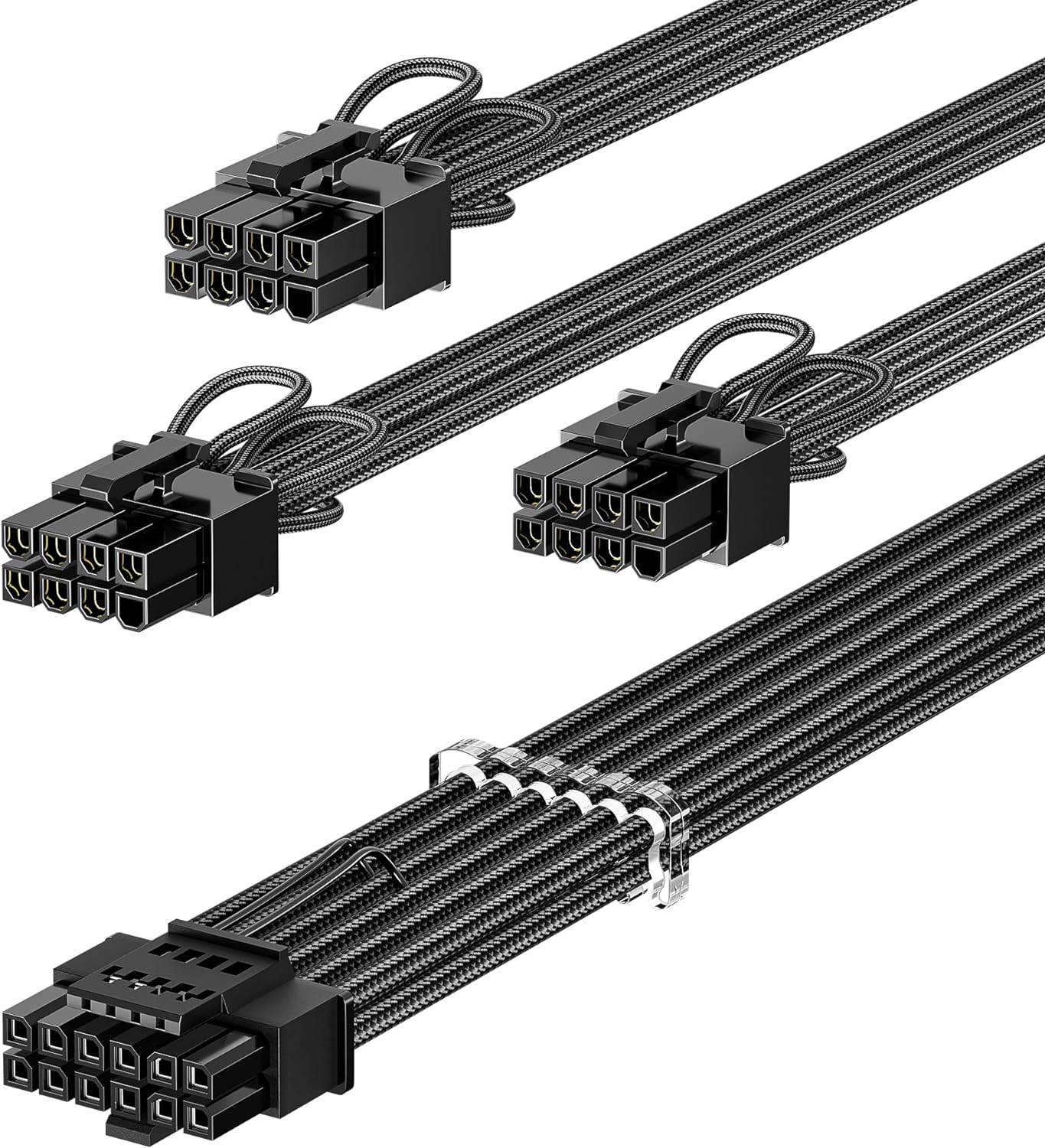
AMD's board-power rating for the RX 9070 XT (304W) sits meaningfully below NVIDIA's rating for the RTX 5080 (360W). In practical terms, that's a smaller gap than a full PSU tier — both cards are comfortably covered by a quality 750W unit in a 9800X3D system, and 850W gives headroom for overclocking or a hot ambient environment. The RTX 5080's higher draw and its 12V-2x6 (12VHPWR-style) power connector do make cable routing slightly more of a consideration, especially in compact cases or vertical-GPU-mount builds where cable bend radius is tight. A sleeved, PCIe 5.0–rated 12VHPWR cable like the Fasgear 600W cable is worth budgeting for rather than relying on a stock adapter bundle in tight cases.
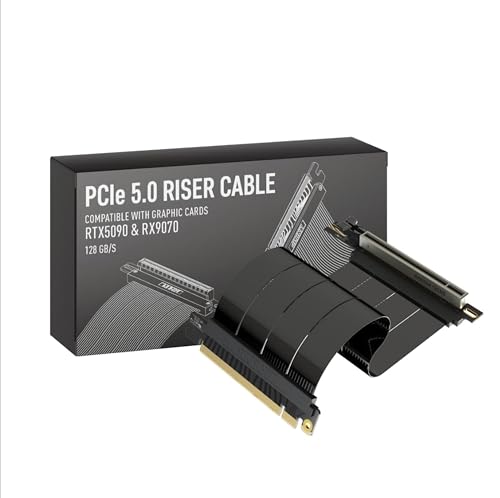
If you're mounting either card vertically for a windowed build, a Cooler Master Vertical GPU Card Holder Kit V3 (also available here) paired with a PCIe 5.0 riser — LINKUP's right-angle riser comes in a few lengths (B0CXJJVR9R, B0CXJKXN29) — avoids the signal-integrity issues that cheaper PCIe 4.0 risers can introduce at PCIe 5.0 speeds.
Value: buying the parts vs. a prebuilt
At current market pricing, the RX 9070 XT's lower launch MSRP compounds with its lower power draw to make it the more budget-friendly half of this matchup, while the RTX 5080 asks a premium in exchange for DLSS 4's broader ray-tracing and frame-generation coverage across more titles. Whether that premium is worth it depends entirely on which games are in your rotation — a title with mature FSR 4 support closes most of the practical gap, while a DLSS-4-only showcase title will favor the 5080.
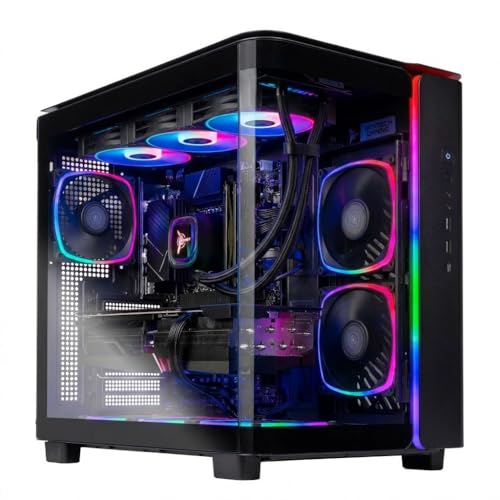
If you'd rather skip individually sourcing a CPU, motherboard, cooler, and GPU, two prebuilts in our catalog already ship with the RX 9070 XT: the Skytech Gaming King 95, pairing a Ryzen 7 7800X3D with the 9070 XT, and the Skytech Gaming Azure 3, which steps up to a Ryzen 7 9850X3D and 32GB of DDR5. Both let you sidestep compatibility questions around cooler clearance, PSU headroom, and case airflow that a DIY 9800X3D + RTX 5080 build has to solve manually.
How this compares to the rest of the GPU stack
If you're still triangulating where these two cards sit relative to the rest of the current lineup, a few related comparisons are worth reading before you commit:
- RTX 5080 vs RTX 4090: Is the Future-Proofing Worth It? — useful if you're weighing a previous-gen flagship against the 5080's newer feature set.
- RTX 5090 vs RX 9070 XT: Specs, Gaming & AI Compared — the ceiling-tier version of this same AMD-vs-NVIDIA question.
- RTX 5080 vs RX 7900 XTX: Which GPU Wins in 2026? — how the 5080 stacks up against AMD's previous-gen flagship rather than RDNA 4.
- Advanced Shader Delivery on the RX 9070 XT — a deeper look at RDNA 4's shader pipeline changes.
- AMD Radeon RX 9070 GRE Review: Thoroughly Midrange — if the 9070 XT is still above budget, the GRE variant sits a tier down.
- RTX 4080M Desktop Build: 100W Gaming vs. RX 9070 GRE — a lower-power comparison point in the same generation.
- AMD Radeon RX 9070 GRE Linux Performance 2026 — relevant if your 9800X3D build is dual-boot or Linux-first.
Bottom line
For a new Ryzen 7 9800X3D build in 2026, the RX 9070 XT and RTX 5080 both make sense — the decision is really about ecosystem and budget rather than raw compatibility. AMD's card draws less power and has historically launched at a lower price, per each brand's own product pages; NVIDIA's card carries a wider ray-tracing and DLSS feature set at a premium. Either way, budget for a proper PCIe 5.0-rated power cable and riser if you're doing a vertical mount, and check current street pricing before assuming either MSRP still holds — both have moved since launch.
Citations and sources
- AMD Radeon RX 9070 XT product page
- NVIDIA GeForce RTX 5080 product page
- AMD Ryzen 7 9800X3D product page
- AMD FidelityFX Super Resolution overview
- NVIDIA DLSS technology overview
This piece is editorial synthesis based on publicly available information. No independent first-party benchmarking is reported.