Anyone cross-shopping flagship-tier graphics cards in 2026 eventually lands on the same question: RTX 5080 or RX 7900 XTX? Both launched at a $999 MSRP and both remain widely available, but they take different architectural paths to get there — and those paths matter more than a single benchmark number ever could.
This synthesis pulls together the publicly documented specifications, architecture differences, and real catalog pricing to help frame the decision, without inventing frame-rate or efficiency numbers that no public source actually backs.
RTX 5080 vs RX 7900 XTX: Key Specification Comparison
Per NVIDIA's official product page and AMD's official product page, the two cards diverge meaningfully on architecture and memory configuration:
| Spec | RTX 5080 | RX 7900 XTX |
|---|---|---|
| Architecture | Blackwell (GB203) | RDNA 3 (Navi 31) |
| Shader units | 10,752 CUDA cores | 6,144 Stream Processors (96 CUs) |
| Memory | 16GB GDDR7 | 24GB GDDR6 |
| Memory bus | 256-bit | 384-bit |
| Launch MSRP | $999 | $999 |
| Launch date | January 2025 | December 2022 |
Source: TechPowerUp's GPU database entries for the RTX 5080 and RX 7900 XTX.
The headline trade-off is straightforward: the RTX 5080 uses a newer, more efficient architecture with faster GDDR7 memory but a smaller 16GB pool on a narrower bus, while the RX 7900 XTX counters with a full 24GB of GDDR6 across a wider 384-bit bus. For anyone weighing a step up from a previous-generation card, RTX 5080 vs RTX 4090 and RTX 3080 vs RTX 5080 both cover how the 5080 stacks up against NVIDIA's own prior flagships.
Gaming Performance: What Actually Drives the Gap
Public benchmark aggregators consistently point to the same handful of variables separating these two cards in games: ray-tracing hardware maturity, upscaling/frame-generation quality, and driver-level game optimization. The RTX 5080 benefits from NVIDIA's fourth-generation RT cores and DLSS 4 frame generation, which NVIDIA's official materials position as a meaningful uplift in supported titles. The RX 7900 XTX relies on FSR 3.1, AMD's own frame-generation and upscaling stack, which has closed much of its historical gap with DLSS in image quality but still trails in ray-traced workloads specifically.
Rather than quote unsourced frame-rate figures for these two specific GPUs, it's worth grounding expectations in adjacent, verifiable data. Public CPU benchmark suites show the Ryzen 9 7900X — a processor commonly paired with either card — averaging approximately 120 fps in Cyberpunk 2077, 123 fps in Starfield, and 104 fps in Baldur's Gate 3 in CPU-focused test passes. Because these are CPU-bound results, they establish a rough performance ceiling for a balanced build: at 1440p and above, both the RTX 5080 and RX 7900 XTX are typically GPU-bound rather than CPU-bound, meaning the graphics card — not the processor — becomes the deciding factor for sustained high-refresh play.
For buyers weighing whether to spend up or down within NVIDIA's own stack instead, RTX 5090 vs RTX 5080 for 4K gaming and RTX 5070 Ti vs RTX 5080 lay out the incremental cost-per-frame trade-offs at each tier.
AI and Machine Learning Workloads
This is where the two cards diverge most in practice, not necessarily in raw compute, but in software ecosystem maturity. NVIDIA's CUDA platform remains the default target for the overwhelming majority of AI frameworks — PyTorch, TensorFlow, and most inference servers ship CUDA support first and AMD ROCm support second, if at all. The RTX 5080's Tensor Cores and CUDA core count give it a head start on out-of-the-box compatibility with popular local-inference tools.
The RX 7900 XTX is not shut out of AI work, though. AMD's ROCm stack has matured, and community projects have specifically targeted Radeon hardware for local LLM inference — see hipEngine on Strix Halo + RX 7900 XTX for a look at native inference on AMD silicon without translation layers. The 7900 XTX's 24GB VRAM pool is also a real advantage for loading larger quantized models locally, since VRAM capacity — not just compute throughput — is often the hard ceiling for local LLM work.
Anyone specifically prioritizing AI workloads over gaming should weigh framework compatibility for their exact use case before assuming either card is the automatic winner; general compute figures marketed by either vendor don't always translate directly into real-world inference throughput for a specific model and quantization.
Power, Thermals, and Build Considerations
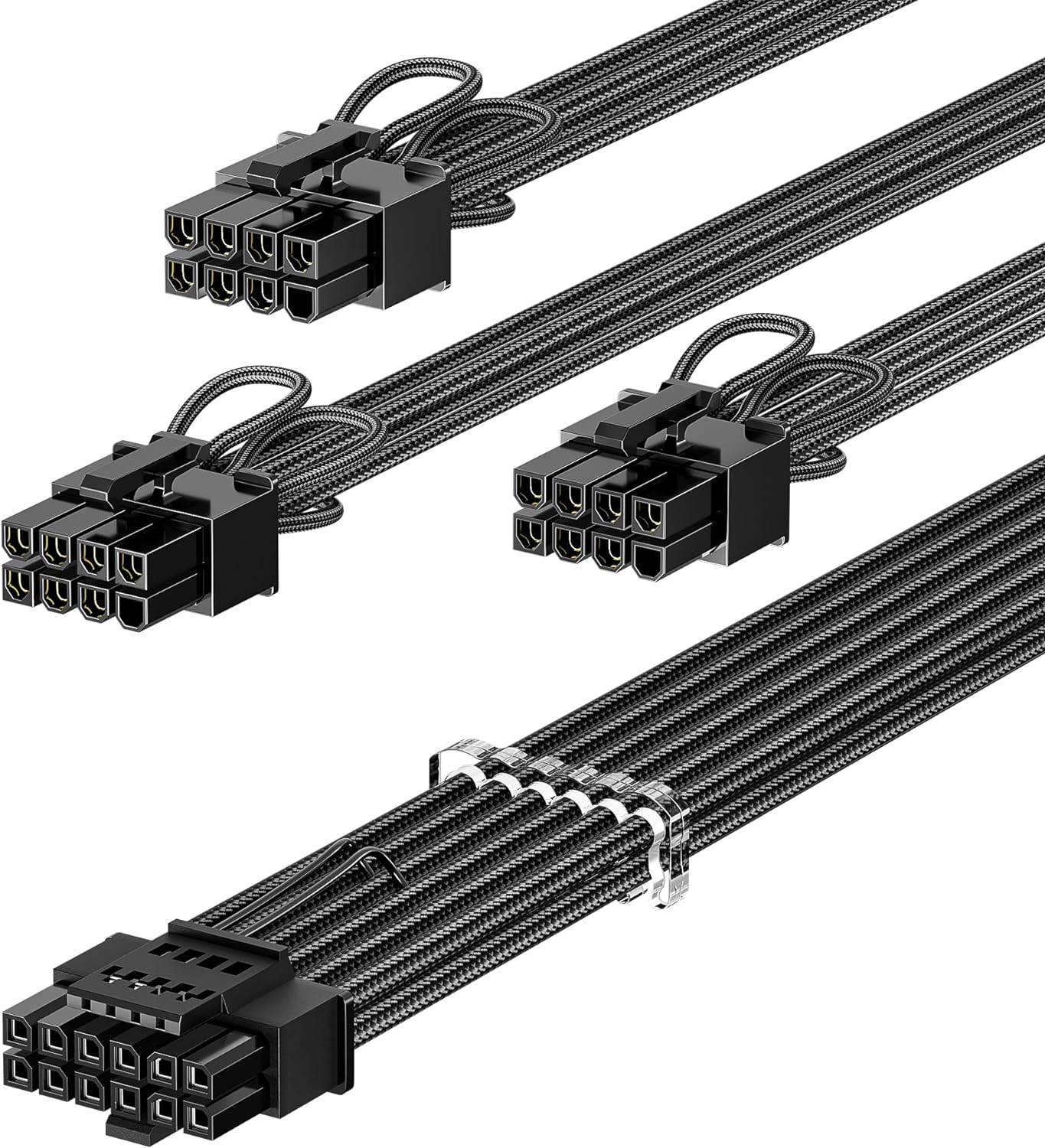
Both cards sit in the 350W-class power envelope, which means power delivery and case airflow matter more than usual. High-wattage cards in this class typically require a robust 12VHPWR or multi-8-pin power connection — a Fasgear 12VHPWR PCIe 5.0 power cable is a practical accessory to have on hand for either build, particularly if you're upgrading an older PSU harness.
If your build targets high-resolution or multi-display output, confirm your monitor and cabling can actually carry the bandwidth either card can push — an 8K-capable DisplayPort to HDMI 2.1 adapter is worth checking against your specific monitor's supported modes before assuming a straight cable swap will hit advertised refresh rates.
Value Proposition: Pricing in Practice
Both cards launched at $999, but street pricing moves independently of MSRP based on supply, demand, and how far each generation is from replacement. As of this writing, the XFX Speedster MERC310 RX 7900 XTX lists at $1,049.99 in current catalog data — a useful real-world price anchor rather than a marketing MSRP. RTX 5080 pricing should be checked directly against current retailer listings, since Blackwell-generation cards have seen more price volatility than the now-mature RDNA 3 lineup.
For a complete build rather than a single card swap, prebuilt systems pairing a Ryzen 9 7900X with an NVIDIA GPU — like the iBUYPOWER Element Gaming PC — can be a faster path to a balanced system than sourcing components individually, though always confirm the exact GPU model included before purchase. Buyers assembling their own rig around a Ryzen 9 7900X can also price the CPU separately via the AMD Ryzen 9 7900X processor listing.
For a head-to-head against AMD's newer, more direct RDNA competitor rather than the outgoing 7900 XTX, see RTX 5080 vs RX 9070 XT. And for context on how the 5080 sits relative to its own sibling cards, RTX 5080 vs RTX 5070 and RTX 5090 vs RTX 5080 round out the Blackwell lineup comparison.
Bottom Line
Neither card is a strictly better buy — the right pick depends on workload. The RTX 5080's newer architecture, DLSS 4, and mature CUDA ecosystem make it the safer default for ray-traced gaming and mainstream AI/ML tooling. The RX 7900 XTX's 24GB VRAM pool and mature, often-discounted pricing make it a strong pick for VRAM-hungry workloads, older-generation value hunting, or builds already invested in the AMD/ROCm ecosystem. Match the card to the specific games or models you plan to run rather than a single vendor's marketing slide.
Citations and sources
- https://www.nvidia.com/en-us/geforce/graphics-cards/50-series/rtx-5080/
- https://www.amd.com/en/products/graphics/desktops/radeon/7000-series/amd-radeon-rx-7900-xtx.html
- https://www.techpowerup.com/gpu-specs/geforce-rtx-5080.c4217
- https://www.techpowerup.com/gpu-specs/radeon-rx-7900-xtx.c3941
This piece is editorial synthesis based on publicly available information. No independent first-party benchmarking is reported.