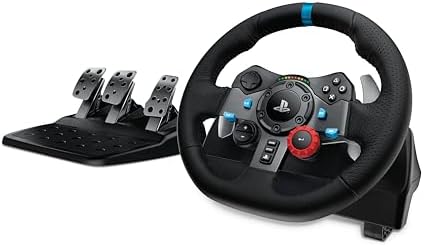
The short answer: buy a wheel that clamps to a normal desk, and spend the first $30 on isolation rather than on more force feedback. The Logitech G29 delivers 900 degrees of rotation through a helical-gear force-feedback drive, per Logitech's own product page — that gearing is what your neighbors hear. A dense pad under the clamp and a closed-cell mat under the pedals fixes more than any in-game slider.
First, diagnose the noise you actually have
There are two completely different noises coming off a desk-mounted sim rig, and they travel to two different places.
Structure-borne vibration is the one your downstairs neighbor hears. Force feedback and pedal impacts push energy into the clamp, the clamp pushes it into the desktop, the desk legs push it into the floor joists, and the ceiling below radiates it as a low thump. This is the complaint that gets a note under your door. It does not care how loud the room sounds to you — a rig can be nearly silent at your ears and still be perfectly audible one floor down.
Airborne gear whine is the one you hear and the one your roommate in the next room hears through a hollow-core door. It is the high-frequency buzz of a gear-driven force-feedback motor reversing direction rapidly — curb strikes, kerb rumble strips, tank-slappers. It sounds dramatic but it dies fast in air and is mostly stopped by a closed door.
Fix them in that order. Almost everyone shopping for a "quiet wheel" is actually shopping for a structure-borne problem, which is a mounting problem, not a wheel problem. A Logitech G29 Racing Wheel and Pedals on a rubber-isolated desk with a matted pedal plate transmits less into the floor than a quieter wheel bolted straight to a flexing particleboard top.
The renter's constraint set
Nearly every sim-racing guide on the internet is written by someone with a garage. The build orders assume an 80/20 aluminium cockpit, a bolted-down direct-drive base, a triple-monitor stand, and a subwoofer under the seat. None of that survives contact with a one-bedroom apartment.
Your constraints look like this. The desk is not yours to modify — no drilling, no bolting, no permanent brackets. The desk is also probably 18 to 25 mm of laminate over particleboard, which means it flexes and rings under load in a way a 40 mm butcher block does not. The floor is thin, and in most buildings from the last thirty years it is a wood-joist assembly with gypsum board below, which is a very efficient transmitter of low-frequency impact. There is somebody sleeping on the other side of at least one wall. And on Monday morning the desk has to be a desk again, which means the whole rig has to break down in under two minutes and fit somewhere that is not the middle of the living room.
That last constraint is the one people underestimate. A rig that takes fifteen minutes to set up gets used twice a month. The apartment build is not a compromise build — it is a build optimized for a different objective function, where teardown time and floor isolation are first-class specs alongside rotation degrees and force-feedback strength.
The good news is that the market for this is better than it looks. A clamp-on wheel, a mat, and a headset get you a genuinely good experience for under $300, and the two upgrades that most people buy next — a shifter and a bigger screen — are the two that matter least in a small room.
Key takeaways
- Isolation beats specs. A $25 closed-cell mat and a rubber clamp pad do more for neighbor peace than a $600 wheel upgrade.
- Pedals are louder than the wheel. Heel-plate thump under braking is an impact event straight into the floor; the wheel is a continuous low-level hum by comparison.
- The G29's 900-degree helical-gear drive is the noisy-but-good option. Real force feedback, audible whine, fully fixable with mounting.
- The HORI Racing Wheel Overdrive is the quiet option — 270 degrees and no force-feedback motor, per HORI's product documentation, which means nothing to whine and nothing to transmit.
- Skip the H-pattern shifter while renting. The metallic gate clack is the single loudest event in the whole rig.
- A wired closed-back headset replaces the subwoofer you cannot have. You lose nothing but bragging rights.
What actually makes a wheel loud
Force feedback is a motor being told to change torque hundreds of times a second. How that torque reaches the wheel rim is the whole story.
Gear-driven designs — the G29 and its siblings — put a helical gear train between motor and shaft. Logitech documents the G29's drive as helical gearing with a dual-motor force-feedback system on its Driving Force product page. Gears multiply torque cheaply, which is why this is the $200 architecture. They also mesh, and meshing teeth under rapidly reversing load produce a characteristic whine. Curb strikes are the worst case: dozens of full-force reversals per second.
Belt-driven designs replace some of the gear train with a toothed belt. The belt absorbs a fraction of the reversal energy and smooths the high-frequency content, so the audible signature is softer and lower. They cost more for the same peak torque.
Direct-drive designs bolt the wheel rim to the motor shaft. There is no gear train to whine at all, so the airborne noise is close to zero. But every newton-metre of torque now goes straight into the mount, and direct-drive bases produce far more torque than a gear wheel does. On a flexing apartment desk, an unisolated direct-drive base can be worse for the downstairs neighbor than a well-mounted gear wheel, because you have removed the airborne noise and doubled the structure-borne energy. Direct drive is a cockpit technology. It is the wrong answer for a clamp.
No force feedback at all — spring-centred wheels like the HORI Overdrive — have no motor to whine and nothing to push into the desk beyond your own steering input. They are dramatically quieter. What you give up is real: you lose the tyre-slip and weight-transfer cues that make a force-feedback wheel worth owning in the first place.
Spec delta: the two wheels worth clamping to a desk
| Wheel | Drive type | Rotation | Mounting | Best for |
|---|---|---|---|---|
| Logitech G29 Racing Wheel and Pedals | Helical gear, dual-motor force feedback | 900° | Integrated clamp, desk-friendly | Renters who want real FFB and will do the isolation work |
| HORI Racing Wheel Overdrive | Spring-centred, no FFB motor | 270° | Integrated clamp, lightweight | Late-night play, thin floors, shared walls, arcade-style titles |
| Thrustmaster TH8A Shifter (add-on) | Mechanical H-pattern / sequential | n/a | Clamp or side-bracket | Manual-gearbox titles only — the loudest single component |
| Turtle Beach Recon 50 (add-on) | Wired 3.5 mm closed-back | n/a | Head | Replacing speaker bass at 11 PM |
| SANSUI 27" 4K Gaming Monitor (add-on) | UHD 160 Hz / FHD 320 Hz dual-mode IPS | n/a | Desk stand or VESA arm | A single-screen setup where a triple rig will not fit |
Is the Logitech G29 too loud for an apartment?
No — but only if you mount it properly, and "properly" means three specific things.
Clamp torque. The supplied clamp needs to be tight enough that the base cannot rock, because a base that rocks converts steering torque into an impact against the desktop on every direction change. Snug it until the base does not move under a firm two-handed tug, then stop. Overtightening a laminate desk dents the top and, worse, pre-loads the desk into a state where it rings more readily.
Desk resonance. This is the variable nobody checks before buying. Put your palm flat on the desktop about 40 cm from the clamp and have someone turn the wheel lock-to-lock against the centring spring. If you can feel the top buzzing, the desktop is acting as a soundboard and every bit of gear whine is being amplified and radiated. The fix is mass and damping: a piece of 18 mm plywood or a thick cutting board between clamp and desktop, plus a dense rubber or sorbothane pad on both faces. This costs under $20 and is the highest-leverage change in the entire build.
Force-feedback level. Dropping in-game FFB strength from 100% to roughly 70% cuts the peak torque the drive has to produce, and peak torque during rapid reversals is exactly what generates whine. You lose some detail on kerbs. For late-night sessions it is a reasonable trade, and unlike the mounting fixes it is a per-session toggle rather than a permanent compromise.
Do all three and the G29 becomes a rig you can run at 10 PM in a wood-frame building. At $199.99 in current catalog pricing it also remains the cheapest way to get 900 degrees and genuine force feedback, and 900 degrees matters more than most beginners expect — it is the difference between steering a car and steering a cursor.
When the HORI Racing Wheel Overdrive is the right call
The HORI Racing Wheel Overdrive exists in a different category and it is important to be honest about that. It is a spring-centred wheel with 270 degrees of rotation and no force-feedback motor, officially licensed for Xbox Series X|S, per HORI's product listing. At $119.99 it is not a cheap G29. It is a different tool.
Buy it when the noise constraint is genuinely binding: a converted attic with an exposed-joist floor, a partner who works nights, a building where you have already had one conversation about noise. With no motor there is no whine, and with 270 degrees and a light centring spring there is very little energy going into the desk at all. You can run it at midnight with the door open.
Buy the G29 instead when you want to actually improve at sim racing. The lower rotation range on the Overdrive means large steering inputs need hand-over-hand movement that the wheel is not designed for, and the absence of force feedback removes the tyre-slip channel that teaches car control. It is excellent for arcade-leaning racers and for players who want a wheel because a wheel is fun. It is a ceiling you will hit inside a season if you are chasing lap times.
Do you need an H-pattern shifter?
Almost certainly not — not while you rent.
The Thrustmaster TH8A Shifter is a genuinely good piece of hardware. Thrustmaster documents it as a switchable H-pattern and sequential unit with PC USB operation on the TH8A product page, it is metal where it counts, and it transforms rally and classic-touring-car titles. At $198.95 it also costs as much as the wheel.
The apartment problem is mechanical and unfixable by settings. An H-pattern gate is a metal knob hitting a metal gate stop. Every gate change is a sharp, broadband impact — the acoustic equivalent of setting a coffee mug down hard, three or four times a lap. Clamped to the same desk as the wheel, it becomes the loudest thing in your apartment by a wide margin, and it is an impact rather than a hum, which means it punches through walls and floors that swallow the wheel entirely.
If you must have one, do not clamp it to the main desk. Mount it to a side bracket attached to a separate weighted surface — a small end table with a paving slab on the shelf works — and put a rubber pad under both the shifter base and the table feet. Decoupling it from the desk stops the gate impact from reaching the desk legs, which are the direct path to the floor.
Pedals are the real neighbor problem
Everyone shops for a quiet wheel. Nobody shops for quiet pedals, and pedals are where the actual complaint comes from.
Braking is an impact event. Your foot decelerates, the pedal bottoms against its stop, and the whole plate takes the load — and unlike the wheel, the pedal plate sits on the floor, with no desk in between to absorb anything. In a wood-joist building that impact is essentially injected straight into the structure. Heel thump is the same story: many players rest and pivot their heel, and every heavy braking zone drops it onto the plate.
The checklist, in order of effectiveness:
- Closed-cell foam or rubber mat under the entire pedal plate, at least 8–10 mm thick. This is the single biggest win. A cheap gym or anti-fatigue mat works; you want something dense that compresses rather than something springy that bounces.
- A rigid board on top of the mat, under the pedals. Without it, the plate sinks unevenly into the foam and the pedals walk forward under braking. Board on foam gives you a floating platform: stable to your feet, decoupled from the floor.
- Carpet is not isolation. Carpet and pad damp airborne noise and do almost nothing for impact transmission. If you are on carpet, still use the mat.
- Stop the plate from sliding. A pedal set that creeps forward under braking gets kicked back into place a dozen times a session, and each of those is another impact. Rubber feet, a non-slip mat, or a strip of hook-and-loop to the board solves it.
- Heel discipline. Learn to brake with the heel off the plate or resting on foam. It is free and it removes an entire class of impact.
What you'll need: desk, clamp, mat, and a stow plan
Before you order anything, measure four things.
Desktop thickness. Clamps on this class of wheel typically want somewhere in the 10–30 mm range. Under-thin means the clamp cannot bite; over-thick means it will not close at all. Measure at the actual clamping point, not at the edge trim.
Clamp clearance. You need unobstructed access along the front edge, above and below. Desks with a front apron rail, a keyboard tray, or a cable-management channel under the lip are the common failure. Measure at least 60 mm of clear depth under the top where the clamp jaw will sit.
Desk depth. A wheel eats 15–20 cm off the front of your usable depth, and your monitor needs to move back by the same amount to keep viewing distance sane. If your desk is 60 cm deep you are going to be looking at a screen from 40 cm, which is too close for a 27-inch panel.
Desk rigidity. Push down hard on the front edge, in the middle. If the top visibly deflects, you have a soundboard, and you need the plywood-and-rubber sandwich described above before you mount anything.
Then plan the teardown before you build. The wheel unclamps in about twenty seconds; the pedals lift off the mat; the mat rolls; cables want to be a single bundled loom with one USB and one power plug so you are not tracing four cords every Monday. A rig that stows into a closet in ninety seconds is a rig you use four nights a week. Route the cables once, with a loop of hook-and-loop tape, and never route them again.
Audio without a subwoofer
The traditional advice for a sim rig is bass — a subwoofer, or a tactile transducer bolted to the seat, feeding you engine and road texture through your body. Both are structure-borne noise generators by design. In an apartment they are non-starters.
A closed-back wired headset replaces most of what you lose. The Turtle Beach Recon 50 is the cheap-and-adequate answer at $27.88 — 40 mm drivers on a plain 3.5 mm analogue connection, which means no wireless link to add latency or jitter. Closed-back matters twice over here: it keeps your audio in, so nobody else hears the race, and it keeps room noise out, so you can run at a genuinely low volume and still hear tyre scrub.
The cues that actually matter in sim racing are mid-frequency, not sub-bass: tyre slip, the change in engine note at the top of the rev range, the scrape of a kerb. Those live in a range a $28 headset reproduces fine. What you lose is the chest-thump of a V8, which is a fun tax rather than a performance one. Take the trade.
Screen and seating geometry in a small room
Triple screens are the sim-racing default and they are the wrong answer here — three panels plus a stand is a permanent installation, which violates the whole premise.
A single 27-inch panel at desk distance covers the same field of view as a smaller screen farther away and gives you back the desk. The SANSUI 27" 4K Gaming Monitor is a reasonable fit at $329.99: a fast IPS panel that runs UHD at 160 Hz or drops to FHD at 320 Hz in dual mode, with height adjustment and rotation on the included stand. The height adjustment is not a luxury in this build — with a wheel clamped to the front edge, your eye line sits lower and farther back than it does for desk work, and a fixed-height stand will put the horizon in the wrong place.
Set geometry like this: eye to screen roughly 70–80 cm, wheel centre roughly 30–35 cm from your chest with a slight elbow bend at the 9-and-3 position, and the screen centre about 10 cm below eye level so the road surface fills the lower half. Then set the in-game field of view to match the real geometry rather than leaving it at the default; a correct FOV is free and does more for immersion and for braking-point consistency than a second monitor would. If you want to read the trade-off in more depth we covered it in Ultrawide vs 27-Inch 4K for Sim Racing on a G29 and RTX 3060.
Performance per dollar: what each $100 buys
First $200 — the wheel and pedals. Non-negotiable. Force feedback and a progressive brake are the two things that change how you drive. Everything else is comfort. The G29 at $199.99 is the whole first tranche.
Next $30 — isolation. Mat, board, rubber clamp pads. This is the best value in the entire build and it is the one everybody skips. It buys you the ability to actually use the rig at the hours you are free.
Next $30 — audio. A wired closed-back headset. Buys you late-night play and better cues than desk speakers at any volume you can legally run.
Next $100 — chair and posture. Unglamorous, and more impactful than any peripheral in this range. A chair that does not let you slide forward under braking removes a whole category of inconsistency.
Next $300 — the screen. Real, but late. A 27-inch 4K panel improves the experience meaningfully and improves your lap times barely at all.
The two upgrades to skip while renting: the H-pattern shifter, for the acoustic reasons above, and any direct-drive base. Direct drive on a clamp is spending $800 to make your downstairs neighbor angrier than a $200 wheel does.
Common pitfalls
Clamping to a desk with a front apron. The clamp cannot reach the top, so people improvise with a shim, the shim slips under load, and the base rocks. Check clearance before ordering.
Buying isolation for the wheel and forgetting the pedals. Extremely common. The wheel gets a rubber pad and the pedals sit bare on a hardwood floor over a downstairs bedroom. The pedals are the loud end.
Turning force feedback to 100% because more must be better. Peak torque is where whine, clipping, and desk resonance all live. Most players run better at 70–80% because the signal stops clipping and they can actually feel detail.
Mounting the shifter to the same desk as the wheel. The gate impact reaches the floor through the desk legs, and it is broadband and sharp. Decouple it or skip it.
Treating carpet as a solution. Carpet handles airborne noise. Impact noise goes straight through it into the subfloor.
Building a rig that takes fifteen minutes to deploy. The stow plan is a spec. If teardown is slow, usage collapses, and an unused rig is the most expensive configuration of all.
Verdict matrix
Get the Logitech G29 Racing Wheel and Pedals if… you want real force feedback and 900 degrees of rotation, you are willing to spend $30 and an afternoon on mounting and isolation, and your building is normal rather than pathologically thin-floored. This is the default recommendation and it is not close.
Get the HORI Racing Wheel Overdrive if… the noise constraint is hard — night shifts on the other side of a wall, an exposed-joist floor, a prior noise complaint — or you mostly play arcade-leaning racers and want a wheel because a wheel is fun. Accept the 270-degree limit and the missing force feedback going in.
Add the Thrustmaster TH8A Shifter only if… you play manual-gearbox titles seriously, you can mount it to a separate weighted surface away from the desk, and nobody sleeps within one wall of the rig. Otherwise the money goes further as isolation plus a chair.
Bottom line — the apartment build under $500
Logitech G29 at $199.99, a closed-cell mat and plywood board with rubber pads at about $30, and a Turtle Beach Recon 50 at $27.88. That is roughly $258 and it is a complete, genuinely quiet, fully stowable sim rig that you can run at 11 PM in a wood-frame apartment without a note under the door.
Spend the remaining budget in this order: a chair that holds you in place under braking, then the SANSUI 27" 4K panel if your current screen is small or fixed-height. Leave the shifter and direct drive for whenever you own the floor.
If you want the broader wheel landscape without the apartment constraint, start with Best Racing Wheels and Controllers for Sim Racing in 2026; if you are still deciding between the two wheels above, Logitech G29 vs HORI Racing Wheel Overdrive goes head-to-head on driving feel rather than noise.
Citations and sources
- Logitech G — Driving Force Racing Wheel (G29) — 900-degree rotation and helical-gear dual-motor force feedback. Accessed 2026-09-02.
- Thrustmaster — TH8A Add-On Shifter — H-pattern and sequential modes, PC USB operation. Accessed 2026-09-02.
- HORI — Racing Wheel Overdrive for Xbox Series X|S — 270-degree rotation, officially licensed, no force-feedback motor. Accessed 2026-09-02.
Specifications are drawn from the manufacturer pages above and from current catalog pricing as of 2026-09-02. Noise behaviour described here is editorial synthesis of published drive-system documentation and standard building-acoustics practice, not first-party laboratory measurement.
Related guides
- Best Racing Wheels and Controllers for Sim Racing in 2026
- Logitech G29 vs HORI Racing Wheel Overdrive: Which Entry Sim Wheel Wins?
- Best Quiet PC Upgrades for Apartment Gaming in 2026
- Ultrawide vs 27-Inch 4K for Sim Racing on a G29 and RTX 3060
- Turtle Beach Recon 50 in 2026: Is the $40 Gaming Headset Still Worth It?