
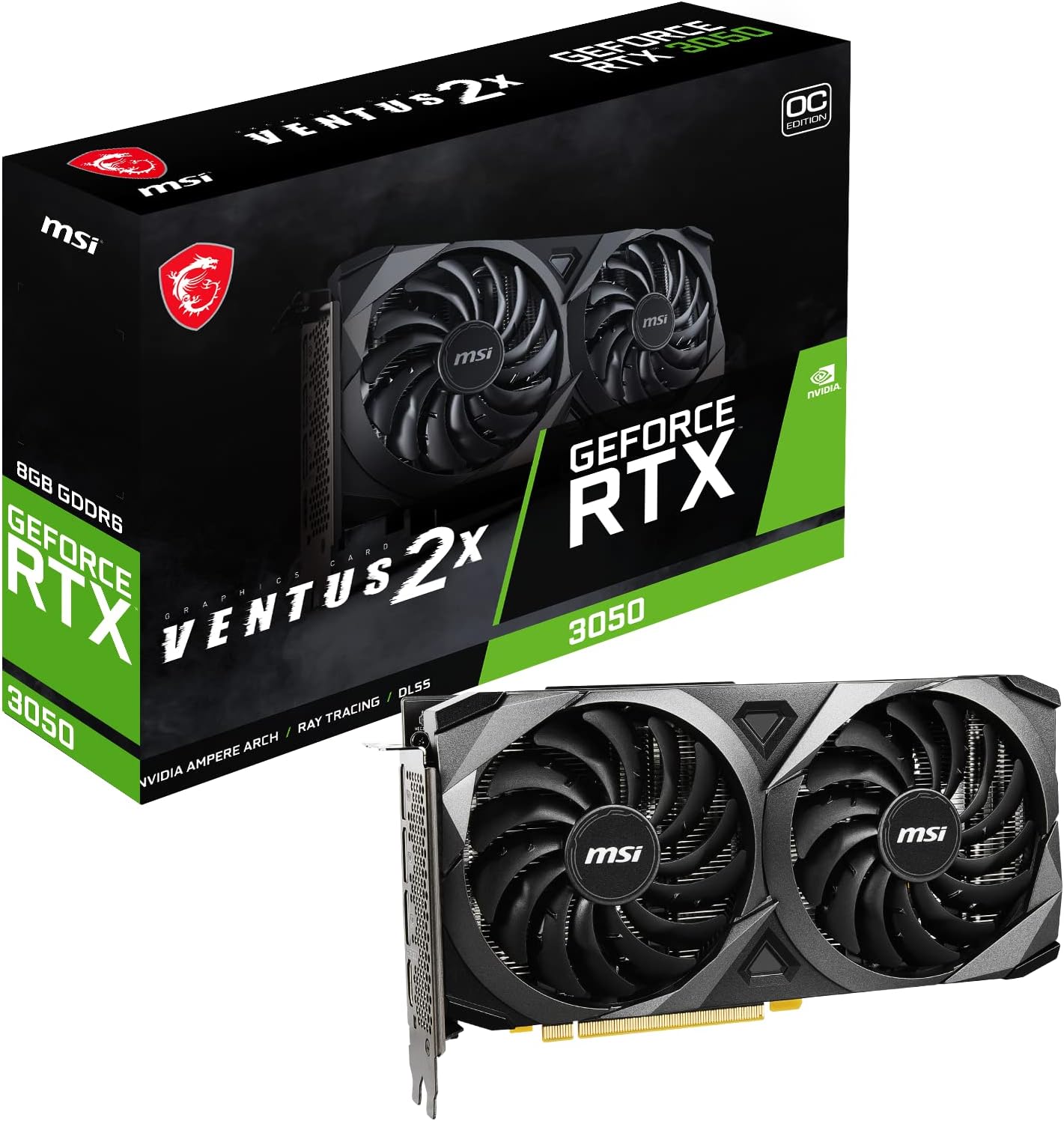
MSI Gaming GeForce RTX 3050 8GB GDRR6 Boost Clock: 1807 MHz 128-Bit HDMI/DP PCIe 4 Torx Twin Fans Ampere OC Graphics Card (RTX 3050 Ventus 2X 8G OC)
Bottom line: The MSI Gaming GeForce RTX 3050 8GB GDRR6 Boost Clock: 1807 MHz 128-Bit ($482.65 on Amazon as of 2026-11-20 23:24 UTC): Factory OC boost clock of 1807 MHz out of the box, no manual tuning needed; main trade-off: 128-bit memory interface limits bandwidth versus wider 192-bit and 256-bit cards.
As an Amazon Associate, SpecPicks earns from qualifying purchases. Full disclosure →
*Price sourced from Amazon.com. Last updated 2026-11-20. Product prices and availability are accurate as of the date/time indicated and are subject to change. Any price and availability information displayed on Amazon.com at the time of purchase will apply to the purchase of this product.
Pros & Cons
Pros
- ✓ Factory OC boost clock of 1807 MHz out of the box, no manual tuning needed
- ✓ 8GB GDDR6 beats the 6GB RTX 3050 variants for texture headroom at 1080p
- ✓ Dedicated RT and Tensor Cores enable ray tracing plus DLSS on an entry card
- ✓ Four display outputs: 3x DisplayPort 1.4a and 1x HDMI 2.1 for multi-monitor setups
Cons
- ✗ 128-bit memory interface limits bandwidth versus wider 192-bit and 256-bit cards
- ✗ Entry-tier Ampere silicon, so 1440p and 4K gaming are out of its comfort zone
- ✗ Ray tracing on a 3050 usually requires DLSS enabled to stay playable
- ✗ Torx Twin Fan dual-slot design is not the most compact option for small ITX cases
Manufacturer description
The MSI GeForce RTX 3050 Ventus 2X 8G OC brings NVIDIA's 2nd-generation Ampere RTX architecture to the entry-level 1080p tier, pairing 8GB of GDDR6 memory on a 128-bit interface with a factory boost clock of 1807 MHz. Because it is a real RTX part, you get dedicated Ray Tracing Cores and Tensor Cores, which means DLSS is on the table when you want ray tracing without giving up playable frame rates. Display connectivity is generous for the class, with three DisplayPort 1.4a outputs plus one HDMI 2.1 port, and support for digital resolutions up to 7680 x 4320. The PCIe 4.0 interface keeps it…
SpecPicks Verdict
SpecPicks has no buyer-rating or benchmark data for MSI Gaming GeForce RTX 3050 8GB GDRR6 Boost Clock: 1807 MHz 128-Bit…, so this read rests on the manufacturer's listed specs and the current price in the graphics cards category (how we evaluate). Compare with similarly-priced alternatives in the graphics cards category before committing. On the listing's own facts, the case for it is "Factory OC boost clock of 1807 MHz out of the box, no manual tuning needed"; the main trade-off is "128-bit memory interface limits bandwidth versus wider 192-bit and 256-bit cards". If those two points fit how you will use it, put it beside one or two close alternatives in the Compare tool to confirm the price.
Common buyer scenarios for graphics cards of this kind: matching it to an existing build, replacing a failing part, or upgrading from a previous-generation equivalent. Check the spec table below against your current setup — particularly socket / form-factor / power-rating fields — and confirm compatibility on the retailer's listing before purchase. Prices and stock are set by the retailer and may have moved since this page was last updated.
Key Features
Quoted from the manufacturer's listing. Where it differs from the pros and cons above, those note the conditions the listing leaves out.
- Chipset: GeForce RTX 3050
- Video Memory: 8GB GDDR6
- Memory Interface: 128-bit
- Output: DisplayPort x 3 (v1.4a) / HDMI 2.1 x 1.Avoid using unofficial software
- Digital maximum resolution: 7680 x 4320
Full Specifications
| Brand | msi |
|---|---|
| Output | DisplayPort x 3 (v1.4a) / HDMI 2.1 x 1.Avoid using unofficial software |
| Weight | 8g |
| Chipset | GeForce RTX 3050 |
| Model Name | VENTUS 2X |
| Model Number | GeForce RTX 3050 VENTUS 2X 8G OC |
| Video Memory | 8GB GDDR6 |
| Built-In Media | Graphics card; quick setup guide |
| Item Type Name | Graphic Card |
| GPU Clock Speed | 1807 GHz |
| Mfr Part Number | G3050V2X8C |
| Video Processor | NVIDIA |
| Antenna Location | Gaming |
| Memory Interface | 128-bit |
| Graphics Card Ram | 8 GB |
| Graphics Ram Size | 8 GB |
| Graphics Ram Type | GDDR6 |
| Compatible Devices | Desktop |
| Memory Clock Speed | 1780.0 |
| Graphics Coprocessor | NVIDIA GeForce RTX 3050 |
Benchmark data for other graphics cards
Ready to buy?
MSI Gaming GeForce RTX 3050 8GB GDRR6 Boost Clock: 1807 MHz 128-Bit HDMI/DP PCIe 4 Torx Twin Fans Ampere OC Graphics Card (RTX 3050 Ventus 2X 8G OC) is listed on Amazon. Price, availability, shipping and returns are set by Amazon and its sellers — check the listing for current terms. SpecPicks earns a small commission on qualifying purchases — thank you for supporting independent review work.
*Price sourced from Amazon.com. Last updated 2026-11-20. Product prices and availability are accurate as of the date/time indicated and are subject to change. Any price and availability information displayed on Amazon.com at the time of purchase will apply to the purchase of this product.
Related Graphics Cards


More guides & deep dives from the SpecPicks archive
Browse all articles & guides →- The Complete Voodoo5 5500 AGP Driver Guide (2026 Edition)
- How to Build a Windows 98 Retro PC in 2026
- Best Budget Gaming PC Build 2026 — ~$1,000 Parts List
- RTX 4070 Super vs RX 7800 XT — Which to Buy in 2026
- Best Retro Handhelds in 2026: Pocket, Mid-Tier and FPGA Picks
- Emulation Hardware in 2026: FPGA, Software, and Cart-Reader Ecosystems
- Best 1440p Gaming GPUs in 2026
More reviews from the SpecPicks archive
Browse all reviews →- Best Retro Gaming Storage Adapters for Win98 and DOS PCs in 2026
- LEGO Batman: Legacy of the Dark Knight Steam Deck FPS
- ExLlamaV2 vs llama.cpp for Single-User Chat on an RTX 3060 12GB in 2026
- Best Budget GPU for CNN and Image-Model Training in 2026: The RTX 3060 12GB Deep Dive
- Best 1440p Monitor for the RTX 3060 12GB (2026)
- 2026 Homelab Stack: OPNsense + Proxmox + TrueNAS + 10GbE
- Best Budget GPU for Local LLM Inference Under $400 (2026)
- AMD Ryzen AI Max 400 'Gorgon Halo': What 192GB of Unified Memory Unlocks for Local AI
- Ryzen 7 5800X + RTX 5060 Combo Drops to $439 with a Free Cooler
- Ryzen 7 5800X vs 5700X for Gaming: Is the $60 Gap Worth It?
- OpenAI Codex Now Repeats a Task After Watching Once — Local Agentic Alternatives
- Add AI Vision to a Raspberry Pi 4 8GB with an AI Accelerator (2026)
- Started a Homelab Last Month — Is the Ryzen 5 5600G Build Right?
- Period-Correct LAN Party Build: 2002 Pentium 4 + GeForce 4 Ti + Sound Blaster Live
- Forza Horizon 6 PC Benchmarks: What GPU Hits 60 FPS at 1440p?
- Best Retro-PC Storage & Drive-Imaging Kit in 2026: 5 Picks
- Motherboard Sales Fell 33% in 2026: Is DIY PC Building Dying?
- Claude Fable 5 Tops the Intelligence Index: What Frontier Cloud AI Means for Local Rig Builders
- Local AI on a Raspberry Pi in 2026: What Actually Runs (and What Doesn't)
- NVIDIA's AI Servers Run on Hot Tub Coolant — No Evaporators Neede
- Best Controllers for Steam Deck and PC in 2026
- vLLM vs Ollama for a Single-User 12GB Rig in 2026
- How to run Llama 3.1 70B on AMD Radeon RX 7900 XTX
- Best CPU Cooler for AM4 Ryzen 7 5800X Overclocking Under $100 in 2026
Earliest SpecPicks reviews
Browse full archive →- Best GPU for Llama 3.1 8B (2026)
- Best GPU for Qwen 3 14B (2026)
- Best GPU for Qwen 3 32B (2026)
- Best GPU for Llama 3.1 70B (2026)
- Best GPU for DeepSeek-R1 32B (2026)
- Best GPU for Llama 3.1 405B (2026)
- How to run Llama 3.1 8B on NVIDIA GeForce RTX 5090
- How to run Qwen 3 14B on NVIDIA GeForce RTX 5090
- How to run Qwen 3 32B on NVIDIA GeForce RTX 5090
- How to run Llama 3.1 70B on NVIDIA GeForce RTX 5090
- How to run DeepSeek-R1 32B on NVIDIA GeForce RTX 5090
- How to run Llama 3.1 8B on NVIDIA GeForce RTX 4090