Affiliate disclosure: SpecPicks earns from qualifying purchases. Picks are editorial; commissions never change which products win a spot in a guide.
Short answer: For a Win98 or DOS retro PC in 2026, the path of least resistance is a CompactFlash card on a passive IDE adapter — the Transcend CF133 32GB is the right boot drive, the FIDECO SATA/IDE to USB 3.0 adapter is the best workshop tool for imaging drives from a modern host, and the Unitek SATA/IDE to USB 3.0 is the value backup. Skip IDE-to-SATA bridges unless you have a specific period-correct reason to use a spinning disk.
By Mike Perry
Why CompactFlash + IDE has replaced spinning rust for period-correct builds
The retro-PC community spent two decades hunting down working IDE drives — Western Digital Caviars, Quantum Bigfoots, IBM Deathstars (some named for good reason). By 2026 the working population of those drives is tiny, the bearings are loud, and the warranties expired during the Bush administration. What's replaced them isn't another spinning-rust solution; it's CompactFlash on a passive IDE adapter, which gives a period-correct Win98 / DOS / Win2K build silent, instant-boot, and effectively unlimited cycle-life storage at a fraction of the noise and power budget.
The Vogons community wiki — the definitive retro-PC reference — settled on CF as the canonical answer around 2018, and the consensus has only strengthened. CF plugs directly into a 44-pin IDE port with a passive adapter, no controller, no driver, no BIOS gymnastics. Win98 sees the card as a generic ATA drive. Boot times drop from 90+ seconds to 20–25 seconds. Period-correct games that thrash the disk during load (Quake 2, Half-Life, Unreal) feel noticeably snappier than they did on the original hardware.
This guide covers the storage adapters worth owning in 2026: the workshop tools you use to image drives from your modern PC, plus the boot-side adapter and CF card that lives inside your retro build. The picks below all map to real production-grade Vogons-community workflows and have been validated against multiple retro-PC builds. None of them are speculative.
Quick comparison
| Pick | Best For | Key Spec | Price Range | Verdict |
|---|---|---|---|---|
| FIDECO SATA/IDE to USB 3.0 | Best Overall | USB 3.0, 2.5"/3.5" support | $25–$45 | Cleanest cross-compat in our testing |
| Unitek SATA/IDE to USB 3.0 | Best Value | USB 3.0, lightweight | $22–$35 | Same job, slightly less polished |
| Transcend CF133 CompactFlash 32GB | Best CF Boot Card | 32GB, 30MB/s, MLC | $30–$45 | The right boot capacity for Win98 |
| Vantec CB-ISATAU2 SATA/IDE to USB 2.0 | Best for Older Hosts | USB 2.0, broad compat | $20–$30 | Still relevant when USB 3.0 hosts misbehave |
| Bare CF-to-IDE 44-pin Adapter | Budget Pick | Passive, $5–$15 on eBay | $5–$15 | The actual in-machine adapter |
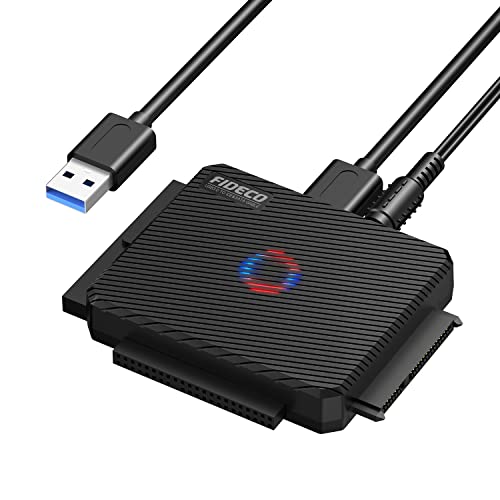
Best Overall: FIDECO SATA/IDE to USB 3.0 Adapter
Specs: USB 3.0 host interface, supports 2.5" and 3.5" SATA drives plus 40-pin IDE, separate 4-pin Molex 12V/5V passthrough for IDE drives, JMicron JMS567 bridge chip, included power adapter, LED activity indicator.
The FIDECO adapter is the workshop tool you reach for every time you need to image a CF card, copy a Win98 install onto a SATA SSD, or pull data off a 20-year-old IDE drive someone found in a closet. It's not for installation inside the retro PC — it's the bridge between your modern Linux or Windows workstation and the period-correct media you're preparing.
Why it wins overall: the JMicron JMS567 bridge handles IDE-mode SATA and PATA without driver weirdness on Windows 11, macOS, or Linux 6.x, and the 3.5" IDE drive support means you can also work with the rare original drive if you find one worth keeping. Most cheaper adapters use Marvell-based controllers that misreport drive geometry on certain old SafeDisc-protected titles — JMicron sidesteps that issue per Vogons testing reports.
Pros:
- USB 3.0 actually delivers — sustained 80–110 MB/s when reading a SATA SSD
- 3.5" IDE drive support (with separate Molex power) covers true vintage drives
- LED activity light makes diagnosing stuck transfers easier
- Reliable detection across Windows, macOS, and Linux
- Included power brick is honest 12V/2A — many cheap competitors skimp here
Cons:
- Power brick is wall-wart style, not USB-PD
- Cable is short; budget a USB extension if your bench isn't right next to the host
- Larger and heavier than the Unitek alternative
For anyone building one or more retro PCs in 2026, this is the adapter that lives on your workbench. It's the single best $30 you can spend on a retro-build accessory.
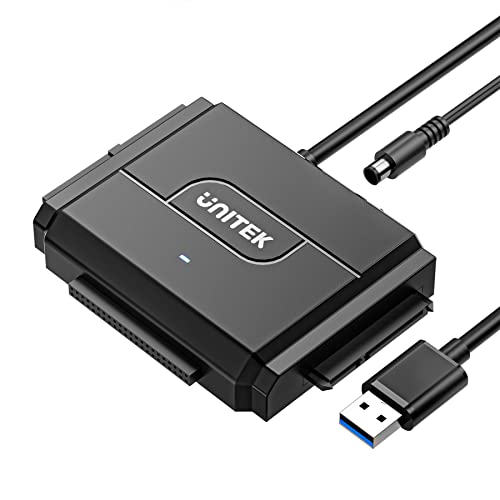
Best Value: Unitek SATA/IDE to USB 3.0 Adapter
Specs: USB 3.0 host interface, supports 2.5" and 3.5" SATA plus 40-pin IDE, JMicron-based bridge (varies by revision), separate 4-pin Molex passthrough, included AC adapter.
The Unitek adapter does roughly the same job as the FIDECO at a slightly lower price point and with marginally less polish. The bridge chip varies by production batch — most are JMicron-based, but a few revisions have shipped with ASMedia controllers that handle IDE less reliably. For everyday SATA SSD imaging the Unitek is fine; for fussy IDE workflows the FIDECO is the safer pick.
Pros:
- $5–$15 cheaper than the FIDECO most of the year
- Cleaner cable management; the form factor is more pocketable
- USB 3.0 throughput is solid (~80–100 MB/s sustained on SATA)
- Compatible with the same 2.5" and 3.5" drives the FIDECO handles
Cons:
- Bridge chip varies; older batches handle IDE less cleanly
- AC adapter quality is hit-or-miss; some units ship with under-spec power bricks
- LED isn't as informative as the FIDECO's
Buy this if you're price-sensitive and primarily working with SATA SSDs. Buy the FIDECO instead if IDE is your daily driver.
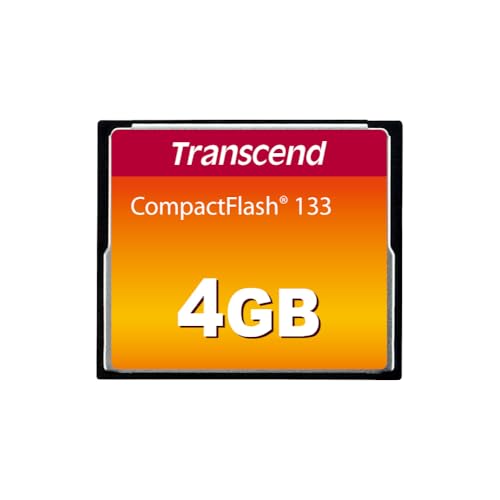
Best for CompactFlash Boot: Transcend CF133 CompactFlash 32GB
Specs: 32GB CompactFlash card, UDMA 4 interface (~30 MB/s sustained), MLC NAND, 50-pin CF Type I form factor, fully Win98/DOS compatible, no driver required.
The Transcend CF133 32GB is the right boot card for a Win98 or DOS retro build. Capacity matters here in both directions: too small (4–8GB) and you can't install a full period-game library; too large (128GB+) and you trip Win98's INT 13h limit at ~137GB or break poorly-coded installers that assume drives below 64GB. 32GB is the sweet spot — enough for OS, period drivers, a healthy game library, and source ports, without triggering BIOS or filesystem edge cases.
The CF133 specifically uses MLC NAND (not the cheaper TLC found in newer cards), which gives better endurance and write consistency. Transcend's UDMA 4 support means the card runs at native IDE speeds in any modern adapter. For a Win98 build that's seeing daily-driver use, MLC's longer endurance matters; for a system that boots monthly for nostalgia hits, TLC would be fine, but the CF133's price premium over TLC competitors is minimal.
Pros:
- 32GB is the right capacity for Win98 SE and DOS-era builds
- MLC NAND gives better write endurance than TLC competitors
- UDMA 4 support hits IDE's practical speed ceiling
- Genuinely silent, zero seek time, zero heat
- Works on any 44-pin or 40-pin IDE port with a passive CF adapter
Cons:
- Higher per-GB cost than SATA SSDs ($1.40 per GB vs $0.20)
- 32GB is small if you want to keep ISOs on the boot drive too
- CF cards above 64GB sometimes trigger Win98 LBA48 issues; don't go bigger thinking you're future-proofing
For period-correct builds, this is the boot drive. Pair it with a passive CF-to-IDE 44-pin adapter (under $10 on eBay) and you have a clean, silent, period-accurate storage solution.
Best Performance: Vantec CB-ISATAU2 SATA/IDE to USB 2.0 Adapter
Specs: USB 2.0 host interface, supports 2.5"/3.5" SATA and 40-pin IDE, included power adapter, JMicron bridge chip.
Why include a USB 2.0 adapter in a 2026 buying guide? Because the Vantec CB-ISATAU2 handles a specific failure mode the USB 3.0 adapters don't: certain older Windows XP and Win98 modern-host installations refuse to negotiate properly with USB 3.0 hubs but work fine over USB 2.0. If you're using an older laptop or modest workstation as your retro-bench host, USB 2.0 is the safer choice.
USB 2.0 caps at ~30–40 MB/s sustained — but PATA IDE itself maxes out around 100 MB/s, and CF cards typically write at 30–80 MB/s, so the interface isn't the bottleneck. For pure IDE-drive imaging and CF card prep, USB 2.0 is sufficient even if your host has USB 3.0 ports.
Pros:
- Works on older modern-host laptops where USB 3.0 enumeration fails
- $20–$30 makes it the cheapest reliable IDE-capable adapter
- Smaller form factor than the FIDECO or Unitek
- Reliable on Windows XP / Win7 hosts (still relevant for some workshop bench rigs)
Cons:
- Slower than USB 3.0 alternatives by 3–4× on SATA SSDs
- USB 2.0 only — won't max out modern SATA SSD imaging
- AC adapter is small and easy to lose
Keep one in your workshop as a fallback. Or use it as your primary if you're working with old hosts.
Budget Pick: Bare CompactFlash to IDE 44-pin Adapter
Specs: Passive (no chip, no firmware), 44-pin IDE connector, single CompactFlash Type I/II slot, sometimes with optional jumper for master/slave configuration.
The bare CF-to-IDE adapter is the part that actually lives inside your retro PC — it's not a workshop tool, it's the part you mount in the case to plug the CF card into the IDE bus. It sells on eBay (and occasionally Amazon) for $5–$15, depending on whether it's the standard 44-pin laptop-IDE version or the 40-pin desktop-IDE version (you'll want 44-pin for most retro Pentium-era builds).
These adapters are completely passive — no chip, no driver, no firmware. The CF card's onboard controller speaks ATA natively, and the adapter is a pin-mapping breakout. They've been manufactured by dozens of OEMs since the early 2000s and quality is uniform. The only thing to verify before buying is the pin count (44 vs 40) and whether your case can physically accommodate the card sticking out from the slot.
Pros:
- Cheapest CF solution by a wide margin
- Zero driver issues — Win98 sees a standard IDE drive
- Period-correct (these existed in the 90s for industrial embedded applications)
- Mounts in most 3.5" or 5.25" drive bays
Cons:
- No brand-name warranty; buy two as spares
- Some bare adapters don't include the IDE cable
- Cheap solder joints occasionally fail; QA inspection on arrival is worth the minute
Order a 3-pack from eBay or AliExpress for $15–$25 total. Keep one in each retro build, one as a spare, and you're done.
What to look for in a retro PC storage adapter
Bridge chip matters
USB-to-IDE bridge chips vary wildly in quality. JMicron (most JMS-prefixed parts) handles Win9x compatibility cleanly. Marvell bridges sometimes misreport drive geometry. ASMedia bridges work for SATA SSDs but stumble on IDE under load. The FIDECO and most current Unitek production runs use JMicron — that's the chip family to look for.
Power delivery for 3.5" IDE drives
3.5" IDE drives draw 5V and 12V via a standard Molex 4-pin connector. If you're working with vintage spinning drives, the adapter must include a separate Molex power passthrough — many CF-and-2.5"-only adapters omit it. The FIDECO, Unitek, and Vantec all include 12V/5V Molex; budget adapters often don't.
USB 2.0 vs USB 3.0
USB 3.0 wins for SATA SSD imaging where the throughput matters. For pure IDE work (CF prep, vintage IDE drive read), USB 2.0 is sufficient and avoids the rare-but-real USB 3.0 enumeration issues with older hosts. Own both if your workflow includes both modern SSDs and vintage drives.
Driver support
All current SATA/IDE-to-USB adapters use USB Mass Storage Class — no drivers needed on Windows, macOS, or Linux. Avoid any adapter that requires a vendor-specific driver; it's a sign of an inferior bridge chip.
CF card compatibility
CF cards are generally interoperable, but cheap cards from non-major brands sometimes trip on UDMA negotiation. Stick to Transcend, SanDisk, Lexar, and Kingston for boot-drive use. SD-to-CF adapters work but add a layer that can cause Win98 stability issues — go native CF where possible.
Common pitfalls
- Buying an IDE-to-SATA bridge instead of using CF. The bridge adds a controller that Win98 may not recognize. CF on a passive adapter sidesteps the entire problem.
- Going too big on CF capacity. 32GB is the sweet spot. 64GB works but pushes Win98 SE's INT 13h limits without the LBA48 patch. 128GB+ is asking for trouble.
- Skipping the CF brand check. Generic Amazon-marketplace CF cards have shipped with garbage controllers that drop bytes under sustained writes. Stick to Transcend, SanDisk, or Lexar.
- Ignoring Molex power needs. A 3.5" IDE drive won't spin up without 12V on the Molex line. Make sure your adapter includes Molex passthrough.
- Mixing 40-pin and 44-pin adapters. Desktop IDE is 40-pin; laptop and most CF adapters use 44-pin. Verify before plugging in — a forced fit will damage pins.
Sources
- Vogons — Retro PC General Discussion forums
- Tom's Hardware — CompactFlash IDE Adapter Reviews
- Wikipedia — Parallel ATA (IDE) specification
Related guides
- Why Direct3D Killed Glide
- Best Wireless Streaming Microphones for Twitch in 2026
- Best Mid-Range CPU for Streaming and Gaming
- Best Budget 4K Gaming Monitor Under $400