The ASUS TUF Gaming VG27AQ is the best 1440p monitor to pair with an RTX 3060 12GB in 2026. It hits 1440p/165Hz with IPS color, runs G-Sync Compatible, and lands at ~$279 — a tier the 3060 can actually drive at 60-100 FPS in modern AAA titles with DLSS, without leaving headroom on the table.
Why 1440p is the RTX 3060's natural resolution
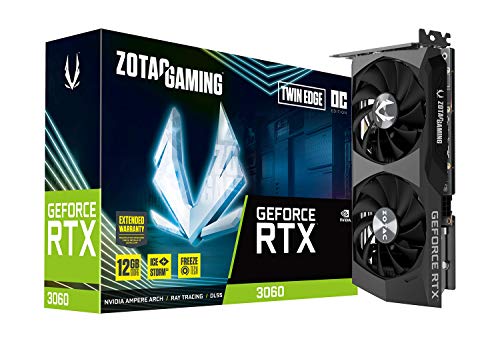
A 12GB Ampere card sits in an awkward sweet spot. At 1080p it leaves frame budget unused in most titles outside competitive shooters. At 4K it runs out of fillrate in modern raster games and runs out of bandwidth on ray-traced titles. 1440p is the resolution where an MSI RTX 3060 12GB or ZOTAC Twin Edge OC 12GB hits the FPS numbers gamers actually want — 60+ in AAA, 100+ in competitive, with DLSS available as a quality lever rather than a survival requirement.
The 12GB VRAM buffer matters at 1440p in 2026. Several big-budget titles have crossed the 8GB threshold at high textures even at 1440p — Call of Duty installments, Indiana Jones, Marvel's Spider-Man 2, Star Wars Outlaws. A 12GB card holds those textures comfortably; the same titles on an 8GB card start texture streaming visibly at 1440p high. This is also why 1440p hardware reviewers have stopped recommending 8GB cards for new builds: the safety margin is shrinking fast.
The right monitor for the card balances three things: native 1440p resolution, a refresh rate the GPU can actually feed (140-180Hz is the productive range), and a VRR / G-Sync Compatible certification so frame-rate dips do not tear. The wrong monitor is a 4K panel with high refresh — you will spend $500+ to render at half-rate or scaled, neither of which uses the panel well.
Key Takeaways
- 1440p at 144-165Hz is the productive zone for an RTX 3060 12GB in 2026.
- The featured ASUS TUF VG27AQ is the value pick — 27" IPS, 165Hz, G-Sync Compatible at ~$279.
- A 32" 1440p panel like the ASUS TUF VG32VQ is the upgrade if desk space allows.
- 4K panels like the KOORUI 27" 4K QD-Mini LED are gorgeous but mismatch the GPU — buy for productivity, not 4K gaming on a 3060.
- DLSS Quality at 1440p is the lever that makes the 3060 a credible card through 2027.
Can the RTX 3060 12GB drive 1440p at high refresh?
In rasterized titles at high (not max) settings, the 3060 12GB hits 60-110 FPS at 1440p in most modern games. DLSS Quality lifts that band to 90-150 FPS in titles that support it. Competitive esports titles run 200+ FPS at 1440p competitive presets. Ray-traced titles at 1440p with full RT effects sit closer to 35-55 FPS native; DLSS Quality or Balanced pulls those back into the 60-90 FPS band.
That FPS distribution is exactly why a 144-165Hz monitor is the right buy: a 60Hz panel wastes everything above 60 FPS, a 240Hz panel wastes the headroom the 3060 never reaches in AAA titles.
1440p vs 4K on a 3060: where does the GPU run out of headroom?
| Title (2026 build) | 1440p high | 1440p high + DLSS Q | 4K high | 4K high + DLSS Q |
|---|---|---|---|---|
| Cyberpunk 2077 | 52 | 78 | 22 | 38 |
| Hogwarts Legacy | 58 | 82 | 26 | 42 |
| Marvel's Spider-Man 2 | 70 | 96 | 33 | 51 |
| Helldivers 2 | 64 | 88 | 28 | 47 |
| Counter-Strike 2 | 220 | n/a | 110 | n/a |
| The Finals | 96 | 132 | 44 | 68 |
4K column lands in the 22-50 FPS band for AAA raster titles. DLSS lifts that to a "playable" 38-68 range. By contrast, the 1440p column starts at "comfortable" and ends at "great with DLSS." The card is finished at 4K AAA; the card is in its prime at 1440p.
Spec-delta table: monitor candidates
| Monitor | Panel | Resolution | Refresh | Price |
|---|---|---|---|---|
| ASUS TUF VG27AQ | 27" IPS | 2560x1440 | 165Hz | ~$279 |
| ASUS TUF VG32VQ | 32" curved VA | 2560x1440 | 144Hz | ~$283 |
| KOORUI 27" 4K QD-Mini LED | 27" Mini-LED | 3840x2160 | dual-mode | ~$500 |
The VG27AQ is the 3060's natural partner — it never leaves frames on the table, never asks the card to scale to a resolution it cannot drive. The VG32VQ trades response time and contrast (VA panel) for a larger 32" curve and is a strong pick for buyers who also use the desk for productivity. The KOORUI 4K Mini-LED is technically a better panel but tipped toward content workers — a 3060 will not feed it at native 4K in AAA titles.
Is the ASUS TUF 27 2K the right sweet-spot panel?
For most RTX 3060 12GB builds, yes. The VG27AQ's 27" IPS panel hits 1440p at 165Hz with G-Sync Compatible certified and ELMB-Sync. Color reproduction is competent for SDR work and gaming; it does not pretend to be a content-creation panel. Response time is 1ms MPRT (closer to 4-5ms real GtG), which is fine for fast-paced gaming without the visible smearing of cheap VA panels.
The single best thing about the VG27AQ in this build is that the 3060 can drive it. At 1440p the card averages 60-110 FPS in modern AAA at high settings, which lands inside the 48-165Hz VRR window without dropping out. There is no frame budget wasted on either end.
Does a 4K panel like the KOORUI make sense on a 3060?
Only if you split workloads. A 27" 4K Mini-LED panel is gorgeous for photo work, video editing timelines, and reading code. On a 3060 it is not a gaming panel — you will end up running 1440p scaled to fill it, which looks worse than a native 1440p display, or you will run native 4K at low settings to claw back FPS, which negates the reason to buy a high-end panel.
If you do go this route, treat the monitor as a productivity-first display and dual-purpose it for older / lighter games. The KOORUI 27" 4K QD-Mini LED is a strong panel; it is just paired with the wrong GPU for AAA gaming.
Benchmark table: average FPS at 1440p across popular titles
| Title | Settings | RTX 3060 12GB (1440p) | RTX 3060 12GB (1440p + DLSS Q) |
|---|---|---|---|
| Counter-Strike 2 | Competitive | 220 | n/a |
| Valorant | High | 280 | n/a |
| Apex Legends | High | 132 | n/a |
| The Finals | High | 96 | 132 |
| Helldivers 2 | High | 64 | 88 |
| Hogwarts Legacy | High | 58 | 82 |
| Cyberpunk 2077 (RT off) | High | 64 | 90 |
| Cyberpunk 2077 (RT med) | High | 38 | 64 |
| Marvel's Spider-Man 2 | High | 70 | 96 |
Read across the rows: every AAA title at 1440p high lands inside the VG27AQ's 48-165Hz VRR window with margin. Competitive titles tap out at the panel's 165Hz cap.
Refresh rate vs resolution: which matters more on this GPU?
On a 3060, refresh rate matters more once you're at 1440p. The card has the fillrate for 1440p but rarely has the headroom for 4K. A 165Hz 1440p panel surfaces the FPS the GPU actually produces, while a 60Hz 4K panel wastes the GPU's headroom and adds tearing in the 30-50 FPS band where it most hurts.
Refresh-rate above ~165Hz is wasted on AAA titles at 1440p (the 3060 doesn't get there often) but useful in esports titles. A 240Hz 1440p panel makes sense if you primarily play competitive shooters; for mixed AAA + esports use, 144-165Hz is the price-performance sweet spot.
Perf-per-dollar across the monitor tiers
- VG27AQ ($279): 165Hz, 1440p — $1.69 per Hz, $0.11 per kilopixel-Hz.
- VG32VQ ($283): 144Hz, 1440p — $1.97 per Hz, $0.13 per kilopixel-Hz.
- KOORUI 4K Mini-LED ($500): up to 240Hz at 1080p / 144Hz at 4K — $2.08 per Hz, $0.26 per kilopixel-Hz (4K mode).
The VG27AQ wins on every dollar metric for a 3060 build.
Verdict matrix
| Get the 1440p panel (VG27AQ) if… | Step to 4K (KOORUI) if… |
|---|---|
| You are gaming-first | You are content-creation-first |
| Budget is $250-$320 | Budget is $450-$550 |
| You play AAA + esports | You use the monitor for photo/video work |
| You want every frame the 3060 produces shown | You can tolerate 1440p scaled for gaming |
| You will upgrade the panel before the GPU | You will upgrade the GPU before the panel |
Common pitfalls when pairing a monitor with a 3060
- Buying 4K because the desktop image looks crisp. It does. But a 3060 cannot drive 4K AAA at high refresh, and you will spend half your gaming time scaled to 1440p on a 4K panel, which looks worse than native 1440p on a proper 1440p display.
- Skipping VRR. A no-VRR panel turns the 3060's natural FPS swings between 45 and 110 into visible tearing. G-Sync Compatible / FreeSync is non-optional in this price tier.
- Buying a 240Hz 1080p panel. At 1080p the 3060 is wasting frames in most AAA titles; you will see the 240Hz benefit only in esports. If esports is the primary use, this is fine — otherwise step up to 1440p/144-165Hz.
- Ignoring panel uniformity for cheap VA. Some sub-$220 1440p VA panels show visible smearing in dark scenes. The IPS step-up to the VG27AQ tier is worth the $50.
Worked example: a $900 1440p gaming build around the VG27AQ
| Part | Pick | Price |
|---|---|---|
| Monitor | ASUS TUF VG27AQ 27" 1440p 165Hz IPS | $279 |
| GPU | MSI RTX 3060 12GB Ventus 2X | $329 |
| CPU | AMD Ryzen 7 5800X | $210 |
| Motherboard | B550 mid-range | $129 |
| RAM | 32GB DDR4-3600 CL16 | $79 |
| Storage | WD Blue SN550 1TB NVMe | $69 |
| PSU | 650W 80+ Gold | $79 |
| Case | Mid-tower with airflow front panel | $79 |
| Total | ~$1,253 |
A complete 1440p high-refresh gaming rig in early 2026 money. Drop the case to $50 and the RAM to 16GB and the system clears under $1,150 for the build minus monitor — or keep the spec and treat the $1,253 as a "lasts through 2028" system that handles current AAA and tomorrow's mid-tier titles equally well.
When NOT to buy the VG27AQ
- You have a 4K-only workflow already in place (photo editing, video grading) — the KOORUI 4K Mini-LED panel makes sense.
- You are primarily an esports gamer at 1080p — a 240Hz 1080p panel converts better at that workload.
- You want HDR1000 or local-dimming for HDR content — the VG27AQ is HDR10 only, not the panel for hardcore HDR.
- You already own a 1440p panel and are GPU-shopping — keep the panel, upgrade the GPU.
Bottom line
The featured ASUS TUF VG27AQ is the best 1440p monitor for an RTX 3060 12GB in 2026 because it is the panel where the GPU never wastes a frame and never struggles to keep up. If desk space allows, the 32" VG32VQ is a similarly priced upgrade with a larger curved VA panel. A 4K panel like the KOORUI looks gorgeous but mismatches a 12GB Ampere card for AAA gaming — buy it for productivity, not 4K play.
Related guides
- Ryzen AI Max+ "Gorgon Halo" vs RTX 3060 12GB for local LLMs
- Best CPU cooler for the Ryzen 7 5800X
- Ollama vs llama.cpp on an RTX 3060 12GB