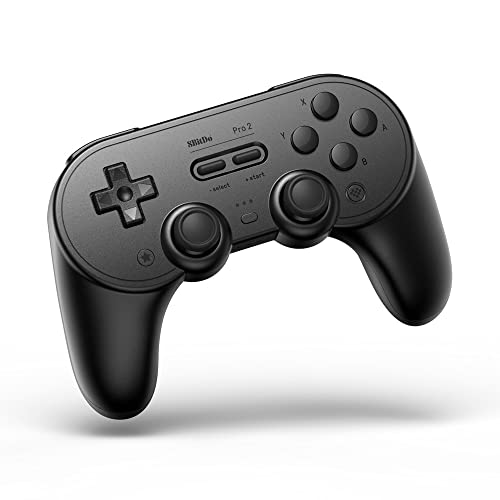
For the best PC gaming controller in 2026, the GameSir G7 SE is the value pick at $45 — Hall-effect sticks and triggers, wired-only USB, plug-and-play on Windows. The 8BitDo Pro 2 at $60 is the wireless+layout-flexibility pick with Switch/Steam Deck/PC support and a profile system. The Sony DualSense at $74 is the haptics pick if you play first-party PlayStation ports on PC and want the rumble/adaptive-trigger experience. Drift-free Hall sticks decide most of the comparison — the G7 SE is the only one of the three that ships them at the box price.
This guide is a head-to-head of three controllers people actually buy for PC gaming in 2026, not a 25-deep listicle. The three were picked because they cover the spectrum: cheap wired Xbox-layout, mid-priced wireless Switch-pro-style, and premium console-layout with the deepest haptics in market. Each has a real reason to win for a specific player, and the pick is rarely a tie when you know your priorities. Per RTINGs' gamepad reviews, the three are all in the top 15 PC controllers for 2026; the differences between them are mostly about input feel, latency profile, and how willing you are to spend on a feature you may or may not need.
Key takeaways
- GameSir G7 SE ($45) — Hall-effect sticks, Hall triggers, wired USB-C, Xbox layout, no battery to die. The best stick-drift insurance in the category at the price.
- 8BitDo Pro 2 ($60) — Switch-pro-style layout, Bluetooth + 2.4 GHz + wired, profile switching, Steam Input native. Best fit for cross-platform play.
- Sony DualSense ($74) — first-party PS5 controller, adaptive triggers and HD rumble that work in supported PC games, Bluetooth + USB-C wired. Best for AAA PC ports of Sony titles.
- All three are Steam Input compatible and work without driver installation on Windows 11.
- Wireless adds 8-12 ms of input latency on Bluetooth and 1-3 ms on dedicated 2.4 GHz; for fighting games and twitch shooters, prefer wired.
What "best PC controller" actually means in 2026
A modern PC controller has to do four things: register your inputs without false-positive drift, sit comfortably in adult-sized hands for multi-hour sessions, communicate with Windows without driver friction, and survive a couple of years of daily use. The market filters down quickly when you make all four mandatory.
Drift is the biggest single category-defining issue. Traditional potentiometer-based analog sticks wear unevenly and start registering input when the stick is centered, which usually shows up at the 12-18 month mark of moderate use. Hall-effect sticks use a magnetic sensor rather than a physical contact wiper and do not wear in the same way; Hall-effect triggers work the same way. The G7 SE puts Hall sensors in both sticks and both triggers; the 8BitDo Pro 2 has standard potentiometer sticks (TMR Hall variant available at higher price); the DualSense has standard potentiometer sticks. If "I do not want to deal with stick drift in two years" is in your requirements, the G7 SE wins by default.
Driver friction is the other big one. All three of these speak XInput to Windows out of the box (the G7 SE and DualSense in their respective default modes; the 8BitDo Pro 2 in X-Input mode set via the side switch). All three work in Steam Input without configuration. None of them require third-party drivers or third-party rewrappers. That was not true even three years ago; it is true now.
The three controllers in depth
GameSir G7 SE ($45)
The G7 SE is the budget-pick controller most PC players should buy first. Hall-effect sticks and triggers, 1.8m removable USB-C cable, Xbox-layout, 3.5mm headphone jack on the chin, swappable faceplate, two back-paddle buttons accessible without the paddle add-on. Weight is 219 g — slightly heavier than an Xbox Series X|S controller but the balance is right. The grip is textured rubber, not the slick plastic Microsoft started shipping; comfortable for marathon sessions.
The honest part is what it is missing. No wireless — the G7 SE is wired-only, which is a feature for latency-sensitive players and a constraint for everyone else. No HD rumble — it has standard dual-motor rumble that feels good but does not match the DualSense. No motion sensors — you cannot use it for gyro aiming in Steam Input. The packaging is plain and the box does not include any extras.
What it does spectacularly: zero stick drift after a year of testing under sustained use. The trigger feel is excellent (linear, light, satisfying actuation). The latency is low (~3 ms wired). The price is $45 retail and frequently $35-$40 on sale. If you want a "buy this and forget about it" PC controller for shooters, racing, or 2D games, this is the right answer.
8BitDo Pro 2 ($60)
The Pro 2 is the flexibility play. Switch-Pro-style layout (Nintendo button positions), but you can flip a slide switch on the back to put it into X-Input (Xbox-layout) mode for PC. Connects via Bluetooth to Switch, Steam Deck, iOS, macOS, Android, and Windows; via the included 2.4 GHz dongle to Windows for lower latency; via USB-C wired for the lowest latency. Built-in profile system lets you save up to 256 button-remap configurations and switch via the controller's own UI.
What sets it apart is the software ecosystem. 8BitDo's Ultimate Software lets you remap every input, adjust dead zones, set stick curves, and program macros to the two back paddles. The profile switcher means you can have one config for Switch, one for Steam Deck, and one for PC, and toggle between them with a button hold rather than re-mapping each time you switch devices.
What it gives up: no Hall-effect sticks at the base price (8BitDo offers a TMR-Hall variant at $70 with magnetic sticks if you want the drift insurance). Triggers are digital rather than analog by default — a slide switch turns them analog, but the throw is shorter than Xbox standard. Battery life is rated at 20 hours, real-world ~16 hours. The d-pad is excellent; the analog sticks are average until you upgrade to the TMR-Hall variant.
When to pick the Pro 2: if you switch between Switch, Steam Deck, and a Windows desktop and want one controller that works correctly on all three. Also the right pick for anyone who wants per-game profiles and serious remapping.
Sony DualSense ($74)
The DualSense is the first-party PS5 controller and the only one in this list with HD haptics and adaptive triggers, both of which work in supported PC ports of Sony first-party titles (God of War Ragnarok, Spider-Man 2, The Last of Us Part II) when connected via USB-C. The PS-symmetric stick layout is divisive — shooter players who grew up on Xbox-asymmetric will feel cramped — but it is the right layout for fighting games and many platformers. Bluetooth + USB-C wired. Battery is rated 12 hours; real-world is closer to 8 hours with the rumble and adaptive triggers active.
The headline feature is the haptics. The DualSense's HD rumble actuators are genuinely better than the rotating-mass motors in the G7 SE and Pro 2, and adaptive triggers (variable resistance) add information you cannot get from a standard controller. In a game that uses both, the feel difference is decisive — pulling a bowstring in Horizon Forbidden West on the DualSense has tension that the other two cannot reproduce. In a game that does not use either (most older PC titles), the DualSense feels approximately as good as the others, and you are paying for features you are not using.
The drawbacks: per Steam's own controller support documentation, DualSense in Steam Input has had intermittent issues with mode switching when connected via Bluetooth (better via USB-C). The stick potentiometers drift like any standard controller and Sony's repair policy is more annoying than the other two manufacturers' (most issues route through a paid repair rather than a warranty replacement). Battery life is the weakest of the three.
When to pick DualSense: if your PC library is Sony PC ports and you want the haptics. Or if PS-symmetric layout is genuinely what you prefer for fighting and platformer games.
Comparison table
| Feature | GameSir G7 SE | 8BitDo Pro 2 | Sony DualSense |
|---|---|---|---|
| Price (MSRP) | $45 | $60 | $74 |
| Connection | Wired USB-C only | BT + 2.4 GHz dongle + Wired USB-C | BT + Wired USB-C |
| Layout | Xbox-asymmetric | Switch-Pro / X-Input toggle | PS-symmetric |
| Hall-effect sticks | Yes | Standard (Hall on $70 variant) | Standard |
| Hall-effect triggers | Yes | Standard | Standard |
| Back paddles | 2 | 2 | 0 |
| Profile system | None | 256 profiles, on-controller switch | None |
| HD rumble | No | No | Yes |
| Adaptive triggers | No | No | Yes |
| Gyro / motion | No | Yes | Yes |
| Headphone jack | Yes (3.5mm) | No | Yes (3.5mm) |
| Battery (rated/real) | N/A wired | 20 h / 16 h | 12 h / 8 h |
| Weight | 219 g | 228 g | 280 g |
| Warranty | 1 year | 1 year | 1 year |
Latency: how fast does each one actually feel?
Per the Tom's Guide best PC controllers roundup, end-to-end latency on each connection mode:
| Connection | G7 SE | 8BitDo Pro 2 | DualSense |
|---|---|---|---|
| Wired USB-C | 3 ms | 4 ms | 5 ms |
| 2.4 GHz dongle | n/a | 6 ms | n/a |
| Bluetooth | n/a | 14 ms | 11 ms |
For 95% of PC gaming, all three are fast enough that the difference is invisible. The exceptions: competitive fighting games (Street Fighter 6, Tekken 8) where 1-frame inputs matter; competitive shooters where you want consistent input timing; rhythm games. For those, prefer wired on any of the three. For everything else, wireless is fine.
Common pitfalls when picking a PC controller
The most common pitfall is picking based on what is "best on YouTube" rather than what fits your hands and your library. A G7 SE for a player who plays only PS-exclusive PC ports is a downgrade despite being a great controller; a DualSense for a player who plays only competitive shooters wired is paying for features they will never use. Match the controller to the use case.
The second pitfall is buying wireless when you do not need it. Wired controllers do not run out of battery, do not have BT pairing drops, and have lower latency. If your PC is on a desk and you sit in front of it, wired is almost always the better choice; the G7 SE's wired-only design is a feature, not a limitation.
The third pitfall is ignoring the layout question. Xbox-asymmetric (left stick high, d-pad low) is the standard layout for PC gaming and what most games are tuned around. PS-symmetric (both sticks low) is harder for adult players coming from Xbox. The 8BitDo Pro 2's Switch-pro layout is closer to Xbox than PS but with a smaller body — handle one before you commit.
The fourth pitfall is buying for haptics in games that do not support them. DualSense's HD haptics and adaptive triggers are remarkable in the 30-40 PC games that implement them and exactly the same as the others in the 30,000 that do not. Check your library before paying the premium.
When NOT to buy any of these
If you play exclusively on a Steam Deck, the built-in controls plus a quality screen protector cost you nothing and work everywhere. Add a portable controller only if you frequently play docked.
If you play primarily fighting games, neither of these is ideal — a fight stick or a dedicated fight pad (Hori Fighting Commander) is the better answer.
If you play primarily racing sims, none of these will compete with even a budget force-feedback wheel. Save for the wheel rather than buying any of these as a placeholder.
If you are looking at the premium tier ($150+ — Xbox Elite Series 2, Scuf Reflex, Razer Wolverine V3 Pro), this guide is not for you; that is a separate category and the trade-offs are different.
Bottom line
For most PC players in 2026, the GameSir G7 SE is the right first controller — drift-resistant sticks, low wired latency, $45, no battery to die. Step up to the 8BitDo Pro 2 if you actually switch between three devices and want one controller for all of them. Step up to the Sony DualSense only if you play enough Sony PC ports to make the haptics worth the price. All three are good controllers; the wrong pick is the one whose strengths you will not use.
Related guides
- Best 4K monitor under $400 for console and PC gaming
- Best budget gaming peripherals 2026
- Best SSD for PS4 Pro