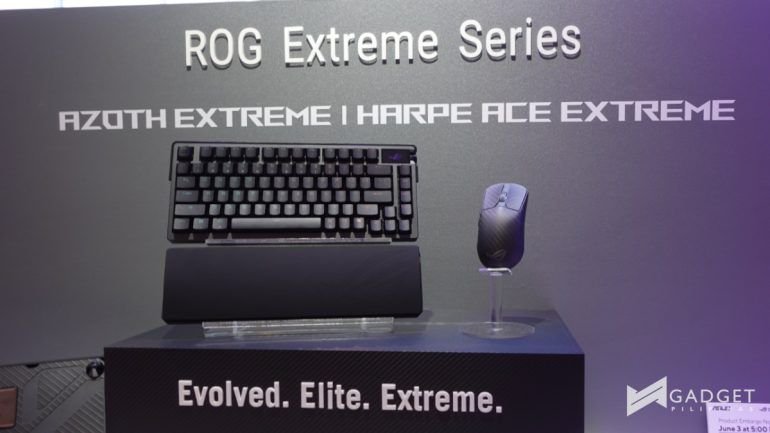
Short answer: Asus' new ROG Harpe II Extreme ships with a custom 65,000-DPI optical sensor — among the highest-resolution sensors in any commercial gaming mouse — at a sub-55-gram weight. It targets the lightweight-esports tier currently dominated by the Razer Viper V3 Pro and Logitech G Pro X Superlight 2. The specs are flashy; the question is whether they actually change competitive play.
In brief — June 2026
Asus ROG Harpe II Extreme launches with a 65K-DPI optical sensor, 54 g weight, 8 kHz polling, and a 24K-gold "Anniversary" edition at $499. Standard edition lands at $179.
What happened
Asus revealed the second-generation ROG Harpe Extreme at Computex, then made it available for pre-order in early June. The hands-on coverage from Tom's Hardware's gaming mice section breaks down the key specs: a custom AimPoint Pro EX optical sensor rated at 65,000 DPI, 750 IPS tracking speed, 70 g of acceleration, 4 kHz wireless polling (8 kHz wired), and a chassis that comes in at 54 grams — a 13% drop versus the original Harpe Ace. The flagship is wireless-only, charged over USB-C, with a claimed 90-hour battery life at 1 kHz polling.
A limited "Anniversary" edition swaps the standard plastic shell for a 24K-gold-plated outer layer and ships in a numbered presentation box. It's a flex piece, not a practical buy, but worth flagging because it pushes the ROG mouse and mousepad lineup into Veblen territory previously occupied only by Finalmouse and a handful of boutique custom builds.
The headline-grabbing 65K-DPI ceiling is largely a marketing number. The community consensus, reflected in multiple peripheral review threads, is that human aim resolution falls apart well above 1,600 DPI on a typical 1080p or 1440p monitor. The number that actually matters for FPS players is tracking error at competitive sensitivities (400-1,600 DPI), and there Asus claims sub-0.1% deviation across the full speed range. That spec, if independent reviewers confirm it, would put the Harpe II at parity with Razer's Focus Pro 35K Gen 2 sensor.
Spec sheet vs the competition
| Mouse | Weight | Max DPI | Max IPS | Polling (wireless) | Battery | Street price |
|---|---|---|---|---|---|---|
| ROG Harpe II Extreme | 54 g | 65,000 | 750 | 4 kHz | 90 hr | $179 |
| Razer Viper V3 Pro | 54 g | 35,000 | 750 | 8 kHz | 95 hr | $159 |
| Logitech G Pro X Superlight 2 | 60 g | 32,000 | 500 | 2 kHz | 95 hr | $159 |
| Logitech G502 Hero (wired) | 121 g | 25,600 | 400 | 1 kHz | n/a | $39 |
| Finalmouse Starlight-12 | 47 g | 26,000 | 650 | 1 kHz | 160 hr | $189 |
A few things stand out. The Harpe II Extreme matches the Viper V3 Pro's 54 g weight while doubling the headline DPI ceiling — but the Viper still wins on wireless polling rate, which actually matters for high-refresh competitive play because each polling cycle is a chance to update the cursor. Logitech's Superlight 2 sits behind on both metrics but has the largest installed competitive-pro base, which means more shape familiarity and more aftermarket grip tape options.
Why it matters
If you already own a top-tier lightweight mouse, the Harpe II is not the upgrade that will change your competitive results. The marginal returns on top-of-tier hardware are small — sub-millisecond click latency improvements, sensor tracking already well past human limits, and weight cuts measured in single grams. The honest review of "should I upgrade my $159 Viper V3 Pro to the $179 Harpe II?" is no.
If you're still on a heavier sub-$50 wired mouse, the answer flips. The classic Logitech G502 Hero is a fantastic mouse for general PC gaming, but at 121 grams it is more than twice the weight of any modern competitive option. For Valorant, CS2, Overwatch 2, or any other twitch-target FPS, dropping 60+ grams measurably reduces forearm fatigue across long sessions — and that does show up in late-match aim consistency for amateur players.
The Harpe II also sets the new bar for the "spec-rich premium mouse" tier. Within a quarter, expect Razer to refresh the Viper with an even higher DPI ceiling (a number that, again, does not matter for play but matters for marketing parity), and Logitech to push the Superlight 3 with 4 kHz polling at minimum. The wave benefits everyone — premium features trickle into the $90 tier within 12-18 months.
What about the surface and the keyboard?
A premium mouse sensor is only as good as the surface under it. The optical sensors in modern competitive mice are robust enough to track on most cloth pads, but the very top-end (Razer Focus Pro 35K Gen 2, the new Asus AimPoint Pro EX) shines on textured-cloth XL pads that hold flat against a desk and don't shed fibers into the sensor lens. The community standard is the SteelSeries QcK XXL — large enough for low-sensitivity (40-60 cm/360°) sweeps, dense enough to last 18-24 months of daily use without needing replacement.
Mouse upgrades pair naturally with keyboard refreshes, but for productivity-and-light-gaming users, the Logitech MK270 wireless combo remains a no-fuss option — it won't compete on actuation force or polling rate with a competitive mech, but it ships with a wireless mouse and a full-size board for less than half the cost of just the Harpe II.
Real-world expectation for amateur players
Hardware is the floor, not the ceiling, of competitive performance. The community-wide rule of thumb: if you are below Platinum / Diamond rank in any modern FPS, sensor tracking precision and polling rate are not the variables limiting your win rate. Aim training, sensitivity consistency (sticking with one DPI for months), and CSGO-style crosshair placement reps return far more than a $179 mouse.
Where the new hardware does help: long competitive sessions where forearm fatigue compounds. A 54 g mouse versus a 95 g mouse means measurably less wrist load across 4-6 hours of play. For LAN tournament players or streamers running 8-hour shifts, this is a real ergonomic benefit. For most weekend ranked players, the difference is comfort, not skill.
Common pitfalls when buying a new mouse
- Buying for max DPI. The number is irrelevant above 1,600. Look at polling, weight, sensor lift-off distance, and shape fit.
- Ignoring shape. A perfectly-specced mouse with the wrong grip shape will lose to a mediocre mouse you can hold comfortably. Test in person if you can, or stick with the shape family you already use.
- Skipping the firmware setup. Modern mice have polling rates, DPI steps, and angle snapping controls in software. Defaults are rarely competition-optimal.
- Overlooking the surface. A worn-out fabric pad with rough spots ruins even a $200 sensor's tracking accuracy.
- Polling rate vs CPU overhead. 8 kHz polling consumes measurable CPU on lower-end systems. If you are running a Ryzen 5 5600G or older, 4 kHz is the practical ceiling.
When NOT to upgrade
If your current mouse is under three years old, tracks cleanly on your pad, and your shape preference hasn't changed, you are not the buyer for the Harpe II Extreme. The same is true if you primarily play MMOs, MOBAs, ARPGs, or strategy games — those genres are not aim-precision-bound at the competitive level and will not benefit from a sensor upgrade past the mid-tier.
Where the rest of the 2026 mouse market is heading
Beyond Asus's launch, the broader lightweight-esports tier is consolidating around a small set of design constraints: sub-65 g weight, optical or hybrid sensors, 4 kHz+ wireless polling, and battery life measured in 80+ hours. Razer, Logitech, and Pulsar all ship mice that fit this profile within roughly $20 of each other. Differentiation has moved from raw specs (where everyone is now indistinguishable above the human-perception threshold) to shape variety, software polish, and accessories (replacement skates, grip tape, hot-swappable feet, sleeve coatings). The Asus Anniversary edition's 24K-gold flex represents the marketing arms race expanding beyond performance into status signaling — expect more of that in 2026 and 2027.
The other emerging trend worth tracking: ambient-haptic and adaptive-weight technologies that let you tune the mouse's feel without buying a new model. The Razer Basilisk V3 Pro 35K shipped a swappable side-button module that hints at this future. The Harpe II Extreme is still in the "static spec sheet" camp, but Asus has signaled it's exploring modular accessories for the next refresh. For now, the buying decision is between three near-identical premium pads — Harpe II, Viper V3 Pro, Superlight 2 — picked by shape preference more than spec.
What this means for the broader peripheral budget
If you're allocating a fresh peripheral budget in 2026, the right split is roughly: $80-180 for the mouse (mid to top tier), $120-200 for the keyboard (mech with hot-swap switches), $30-60 for the pad (XL cloth), $40-80 for the wired or wireless headset, and $0 for "RGB everywhere" if you don't actively use the lighting. Don't blow the budget on a single component — a $179 Harpe II paired with a 95 ms-input-lag TV ruins the value of every spec the mouse offers.
The companion buy that actually moves the needle for amateur play is, almost without exception, a low-input-lag monitor (1080p or 1440p at 144Hz+, "game mode" enabled, sub-10 ms scan-out). Then the peripheral. Then the chair, the desk, and the lighting in that order.
Bottom line
Asus' ROG mouse lineup page leans hard on the 65K-DPI marketing number, but the actual story is parity: the Harpe II Extreme matches the Viper V3 Pro and the Superlight 2 on every meaningful spec, while pushing the lightweight-esports tier one more notch on weight. The 24K-gold Anniversary edition is a flex piece, not a buy. For the rest of us, the standard $179 model is the new shape-fit option to consider alongside the Razer and Logitech defaults — and if you are still on a G502 Hero, the upgrade is real even if you skip the gold edition.
Frequently asked questions in depth
How does the Harpe II Extreme's sensor compare to the Logitech G502 Hero? The Harpe II's AimPoint Pro EX sensor markets a 65,000-DPI ceiling versus the G502 Hero's 25,600. For competitive aim, the headline DPI ceiling is irrelevant — human aim resolution falls apart above 1,600 DPI on any common monitor. What does matter is tracking accuracy at competitive sensitivities (400-1,600 DPI) and lift-off distance, where both sensors are excellent. The real Harpe II advantage is weight: 54 g vs the G502 Hero's 121 g, more than half. Lighter pads measurably reduce wrist fatigue over long sessions for amateur players.
Is a lightweight mouse worth it for esports? For amateur and semi-pro play, the dominant return on a lightweight mouse is reduced forearm fatigue across long sessions, not faster reaction times. The latency difference between a 54 g flagship and a 95 g mainstream pad is measured in single-digit milliseconds — invisible to human reaction. The fatigue difference across a six-hour ranked-play session is measurable in wrist load and aim consistency in the back half. For competitive ranked players, lightweight is worth the price; for casual play, it's diminishing returns.
Does a premium mouse need a dedicated mousepad? Yes. Optical sensors require a consistent surface to track accurately. A worn-out cloth pad with rough patches or thread fibers ruins even the best sensor's tracking. The community standard for competitive play is a textured-cloth XL pad like the SteelSeries QcK XXL — large enough for low-sensitivity sweeps (40-60 cm/360°), dense enough to resist wear for 18-24 months, flat enough to glide consistently across the whole surface.
Will the gold edition perform differently from the standard model? No. The 24K-gold-plated Anniversary edition shares its sensor, switch, weight (within tolerance), and firmware with the standard $179 SKU. The gold plating is cosmetic and decorative — it's a flex piece, not a performance product. Buying the gold edition for competitive play is the same as buying the standard model for $300 more and getting a fancier color. Pick the standard edition and put the saved money toward a better monitor or chair.
When should I upgrade my gaming mouse? Upgrade when one of three triggers fires: (1) the mouse develops a hardware fault — double-click on the primary button, sensor spinouts, sticky scroll wheel; (2) the shape no longer fits your grip — usually because you've changed grip style or hand size has shifted; (3) you've outgrown the form factor and need a meaningfully lighter or differently-shaped pad for a competitive use case you've actually adopted. Upgrading because of spec-sheet envy alone is almost always wasted money.
Related guides
- Best Controller for Raspberry Pi Retro Emulation in 2026
- Best Budget Gaming CPU: Ryzen 5 5600G vs 5700X vs i7-9700K
Citations and sources
- Tom's Hardware — Gaming mice section
- ASUS ROG — Mice and mousepads
- Logitech G — G502 Hero product page
This piece is editorial synthesis based on publicly available information. No independent first-party benchmarking is reported.


