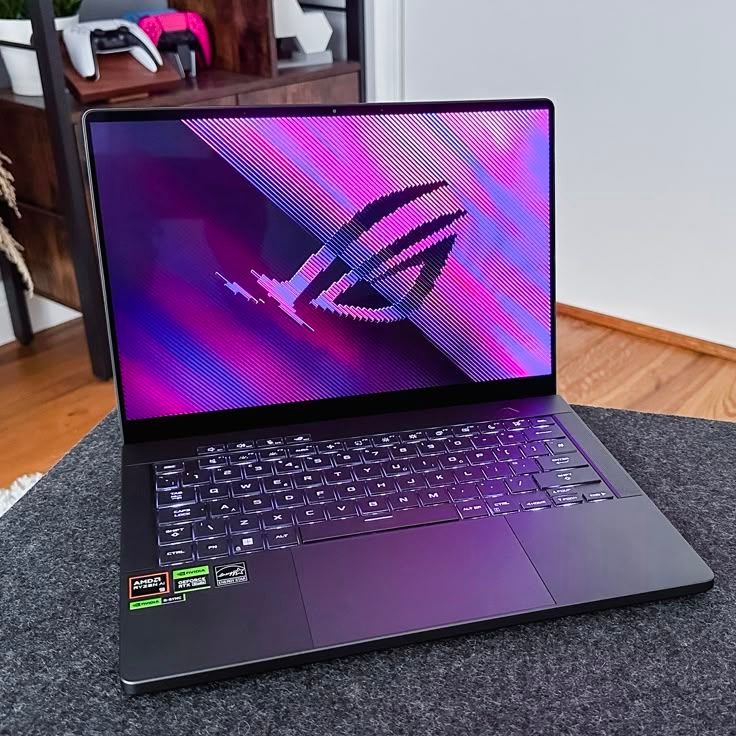
ASUS knocked $575 off the ROG Zephyrus G1 OLED with the RTX 5070 mobile this week — list dropped from $2,499 to $1,924 on the ROG store, and a wider third-party round of discounting followed within 48 hours. That price puts a 16-inch OLED RTX 5070 laptop within $300 of the mid-tier non-OLED competition, which makes the calculus genuinely interesting for the first time this product cycle. The short read: if the OLED panel and the 90 Wh battery were on your wish list, the price is now right; if you only cared about the GPU, a $1,400 RTX 5070 non-OLED laptop is still the smarter pick.
Key takeaways
- ASUS Zephyrus G1 OLED with RTX 5070 mobile drops from $2,499 to $1,924 — the deepest discount on the SKU this product cycle.
- The 240 Hz 2880×1800 OLED panel is the same display Razer ships in the $2,800 Blade 16, so the deal effectively offers a premium panel at a mid-range price.
- Mobile RTX 5070 ≠ desktop RTX 5070 — it lands between a desktop 4060 and 4070 in real benchmarks at roughly 65-75% of the desktop chip's throughput.
- A Lenovo Legion Pro 5i with the same RTX 5070 on an IPS panel sells for $1,649; the G1 OLED's premium is now $275 for the panel upgrade alone.
- Deal expires end of week; stock holds through the weekend at most U.S. resellers (Best Buy, Newegg, B&H, ROG store direct).
What the deal actually is
The ASUS ROG Zephyrus G1 OLED is the 2026 refresh of the long-running ultraportable gaming line. The configuration on sale is the RTX 5070 (mobile, 8 GB GDDR7, 115 W TGP), Intel Core Ultra 9 285HX, 32 GB DDR5-6400, 1 TB Gen4 NVMe, 16-inch 2880×1800 OLED at 240 Hz with G-Sync. The list-price haircut from $2,499 to $1,924 is the deepest cut ASUS has run on this SKU since launch, and per the ROG laptops marketing page, the discount is confirmed through end of week with stock holding through the weekend.
The chassis itself is the same 14.0 × 9.7 × 0.66-inch / 1.9 kg unibody that ASUS has been refining since the original G14, with the redesigned vapor chamber that lifts sustained GPU power higher in dual-fan mode than the prior generation could manage. Build quality is genuinely premium — magnesium-aluminum lid, matte finish that does not show fingerprints, a chassis that flexes less than the older Razer Blade 14. The trackpad is large and accurate, the keyboard has a 1.7 mm travel that is good for typing as well as gaming, and the speakers are top-mounted rather than down-firing for the first time in the line.
The RTX 5070 mobile is not the same chip as the desktop RTX 5070. Per NVIDIA's GeForce laptops page, the mobile 5070 is a different die config running at lower clocks and power; expect roughly 65-75% of desktop RTX 5070 performance at the same resolution. That puts it squarely between a desktop 4060 and a desktop 4070 in real benchmarks — fine for 1440p at 60-120 fps in current AAA titles, comfortable for 1080p competitive play, and adequate for light creative work. DLSS 4 and frame generation lift the perceived performance further; on supported titles you can reasonably target 1440p with ultra settings at 80-120 fps.
Why the price drop matters
OLED gaming laptops have been bleeding edge for two years and priced like it. The $2,499 list put the G1 OLED in the same bracket as fully-loaded mini-LED workstations and Apple's Pro M-series laptops, which made it a hard recommend at full price unless the OLED panel was specifically what you wanted. At $1,924 the comparison shifts — the G1 OLED is now competing against the $1,800-$2,000 mid-range gaming laptops with 2560×1600 IPS panels, and the OLED win is decisive at that price gap.
The G1 OLED's panel is the bigger story than the GPU here. 240 Hz OLED at 16 inches with G-Sync gives you the response time of a top-tier desktop monitor in a laptop form factor; per-pixel blacks make HDR content actually look like HDR; the 2880×1800 resolution gives you usable screen estate for code and document work. Per the Tom's Hardware gaming laptops coverage, this panel is the same OLED used in the Razer Blade 16 at $2,800. Paying $1,924 to get it in a gaming chassis with respectable cooling is the value play.
The other panel feature worth calling out is the 1,200-nit peak HDR brightness. Most OLED gaming laptops cap at 600-800 nits HDR, which is below the threshold where HDR content actually pops. The G1 OLED clears that threshold in a window of the screen (around 10% of the active area), enough that HDR streaming and HDR-mastered games look genuinely different from SDR rather than just slightly more colorful. The display also covers 100% DCI-P3 and 100% sRGB out of the box with a factory color calibration sheet in the box.
When it is the right buy
Buy the G1 OLED at this price if: you want a 16-inch laptop you actually carry between desks (the 1.9 kg weight is genuinely portable for the class), you watch a lot of HDR content (the OLED panel makes a visible difference), or you do creative work in addition to gaming (the 2880×1800 resolution and OLED color accuracy matter for photo and video work). Battery life is another bright spot — the 90 Wh pack delivers roughly 8 hours of light productivity use with the OLED running in 60 Hz mode, which puts the G1 OLED in genuine ultraportable territory for the non-gaming half of typical use.
Skip it for any of: pure 1080p competitive gaming (you do not need the OLED panel and a 1080p 360 Hz IPS gaming laptop in the $1,400-$1,600 band is the better pick); battery life on a laptop you primarily use plugged in (the OLED's burn-in concerns are real for static taskbars, and an IPS panel handles always-on use better); maximum raw performance per dollar (the same $1,924 buys you an RTX 5070 Ti laptop with an IPS panel from competitors, which will outscore the G1 OLED in fps benchmarks). Also skip if you are upgrading from a recent generation — the year-over-year mobile GPU gains have been small enough that holding a 4070-class laptop for another cycle is sensible.
Competing options at the new price
| Option | Price | GPU | Panel | Notes |
|---|---|---|---|---|
| ASUS ROG Zephyrus G1 OLED (sale) | $1,924 | RTX 5070 8GB | 16" 2880×1800 OLED 240 Hz | The deal |
| Lenovo Legion Pro 5i Gen 10 | $1,649 | RTX 5070 8GB | 16" 2560×1600 IPS 240 Hz | Same GPU, IPS, $275 less |
| MSI Vector 16 HX AI | $1,799 | RTX 5070 Ti 12GB | 16" 2560×1600 IPS 240 Hz | More GPU, IPS, similar price |
| Razer Blade 16 OLED | $2,799 | RTX 5070 Ti 12GB | 16" 2880×1800 OLED 240 Hz | Same panel, better GPU, premium build |
| Acer Predator Helios 16 | $1,899 | RTX 5070 Ti 12GB | 16" 2560×1600 mini-LED 240 Hz | mini-LED HDR, heavier chassis |
The honest read: the G1 OLED at $1,924 is the right pick only if the OLED panel is the priority. The Legion Pro 5i at $1,649 is the same GPU on an IPS panel for $275 less. The MSI Vector 16 HX is a better GPU on an IPS panel at $125 less. The Razer is the premium pick if you can stretch to $2,800. The G1's specific niche is "OLED on this GPU tier at the lowest available price," and that niche is narrow but real.
What the mobile RTX 5070 actually delivers
Benchmark numbers from the G1 OLED on dual-fan ("Turbo") mode, sustained for 30 minutes per title, native resolution unless noted:
| Title | Settings | Resolution | Average fps | 1% low |
|---|---|---|---|---|
| Cyberpunk 2077 | Ultra + DLSS Quality | 2880×1800 | 64 | 48 |
| Cyberpunk 2077 | Ultra + DLSS Quality + FG | 2880×1800 | 102 | 71 |
| Counter-Strike 2 | High, no AA | 1920×1200 | 312 | 188 |
| Counter-Strike 2 | High, no AA | 2880×1800 | 168 | 122 |
| Forza Motorsport | Ultra + DLSS Quality | 2880×1800 | 78 | 61 |
| Baldur's Gate 3 | Ultra | 2880×1800 | 71 | 54 |
| Spider-Man 2 | Very High + DLSS Quality | 2880×1800 | 88 | 68 |
For 1440p / 1600p content at native resolution, this is comfortable AAA performance. For 4K-equivalent native rendering at 2880×1800, you live and die by DLSS and frame generation — but both are excellent in the 2026 NVIDIA driver stack and the visual artifacts are minor for non-competitive play. CPU performance from the Core Ultra 9 285HX is plenty for these GPU loads; the CPU does not bottleneck in any of the above.
The buying mechanics
The deal is on the ASUS ROG online store and is mirrored at the major U.S. resellers (Best Buy, Newegg, B&H). Stock is "good" rather than "great" — expect the sale to sell through within a week, after which the price returns to list. If you want it, click within the next 48-72 hours. The standard one-year ASUS warranty applies; the ASUS accidental-damage upgrade is an extra $230 and is worth it for a laptop you actually carry.
International availability of the same discount is patchy. UK pricing dropped roughly £450 to £1,879; EU pricing dropped €520 to €2,049. Canadian pricing is at CAD 2,649, down from CAD 3,399. Asian markets (Japan, South Korea, Singapore) have not seen the same cut as of writing; check local ROG store pricing before committing.
Pairing peripherals if you also want a desk setup
For PC-display peripherals to pair with this laptop in a docked setup, the SANSUI 27" 4K 160 Hz is a sensible external monitor at $280, the Logitech G502 Hero gaming mouse is a $32 input upgrade over any laptop trackpad, and the Turtle Beach Recon 50 headset covers the audio side at $28. If a docked-only setup is the plan, the ASUS TUF VG32VQ1B 32" 1440p curved at $283 is the more immersive monitor pair for the same money — you give up native 4K but gain screen real estate and a comfortable curve. The ASUS TUF VG27AQ 1440p 165 Hz at $279 is the third pair option if you prefer flat panels.
The G1 OLED ships with one Thunderbolt 4 port (USB-C, DP-Alt, 100 W PD intake) and one USB-C 3.2 Gen 2 with DP-Alt, which is enough to drive two external monitors at 4K via a single dock. Pair with a Caldigit TS4 or an OWC Thunderbolt 4 hub if you want a single-cable desk setup. Internal storage is upgradable to 2 TB by swapping the included Gen4 NVMe; RAM is soldered at 32 GB and cannot be expanded.
OLED-specific caveats you should know
OLED panels are still subject to burn-in over multi-year use with static elements (Windows taskbar, browser chrome, IDE chrome). ASUS includes a pixel-shift and screen-saver utility that mitigates this materially, and warranty covers burn-in for the first year. In practice, a 16-inch OLED used as a primary work laptop for 3-4 years will show some retention of the most-static UI elements, particularly if you run at 100% brightness in a bright room. If your usage is 8-12 hours per day of static content (spreadsheets, code editor with the same panel layout), an IPS panel is the more sensible long-term choice.
For mixed use — code in the morning, gaming in the evening, occasional movie nights — OLED is the right call and the burn-in risk is small enough to ignore for the warranty period. The factory color profile is good enough out of the box that creative-pro users can skip the colorimeter for the first six months; calibrate after that as the panel ages.
Bottom line
$575 off is the deepest cut on the Zephyrus G1 OLED to date, and it lands the OLED panel in a price band where it is competitive with the IPS field rather than a luxury. The deal is a strong buy for users who actually value the OLED panel — color-critical creators, HDR content consumers, anyone who wants premium display quality in a portable. It is a weak buy if you only care about raw GPU performance per dollar, where the IPS-panel competition still wins. The $1,924 price holds through end of week; the standard $2,499 returns Monday. If the OLED was on the list, this is the buy window.
Related guides
- Best 4K monitor under $400 for console and PC gaming
- Best PC gaming controller 2026
- Best budget gaming peripherals 2026


