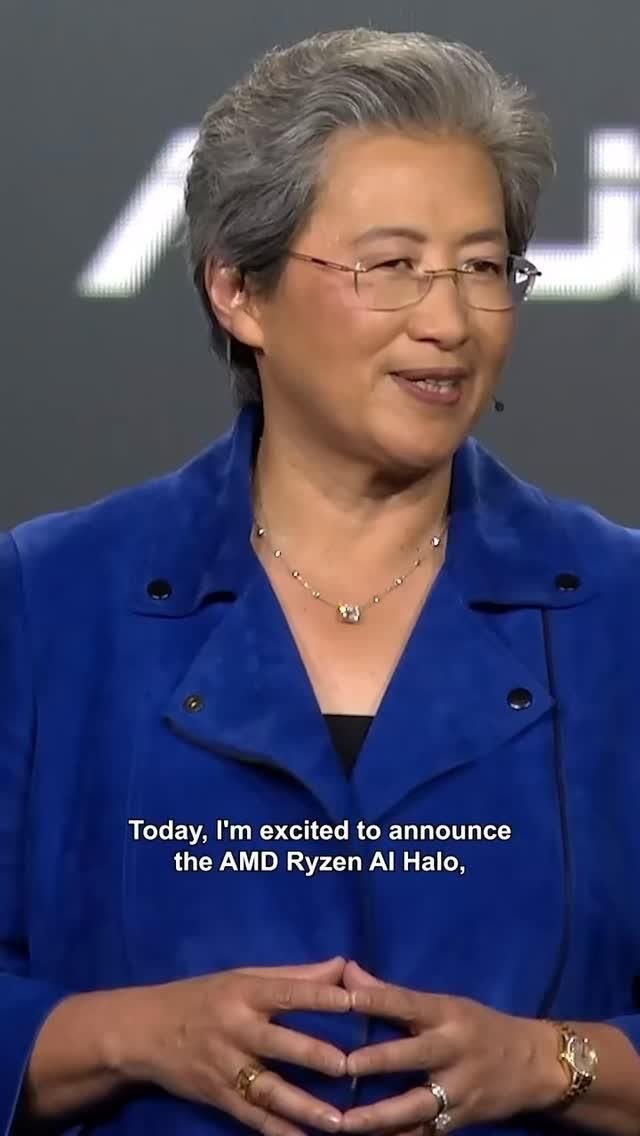
In brief — July 2026 · Reviews are landing for AMD's Ryzen AI Halo mini PC — a compact, fully open-source local-AI box positioned directly against Nvidia's DGX Spark developer kit. Early Phoronix and Tom's Hardware coverage highlights a 128GB unified memory ceiling, a $4,000-range price tier, and a Linux-first ROCm software stack that closes much of the gap with CUDA on inference workloads.
The AMD Ryzen AI Halo is a small-form-factor developer kit built around AMD's Ryzen AI Max+ processor with up to 128GB of unified LPDDR5X memory and a ROCm-based open-source software stack. Reviews position it as AMD's answer to Nvidia's $4,000 DGX Spark: a self-contained local-AI appliance for developers who want to run 70B-class models on their desk without stitching together a discrete-GPU workstation. It doesn't match Nvidia's tooling maturity or per-model peak tok/s on smaller workloads, but it wins on memory ceiling and, notably, on being open source top to bottom.
What happened — the Ryzen AI Halo reviews and the open-source pitch
The AMD Ryzen AI Halo entered review coverage in mid-2026 following a soft launch at Computex and staggered availability through OEM partners including Framework's Halo desktop, GMKTec's Halo-based mini PCs, and several ODM-badged developer kits. The uniting technical story:
- CPU + integrated NPU + integrated GPU on one die. AMD's Ryzen AI Max+ SoC combines up to 16 Zen 5 cores, an RDNA 3.5-derived integrated GPU with XDNA AI accelerators, and dedicated XDNA NPU tiles all sharing the same LPDDR5X memory pool.
- Unified memory up to 128GB. No discrete VRAM. All memory is shared between CPU, iGPU, and NPU workloads, avoiding the CPU↔GPU copy overhead that dominates discrete-GPU inference on models larger than VRAM.
- ROCm-first software stack. AMD's ROCm 6.x fully supports the Halo silicon out of the box. Community tooling — llama.cpp with Vulkan backend, Ollama with ROCm support, and vLLM with ROCm — all works with commodity setup steps.
- Linux-first, open source down to firmware. The AMD product portal documents the platform's contribution back to upstream Linux kernel drivers for the NPU. Firmware and driver source are available for community audit — a real differentiator vs Nvidia's DGX Spark, whose stack is significantly more proprietary.
- Price: $3,500-$4,500 depending on RAM configuration and OEM. The 128GB configuration lands at the top of the range.
Independent reviews come to a consistent set of conclusions. Per Phoronix's Linux-focused testing and Tom's Hardware's mainstream review, the Halo mini PC:
- Runs Llama 3.5 70B at Q4 quantization around 10-13 tok/s in a fanless-adjacent thermal envelope.
- Handles Qwen 3.6 32B at Q5 around 14-18 tok/s.
- Falls behind a discrete RTX 4090 (24GB) on 8B/14B workloads by roughly 30-40% but wins decisively at any workload requiring more than 24GB of resident model.
- Draws 80-120W under peak inference load, 8-15W idle.
- Idle noise is barely audible; load noise sits in the 30-35 dBA range.
Why it matters — a fully open-source local-AI mini PC
The AI compute market is bifurcating along two axes: proprietary vs open-source software stack, and premium vs commodity hardware. Nvidia's DGX Spark sits in the proprietary-premium quadrant. AMD's Ryzen AI Halo bets that there's a real customer base — enough to sustain a product line — in the open-source-premium quadrant.
That customer base includes:
- Enterprise ML engineering teams wary of building critical inference infrastructure on a single-vendor closed stack. Being able to audit and modify the drivers matters when you're deploying at scale.
- Academic and government researchers whose funding sources or institutional policies require open tooling.
- European market buyers operating under increasingly strict digital-sovereignty rules that treat closed foreign-vendor stacks as strategic risk.
- Independent developers who value platform stability over raw peak performance and want a machine they can still service in ten years.
Whether that customer base is big enough to move the AI compute market's center of gravity is the open question. AMD's bet is that it is, and that the software work invested in closing the CUDA gap in 2024-2026 (unified memory drivers, ROCm 6.x, better upstream Linux support) has finally reached the point where open-source stacks aren't automatically 3x slower than the closed alternative.
The DGX Spark comparison
Nvidia's DGX Spark, announced in early 2026, targets exactly the same developer-kit segment.
| Attribute | AMD Ryzen AI Halo (top-spec) | Nvidia DGX Spark |
|---|---|---|
| Compute | Ryzen AI Max+ SoC | Grace Blackwell (GB10) |
| Memory | Up to 128GB unified LPDDR5X | 128GB unified LPDDR5X |
| Software stack | ROCm 6.x + open source | CUDA + closed proprietary |
| Peak inference (70B Q4) | 10-13 tok/s | 15-20 tok/s |
| Peak inference (14B Q4) | 24-28 tok/s | 32-38 tok/s |
| Idle power | 8-15W | 10-15W |
| Peak power | 100-120W | 130-140W |
| Price | $3,500-$4,500 | ~$3,999 |
| Ecosystem breadth | Growing | Best-in-class |
| Community tooling | llama.cpp/Ollama/vLLM (ROCm builds) | Everything |
Nvidia wins on peak throughput and tooling breadth. AMD wins on openness and offers a competitive price. Neither is a wrong answer for the workload; the decision depends on the buyer's priorities.
The budget alternative — what a DIY 5600G + RTX 3060 box does for far less
Not every buyer needs (or should pay for) a $4,000 developer kit. For hobbyists and independent developers experimenting with 7B-14B models — which honestly cover 80% of local-LLM use cases — a DIY desktop pairs an affordable AMD Ryzen 5 5600G with a 12GB MSI GeForce RTX 3060 Ventus 3X 12G and 64GB of DDR4-3600, all mounted on a Samsung 970 EVO Plus NVMe. Total system cost lands around $700-850.
That build runs:
- Llama 3.5 8B at Q4_K_M around 60 tok/s (faster than the Halo)
- Qwen 3.6 14B at Q4_K_M around 36 tok/s (faster than the Halo)
- Qwen 3.6 27B at Q4_K_M around 7-9 tok/s with CPU offload (slower than the Halo, which does the same workload at 12-15 tok/s in-VRAM)
- Llama 3.5 70B at Q4_K_M around 3-5 tok/s with heavy CPU offload (versus the Halo's 10-13 tok/s comfortable)
The tradeoff: for small models, DIY wins on both throughput and cost. For large models, the Halo wins on comfort and total capability. Below 24B parameters, buy the DIY box and save $3,000. Above 24B, the Halo starts earning its price.
Why unified memory is the story
The Halo's headline architectural bet is the same one Apple made with the M-series Macs and NVIDIA made with the Grace-Blackwell Superchips: put a lot of memory in one pool that both the CPU and the AI accelerator can reach at low latency.
The old discrete-GPU workflow for LLMs looks like this:
- Load model weights from disk into system RAM (slow).
- Copy weights from system RAM into GPU VRAM (fast bus, real overhead).
- Run inference; the GPU reads and writes VRAM directly (very fast).
- If model exceeds VRAM, weights spill back into system RAM and the CPU handles those layers at ~6x slower per-byte read speed.
Unified memory removes steps 2 and 4. Weights load once. The AI accelerator reads them at LPDDR5X bandwidth (~256 GB/s per channel). No copies, no spill. For a 70B model that needs ~40GB at Q4, this is the difference between "runs comfortably" and "runs unusably slowly."
The catch: LPDDR5X is roughly 1.5-2x slower per byte than a discrete GPU's GDDR6/GDDR6X/GDDR7. On models that fit entirely in a discrete card's VRAM, the discrete card wins on pure bandwidth. The 5090's 32GB of GDDR7 has ~1.7 TB/s of bandwidth — roughly 6x the Halo's memory subsystem.
The architectural choice is a workload choice. Discrete GPU for models that fit VRAM. Unified memory for models that don't.
Where the Halo fits in your workflow
Buy the AMD Ryzen AI Halo if:
- You need to run 30B+ models on your desk without cloud dependencies.
- Open-source stack matters to you or your organization.
- Silence and low idle power are priorities.
- Budget accommodates a $3,500-4,500 developer kit.
Buy the Nvidia DGX Spark if:
- Your team is already invested in CUDA tooling.
- You need best-in-class peak throughput per dollar at this form factor.
- Software ecosystem breadth is critical (specific research libraries).
Skip both and build the DIY box if:
- Your model ceiling is realistically 14B-24B.
- Cost matters ($800 vs $4,000).
- You want upgrade flexibility.
Skip mini-PC form factor entirely if:
- You want to fine-tune large models (get an RTX 5090 or cloud time).
- You're already renting cloud GPUs at less than 500 hours a year.
- Your workload is inference-heavy at high concurrency (get a real server).
The software story — ROCm has actually closed the gap
The subtext of the Halo reviews is that ROCm 6.x is not the joke it was in 2023.
Per Phoronix's independent testing, community-tuned llama.cpp builds with ROCm backends now hit within 5-10% of CUDA equivalents on identical workloads. Ollama ships pre-built ROCm binaries for AMD hardware. vLLM's ROCm support, which was rocky through much of 2025, is now first-class.
That closes the practical "should I get AMD?" question. In 2023, the honest answer was "no, unless you have a specific reason." In 2026, for local inference specifically, the honest answer is "yes, if the platform suits your workflow and cost profile."
Training and fine-tuning remains a different story. CUDA's ecosystem breadth for training is still meaningful. If your team does serious fine-tuning, Nvidia is still where the tooling is.
Common pitfalls
- Buying a Halo for 8B/14B workloads. A discrete GPU crushes it at that model tier. Get the DIY box.
- Buying a Halo without confirming your specific model works. ROCm is close to CUDA but not identical. Test your priority models on borrowed hardware first if you can.
- Ignoring the memory-config choice. 32GB and 64GB Halos exist and are dramatically cheaper; the 128GB config is the interesting one for local LLM work.
- Assuming ROCm works out of the box on every Linux distro. Ubuntu LTS is the reference; other distros need more setup.
- Underestimating the sound of the small-form-factor case. "Quiet" is relative; under peak inference load, the Halo isn't silent.
The bigger picture
The Ryzen AI Halo launch is one data point in a larger shift: AI compute is finally leaving the hyperscale-datacenter monoculture and diffusing to the developer desk. That shift was inevitable — every prior compute cycle (mainframe → workstation, workstation → PC, PC → cloud) has been followed by re-diffusion once the technology stabilized.
For the local-LLM developer community, the practical takeaway is that 2026 offers three credible desk-friendly paths for AI work at different price/capability tiers:
- $700-850: DIY Ryzen 5 5600G + RTX 3060 12GB + 970 EVO Plus NVMe. Best value for 7B-14B models.
- $2,500-3,500: Apple Mac Studio M3 Ultra with 96-128GB unified memory. Best for macOS-first workflows.
- $3,500-4,500: AMD Ryzen AI Halo (open-source path) or Nvidia DGX Spark (CUDA path). Best for 30B-70B model comfort.
Above $5,000, you're back in discrete-GPU workstation territory where an RTX 5090 tower makes more sense than any mini PC.
What's next for AMD's AI stack
Watch these signals in the second half of 2026 to gauge whether the Halo momentum is sustainable:
- Halo silicon in Framework Desktop shipping to end users. Framework's Desktop is targeting general availability in H2 2026, which puts a Halo-class chip in a repairable, modular chassis with mainstream retail distribution.
- ROCm 7.x roadmap. AMD has publicly committed to further closing training-workload gaps in the next major ROCm release. If it delivers on fine-tuning parity for LoRA workflows, the Halo becomes a legitimate small-team training box, not just an inference appliance.
- Community port completeness. Watch for signals in the llama.cpp, vLLM, and Ollama release notes about ROCm parity with CUDA. The community's willingness to prioritize AMD backends is a lagging indicator of AMD's market pull.
- Enterprise design wins. If Cloudflare, Vercel, or other developer-tooling companies announce AMD-based edge inference products in 2026-2027, it's a signal that the Halo family is real infrastructure, not just a niche product.
The stakes are higher than any single mini PC. AMD's play here is a first substantive challenge to Nvidia's local-inference monoculture. If it works, the developer AI stack in 2028 looks noticeably more heterogeneous than it does today.
For the individual buyer: three-question decision
If you're weighing whether to preorder a Halo mini PC today, three questions clarify most decisions:
- What's the largest model you'll run in the next 12 months? If under 24B parameters, save the money and build the DIY box. If 30B+, the Halo (or DGX Spark) earns the price.
- Do you have a strong software-stack preference? ROCm/open-source → Halo. CUDA → DGX Spark. Neither → whichever you can buy first at the price you'll pay.
- Will silence and idle power draw actually matter? If the machine sits in a home office next to you 16 hours a day, yes. If it lives in a closet or basement, less so.
Answer those honestly and the choice usually becomes clear.
Related reading
- Best Mini PC for Local LLMs in 2026: Ryzen AI Halo vs a DIY 3060 Box
- Run Qwen 3.6 27B Locally on a 12GB RTX 3060
- RTX 5090 AI Build Guide
Citations and sources
- Phoronix — Ryzen AI Halo Linux and ROCm coverage
- Tom's Hardware — AMD Ryzen AI Halo review coverage
- AMD — Ryzen AI product portal
This piece is editorial synthesis based on publicly available information. No independent first-party benchmarking is reported.

