The best game controller for PC in 2026 is the PlayStation DualSense for players who want one controller that does everything, the 8BitDo Pro 2 for the best value with programmable back paddles, the GameSir G7 SE for wired low-latency Xbox-native play, the HORI Wireless HORIPAD for a lightweight everyday pad, and the MAYFLASH F500 arcade stick for fighting games. Pick by genre — the "best" controller depends entirely on what you play.
Why "one best controller" is the wrong question
The Xbox 360 pad was the correct answer to "best PC controller" for close to a decade because PC games shipped with a single XInput profile and nothing else. That is not the market anymore. In 2026 Steam Input abstracts away controller identity, per-game community configs are one click away in the Steam UI, and the manufacturers themselves have caught up: DualSense haptics work in first-party PlayStation ports, 8BitDo firmware exposes every button as a remap target, and hall-effect sticks on wired sub-$50 pads have finally solved the drift problem that killed the original Elite Series 2. So the honest answer to "what should I buy" is "which of these five genres do you play the most" — and then you pick the one pad that dominates that genre, or the one pad that credibly covers three of them.
Two ground rules for the picks below. First, every controller here works over both wired USB and (where applicable) Bluetooth on Windows 10 and 11 with no third-party driver required beyond Steam Input. Second, every price shown is the mid-2026 Amazon price we last verified; the ordering by category, not by price, so you can jump to your genre and skip the rest.
The comparison table
| Pick | Best For | Key Spec | Price Range | Verdict |
|---|---|---|---|---|
| Sony DualSense | Best overall, one-pad-does-all | Haptics + adaptive triggers, USB/BT | $65-$75 | The single most versatile PC pad in 2026 |
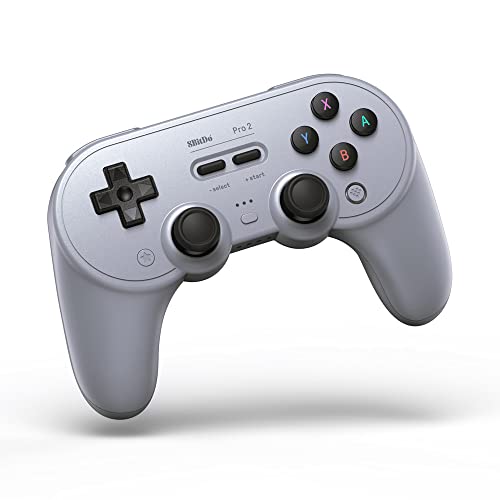
| 8BitDo Pro 2 | Best value with back paddles | 4 remappable buttons, firmware editor | $35-$45 | The value king; retro-friendly ergonomics |
| GameSir G7 SE | Wired competitive Xbox play | Hall-effect sticks + triggers, wired | $40-$50 | The drift-proof wired competitive pick |
| HORI Wireless HORIPAD | Lightweight all-day pad | 260g, official Switch/PC support | $55-$65 | The lightest 2.4GHz pick that is still good |
| MAYFLASH F500 Arcade Stick | Fighting games | Sanwa-clone parts, universal ports | $80-$95 | The right tool for fighting-game mains |
🏆 Best Overall: Sony DualSense Wireless Controller — $74
The Sony DualSense is our default PC-controller pick in 2026 for one reason: it is a first-party pad from a major console vendor, and Steam Input has full support for its haptics, adaptive triggers, touchpad, and gyro out of the box. Plug in over USB or pair over Bluetooth and Windows sees it as an XInput device with extended features accessible via Steam. No drivers, no third-party remapper, no restart.
The actually-good specs that make it worth the $65-$75: linear resonant actuator "haptics" instead of rumble motors (they feel textured, not shaky), adaptive triggers that resist your finger to simulate a bow draw or a gun grip, a large capacitive touchpad that some games use as a keyboard, a mono speaker on the pad itself for radio chatter, and gyro that Steam Input can layer on top of the right stick for finer aim. Battery life is 8-10 hours mixed use over Bluetooth, which is average — the DualSense drains fast because haptics and adaptive triggers cost power. Get used to charging it during the day.
Where the DualSense wins over the Xbox Series pad: haptics are a genuine gameplay signal in the games that support them (first-party Sony PC ports, and a growing list of PC-only games that have added support). Where it loses: the D-pad is not competitive for fighting games (get the arcade stick or the 8BitDo for that), and the touchpad is a novelty in most non-Sony titles. If you want one pad, and you do not mind carrying a charging cable, this is the pad.
💰 Best Value: 8BitDo Pro 2 Bluetooth Controller — $39.99
The 8BitDo Pro 2 is what we hand to anyone who wants "gaming pad, not console pad" and does not want to spend $80 on a wired competitive pad or $150 on a pro-tier remappable pad. It is $40. It has four back paddles that are physically comfortable to reach (unlike some pro pads where the paddles are too far up the back). It has an on-device firmware editor via 8BitDo's Windows/macOS app that exposes every stick, button, and paddle as a remap target with per-profile dead zones. It has a physical mode switch on the back that flips between Switch, X-Input, D-Input, and macOS profiles.
Where the Pro 2 beats pads two or three times its price: the firmware editor is the whole point. You can create a "Metroidvania" profile that remaps the back paddles to dash and attack, a "Souls-like" profile that puts heavy attack on a back paddle so your thumb stays on the right stick for camera control, and a "generic" profile that just makes it a normal Xbox pad — and you switch with a chord on the pad, not in software. Nothing else at $40 has this.
Two honest limitations. First, the sticks are conventional potentiometer sticks, not hall-effect, so long-term drift is a real risk after 12-18 months of heavy use (though 8BitDo's warranty desk has been responsive on drift cases). Second, the ergonomics are deliberately SNES-shaped — wider, flatter, less "gaming-cockpit" than an Xbox pad. Some players love it, some players find the offset stick placement uncomfortable. Read reviews from small-hand owners if you are unsure.
🎯 Best for Wired Low-Latency: GameSir G7 SE Wired Controller — $44.99
The GameSir G7 SE is the pad we send to anyone who wants "Xbox-shape, wired, drift-proof, cheaper than an Xbox Elite" and does not need Bluetooth or wireless at all. Hall-effect thumbsticks. Hall-effect triggers. Xbox Series X|S native licensing. A 3.5mm audio jack on the pad. A shipping cable that is actually detachable, not molded in. All for $45.
Why hall-effect matters at this price: the drift problem that has plagued Xbox pads for two console generations is caused by potentiometer wear on the analog sticks. Hall-effect sensors use a small magnet and a solid-state sensor, so there is no wear surface, and no drift at year one, year two, or year five. Until 2023 you paid $150-$200 for hall-effect sticks on a competitive pad. That has now trickled down to $45, and the G7 SE is the cleanest execution of it we have tested.
Where the G7 SE loses: no wireless. That is not a bug for the intended use case (wired competitive play on a desktop or wired console play on a TV that is 6 feet from the couch), but if you play from the couch across a big living room, the G7 SE is not the pick — get the DualSense or the HORIPAD instead. Also, the G7 SE has no gyro, so if you want mixed-input aim in a supported title, this is not the pad.
⚡ Best Lightweight: HORI Wireless HORIPAD — $59.95
The HORI Wireless HORIPAD is the pick for players who found the Xbox Series X pad too heavy after a 3-hour session. HORI's licensed Nintendo Switch pad is 260 grams (against 287g for the Xbox pad, and 280g for the DualSense) and the reduced weight shows up in wrist and thumb fatigue during long sessions. It uses a 2.4GHz USB dongle for the wireless connection instead of Bluetooth, which gives it lower input latency than the DualSense over BT — meaningful for tempo-heavy 3D action games.
The compatibility caveat: this is an officially-licensed Switch controller, so it enumerates as a Switch pad on Windows. That means Steam Input treats it correctly, and any Steam game works, but non-Steam launchers (Epic, GOG Galaxy, ubisoft Connect) may need a small compatibility profile from the Steam controller manager. This is a 30-second task in Steam Big Picture; it is not a driver install.
Where the HORIPAD wins: lightweight, low-latency wireless over a dedicated 2.4GHz link, and a symmetrical stick layout that Switch fans and some retro-inclined PC players find more comfortable than the offset Xbox layout. Where it loses: no gyro-through-Steam-Input on par with DualSense, no haptics, and if you play a lot of games outside Steam the launcher-level compatibility work will get annoying. Recommended if you already know you want the light, symmetrical Switch shape on PC.
🧪 Best for Fighting Games: MAYFLASH F500 Universal Arcade Fighting Stick — $84.98
The MAYFLASH F500 is the correct fighting-game input for PC in 2026 if you play Street Fighter 6, Tekken 8, Guilty Gear Strive, Under Night In-Birth 2, or any of the retro fighter revivals that keep landing on Steam. It is a full-size wooden-body arcade stick with an eight-way Sanwa-clone Lever and eight Sanwa-clone action buttons, three system buttons, a headphone jack, and a Turbo mode you should ignore. Universal compatibility means it works on Switch, Xbox Series/One/360, PS4/3, Windows, macOS, Android, Raspberry Pi, and Steam Deck via a mode switch on the panel.
Why this over a gamepad for fighting: motion inputs (quarter-circles, dragon-punches, 360s) are more consistent on a lever than on a thumbstick, and rapid multi-button chords (light-medium-heavy links, EX moves) are physically easier on a horizontal button plate than on the four face buttons of a gamepad. If you play fighting games seriously and want to be able to play the same character on ranked as pros do at EVO, you buy an arcade stick, and the F500 is the cheapest current stick that does not compromise on lever and button parts.
Where the F500 loses: literally everywhere outside fighting games. It is a poor pad for platformers, first-person shooters, driving games, and anything else — the diagonals of the lever are not that precise for aiming, and there is no analog input. Buy it as your second controller if fighting games are a major part of your library; do not buy it as your only controller.
What to look for in a PC controller
Stick technology (potentiometer vs. hall-effect)
Potentiometer sticks wear out and drift. Hall-effect sticks do not. Under $30, everything is potentiometer. From $40 up you can get hall-effect, and the price premium keeps dropping — the G7 SE at $45 is currently the cheapest full-set-of-hall-effect pad on the market. If you play daily and expect the controller to last 3+ years without repair, hall-effect is worth the $10-$15 markup.
Wireless mode (Bluetooth vs. 2.4GHz)
Bluetooth is convenient (no dongle) but slightly higher latency (typically 8-12ms end-to-end on 5.3, versus 3-5ms on a dedicated 2.4GHz dongle) and it drains battery on the pad slightly faster. For competitive shooters and fighting games you want either wired or a 2.4GHz dongle; for everything else Bluetooth is fine and less annoying to carry.
Remap and profiles
The single biggest feature-per-dollar upgrade in this category is on-device remapping (the 8BitDo Pro 2's firmware editor and mode switch, or Steam Input profiles synced through Steam Cloud). If you play games where the default control layout fights your muscle memory, remap. It is 15 minutes of setup and adds years of comfort.
Gyro
Gyro is meaningful in first-person shooter titles that support "flick stick" or gyro-assisted aim (Splatoon lineage games, some indie shooters, most first-person games that added gyro support through Steam Input in 2024-2026). The DualSense and Switch-native pads have first-party gyro; Xbox-shape pads generally do not.
Skip: "gaming controllers" from unknown brands under $20
Every generation there is a wave of $15-$20 no-brand pads on Amazon with a huge feed of 4.5-star reviews from the same three-week window. Stick to the brands with a multi-year continuous listing history: Sony, Microsoft, 8BitDo, GameSir, HORI, MAYFLASH, Nacon, and Razer are all in this bucket. Anything else at $20 is a coin flip on whether the sticks last 6 months.
Real-world scenarios
"I play everything, one pad only." DualSense. Absorb the haptics and adaptive-trigger overhead, plug in when you need latency, unplug when you want couch play.
"I play RPGs and Metroidvanias on Steam, I want back paddles." 8BitDo Pro 2. Cheapest way to get back-paddle remaps that actually work.
"I only play at the desk, no couch, no wireless." GameSir G7 SE. Wired, hall-effect, cheap, drift-proof.
"I want the lightest wireless pad." HORIPAD.
"I play Street Fighter 6 and Tekken 8 competitively." MAYFLASH F500 as your fight input, plus a cheap pad for everything else.
Common pitfalls
Buying an Xbox Elite Series 2 for drift-prone stock sticks. Skip it. Buy the G7 SE and put the $130 saving into a better mouse and headset.
Buying a cheap "PS5-style" no-brand pad. They typically look like a DualSense, use potentiometer sticks that drift in 6-9 months, and have no working haptics on PC. Save up for a real DualSense.
Trying to play fighting games on a stock D-pad. The Xbox pad D-pad has been unreliable for motion inputs since the 360. If you play fighters, invest in the F500 or a modern hitbox — the stock D-pad is not the answer.
Related guides
- Best Budget Gaming Peripherals Under $50 in 2026 — the input, audio, and surface companion to this controller guide
- Best Budget PC Gaming Upgrades Under $150 in 2026 — the upgrades that make the games look and feel good, once your controller is sorted
- Best 4K Monitor Under $700 in 2026 — the display for the couch setup you are pairing this controller with
Sources
- Tom's Hardware — Best PC Game Controllers — reference bench for controller latency and stick characterization methodology
- RTINGS — measured latency, weight, and durability rankings for the pads referenced above
- Sony — DualSense product page — first-party spec for haptics, adaptive triggers, and battery life
Prices in this article were checked July 4, 2026.