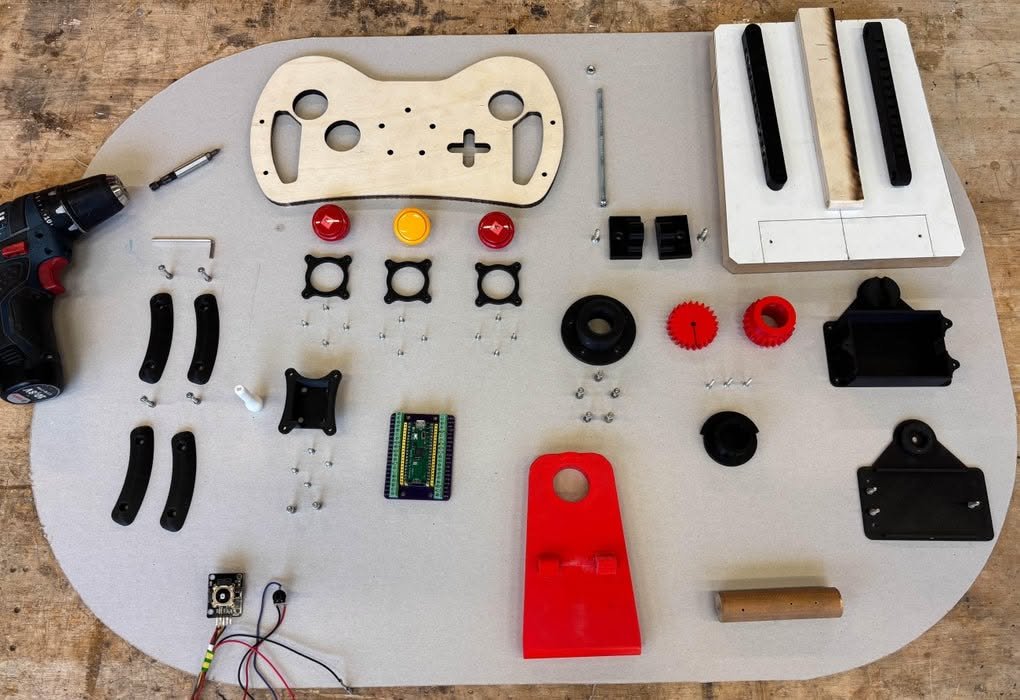
A team at the Belgian Designed for Everyone (D4E1) program just released V2 of an open, 3D-printed steering-wheel controller for the Nintendo Switch Lite and standard Switch, aimed at players who can't comfortably use a traditional gamepad. The V2 iteration refines the housing, swaps in better-feeling inputs, and ships full print files plus a parts list so other makers can build one. It is one of the cleanest demonstrations in 2026 of how 3D printing is quietly reshaping accessible gaming — and it is also a useful jumping-off point for thinking about commercial racing wheels like the HORI Racing Wheel Overdrive when a fully custom build is more than you need.
What happened
The D4E1 design team published V2 of the Switch Steering Wheel build through Adafruit's coverage, documenting an iteration of an earlier accessibility project. The wheel is a steering-style controller — a one-handed-friendly housing, large rotation surface, and a small set of adapted buttons — that connects to a Switch or Switch Lite using standard input methods. The team's writeup includes the 3D-printable parts, the electronics bill of materials, and assembly notes, and a build like this typically takes a weekend for someone already comfortable with a Prusa or Bambu-class printer.
The "V2" label matters. V1 was a working proof of concept; V2 is a refinement informed by user feedback. Reports point to a sturdier shell, a more comfortable rotation axis, and revised button placement that makes the wheel easier to grip for players with limited fine motor control. The team did not redesign the whole controller — they iterated on the failure points actual users hit. That iterative loop, with the design files staying open the whole time, is what makes the project interesting beyond the immediate accessibility win.
Why it matters
Accessible gaming hardware has had a slow few years in the mainstream market. Microsoft's Xbox Adaptive Controller remains the canonical commercial product, but it is expensive, complicated to set up, and almost entirely Xbox-oriented. Sony's Access Controller is a quality alternative on PlayStation but priced as a premium accessory. Nintendo, meanwhile, has invested very little in first-party accessibility hardware for the Switch family. That leaves a meaningful gap on a platform that millions of casual players, kids, and seniors actually own.
3D-printed and maker-built accessibility hardware fills that gap, and it does so with three advantages a commercial product struggles to match. First, the design is tunable per user — when a single button is in the wrong place, the housing can be re-printed in a few hours. Second, the cost floor is low enough that a school, library, or community makerspace can afford to keep a printer's worth of these on hand. Third, the project files are open, so a parent who needs one for their child does not have to lobby a global hardware company to add support.
The Switch is a particularly good target platform for this kind of work. It has a large installed base of family-friendly games, the Switch Lite costs less than $230 retail, and Nintendo's catalog includes the kinds of racing, party, and platformer games that are widely accessible in subject matter. A wheel-style controller specifically opens up racing games — Mario Kart 8 Deluxe being the obvious one — to players who can't manage a thumbstick. That is the kind of unlock that quietly changes whether someone gets to play with their family at all.
How the build slots into the broader sim-racing-on-Switch story
The D4E1 project is built for accessibility, not for competitive sim-racing — but it sits in an interesting middle ground next to two other categories of Switch wheel hardware.
On one side are the budget commercial wheels. The HORI Racing Wheel Overdrive, originally an Xbox accessory, has cousins in the HORI lineup that target the Switch family. They are aimed at casual racing fans and they do the basic job — wheel rotation, foot pedals, a small button cluster — at a price that makes sense for a kid's Mario Kart setup. They are not adaptive: they assume two hands, conventional thumb dexterity, and a stable seated posture. For players without those constraints, they are a fine commercial choice and far simpler than building anything yourself.
On the other side is the small but growing community of fully custom builds. Hobbyists in the Switch and sim-racing communities have been printing adapter brackets, mounting frames, and custom button boxes for years; the D4E1 wheel sits squarely inside this maker ecosystem. The big difference is that D4E1's work is explicitly accessibility-driven and rigorously documented, where most maker builds are one-off projects with sparse instructions. That matters for replicability — someone else with the same need can build the same wheel without reverse-engineering a thread of forum posts.
The wired HORI HORIPAD Pro Controller and Nintendo's official Pro Controller round out the picture for players who can use a traditional pad but want something more durable than the Joy-Cons. Together, the three product categories — adaptive custom builds, budget commercial racing wheels, and high-quality conventional pads — cover almost every player's needs on the Switch family. The interesting space the D4E1 project is operating in is the first category, where commercial alternatives don't really exist.
What you actually need to build one
For readers who want to attempt the build, the high-level shopping list is straightforward. You need a 3D printer capable of printing the wheel housing (a Prusa MINI, Bambu A1, or Ender 3 V2 all qualify), a roll of PLA in your preferred color, a small set of common electronics components, a soldering iron, and the project files. The total bill of materials is well under $100 for someone who already owns a printer, and meaningfully cheaper than a commercial adaptive controller even for someone who doesn't.
The bigger investment is time. A first build typically takes a full weekend — print, assemble, wire, test, troubleshoot, iterate — and the first one you make for a real user often gets a second iteration once they try it. That is a feature, not a bug. The whole point of the project is that the wheel can be tuned to the player, which means treating the first build as a draft and being ready to reprint a part if a button is in the wrong place.
If you want to take the project on for someone else, recruit them into the build. Print decisions about color, button placement, and rotation feel are best made by the person who will actually use the wheel, and watching them attempt to grip an early test print is far more useful than guessing. Builders who skip that step almost always have to reprint the housing later.
When the commercial route is the right one
The D4E1 build exists for a specific reason: there is no commercial product that solves the problem. For players who do not have accessibility constraints and just want a steering wheel for casual Switch racing, that reason does not apply, and the right move is a commercial wheel. The HORI Racing Wheel Overdrive and its Switch-targeted siblings are inexpensive, immediately compatible, and don't require a printer or a weekend. They lack adaptive features by design — that is the trade.
The decision tree is honestly quite simple. If a conventional gamepad is uncomfortable, painful, or physically not viable for the player, look at the D4E1 wheel and similar maker builds — or at the commercial Xbox Adaptive Controller / PlayStation Access Controller routes if you need a turnkey product and can afford the premium. If a conventional gamepad is fine and you just want a steering wheel for the fun of it, a budget commercial wheel like the HORI is a better use of your time than building one yourself. The two categories serve different needs, and the maker community is largely focused on the first.
What 3D printing has changed in accessible-gaming hardware
The Switch Steering Wheel V2 is part of a broader shift that has been quietly underway since affordable resin and FDM printers became commonplace. The Open Source Assistive Technology (OATS) project, the Makers Making Change network, and dozens of academic disability-tech labs have collectively built up a library of printable adaptive devices — joystick toppers, switch mounts, controller bracing, eye-gaze rigs — that simply did not exist as accessible products five years ago. The economics of a $300 printer and a $25 spool of PLA make it feasible for a parent, teacher, or sibling to produce the right piece of hardware for one specific player, then share the file with the next family that needs it.
D4E1 sits inside that movement and is one of its more sophisticated outputs. It is documented properly, iterated based on real feedback, and explicitly targets a major mainstream platform rather than a niche console. That combination of documentation, iteration, and platform reach is what makes the V2 release worth noting beyond the immediate "cool 3D-printed thing" story. It is a template other accessibility builders can borrow.
Tools and platforms worth knowing if you want to follow this work
If the D4E1 project lights you up and you want to follow the broader space, there are a few specific places to look. Adafruit's accessibility section catalogs build writeups including the D4E1 work. Makers Making Change runs a global network of volunteers who build adaptive devices on request and maintains a project library indexed by need. Hackster and Hackaday both regularly cover accessibility builds, often before they hit broader audiences. For the Switch ecosystem specifically, Reddit's r/NintendoSwitch and the various retro-gaming forums are where parents and players surface needs that a maker might address.
If you have a printer and you want to start contributing, the lowest-friction first step is to print one of the existing OATS or Makers Making Change designs for someone who needs it. The bigger contribution — designing a new device that solves a problem no commercial product addresses — usually starts the same way: you watch a specific person struggle with a specific piece of hardware, then prototype your way to something that works for them.
How the Switch hardware itself fits in
The Switch Lite is the natural target for this kind of build. It is the cheapest member of the family, the most self-contained, and it is the version most often bought as a kid's first console or a hand-me-down. Its single-mode handheld form means a player who can't manage Joy-Cons can't easily detach and remap them, which is precisely the constraint the D4E1 wheel works around. The standard Switch is fine too — the wheel doesn't care which version of the console you have — but the Lite is where the accessibility argument is sharpest.
For a non-adaptive player who still wants a more durable input than the Joy-Cons, the HORI Wireless HORIPAD Pro Controller is a solid budget alternative to Nintendo's first-party Pro Controller. It costs less, the build is good, and it slots into the standard Switch software without any special setup. It is not adaptive — that is what the D4E1 wheel exists for — but it is a sensible upgrade for the rest of the family.
What to watch next
Two things make this project worth tracking. First, the V2 release suggests the team is continuing iteration. A V3 that improved the rotation feel further or added a second button cluster would broaden the set of games the wheel works for. Second, the wider 3D-printed accessibility movement is starting to coalesce around shared standards — mounting hole patterns, common interfaces to the Xbox Adaptive Controller's 3.5mm jacks, recommended materials. As those standards settle, projects like D4E1's wheel become easier to adapt to other platforms and other players.
If you want to follow the project specifically, the original Adafruit writeup is the best starting point — it links to the design files and the team's documentation, and it credits the people who actually built the thing.
The source
The D4E1 team's work was documented through Adafruit's coverage of the project. We link the source below so you can read the original parts list, print files, and assembly notes directly from the designers rather than from a secondhand summary. For accessibility builds especially, going to the primary source matters: small details in the documentation — torque values, recommended print orientations, notes about which buttons replaced which — often make the difference between a build that works for a specific player and one that doesn't.
Related guides
- Best Controller for Raspberry Pi Retro Emulation in 2026
- Best Sim-Racing Wheel and Shifter Setup for Beginners in 2026
- Build a Pi Zero W Handheld Retro Emulator in 2026
- Revive a Dead Payphone with a Raspberry Pi Zero 2 W

