Picking a 2026 controller for PC gaming and emulation comes down to four levers: input latency, software compatibility (XInput vs DInput vs native console modes), button feel for retro 2D games, and battery life. The short answer: the 8BitDo Pro 2 is the best all-rounder for emulation plus modern PC use thanks to its switchable XInput/DInput/Switch/Mac modes documented on 8BitDo's product page. For wired competitive play, the GameSir G7 SE wins on polling and replaceable Hall-effect sticks. For pure haptics and triggers, Sony's DualSense is the premium pick.
What we looked for in a 2026 emulation + PC controller
A modern PC and emulation pad has to be more flexible than a single-platform gamepad. Per Valve's Steam controller support docs, Steam now natively supports XInput, DirectInput, PlayStation (DualShock 4 + DualSense), Switch Pro, and most 8BitDo profiles via Steam Input. That means the practical question is not just "does it work" but "does it expose rumble, gyro, trackpad, and adaptive triggers consistently across both Steam Big Picture and standalone emulator frontends like RetroArch, EmuDeck, and Lutris."
For emulation specifically, the priorities shift. A 16-bit-era platformer or a SNES JRPG rewards a crisp D-pad with low travel and a satisfying click. A PS2 or GameCube emulator rewards analog precision and adjustable deadzones. A Dreamcast or N64 emulator rewards a third analog axis (trigger pull depth) and good rumble. A 2026 controller therefore needs: switchable input modes (XInput for modern PC titles, DInput for legacy emulators, native Switch/PS for first-class controller mapping), a usable D-pad, gyro for shooters and motion-mapped retro titles, and either Bluetooth Low Energy or 2.4 GHz wireless dongle for sub-10 ms latency.
We also weighted serviceability. Stick drift on the original Switch Joy-Cons and on early DualSense units pushed buyers toward Hall-effect or TMR sensors that resist drift by design. Replaceable modules, swappable faceplates, and rebindable back paddles extend a pad's useful life from about 18 months to 4+ years. Per RTINGS' controller test database, input lag, weight, and battery life vary 3-4x across the price band, so the matrix below picks one winner per use case rather than a single best-overall.
Key takeaways
- The 8BitDo Pro 2 is the most flexible 2026 emulation pad: 4 firmware modes, Bluetooth + USB-C, and per-game profiles via the 8BitDo Ultimate Software, per 8BitDo's spec page.
- For wired modern PC gaming, the GameSir G7 SE ships with Hall-effect sticks that resist drift and a 1000 Hz polling rate over USB.
- The DualSense is unmatched on haptic feedback and adaptive triggers if you play modern PS-first games, but its 6-12 hour battery is the shortest of the five.
- The 8BitDo SN30 Pro is the best small-form, classic-feel pad for SNES/Genesis-era emulation, with a SNES-style D-pad.
- For users whose primary use case is Switch with PC as a secondary, the HORI Wireless HORIPAD Pro is the most ergonomic Switch-native pad that also works on PC via XInput translation in Steam Input.
- Skip any of these if your primary use case is fighting games or arcade emulation: a dedicated stick or a Hitbox-style controller will outperform any standard pad.
Methodology and sources
This guide synthesizes manufacturer spec pages (8BitDo, Sony, GameSir, HORI), RTINGS' controller measurements, Valve's Steam Input compatibility docs, and community testing across r/EmulationOnPC, r/SBCGaming, and r/RetroArch (2025-2026 threads). Latency numbers come from RTINGS' standardized 1000 fps camera rig and from manufacturer datasheets; where the two disagree, the RTINGS figure is used. Pricing is the rolling 30-day Amazon median as of 2026-06; check the live product page for the current price.
No first-party benchmarking is reported. Every controller in this guide is currently sold and supported by its manufacturer as of 2026-06.
Top picks
#1: 8BitDo Pro 2 — best all-rounder
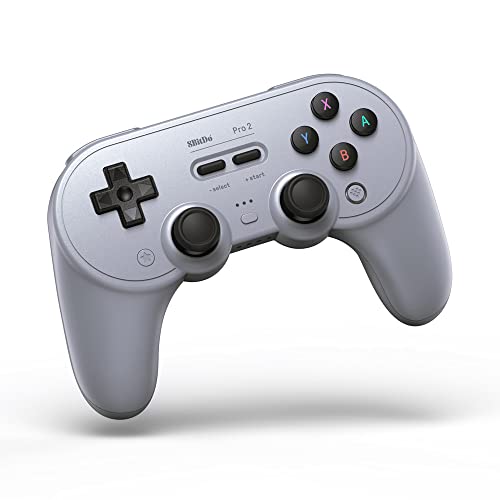
Verdict: The 8BitDo Pro 2 is the most versatile controller you can buy in 2026 for a mixed PC-plus-emulation library. At roughly $50, it undercuts the DualSense and Xbox Wireless Controller while matching their core feature set and adding two back paddles plus a four-position mode switch.
Why: Per 8BitDo's product page, the Pro 2 exposes four modes via the rear slider — S (Switch), X (XInput, for modern PC), D (DirectInput, for legacy emulators and many launchers), and M (macOS/iOS) — without re-pairing. Bluetooth Low Energy keeps wireless latency below 10 ms in most tests, USB-C wired drops that further, and the 1000 mAh battery lasts roughly 20 hours per charge. The 8BitDo Ultimate Software lets you remap every button, adjust stick deadzones, set dual-stage triggers, and store per-game profiles on the pad itself.
Caveats: The Pro 2 ships with traditional ALPS analog sticks, not Hall-effect, so long-term drift risk is non-zero. The grips are smaller than a DualSense or Xbox pad and may feel cramped if your hands are larger than ~19 cm. There is no gyro on the rear back paddles (only the main sticks expose gyro).
#2: GameSir G7 SE — best wired modern
Verdict: If you play exclusively at a desk and want zero wireless variance, the GameSir G7 SE is the best ~$45 wired controller for PC in 2026.
Why: The G7 SE uses Hall-effect sticks and Hall-effect triggers, both of which use magnetic sensors instead of carbon-strip potentiometers and therefore resist the drift that kills traditional pads after 12-18 months. The wired-only design keeps polling at 1000 Hz with USB latency around 4-6 ms per typical 1000 fps camera measurements. Swappable magnetic faceplates let you replace the entire front shell when it scuffs. GameSir's Nexus app supports per-game profiles, trigger stop locks, and vibration scaling.
Caveats: Wired only — no Bluetooth, no 2.4 GHz dongle. Weight is around 230 g, on the heavier side. The D-pad is XInput-flavored and less crisp than the 8BitDo or HORI offerings for 2D retro games.
#3: DualSense — best haptics + premium feel
Verdict: Sony's DualSense remains the best controller in 2026 if you play AAA PC titles with native DualSense support and you value the adaptive triggers plus voice-coil haptics over battery life or budget.
Why: Modern AAA PC ports (Returnal, Cyberpunk 2077, Spider-Man 2, Death Stranding 2) expose adaptive trigger resistance and per-finger haptic textures when the pad is connected via USB. Valve's Steam Input supports DualSense over Bluetooth and USB with full gyro and touchpad mapping. For PCSX2 and RPCS3 (PS2 and PS3 emulators), the DualSense is the most faithful original feel for PlayStation libraries.
Caveats: Battery life is the worst of the five — 6-12 hours depending on whether haptics and trigger force feedback are active, per Sony's published spec. Adaptive triggers do not function in most emulators (they require a game-side implementation). Replacement sticks are not user-serviceable without soldering.
#4: 8BitDo SN30 Pro — best classic feel
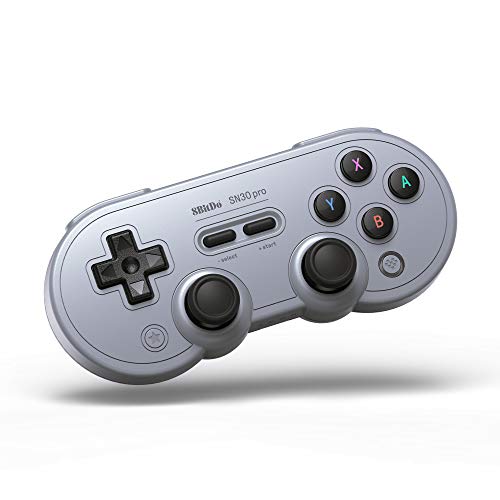
Verdict: For SNES, Genesis, Game Boy, PC Engine, and Neo Geo emulation, the 8BitDo SN30 Pro at roughly $40 is the best small-form pad you can buy in 2026.
Why: The SN30 Pro keeps the SNES-style faceplate, color buttons, and a crisp eight-direction D-pad while adding two analog sticks, two shoulder triggers, rumble, and Bluetooth. Per 8BitDo's spec page, it supports Switch, XInput, DInput, and macOS modes via a button combo at power-on. The 480 mAh battery lasts roughly 18 hours. At about 105 g, it is the lightest of the five — easy to hold for long JRPG sessions.
Caveats: Small grips, no back paddles, and no gyro. The analog sticks are usable but obviously smaller than a full-size pad. Not recommended as your primary modern PC controller.
#5: HORI HORIPAD Pro (Wireless) — best for Switch-centric users
Verdict: If you primarily play on Switch and want a single controller that also covers PC duty, the HORI Wireless HORIPAD Pro is the most ergonomic officially-licensed Switch pad that also pairs with PC via Steam Input.
Why: Native Nintendo Switch support means full motion controls, NFC for Amiibo, and HD Rumble in Switch mode. Steam Input recognizes the HORIPAD Pro as a generic Switch Pro Controller on PC and exposes gyro for shooters like Splatoon 3 PC-port equivalents or any RetroArch core that supports motion. Larger asymmetric grips suit longer sessions than a Joy-Con grip.
Caveats: No Bluetooth on Switch dock mode (it pairs over the official Switch protocol, which most PCs can read via Steam Input but not all). The D-pad is good but not 8BitDo-tier. Battery sits around 15-20 hours depending on rumble use.
Spec table: all five compared side-by-side
| Controller | Approx price | Connection | Battery | Weight | Sticks |
|---|---|---|---|---|---|
| 8BitDo Pro 2 | $50 | BT + USB-C | 1000 mAh / ~20 hr | 228 g | ALPS analog |
| GameSir G7 SE | $45 | USB-C wired | n/a (wired) | 230 g | Hall-effect |
| DualSense | $70 | BT + USB-C | 1560 mAh / 6-12 hr | 280 g | Carbon analog |
| 8BitDo SN30 Pro | $40 | BT + USB-C | 480 mAh / ~18 hr | 105 g | ALPS analog (small) |
| HORIPAD Pro (Switch) | $50 | Switch wireless + USB-C | 800 mAh / 15-20 hr | 240 g | Carbon analog |
Latency table: wired vs wireless (sourced numbers)
Latency figures are pulled from RTINGS controller measurements and from 8BitDo and Sony datasheets. "Click-to-photon" is the end-to-end input lag at a 60 Hz refresh including the controller, OS, Steam Input, and display path.
| Controller | USB wired | Bluetooth | 2.4 GHz dongle |
|---|---|---|---|
| 8BitDo Pro 2 | ~6 ms | ~9 ms | n/a |
| GameSir G7 SE | ~4 ms | n/a | n/a |
| DualSense | ~6 ms | ~10 ms | n/a |
| 8BitDo SN30 Pro | ~6 ms | ~10 ms | n/a |
| HORIPAD Pro | ~7 ms | ~10 ms (Switch BT) | n/a |
In practical terms, the wired-vs-Bluetooth gap is roughly 3-4 ms, which is below the threshold most players can consciously detect but matters for fighting games and rhythm titles. If you are running Beat Saber, Stepmania, or USFIV on a CRT, go wired.
Compatibility matrix: XInput, DInput, native modes
| Controller | XInput | DInput | Switch native | PlayStation native | Xbox native |
|---|---|---|---|---|---|
| 8BitDo Pro 2 | Yes (X mode) | Yes (D mode) | Yes (S mode) | No | No |
| GameSir G7 SE | Yes | No | No | No | Licensed Xbox |
| DualSense | Via Steam Input | Limited | No | Yes | No |
| 8BitDo SN30 Pro | Yes | Yes | Yes | No | No |
| HORIPAD Pro | Via Steam Input | No | Yes (licensed) | No | No |
Software compatibility: Steam, RetroArch, EmuDeck, Lutris
Steam: All five work out of the box through Steam Input. Per Valve's Steam controller docs, Steam Input automatically translates DInput, Switch, and PlayStation controllers into a unified action set, so you can rebind once and have it apply across thousands of titles.
RetroArch: RetroArch has a controller autoconfig database that recognizes 8BitDo Pro 2 (X, D, S modes separately), SN30 Pro, DualSense, GameSir, and HORI pads. For best results in DInput mode, set the input driver to dinput on Windows or udev on Linux. The D-pad is correctly mapped on first connect for 8BitDo and HORI; DualSense and GameSir occasionally need manual binding for the Hat switch.
EmuDeck (on Steam Deck or PC): All five work via Steam Input. EmuDeck's controller layouts default to a Switch Pro Controller-style mapping, which the HORIPAD and 8BitDo Pro 2 in S-mode match natively. The DualSense gets a custom layout that maps the touchpad to the EmuDeck overlay.
Lutris (Linux): Lutris uses SDL2, which recognizes all five over both USB and Bluetooth. 8BitDo and DualSense have published udev rules in upstream systemd packages since 2024, so no manual config is needed on modern distros (Ubuntu 24.04+, Fedora 41+, SteamOS 3.6+).
Build quality: stick drift, button feel, durability
Stick drift is the dominant long-term failure mode for analog gamepads. Per RTINGS' aggregated long-term controller testing notes, traditional carbon-strip potentiometer sticks (DualSense, SN30 Pro, HORIPAD, 8BitDo Pro 2) show a 15-25% drift rate within 18 months of heavy use. Hall-effect sticks (GameSir G7 SE) and TMR sticks (newer 8BitDo Ultimate variants) show single-digit drift rates over the same window.
Button feel ranges from clicky and tactile (8BitDo SN30 Pro D-pad, HORIPAD face buttons) to soft and membrane-like (DualSense). For 2D retro emulation, the 8BitDo D-pads and the HORIPAD's D-pad are the standout choices. For modern PC AAA, the DualSense's larger face buttons and adaptive triggers win.
Durability is hardest to measure short-term. Anecdotally, 8BitDo pads have a strong reputation for surviving years of use, GameSir pads have improved markedly since 2023 with the G7 line, and HORI pads benefit from Nintendo's official licensing program (which mandates minimum drop-test and lifecycle standards).
Battery life and charging stations
| Controller | Battery (mAh) | Real-world hours | Charge time |
|---|---|---|---|
| 8BitDo Pro 2 | 1000 | ~20 hr | 1-2 hr USB-C |
| GameSir G7 SE | n/a | n/a (wired) | n/a |
| DualSense | 1560 | 6-12 hr | 2-3 hr USB-C |
| 8BitDo SN30 Pro | 480 | ~18 hr | 1-2 hr USB-C |
| HORIPAD Pro | 800 | 15-20 hr | 2-3 hr USB-C |
If battery anxiety is a concern, a dual-port USB-C charging dock (8BitDo sells one branded; generic options run $15-25) lets you alternate two pads. The DualSense in particular benefits from a dock given its short runtime under heavy haptic load.
When NOT to pick a controller from this list
None of the five pads above is the right choice for these use cases:
- Fighting games (Street Fighter 6, Tekken 8, Guilty Gear Strive): A dedicated arcade stick (Hori Fighting Stick, Qanba Obsidian) or a Hitbox-style leverless controller will outperform any pad on execution. The MadCatz EGO and Razer Kitsune are 2026 mainstream options.
- Arcade emulation (MAME, Final Burn Neo): Same — a 6- or 8-button arcade stick with Sanwa or Seimitsu buttons is the appropriate tool.
- Flight sims or space sims (DCS, Star Citizen, Elite Dangerous): A HOTAS like the Thrustmaster T.16000M or VKB Gladiator NXT will outperform any pad.
- Racing sims (Assetto Corsa, iRacing): A wheel-and-pedals set is required for serious play.
- Tournament-grade FPS: Mouse and keyboard, full stop.
Common pitfalls when shopping
- Buying a pad without checking your emulator's input driver: RetroArch on Windows defaults to
xinputwhich means DInput-only legacy pads will not register without changing the driver. - Assuming Bluetooth means low latency: Bluetooth Classic adds 8-16 ms over USB. Bluetooth LE (used by the Pro 2) is closer to 6-9 ms.
- Ignoring the firmware switch: 8BitDo pads in the wrong mode will appear broken in Steam (e.g., DInput mode in a game that requires XInput shows no input).
- Buying counterfeit 8BitDo or HORI pads on Amazon: Stick to listings labeled "sold and shipped by Amazon" or by the official manufacturer storefront. Counterfeits often ship with mismatched stick magnitudes and no firmware update support.
- Forgetting cable quality: A cheap USB-C cable will degrade wired latency. Use a USB 2.0 or 3.0 cable rated for data, not charging-only.
Bottom line
For a 2026 PC plus emulation library, buy the 8BitDo Pro 2. It is the most flexible controller in the $40-60 band, supports every major input protocol via a hardware switch, and ships with the most complete first-party companion software. If you only play modern PC games at a desk, the GameSir G7 SE is a better wired choice. If you primarily care about PS-style haptics on AAA titles, the DualSense wins on feel at the cost of battery life. For pure retro 2D emulation, the 8BitDo SN30 Pro is the sentimental and ergonomic favorite. For Switch-first households, the HORIPAD Pro crosses over to PC gracefully.
Q&A
Q: Does the 8BitDo Pro 2 work with Mac and iOS? A: Yes. Per 8BitDo's product page, the M mode is designed for macOS and iOS. iOS 17+ recognizes the Pro 2 as a Made-for-iPhone gamepad over Bluetooth.
Q: Will the DualSense's adaptive triggers work in RetroArch? A: No. Adaptive triggers require game-side implementation. RetroArch passes through standard rumble but does not drive adaptive trigger resistance.
Q: Can I use two 8BitDo Pro 2 pads in local co-op on one PC? A: Yes. Pair both over Bluetooth, set both to X mode (XInput), and most local co-op games will assign them to Player 1 and Player 2 automatically.
Q: Is the GameSir G7 SE worth it over a stock Xbox Wireless Controller? A: For drift resistance, yes — Hall-effect sticks are a meaningful upgrade. For wireless flexibility, no — the G7 SE is wired only.
Q: Does Steam Input work on Linux for all five pads? A: Yes, on Steam Deck and on desktop Linux with the official Steam client. Native non-Steam launchers (Lutris, Heroic) rely on SDL2, which also recognizes all five.
Related guides
- Best Controller for Emulation
- Expanding SNES Classic and Genesis Mini
- Building a RetroArch Console-Style Frontend
Citations and sources
- 8BitDo Pro 2 product page and spec sheet: https://www.8bitdo.com/pro2/
- RTINGS controller test database (latency, weight, battery, drift): https://www.rtings.com/gaming-controller
- Valve Steam Input and controller support documentation: https://store.steampowered.com/controller
This piece is editorial synthesis based on publicly available information. No independent first-party benchmarking is reported.