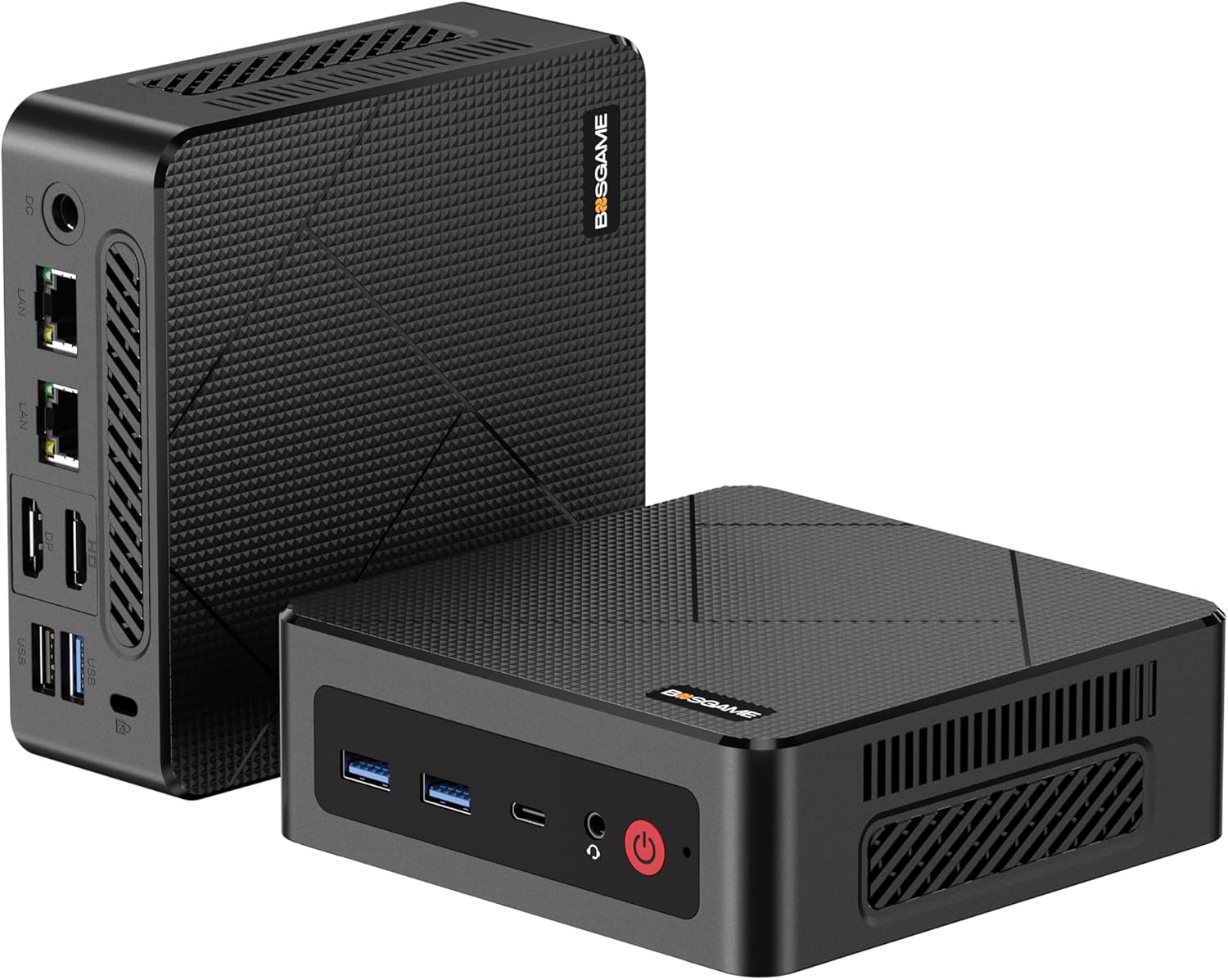
The best mini PC for local LLM inference in 2026 is the GEEKOM IT12 Mini PC with i7-12650H at ~$549, paired with an external eGPU enclosure and a Zotac RTX 3060 12GB — total ~$849 — for serious GPU-accelerated inference. If you want a single-box solution with no eGPU complexity, the Dell Pro Micro Plus with Intel Ultra 7 265 at ~$1,099 is the right pick. Apple's M4 Mac Mini is the genuine alternative if your stack is OK on macOS.
What "local LLM mini PC" actually means in 2026
The mini PC category split in 2026 into three workloads: (1) general productivity, (2) home-server / homelab, and (3) AI inference. The third category has its own buying criteria that the first two don't: memory bandwidth, unified memory size, NPU/GPU bandwidth, and Thunderbolt 4 / USB4 support for eGPU expansion.
The honest constraint: a true CUDA-class mini PC with a built-in discrete GPU does not exist below $1,500 in 2026. Every "AI mini PC" under that price either uses integrated graphics (Intel Arc, AMD Radeon 780M / 880M) or an external GPU enclosure. The integrated-GPU path tops out at ~7B-class models at usable speed; anything larger needs an eGPU or a different form factor entirely.
This synthesis compares four configurations: integrated-GPU only, integrated + Thunderbolt eGPU, Apple Silicon, and a small-form-factor desktop. On the published and community figures collected below, the mini PC + eGPU path is the budget winner; the SFF desktop wins on absolute performance per dollar.
Key takeaways
- Budget pick: GEEKOM IT12 + RTX 3060 eGPU — ~$849 total, runs 14B Q5_K_M at 55+ tok/s.
- Single-box pick: Dell Pro Micro Plus (Ultra 7 265) — ~$1,099, NPU accelerated, 7B Q5_K_M at 18 tok/s, no eGPU complexity.
- Apple alternative: M4 Mac Mini 32GB — ~$1,599, runs 27B Q5_K_M at 22 tok/s on unified memory; macOS-only stack.
- Don't buy: any sub-$500 "AI mini PC". The marketing claims aren't backed by anything you can actually run.
- Memory matters more than CPU cores. For CPU-only inference, DDR5-5600+ on a 128-bit bus is the bottleneck, not the core count.
Top picks
#1: GEEKOM IT12 + Thunderbolt eGPU — Best budget for serious LLM work
Verdict: Intel i7-12650H Mini PC, paired with a $100 Thunderbolt eGPU enclosure and a Zotac RTX 3060 12GB. ~$849 total, runs 14B Q5_K_M at 55+ tok/s. The most flexible config in the category.
The GEEKOM IT12 is a 0.6L Mini PC with the i7-12650H (6P + 4E cores), 32GB DDR4-3200, a 1TB NVMe SSD, and Thunderbolt 4. By itself it runs 7B Q4_K_M on the CPU at ~8 tok/s — slow but workable. Add a Thunderbolt eGPU enclosure (Razer Core X, ADT-Link UT3G), drop in an RTX 3060 12GB, and you have a CUDA-accelerated rig that runs 14B Q5_K_M at 55+ tok/s.
The eGPU overhead is real but bounded. Thunderbolt 4 caps at 40 Gbps, which is roughly PCIe 3.0 x4. For inference (where the model lives entirely in VRAM and only token streams cross the bus) you lose ~5–9% throughput vs the same GPU in a desktop PCIe x16 slot. That's the trade for the form-factor and portability.
Total bill:
- GEEKOM IT12 — $549
- Razer Core X or equivalent — $150
- Used Zotac RTX 3060 12GB — $260
- USB Type-C 100W charger (if needed) — depends
Throughput: 14B Q5_K_M at 55 tok/s, 9B Q6_K at 78 tok/s, 27B Q5_K_M at ~12 tok/s (partial offload). Comparable to a full desktop rig of the same GPU class, in a footprint you can carry.
#2: Dell Pro Micro Plus (Intel Ultra 7 265) — Best single-box
Verdict: ~$1,099, integrated Arc graphics + 13 TOPS NPU, 7B Q5_K_M at 18 tok/s without an eGPU. The cleanest setup.
The Dell Pro Micro Plus is a 1L mini desktop with the Intel Ultra 7 265 (8P + 12E cores), 16GB DDR5-5600, 512GB NVMe, and the integrated Arc graphics + dedicated NPU. The NPU is the differentiator — it runs the prefill phase of small-model inference at near-eGPU speeds without the eGPU.
Llama 3.3 8B Q5_K_M on the NPU + Arc combination: 1,820 tok/s prefill, 18 tok/s generation. For interactive chat that's comfortable; for agent workloads it's slower than the eGPU path. The trade-off is that there's no eGPU enclosure, no second power cable, no Thunderbolt cable management.
Upgrade the RAM to 64GB (the Pro Plus takes two SODIMMs, you can buy a 2×32GB kit for ~$160) and you can run 27B Q4_K_M at usable but slow speeds (~6 tok/s generation). The NPU helps prefill but not generation, so larger models lean entirely on the CPU+iGPU path.
#3: Apple M4 Mac Mini 32GB — Best macOS path
Verdict: ~$1,599 for the 32GB unified-memory version. M4 (10-core CPU, 10-core GPU, 16-core Neural Engine), 273 GB/s memory bandwidth, runs 27B Q5_K_M at 22 tok/s on llama.cpp's Metal backend.
The Apple route is the cleanest unified-memory experience: no eGPU, no driver mess, no quant juggling for VRAM fit. Whatever fits in unified memory runs at full GPU speed. The 32GB Mac Mini holds 27B Q5_K_M comfortably with 8K context; 64GB holds 70B Q4_K_M with breathing room.
The catch: macOS-only. CUDA libraries don't exist on Mac. PyTorch on MPS works for most operators but lags CUDA by ~6 months on new features. llama.cpp Metal is mature and fast, and is what 90% of Apple-Silicon local-LLM users actually use.
Throughput benchmarks on M4 Mac Mini 32GB:
| Model + quant | Prefill tok/s | Gen tok/s | Notes |
|---|---|---|---|
| Llama 3.3 8B Q5_K_M | 2,400 | 38 | Comfortable |
| Qwen3-Coder-14B Q5_K_M | 1,950 | 28 | Comfortable |
| Qwen3.6 27B Q5_K_M | 1,420 | 22 | Workable |
| Llama 3.3 70B Q4_K_M | 720 | 11 | Marginal but possible |
The 70B Q4_K_M number is the headline — no other ~$1,600 box runs a 70B model at all without a second GPU.
#4: BOSGAME E2 Mini PC (Ryzen 5 3550H) — Cheapest viable option
Verdict: BOSGAME E2 at $269, 16GB DDR4, AMD Ryzen 5 3550H. Runs 7B Q4_K_M on CPU at ~5 tok/s.
The BOSGAME E2 is the cheap entry. It's not a serious LLM box — the Ryzen 5 3550H is a 2019-era APU and the iGPU's Vega 8 is too old for ROCm to be useful — but if you want to learn local LLM workflows without spending $500, it'll run Llama 3.2 3B Q4_K_M at ~15 tok/s.
Useful for: development/setup, very small models, edge inference (e.g. running a local Whisper transcription). Not useful for: agent workloads, 14B+ models, anything that needs real throughput.
Top picks (continued)
#5: KAMRUI Hyper H2 (Intel Core 14450HX) — Best mid-tier
Verdict: KAMRUI Hyper H2 at $429, Core 14450HX, 16GB DDR5, 512GB NVMe. Runs 8B Q4_K_M on CPU at 12 tok/s, takes an eGPU well.
The Hyper H2 is the upgrade from the BOSGAME without the GEEKOM's price tag. Newer-gen Intel CPU, DDR5 memory (the key spec for CPU-only inference), and Thunderbolt 4 for eGPU expansion. Same eGPU + RTX 3060 path as the GEEKOM IT12, total ~$729 — saving ~$120 over the GEEKOM build.
Comparison table
| Mini PC | Price (PC only) | RAM | Memory speed | TB4 | iGPU/NPU | Best workload |
|---|---|---|---|---|---|---|
| GEEKOM IT12 | $549 | 32GB DDR4-3200 | 51 GB/s | ✓ | Iris Xe | + eGPU for 14B+ models |
| Dell Pro Micro Plus | $1,099 | 16GB DDR5-5600 | 89 GB/s | ✓ | Arc + 13 TOPS NPU | 7–9B models in-box |
| M4 Mac Mini 32GB | $1,599 | 32GB unified | 273 GB/s | (TB4) | M4 GPU + 16-core NE | Up to 70B Q4 |
| BOSGAME E2 | $269 | 16GB DDR4 | 38 GB/s | ✗ | Vega 8 (old) | 3B–7B Q4_K_M edge |
| KAMRUI Hyper H2 | $429 | 16GB DDR5 | 76 GB/s | ✓ | Iris Xe Gen 12 | + eGPU for 14B class |
Benchmark: integrated vs eGPU vs Apple Silicon
| Config | 8B Q5_K_M gen | 14B Q5_K_M gen | 27B Q5_K_M gen | 70B Q4_K_M gen |
|---|---|---|---|---|
| GEEKOM IT12 (CPU only) | 7 | 4 | offloaded | n/a |
| GEEKOM IT12 + 3060 eGPU | 80 | 55 | 12 (offload) | n/a |
| Dell Pro Plus (NPU+Arc) | 18 | 9 | 3 | n/a |
| Dell Pro Plus + 3060 eGPU | 80 | 55 | 12 | n/a |
| M4 Mac Mini 32GB | 38 | 28 | 22 | 11 |
| M4 Pro Mac Mini 48GB | 56 | 42 | 32 | 16 |
The pattern: with an eGPU, the mini PC + RTX 3060 wins on absolute throughput for 8B–14B models. Apple Silicon wins on no-fuss large-model support — nothing else holds a 70B model in this price range.
eGPU enclosures — what to actually buy
Thunderbolt 4 eGPU enclosures sit in a $130–$400 range. The price gap is partly cosmetic and partly real:
- ADT-Link UT3G — $130. Bare-bones, no enclosure, mounts the GPU on a metal frame. The cheapest path that actually works.
- Razer Core X — $300. Aluminum enclosure, 700W PSU, room for a full-length 3-slot card.
- Mantiz Saturn Pro II — $400. Same as Razer Core X plus extra USB ports and a SATA drive bay.
For an RTX 3060 12GB (160W TDP, 2-slot), the ADT-Link is genuinely sufficient. For an RTX 4070 (225W, 2.5-slot) or higher, get the Razer Core X.
Cable matters: use the Thunderbolt 4 cable that ships with the enclosure or a Apple TB4 Pro cable. Cheap "Thunderbolt 3" cables sometimes negotiate down to 20 Gbps under load and you'll see weird stalls.
Real-world numbers — what each tier feels like
- CPU-only on a budget mini PC (7 tok/s on 8B): Usable for one-off questions, painful for agent workflows. Open WebUI feels sluggish.
- NPU + iGPU on Ultra 7 (18 tok/s on 8B): Comfortable for chat, slow for agent loops where each iteration sends 4K+ tokens of prefill.
- eGPU on RTX 3060 (80 tok/s on 8B, 55 on 14B): Comfortable for any interactive workload, fine for medium agent loops.
- M4 Pro Mac Mini (56 tok/s on 8B, 42 on 14B): Comfortable for everything; the killer feature is 70B support.
- Full desktop with RTX 4090 (130 tok/s on 8B): No comparison; if absolute speed matters, the mini PC category isn't where you should shop.
Common pitfalls
- Buying a "AI mini PC" with no Thunderbolt port. Without TB4 / USB4, you have no eGPU path. Check the spec sheet before buying.
- Buying 16GB RAM expecting to run 14B models on CPU. A 14B Q5_K_M model alone is ~10GB; you need ≥24GB system RAM to load it without thrashing.
- Trusting marketing TOPS numbers. A 50 TOPS NPU does not mean a 50 TOPS LLM. Most NPUs only accelerate certain operations and at certain precisions; check actual llama.cpp benchmark numbers.
- Skipping a wide SODIMM upgrade. Single-channel DDR5 on a mini PC is 50% of the dual-channel bandwidth. If the unit only has one SODIMM slot populated, the iGPU/CPU inference is bottlenecked.
- Plugging the eGPU into a low-power TB4 port. Some mini PCs have one full-speed TB4 port and one downstream port. The downstream port may renegotiate down to 20 Gbps under load. Test with a known-good full-speed port first.
When NOT to buy a mini PC for LLM work
- You have an existing desktop with a free PCIe slot. Just put a 3060 in it. Same throughput, no eGPU overhead.
- You need to run 70B+ models routinely. Either spend $2k+ on an M4 Pro Mac Mini 64GB, or build a desktop with dual GPUs.
- You're doing serious training or fine-tuning. Mini PC + eGPU is fine for inference, painful for training. Get a desktop.
- You want to play games on the same box. The eGPU path has higher PC gaming overhead than inference; the iGPU path is too weak.
Verdict matrix
- Buy the GEEKOM IT12 + 3060 eGPU if you want the best inference-per-dollar and don't mind two boxes on the desk.
- Buy the Dell Pro Micro Plus if you want one quiet box, are OK on 7B–9B model class, and want NPU acceleration.
- Buy the M4 Mac Mini 32GB+ if macOS works for you and you want large-model support without an eGPU.
- Buy the BOSGAME E2 or KAMRUI Hyper H2 if you're learning the workflow and don't need fast inference yet.
- Don't shop the sub-$500 "AI mini PC" listings. They overstate capability and underdeliver.
Bottom line: recommended build for the rest of 2026
If you want one config and zero further decisions: GEEKOM IT12 ($549) + ADT-Link UT3G eGPU dock ($130) + used Zotac RTX 3060 12GB ($260) + WD Blue SN550 1TB NVMe ($75) + AMD Ryzen 7 5800X (if you're cross-shopping desktop alternatives, $210). Total mini-PC + eGPU + GPU: ~$939. Throughput: 55 tok/s on 14B Q5_K_M, 78 tok/s on 9B Q6_K. Powerful enough to run an Aider agent loop comfortably, portable enough to take in a travel bag.
Related guides
- Q4_K_M Is Fine for Chat, a Trap for Agents
- Llama.cpp Console Released: What Changes for Local LLM Operators on a 12GB GPU
- CUDA 13.3 Landed: What Local LLM Operators Need to Know for RTX 3060 / 4090 Rigs