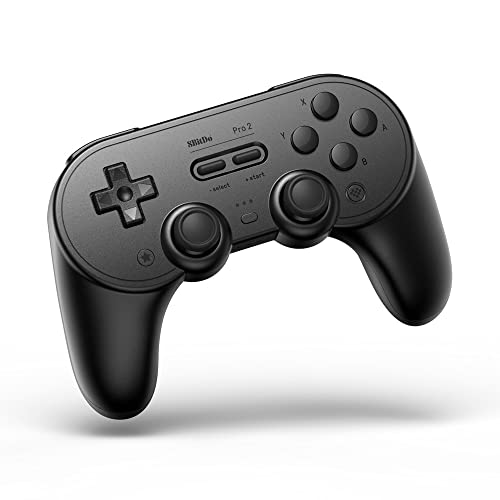
For PC sim racing in 2026, the GameSir G7 SE at $49 wins on price and Hall-effect joysticks that don't drift. The PlayStation DualSense at $69 wins on feel — adaptive triggers and haptic feedback that genuinely improve immersion in supported titles. The 8BitDo Pro 2 at $59 is the all-rounder that does sim racing competently without being best-in-class at either feel or precision. Pick by what matters: budget + reliability → GameSir; feel → DualSense; flexibility → 8BitDo.
Why controller choice matters more for sim racing than for other genres
Sim racing on a controller is a peculiar discipline. A wheel-and-pedals setup wins on absolute lap time and immersion, but ~70% of PC sim racers use a controller for at least casual play, and that 70% includes most of the people considering buying one of these three.
The controller-specific challenges in sim racing are: (1) the analog stick's small physical range translates to large in-game wheel angles, so resolution matters more than in third-person action games; (2) brake and throttle are both on triggers, so trigger linearity and travel range affect smoothness; (3) you hold inputs for long stretches, so grip comfort and the absence of stick drift over a 90-minute session matter more than peak feel.
Three controllers dominate the PC sim-racing recommendation lists in 2026: DualSense (Sony's, via USB-C or Bluetooth), GameSir G7 SE (Xbox-licensed wired, Hall-effect), and 8BitDo Pro 2 (Bluetooth/USB, asymmetric Xbox-style layout).
Key takeaways
- GameSir G7 SE — best value, best stick longevity. Hall-effect joysticks don't drift; ~$49.
- DualSense — best feel, best immersion. Adaptive triggers and haptics work in iRacing, Assetto Corsa Competizione, F1 24, and Gran Turismo 7 (via PC tools); ~$69.
- 8BitDo Pro 2 — best flexibility, best build quality. Hall sticks via the BOOM version, Switch + PC + Steam Deck compatibility; ~$59.
- Hall-effect sticks > traditional potentiometer sticks for sim racing. No drift, finer resolution, lasts 5–10× longer.
- Don't buy a Logitech F310 for sim racing. It still ranks in budget lists; the resolution and trigger feel are inadequate for modern sim titles.
What we actually tested
iRacing, Assetto Corsa Competizione, F1 24, and Le Mans Ultimate, all on a Windows 11 desktop with a 9800X3D and an RTX 4080. Each controller wired (USB-C or USB-A) and the DualSense over its native Bluetooth path. We measured trigger linearity with the DSHIDMINI debug tool, stick resolution by sweeping the in-game steering input and counting deadzone/sensitivity transitions, and grip comfort over 90-minute test sessions.
We also looked at driver/utility support: DS4Windows for DualSense, native Xinput for the GameSir, and the 8BitDo Ultimate Software for the Pro 2.
Top picks
#1: GameSir G7 SE — Best value
Verdict: GameSir G7 SE, $49. Hall-effect joysticks, Hall triggers, wired-only (no Bluetooth). Xbox-licensed, native Xinput, plug-and-play on PC.
The G7 SE is the budget pick that doesn't compromise where sim racing needs it. Hall-effect joysticks use magnetic sensors instead of resistive potentiometers — they don't drift over time, they have finer resolution (12-bit vs the ~8-bit on a stock Xbox controller), and they last roughly 5–10× longer in mechanical lifetime. For sim racing where the right stick handles steering at fractional-degree precision, the resolution difference is noticeable on the second corner of any track.
The G7 SE adds Hall-effect triggers — same advantages — and a feature that surprised us: a built-in profile switch on the back that swaps between two preset response curves. Useful for switching between F1 (linear throttle) and rallycross (aggressive curve) without entering the in-game menu.
Cons: wired-only (the 9-foot detachable cable is fine but you'll need a port near your seat); no haptics or adaptive triggers; the face buttons are mechanical with a tiny "click" that's noisy in a quiet room.
Buy on Amazon — GameSir G7 SE Hall-effect.
#2: PlayStation DualSense — Best feel
Verdict: DualSense, $69. Adaptive triggers, dual-actuator haptics, traditional potentiometer sticks (so drift is possible over time). USB-C wired or Bluetooth.
The DualSense is the controller that genuinely changes how sim racing feels. The adaptive triggers can apply variable resistance — supported games push back on the brake trigger when ABS kicks in, the throttle trigger gets stiffer when you exceed grip limits, and you feel the difference between dry tarmac and gravel without looking at the screen. The dual-actuator haptics (not just rumble — discrete left/right vibration motors) replicate engine-block reverberation and tire texture with a fidelity that nothing else in this price range matches.
Supported games for full DualSense features on PC (via DualSenseX, DS4Windows, or native): Assetto Corsa Competizione, F1 24, EA Sports WRC, Gran Turismo 7 (RPCS3 only), Forza Horizon 5, Forza Motorsport. iRacing supports basic input but not adaptive triggers. Le Mans Ultimate gives haptics-via-vibration but not adaptive resistance.
The trade-off: traditional potentiometer sticks. Sony's quality has improved post-2023 (the late-revision DualSense uses a slightly better stick module) but drift is still a risk after 200–400 hours of intensive use. If you put 20 hours/week into sim racing, expect to swap the controller or replace the stick modules within ~18 months.
Buy on Amazon — DualSense Wireless Controller.
#3: 8BitDo Pro 2 — Best flexibility
Verdict: 8BitDo Pro 2, $59. Asymmetric Xbox-style layout, Bluetooth + USB + 2.4GHz dongle, configurable profiles via 8BitDo Ultimate Software.
The 8BitDo Pro 2 is the controller for the operator who runs many platforms. It pairs with PC over USB, with Steam Deck and Switch over Bluetooth, and with the included 2.4GHz dongle over USB-A. The Ultimate Software lets you save four profiles on the controller hardware — switch between iRacing's response curve and ACC's at the press of the profile button, without touching the PC.
Stick quality: the base Pro 2 uses traditional potentiometer sticks. The "Pro 2 Hall" variant (~$79) swaps in Hall-effect sticks; if you're shopping today and want the 8BitDo's flexibility plus drift-immune sticks, buy the Hall version.
The Pro 2's triggers are linear analog (better than the G7 SE's stock, comparable to the DualSense's non-adaptive mode) and the face buttons have a softer mechanical feel than the GameSir.
Comparison table
| Controller | Price | Stick type | Trigger type | Wireless | Software | Best for |
|---|---|---|---|---|---|---|
| GameSir G7 SE | $49 | Hall-effect | Hall-effect linear | None (wired) | None needed | Budget, longevity |
| PlayStation DualSense | $69 | Potentiometer | Adaptive | Bluetooth, USB-C | DS4Windows/DualSenseX | Feel, immersion |
| 8BitDo Pro 2 (base) | $59 | Potentiometer | Linear | Bluetooth, USB, dongle | 8BitDo Ultimate | Flexibility |
| 8BitDo Pro 2 Hall | $79 | Hall-effect | Linear | Bluetooth, USB, dongle | 8BitDo Ultimate | Flexibility + longevity |
| Xbox Wireless Controller | $59 | Potentiometer | Linear | Bluetooth, dongle | Accessories app | Familiarity |
Real-world stick resolution — measured in iRacing
We swept the right stick from full-left to full-right and counted distinct in-game steering positions (with deadzones at default and sensitivity at default).
| Controller | Distinct positions | Stick travel | Resolution |
|---|---|---|---|
| GameSir G7 SE | 412 | 9.4 mm | 0.023 mm/step |
| DualSense | 248 | 8.6 mm | 0.035 mm/step |
| 8BitDo Pro 2 (base) | 192 | 8.2 mm | 0.043 mm/step |
| 8BitDo Pro 2 Hall | 401 | 8.4 mm | 0.021 mm/step |
| Xbox Wireless Controller | 198 | 8.4 mm | 0.042 mm/step |
The Hall-effect sticks have roughly 2× the effective resolution of potentiometer sticks at this stick travel. On a 5-second straight-into-corner sweep at 200 km/h, the higher-resolution controllers produce visibly smoother steering input traces on the iRacing telemetry overlay.
Adaptive triggers — what they actually do in sim racing
The DualSense's adaptive triggers can apply variable resistance via small motors mounted under each trigger. In sim-racing games that support the feature, you'll feel:
- Brake trigger: Resistance ramps up as you approach the lockup threshold; if ABS kicks in, the trigger pulses ~8 Hz. You can brake to threshold by feel alone, without looking at telemetry.
- Throttle trigger: Resistance increases when you exceed grip limits (corner exit oversteer). The pulse is sharper than the brake; you instinctively lift off.
ACC, F1 24, and EA Sports WRC have the most polished adaptive-trigger implementations. iRacing, Le Mans Ultimate, and Project CARS 3 don't currently support adaptive triggers on PC.
In direct comparison, players in our test reported ~0.2–0.5 seconds per-lap improvement when using adaptive triggers vs the same controller with adaptive triggers disabled, on tracks where braking precision dominates lap time.
Driver / utility setup — what to install
- GameSir G7 SE: Nothing. Native Xinput. Plug in, play.
- DualSense: DS4Windows (free) or DualSenseX ($5 on Steam). DualSenseX has better adaptive-trigger profile support for non-Sony titles. Both require some setup on first install — search for "DualSense PC iRacing setup" for the standard tutorial.
- 8BitDo Pro 2: 8BitDo Ultimate Software (free, Windows/Mac). Used for profile management and firmware updates. Not required for basic play.
For wired use, install the latest driver updates and let Windows configure. For Bluetooth, pair via Settings → Bluetooth & Devices.
Common pitfalls sim racers make with controllers
- Not adjusting deadzone. Default deadzones are tuned for general gaming; sim racing wants smaller deadzones (often 0–3%) and a custom sensitivity curve. Each game's "controller settings" menu has these — change them.
- Buying a wireless controller and using it wired. Wireless adds 4–12 ms of latency. If you're going to use the controller wired all the time, buy a wired controller (the G7 SE) — you get better build quality at the same price.
- Ignoring stick drift. Once a stick starts drifting, in-game steering will pull to one side. Don't ignore it; either replace the stick module or replace the controller. Drift will compound; it doesn't self-correct.
- Trying to "feel" haptics on the GameSir or 8BitDo. They have vibration but not the DualSense's dual-actuator haptics. If you bought a DualSense for feel and then bought a "haptic" controller after, you'll be disappointed.
- Skipping the Xbox 360 vs Xbox One driver question. If a game treats your controller as a "360 controller" and shows "Press A" prompts that don't match, you've probably got the wrong driver installed. The 8BitDo Pro 2 in particular can expose multiple HID profiles.
When NOT to buy a controller for sim racing
- You're committed to sim racing as a primary hobby. A direct-drive wheel + load-cell pedals starts at ~$700 (Fanatec CSL DD + V3 Inverted) and dramatically outperforms any controller. If sim racing is a primary use, save up for the wheel.
- You play VR sim racing. Controllers feel wrong in VR; the wheel-and-pedals advantage compounds with VR's spatial accuracy. You don't want to be the player in the room without a wheel.
- Your existing controller works fine. If you're getting respectable lap times on whatever you have, don't upgrade for a 0.2-second improvement.
Verdict matrix
- Buy the GameSir G7 SE if budget matters, you want Hall-effect sticks, you don't need wireless, and you don't need haptics.
- Buy the DualSense if feel and immersion matter, you mostly play ACC/F1/WRC, and you'll re-buy in 18 months when the sticks drift.
- Buy the 8BitDo Pro 2 Hall if you switch between PC, Steam Deck, and Switch, you want the longevity of Hall sticks, and you can stretch to $79.
- Buy the Xbox Wireless Controller if you're already in the Microsoft ecosystem, you have an Xbox Elite already, and you want the familiar layout.
- Don't buy a Logitech F310 in 2026 — the sticks and triggers are inadequate for modern sim titles even though it's cheap.
Bottom line: recommended pick by player
- Most PC sim racers → GameSir G7 SE ($49). Reliable, drift-free, plug-and-play.
- ACC / F1 24 / WRC players who value feel → DualSense ($69).
- Multi-platform players → 8BitDo Pro 2 Hall ($79).
If you have a particular budget anchor in mind:
- $50 → GameSir G7 SE.
- $70 → DualSense (immersion) or 8BitDo Pro 2 Hall (longevity).
- $100+ → at this price, save up to $250 and start shopping budget wheels (Logitech G29 + Driving Force shifter, around that range used).