Why Monitor Model Numbers Look Like Alphabet Soup
If you've ever tried to parse "ASUS ROG Swift PG279QM" or "LG 27GN950-B" from a product listing, the model string probably looked like a random sequence of characters. Unlike GPU names — where RTX 4080 communicates generation and tier in three tokens — monitor names are almost entirely proprietary to each manufacturer. Every brand has built its own prefix system, and the digit logic changes depending on whether you're looking at Dell, LG, ASUS, Samsung, or BenQ.
Decoding the pattern matters because specification pages often bury the details that distinguish a $250 panel from a $550 one. Understanding the naming system lets you filter faster and spot mismatched tiers before clicking through. This guide breaks down how each major brand structures its model numbers, what the letters signal, and where the system quietly breaks down.
If you're comparing current-generation tiers while shopping, the 180Hz 1440p Monitor Entry Pricing breakdown shows how the performance-per-dollar stack has shifted — context that's directly useful when evaluating whether an older suffix tier is still competitive.
Dell: Prefix Letters as Direct Tier Markers
Dell's monitor lineup is among the most readable in the industry because the prefix letter maps one-to-one with product tier and intended audience.
| Prefix | Product Line | Target Use |
|---|---|---|
| SE | Standard Entry | Budget consumer |
| S | Standard | General home and office |
| P | Professional | Mid-range business productivity |
| U | UltraSharp | High-end professional, wide color gamut |
| AW | Alienware | Gaming |
The numeric portion follows a consistent structure. In a model like S2722D, the first two digits (27) indicate diagonal screen size in inches. The next two (22) represent the product generation within that tier. The trailing letters specify connectivity: "D" commonly signals DisplayPort availability, while "QP" appears on models with quad-display output support, per Dell's published product specifications.
Dell's UltraSharp U-series targets designers and content creators. The U2723D — a 27-inch, generation-23 UltraSharp with DisplayPort — ships with factory-calibrated IPS Black panels that cover 100% of the sRGB color space and the DCI-P3 gamut, according to Dell's spec sheets. The S-series uses similar digit logic but ships without factory calibration and at a lower price tier.
The Alienware AW-series applies gaming-specific suffixes: "DW" appears on wide-format models, and generation numbering now tracks annual refresh cadence rather than arbitrary tier count.
LG: Screen Size First, Then Product Family Code
LG names every monitor by leading with the screen size in inches, followed by a two-to-four-letter series code identifying the product family.
| Series Code | Family | Positioning |
|---|---|---|
| GN / GP | UltraGear | High-refresh gaming |
| QN | UltraGear OLED | OLED gaming |
| UN / UP | UltraFine | Professional / color accuracy |
| WN / WP | UltraWide | Wide-format productivity |
A model like 27GN950-B reads as: 27-inch, UltraGear gaming family (GN), tier 950 (flagship), with "-B" indicating the black colorway. The three-digit tier number is consistent within a family: higher numbers indicate more premium specifications — faster refresh rate, better factory calibration, or a superior panel type. Per LG's published product pages, the "G" in the series code consistently marks gaming-positioned hardware optimized for high refresh rates and adaptive sync support.
The 27GP850 sits one step below the 27GN950 in the UltraGear stack, using a Nano IPS panel targeting the 165Hz 1440p segment without the OLED pricing premium. Moving to the 27QN880 or similar QN-coded models signals the shift to OLED output.
ASUS: Brand Family as the Top-Level Sort
ASUS distributes its monitors across several distinct sub-brands, each with its own prefix and internal numeric convention.
| Brand Family | Model Prefix | Positioning |
|---|---|---|
| ROG Swift | PG | High-end gaming |
| TUF Gaming | VG | Mid-range gaming |
| ProArt | PA | Creative professional |
| ZenScreen | MB | Portable productivity |
| General | VP / VZ | Budget to mid-range |
The PG prefix in ROG Swift models is documented by ASUS as the ProGaming series identifier. A model like PG279QM is a 27-inch ROG Swift; the "Q" suffix historically pointed to QHD (2560×1440) resolution, while "M" has indicated 240Hz or higher refresh rates in the current generation, per ASUS product documentation.
TUF Gaming VG-series monitors follow similar digit logic. The VG279Q is a 27-inch TUF Gaming display, with "Q" pointing to QHD resolution. ASUS applies this suffix convention consistently enough across lines that spotting a "Q" in a VG or PG model string reliably indicates 1440p output.
ProArt PA-series models target the professional creative market. The PA329C is a 32-inch ProArt display with USB-C connectivity ("C" suffix), according to ASUS product specifications. These typically ship with Calman-verified color accuracy and wider color gamut coverage than the gaming lines.
For creators evaluating monitors alongside capture cards and audio gear, the Best Budget Streaming and Content-Creation Gear in 2026 roundup covers the peripheral stack that commonly pairs with ProArt and similar calibration-focused displays.
Samsung: Odyssey G-Numbers and Smart Monitor M-Numbers
Samsung separates its gaming line (Odyssey) from its Smart Monitor line and creator line (ViewFinity), using tier numbers that indicate hierarchy rather than detailed technical specs.
| Line | Example Models | What the Number Signals |
|---|---|---|
| Odyssey G | G7, G9 | Tier within gaming lineup |
| Odyssey OLED G | G8 OLED | OLED variant of the tier |
| Smart Monitor M | M7, M8 | Smart tier with built-in streaming |
| ViewFinity S | S8, S9 | Professional color and creator work |
The Odyssey G7 and G9 are Samsung's primary curved gaming monitors. The G-number correlates to position in Samsung's gaming hierarchy — it does not encode screen size or calendar year the way Dell's system does. The G9 is Samsung's ultrawide flagship; the G7 targets the 27-inch curved 1440p segment. An "S" appended to a model name (e.g., G7-S) typically indicates a revised refresh in Samsung's current lineup, per Samsung's official product catalog.
Samsung's ViewFinity S8 and S9 target post-production and studio color work. The ViewFinity S9 ships with a built-in Color Expert Pro tool and a companion camera, according to Samsung's published specifications.
The recent OLED tier expansion has pushed Samsung to add "OLED" explicitly into both the marketing name and the model string. The Samsung 360Hz 4K QD-OLED versus budget 4K gaming monitors comparison examines how the premium QD-OLED tier positions against the broader 4K stack — useful context when interpreting whether a high-tier Odyssey model code justifies the price delta.
BenQ: Prefixes That Telegraph the Use Case Directly
BenQ's naming is arguably the most transparent of any major monitor brand. The two-letter prefix directly states what the product is designed for, making it straightforward to filter by use case without reading the full spec sheet.
| Prefix | Series | Target Market |
|---|---|---|
| PD | PhotoDesign | Creative professionals |
| SW | Professional photography | Calibrated photo and print work |
| EW | EyeCare | Extended work sessions |
| EX | Entertainment | Home theater and mixed-use |
| XL | eSports | Competitive gaming |
| RD | Developer | Coding and long-form text work |
The PD3220U is a 32-inch PhotoDesign monitor with USB-C connectivity ("U" suffix). The SW271C is a 27-inch professional photography monitor with USB-C hub ("C" suffix). BenQ applies the trailing letter consistently: "U" for USB-C, "C" for USB-C with hub integration, "Q" for QHD resolution, according to BenQ's published product specifications.
The EW-series incorporates BenQ's proprietary B.I.+ (Brightness Intelligence Plus) ambient light sensor. The EX-series adds features aimed at streaming and home theater use cases, including remote control support and HDR-tuned presets.
For budget 4K panel options, the Budget 4K QD-Mini LED Gaming Monitors Hit New Lows in 2026 roundup is a useful reference for what the current pricing tier actually delivers versus what the model names suggest.
Common Suffix Patterns Across Brands
Several letter codes appear often enough across brands to function as informal shorthand, even though they are never formally standardized.
| Suffix | Common meaning |
|---|---|
| Q | QHD / 2560×1440 resolution |
| U or C | USB-C connectivity |
| H | HDMI-primary connectivity |
| W | Wide format |
| D | DisplayPort |
| G | Gaming optimization or high refresh |
| B | Black colorway |
| -T | Touch-panel variant |
| OLED | OLED panel (almost always appended explicitly) |
These are not enforced by any industry body — each manufacturer defines them internally, which is why "Q" means QHD at ASUS, QD-OLED context at Samsung, and QHD resolution at BenQ simultaneously. The suffix is meaningful only in the context of the brand using it.
What the Numbers Don't Tell You
Model names encode some information reliably — screen size, product family, approximate tier — but they deliberately omit others. Panel technology (IPS, VA, TN, OLED, IPS Black) is almost never stated in the model string; it lives in the spec sheet. The same is true for HDR certification tier (DisplayHDR 400 vs. 600 vs. 1000), backlight type (edge-lit vs. full-array local dimming vs. QD-Mini LED), and whether a panel uses true local dimming zones or a single-zone workaround.
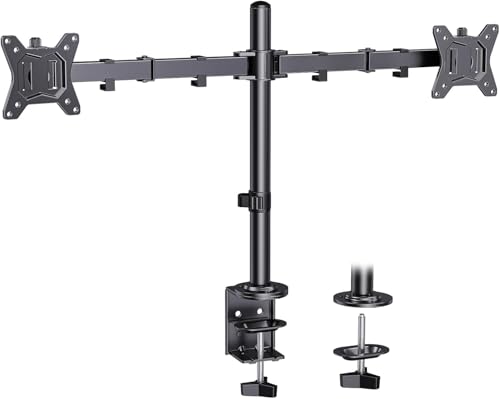
For multi-monitor setups where panel consistency matters across multiple units, the ErGear Dual Monitor Desk Mount provides a VESA-compatible arm system for displays up to 34 inches. For three-monitor configurations, the WALI Triple Monitor Mount accommodates 13–27-inch screens on a single desk clamp. Pairing a USB-C docking station like the Selore 14-in-1 USB-C Dock simplifies cabling across multi-display arrangements.
Beyond connectivity, older display cables can introduce their own complications. A related analysis on why retro cables are degrading in storage covers plasticizer migration in aging VGA and DVI cable sheaths — relevant context for anyone pairing modern monitors with vintage hardware or older signal chains.
Reading a Full Model String: A Worked Example
Taking ASUS ROG Swift PG32UQX as a reference:
- ROG Swift → brand family: high-end gaming
- PG → ProGaming prefix, ROG Swift tier
- 32 → 32-inch diagonal
- U → UHD / 4K resolution
- QX → specific technology tier (in this case, Mini LED backlighting at the QX spec point)
Working from left to right — brand family, prefix, screen size, resolution tier, feature suffix — is the correct decoding direction for ASUS and for most other major manufacturers. The further right you go, the more specific and less universal the meaning becomes.
How the Refresh Rate Surge Changed Naming
The rapid expansion of high-refresh SKUs — from 144Hz through 165Hz, 240Hz, 360Hz, and now 500Hz — has pushed several manufacturers to add refresh-rate indicators into their model codes or at minimum their marketing names. Samsung's Odyssey Neo G8 and G9 refresh releases now carry explicit Hz callouts in their retail names even when the formal model string doesn't encode them. ASUS has added "M" as a shorthand for 240Hz and above in its PG line.
The 180Hz 1440p Gaming Monitors Hit Entry-Level Pricing analysis tracks how those tier boundaries have shifted, which directly affects whether older tier-suffix conventions in 2021–2023 model strings still reflect meaningful performance distinctions by current standards.
FAQs
Does the first number in a monitor model always indicate screen size? For Dell, LG, and BenQ it reliably does — the first two digits map directly to diagonal inches. ASUS and Samsung are less consistent; ROG Swift PG-series and Samsung Odyssey G-series use their leading digits differently. Always verify against the published specifications rather than relying solely on the model string.
What does a 'Q' suffix mean on a monitor model? It most commonly indicates QHD (2560×1440) resolution. ASUS applies it this way in TUF Gaming VG and ROG Swift PG lines. BenQ also uses 'Q' for QHD. Samsung's 'Q' in certain product lines refers to QD-OLED context, so check the spec sheet when a Samsung model string includes it.
How do I know if a monitor has an OLED panel from its name? Most manufacturers now include 'OLED' explicitly in the marketing name even if not in the formal model number. Samsung appends it to Odyssey G models where applicable; LG uses the 'QN' series code for OLED UltraGear models. ASUS and BenQ add 'OLED' as a distinct product-family suffix. If 'OLED' does not appear anywhere in the name, the panel is almost certainly IPS, IPS Black, VA, or TN.
Do higher model numbers always mean a better monitor? Within the same product family, generally yes — a BenQ PD3220U outranks the PD2725U in tier. Across families, no. A Dell S2722D is not inferior to a Dell P2723D simply because of the number; the prefix (S vs. P) is the relevant tier indicator. Always check which product family the number sits inside before comparing across models.
Why do some monitors have letters after the model number, like '-B' or '-W'? These typically denote color finish or regional variant. LG uses '-B' for black and '-W' for white. Dell sometimes uses trailing letters for regional configurations. They do not affect panel type, resolution, or refresh rate and can usually be ignored when comparing core specifications.
Are monitor naming conventions standardized across the industry? No. Each manufacturer defines its own system independently, and the conventions shift across product generations. The patterns described in this guide reflect naming as documented on manufacturer specification pages. Legacy models from 2019–2022 may follow older internal tier logic that predates the naming schemes those brands use today.
Citations and sources
- https://www.dell.com/en-us/shop/computer-monitors/ar/3796 — Dell monitor lineup and published tier/prefix definitions
- https://www.lg.com/us/monitors — LG monitor series codes: UltraGear GN/GP, UltraFine UN, UltraWide WN, OLED QN
- https://www.asus.com/displays-desktops/monitors/ — ASUS ProArt PA, TUF Gaming VG, and ROG Swift PG naming documentation
- https://www.samsung.com/us/televisions-home-theater/monitors/ — Samsung Odyssey G-series, Smart Monitor M-series, and ViewFinity S-series product specifications
- https://www.benq.com/en-us/monitor.html — BenQ PD, SW, EW, EX, and XL prefix documentation and product catalog
- https://www.rtings.com/monitor — Independent monitor specifications, panel verification, and benchmark database
- https://www.tomshardware.com/monitors — Tom's Hardware monitor review archive and specification fact-checking
This piece is editorial synthesis based on publicly available information. No independent first-party benchmarking is reported.