For most gamers in 2026, an entry-priced 180Hz 1440p monitor delivers more usable framerates on the GPUs people actually own than a cheap 4K panel does — pairing better with mid-range cards like the RTX 3060 12GB, keeping motion smooth in competitive games, and costing meaningfully less than QD-Mini LED 4K panels like the KOORUI 27" 4K or Samsung Odyssey 4K 144Hz.
In brief — 2026-06-24 · A 27-inch 1440p 180Hz gaming monitor just dropped to entry-level pricing, sharpening the value question against 4K panels for gamers on mid-range hardware.
What happened: the 1440p 180Hz price drop
Per recent coverage on Tom's Hardware, 27-inch 1440p IPS panels with 180Hz refresh rates have hit a new price floor in mid-2026, dropping into the same budget tier previously held by 1080p high-refresh monitors. The deal post highlights the obvious value angle: 1440p at 180Hz, in a 27-inch IPS panel with decent response time, is now available at prices that used to buy a 1080p panel.
That matters because it shifts the value calculation for everyone buying a monitor in 2026. The question is no longer "1080p high-refresh or 1440p mid-refresh" — both at similar prices. It's "1440p 180Hz entry tier or step up to a 4K panel and trade refresh rate for resolution." Different reader, different answer, but the trade-off is now sharper because the cheap 4K panels haven't dropped as far as the high-refresh 1440p tier has.
Why it matters: how 1440p high-refresh stacks against 4K
The choice between 1440p 180Hz and 4K is not a pure resolution question — it's a question about whether your GPU can drive what you're buying. A 4K panel at native resolution needs roughly 2.25x the pixels per frame of a 1440p panel, which translates to roughly 2-2.5x the GPU load in modern games at the same settings. Per RTINGS' monitor testing methodology, refresh rate utilization is a real metric — a 144Hz or 180Hz panel locked at 60fps because the GPU can't keep up is wasted refresh capacity.
For someone with an RTX 3060 12GB (or the ZOTAC Twin Edge variant) — still the most common mid-range Nvidia card in 2026 — modern AAA games at 1440p with high settings often hit a smooth 90-130 fps, which makes a 180Hz panel feel meaningfully smoother in motion than a 60Hz panel and uses most of the refresh headroom in fast titles. The same card at native 4K often falls to 40-70 fps in AAA titles, meaning a 144Hz 4K panel is locked well below its rated refresh in the games that benefit from refresh the most.
That's the practical case for high-refresh 1440p over high-resolution 4K on mid-range GPUs in 2026: utilization. The 4K panel becomes the right answer when (a) your GPU is strong enough to feed it (RTX 4070-tier or better), (b) you mainly play single-player titles where sharpness matters more than motion, or (c) you specifically want HDR and Mini-LED contrast that 4K premium panels deliver.
Spec table
| Panel | Resolution | Refresh | Panel tech | Price band (2026) |
|---|---|---|---|---|
| Entry 1440p 180Hz IPS (27") | 2560x1440 | 180Hz | IPS | $150-250 |
| KOORUI 27" 4K QD-Mini LED (dual-mode) | 3840x2160 / 2560x1440 | 160Hz / 320Hz | QD-Mini LED IPS | $400-550 |
| Samsung 27" Odyssey 4K 144Hz | 3840x2160 | 144Hz | Fast IPS | $400-550 |
The 1440p panel undercuts both 4K options by roughly $200-400. The Mini-LED tier brings HDR and contrast that the entry 1440p panel can't match, but for gamers with mid-range GPUs the resolution-refresh math usually favors the 1440p tier first and the 4K panel later when the GPU is upgraded.
What GPU drives what panel?
| GPU | Comfortable target |
|---|---|
| RTX 3060 12GB | 1440p high refresh, 1080p ultra-high refresh |
| RTX 3070 / 4060 Ti 16GB | 1440p high refresh, 4K medium settings |
| RTX 4070 / 4070 Ti | 1440p high refresh stable, 4K high settings |
| RTX 4080 / 4090 | 4K high refresh stable |
Pairing a panel above your GPU's tier leaves performance on the table; pairing below it wastes panel capability. The sweet spot for most mid-range buyers in 2026 is the 1440p 180Hz tier.
Refresh rate utilization on real GPUs
Refresh rate matters only to the extent your GPU can feed it. A 240Hz monitor fed at 70fps shows 240Hz worth of refresh capacity wasted as the panel waits for frames the GPU isn't producing. The two pieces of the chain — GPU and monitor — have to be matched, and a mismatch in either direction is wasted money.
Practical pairings for 2026's mid-range GPUs:
| GPU | 1080p target | 1440p target | 4K target |
|---|---|---|---|
| RTX 3050 | 120-160 fps high | 60-80 fps medium | not viable |
| RTX 3060 12GB | 144-240 fps high | 70-110 fps high | 40-60 fps low/med |
| RTX 4060 8GB | 144-240 fps high | 90-120 fps high | 45-65 fps med |
| RTX 4070 / 4070 Ti | 240+ fps high | 120-180 fps high | 60-80 fps high |
| RTX 4080 / 4090 | 240+ fps high | 180-240 fps high | 100-144 fps high |
Per TechPowerUp's GPU specifications database, card-level memory bandwidth and shader counts dictate which resolution/refresh targets are realistic on each tier.
The match for a 1440p 180Hz panel is roughly an RTX 3060 12GB through RTX 4070. The match for a 4K 144Hz panel is RTX 4070 Ti through RTX 4090. Pairing a 4K 144Hz panel with a 3060 typically delivers 4K at 50fps in modern AAA — visibly worse than 1440p 144fps on the same hardware.
Mini-LED versus standard IPS for non-HDR work
For SDR gaming, the gap between Mini-LED and well-tuned standard IPS is meaningful but not transformative. Mini-LED's local dimming improves black levels and HDR highlights; for daytime SDR gaming, both look broadly similar in motion. The benefit appears most clearly in dark scenes, where Mini-LED's per-zone dimming preserves detail standard panels can't.
If you mainly play in bright environments and don't care about HDR, the Mini-LED premium is harder to justify. If you watch HDR content or play HDR-capable games in a dim room, Mini-LED's improvement is visible.
The HDR and color question
QD-Mini LED panels like the KOORUI deliver materially better HDR highlights and contrast than the entry 1440p tier. For people watching HDR movies or playing visually rich HDR-capable games, that's a meaningful step up. For competitive players or anyone playing primarily older or non-HDR titles, the HDR gap matters less.
If HDR is a priority, the KOORUI 27" 4K QD-Mini LED and Samsung Odyssey 4K both deliver genuine HDR experiences — true contrast from local dimming on the KOORUI's Mini-LED backlight, faster response and quantum-dot color from both. If HDR doesn't matter to you, the entry 1440p tier saves the difference and keeps the refresh-rate headroom.
Pixel density and viewing distance
A 27-inch 1440p panel sits at roughly 109 pixels per inch, while a 27-inch 4K panel is at roughly 163 ppi. At normal desktop viewing distances (50-70cm) the 4K panel is visibly crisper for text and fine detail, while the 1440p is sharper than the 1080p tier it replaces and entirely adequate for gaming. Pixel density matters more for productivity work — code, text, photo editing — than for fast-motion gaming, where actual perceived sharpness is dominated by frame pacing, motion blur handling, and the panel's response time.
Three buyer scenarios
Scenario 1 — Competitive shooter player on an RTX 3060. Plays CS2, Valorant, Apex daily. Wants smooth motion, doesn't care about HDR or fine sharpness. Pick: 1440p 180Hz entry tier. Frame rates land in the 180-240 fps range on competitive titles; refresh rate is fully utilized; cost saves $200-300 over a 4K panel.
Scenario 2 — Single-player AAA enthusiast on an RTX 4070 Ti. Plays Cyberpunk, Horizon, Spider-Man. Wants sharpness and HDR. Pick: 4K Mini-LED panel like the KOORUI 27" 4K QD-Mini LED. GPU is strong enough to drive 4K at high settings, HDR delivers real impact in single-player titles, sharpness pays off in cinematic gameplay.
Scenario 3 — Mixed workload, productivity + gaming. Codes during the day, games at night. Wants pixel density for text + reasonable gaming. Pick: depends on GPU. If 4070-class or above, 4K panel makes sense for productivity. If 3060-class, 1440p 180Hz wins because gaming refresh dominates and 1440p text is sharp enough on a 27" panel.
Dual-mode panels: a sleeper option
Some 2026 4K panels — including the KOORUI 27" 4K QD-Mini LED listed above — ship as dual-mode displays that can switch between native 4K at one refresh rate and 1440p at a much higher rate. The KOORUI specifically supports UHD 160Hz and 2K 320Hz modes, which gives the buyer both options on one panel. That's a meaningful argument for the more expensive panel if you genuinely care about both modes — you get 4K for content-rich gaming and 1440p high-refresh for competitive titles on the same display.
The trade-off is that 1440p mode on a 4K panel involves scaling, which is rarely as crisp as native 1440p on a dedicated 1440p panel. For most users, picking a panel that's native to your primary use case is the cleaner choice; dual-mode is for buyers who need flexibility.
What about ultrawide?
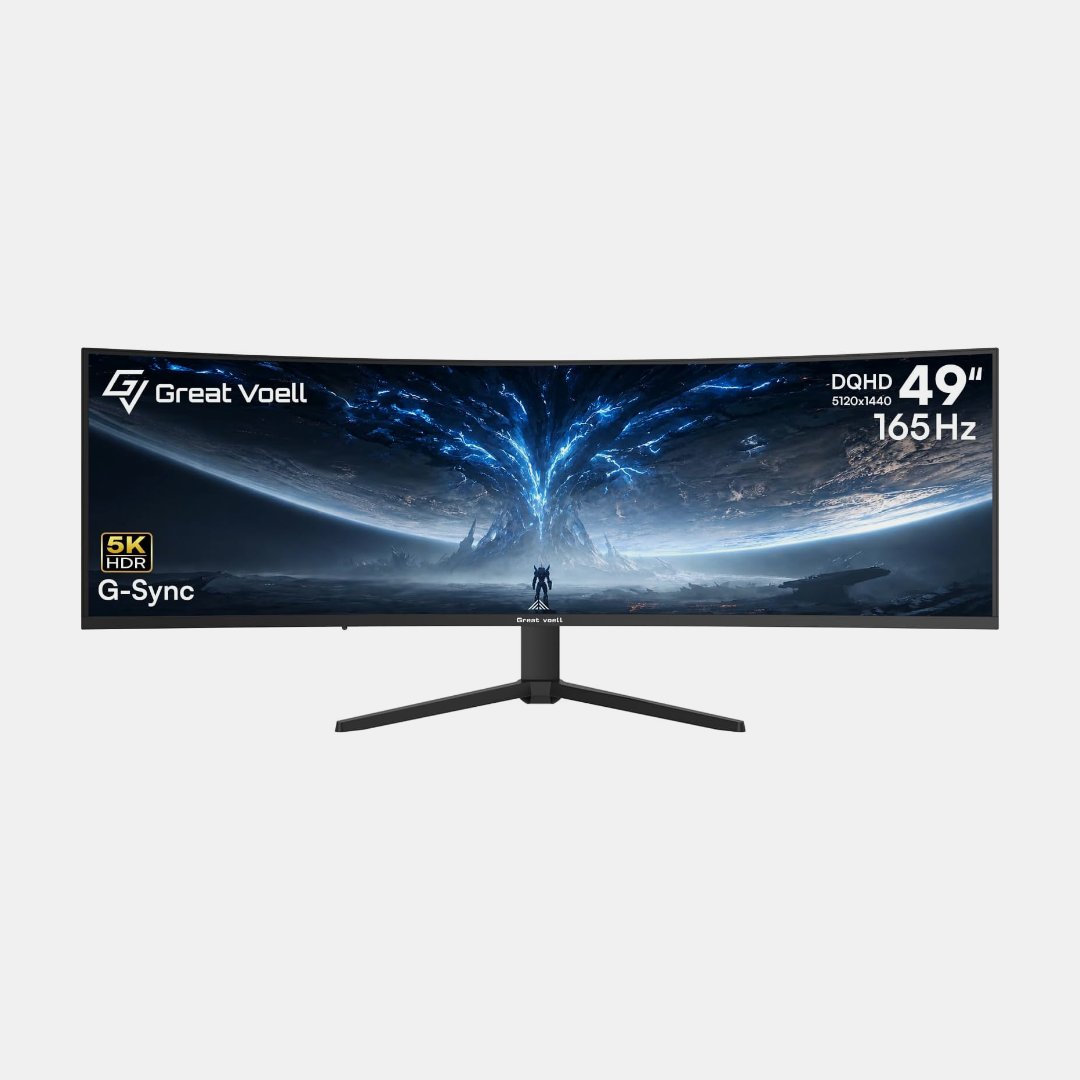
Ultrawide 1440p (3440x1440) and 1440p super-ultrawide (5120x1440) panels add a horizontal dimension to the decision. They're not directly comparable to 16:9 1440p high-refresh — they're a different aspect ratio, generally at 100-165Hz refresh rates, and they cost meaningfully more.
For sim racing, flight sims, MMO, and productivity-heavy users, ultrawide is the better answer than either 16:9 1440p or 4K. For fast competitive titles, the narrower 16:9 aspect is usually preferred because peripheral vision benefits less and the GPU has fewer pixels to push.
Connectivity and cable choice
A practical detail buyers miss: getting 4K at 144Hz over a cable. DisplayPort 1.4 with DSC (Display Stream Compression) or HDMI 2.1 are the two paths. Cheap cables sometimes fail to maintain the rated bandwidth even though they advertise it. Stick to first-party cables from the monitor manufacturer or VESA-certified DisplayPort 1.4 cables.
The 1440p 180Hz tier is easier on cables — almost any DisplayPort 1.2+ cable handles 1440p 180Hz cleanly. That's one less thing to worry about.
Common pitfalls
- Buying refresh you can't drive. A 240Hz panel paired with a card that hits 90fps in your games is wasted.
- Ignoring response time. Some IPS panels list 1ms (MPRT) but have actual gray-to-gray transition times that smear motion.
- HDR claims that aren't really HDR. Many sub-$300 4K panels claim "HDR400" or "HDR10" but lack the local dimming to deliver real HDR contrast.
- Wrong aspect ratio. Ultrawide adds a third dimension to the decision; for fast competitive titles, narrower aspect can simplify aim.
- Cable choice. 4K at 144Hz needs DisplayPort 1.4 or HDMI 2.1. Cheap cables sometimes fail at the rated rate.
When NOT to buy a 4K monitor
Skip 4K if any of: you play mostly competitive titles, your GPU is mid-range, you care more about motion than fine detail, or your budget doesn't stretch to a panel with real local dimming. The 1440p 180Hz entry tier is the better value for most mid-range buyers.
Bottom line
For gamers on mid-range GPUs like the RTX 3060 12GB, the freshly-cheap 1440p 180Hz tier delivers better real-world experience than a same-priced 4K panel — actual refresh utilization, smoother motion, and a sensible match to the GPU's capability. Step up to a 4K Mini-LED tier panel like the KOORUI 27" 4K QD-Mini LED or Samsung Odyssey 4K 144Hz when (a) your GPU is strong enough to drive 4K at usable framerates, (b) you want HDR and Mini-LED contrast, or (c) you do enough productivity work that pixel density matters as much as refresh rate.
The right answer depends on your GPU first, your content second, and your budget third — in that order. For most mid-range builds, the high-refresh 1440p tier wins this year.
Related guides
- GLM-5.2 local GPU VRAM requirements
- Best gaming monitor for the RTX 3060
- 4K vs 1440p gaming
Citations and sources
- Tom's Hardware — monitor coverage and deals
- RTINGS — monitor testing and reviews
- TechPowerUp — GPU and monitor specifications database
This piece is editorial synthesis based on publicly available information. No independent first-party benchmarking is reported.



