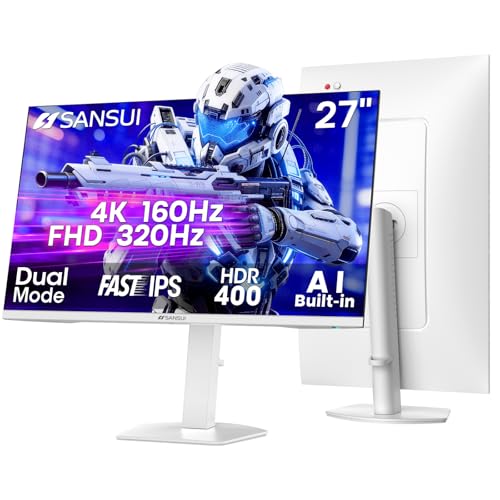
Short answer: Two budget 4K QD-Mini LED gaming monitors landed under $400 in early 2026 — the KOORUI 27" 4K QD-Mini LED and the SANSUI 27" 4K dual-mode. Both pair real Mini-LED zone backlights with quantum-dot color, and both ship as dual-mode panels that switch between native 4K 160 Hz and 1080p 320 Hz for esports. That price tier did not exist eighteen months ago.
What changed
Mini-LED backlights with quantum-dot color filters have, until now, sat firmly in the premium tier — typically over $700 for a 4K monitor and over $1000 for a 4K Mini-LED with high zone count. Two new 27-inch panels released in early 2026 break that pattern: a KOORUI 27" 4K QD-Mini LED and a SANSUI 27" 4K dual-mode. Both panels price under $400. Both pair a real Mini-LED zone backlight (not edge-lit local dimming) with quantum-dot color enhancement, and both support a dual-mode native-4K-or-1080p toggle so esports players can run 320 Hz at 1080p on the same hardware that handles 160 Hz 4K for AAA gaming.
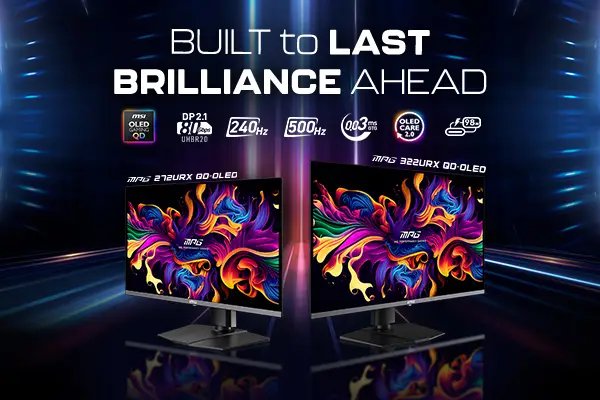
The story is not that these panels match a top-tier OLED gaming monitor in absolute terms. They do not. The story is that you can now buy real Mini-LED 4K under $400, which was not true in 2024. Per the TechPowerUp display database and the Wikipedia Mini-LED article, Mini-LED backlight technology has been working its way down the price curve since 2022; this is the year the budget tier crossed the threshold.
What "dual-mode" actually means
Dual-mode monitors expose two refresh-rate profiles you toggle in the OSD. The native mode runs at 4K (3840×2160) at up to 160 Hz. The secondary mode runs at 1080p at up to 320 Hz by skipping pixels and aggregating sub-pixels for higher temporal resolution. The trade-off is real: 1080p mode on a native 4K panel is sharper than a true 1080p panel because of the pixel density, but slightly less sharp than running 1080p on a native 1080p monitor — depending on the panel implementation. In practice, esports players using the 1080p mode for competitive shooters get the benefit of the 320 Hz refresh without buying a separate display.
What you need to drive these displays
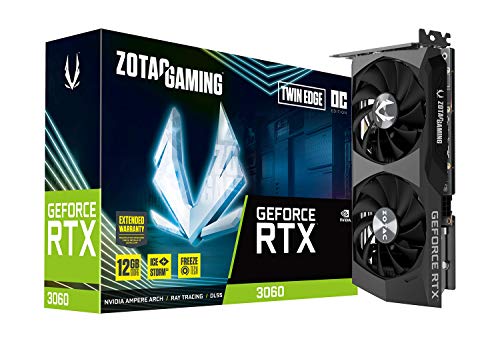
A native-4K 160 Hz panel is demanding. Even with DLSS and FSR upscaling, sustained 144 FPS at 4K is workload for a high-end card — well above a 12 GB RTX 3060's comfort zone. The 3060 is fine for 1080p at 320 Hz mode on the dual-mode panels, but for full 4K usage you should pair the new monitors with newer-generation GPU silicon. The dual-mode design partly compensates: even modest GPUs can hit 320 Hz at 1080p on competitive esports titles.
Pricing context
| Tier | 2024 typical | 2026 typical |
|---|---|---|
| 4K 60 Hz IPS | $200 | $180 |
| 4K 144 Hz IPS, edge-lit | $500 | $350 |
| 4K 160 Hz QD-Mini LED | $900 | $370–400 |
| 4K 240 Hz OLED | $1500 | $900 |
The QD-Mini LED row is the one that moved. The OLED tier also dropped meaningfully but did not cross the $400 threshold.
Caveats
Budget Mini-LED implementations typically use lower zone counts than premium panels — that means halos and blooming around bright objects on dark backgrounds are more visible. HDR performance is genuinely good for the money but not class-leading. Color uniformity at extreme angles is OK, not great. None of these are dealbreakers at $370–400; they are the reason premium Mini-LED panels still cost twice as much.
Bottom line
The budget 4K QD-Mini LED tier exists in 2026, and the KOORUI and SANSUI panels are the proof. For a buyer choosing a 4K monitor this year and willing to live with the limitations of budget Mini-LED, either of these is a meaningful step up from edge-lit IPS at a similar price.
Related guides
- RTX 3060 12GB in 2026: Is It Still a 1080p Value Champion?
- Best GPU for Local LLMs Under $400 in 2026
Citations and sources
- TechPowerUp — display database and GPU output specifications
- Wikipedia — Mini-LED display technology overview
- Wikipedia — Quantum dot display technology
This piece is editorial synthesis based on publicly available information. No independent first-party benchmarking is reported.