The short answer: skip SSDs with no published TBW rating
If a listing for a SATA or NVMe SSD doesn't disclose a TBW (terabytes written) endurance rating, the NAND manufacturer, or the controller brand, treat that silence as the answer. It usually means none of those components would help the sales pitch. Established brands publish these numbers because they're confident in them — Samsung, for one, rates its 870 EVO line at up to 4,800 TBW with a 5-year limited warranty (Samsung's 870 EVO product page); unbranded and marketplace-only SSDs frequently omit them because the components inside change from batch to batch.
This isn't about brand snobbery -- it's about what actually fails first in a storage device, and why the failure mode on a bargain drive tends to be worse than "it's a little slow."
Why no-name SSDs fail differently than branded ones
A solid-state drive is three things stacked together: NAND flash (where data lives), a controller (that manages writes, wear-leveling, and error correction), and often a small DRAM cache (that holds the mapping table so the controller can find data fast). Cut costs on any one of those and the drive still boots a PC and passes a basic file-copy test -- which is exactly why cheap drives look fine in a five-minute demo and struggle months later.
- No DRAM cache, no HMB fallback. Some budget drives skip the DRAM cache entirely and don't implement Host Memory Buffer to compensate. Once the drive's static SLC write cache is exhausted -- which happens sooner as the drive fills up -- sustained write speeds can fall off sharply, a pattern documented across budget SATA and NVMe reviews on outlets like StorageReview.
- Weaker controllers and error correction. Lower-tier controller silicon has less headroom for TRIM commands and garbage collection, so performance degradation and, in worse cases, data integrity issues become more likely under sustained load rather than short bursts.
- No disclosed NAND source. Reputable drives name their NAND (their own fabs, or a known partner). Unbranded drives frequently don't say, which makes it impossible to judge endurance or QC consistency batch to batch.
- Thermal management is an afterthought. Compact SFF builds and laptops push drives harder thermally; drives without any heat spreader or firmware-level throttling curve are more exposed to throttling in tight enclosures.
What the community reports look like
Searches through communities like r/buildapc turn up a recurring pattern with unbranded, marketplace-only SSDs: normal performance when nearly empty, then noticeably slower writes and occasional read/write errors as the drive approaches capacity. That pattern lines up with what you'd expect from a DRAMless drive with a weak controller and no meaningful over-provisioning -- it's a known failure mode, not a one-off. Treat any individual anecdote with appropriate skepticism, but the shape of the complaints (degraded performance under load, followed by instability near full capacity) is consistent enough across posts to be a useful warning sign when a specific listing has no brand history or reviews to check against.
Checklist: what a trustworthy budget SSD actually discloses
| Spec | Red flag | What to look for instead |
|---|---|---|
| TBW / endurance rating | Not listed anywhere on the listing or spec sheet | A specific TBW figure per capacity, published by the manufacturer |
| DRAM cache or HMB | No mention of either | Either a stated DRAM cache size, or explicit HMB support |
| NAND source | "High quality NAND" with no brand named | A named NAND partner or in-house fab |
| Controller | Unnamed or generic "controller chip" | A named controller (even a budget-tier one is better than unnamed) |
| Warranty | Under 1-2 years, or seller-only support | 3-5 year manufacturer warranty with real RMA process |
| Independent reviews | Only the seller's own product photos | Coverage on sites like TechPowerUp or established retailer reviews |
If a listing fails three or more of these, it's not automatically defective -- but you're buying without the information that would tell you whether it's fine.
The next question: knowing what to avoid still leaves the choice of what to buy. Best Budget SSD for 2026: 5 SATA and NVMe Picks ranks five named-brand drives across SATA and NVMe, with the use case each one suits.
Budget SSDs that publish their specs
The fix isn't spending more, it's spending on a drive that discloses what's inside it. Two names come up consistently in budget-tier recommendations because they publish full spec sheets rather than leaving gaps:
- Crucial MX500 (SATA) -- Crucial publishes per-capacity endurance ratings and has a long track record as a drop-in upgrade for older gaming PCs and retro rigs still on SATA. See SpecPicks' best SATA SSDs for gaming and retro builds and best SATA SSDs for console and retro PC upgrades for capacity-specific picks.
- WD Blue SN570 (NVMe) -- Western Digital lists full specifications including endurance and cache behavior, making it a common budget-NVMe recommendation for builds where a SATA drive isn't an option. It's covered alongside other budget NVMe options in SpecPicks' best budget SSDs for gaming PCs and consoles roundup.
For emulation-focused and console-adjacent builds specifically, see best SATA SSDs for gaming and emulation -- storage patterns for ROM libraries and save states favor drives with consistent random-write performance, which is exactly where DRAMless no-name drives tend to struggle most.
Migrating off a suspect drive before it fails
If you're already running an unbranded SSD and want out ahead of a failure, the safest path is external imaging rather than waiting for symptoms:
- Back up anything irreplaceable to a second drive or cloud storage first, independent of the suspect SSD.
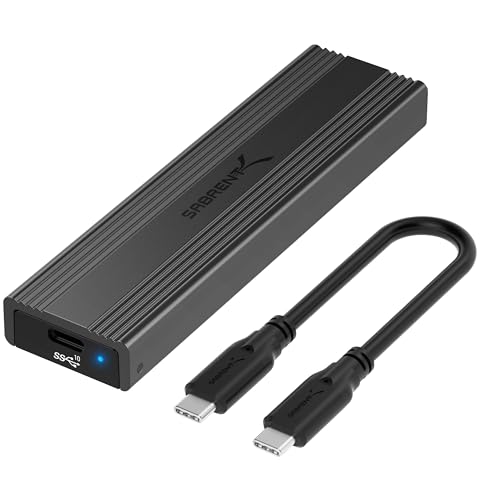
- Pull the drive and connect it externally via a tool-free M.2 enclosure -- for example, the Sabrent EC-SNVE (NVMe and SATA M.2, USB 3.2 Type-C) supports both drive types without opening the case twice.
- Clone or copy data to the replacement drive, then retire the old one rather than repurposing it for anything you can't afford to lose.
Product callout: Sabrent Tool-Free NVMe & SATA M.2 SSD Enclosure, USB 3.2 Type-C (EC-SNVE) -- $29.95 · Details Price accurate as of publish date and may vary. As an Amazon Associate, SpecPicks earns from qualifying purchases.
This kind of enclosure is also useful preventively: if you're not sure whether an existing drive is a no-name part, pulling it and checking the label under good lighting is often the only way to confirm what's actually installed, since OEM prebuilts sometimes ship unbranded storage without disclosure. Related reading on hardware transparency issues in budget components: why cheap monitors use HDMI instead of DisplayPort covers a similar cost-cutting pattern on the display side, and best cheap Raspberry Pi alternatives is a useful comparison point for how spec disclosure varies across budget SBC and storage categories alike.
The bottom line
A cheap SSD isn't inherently a bad SSD. An SSD with no disclosed TBW rating, no named controller, and no NAND source is a bad SSD, and price alone won't tell you which one you're looking at. Check the spec sheet before the price tag, favor drives from brands that publish full endurance data, and keep backups current regardless of which drive is installed.
Citations and sources
- https://www.crucial.com/ssd/mx500
- https://www.westerndigital.com/products/internal-drives/wd-blue-sn570-nvme-ssd
- https://www.storagereview.com/
- https://www.techpowerup.com/
- https://www.reddit.com/r/buildapc/
This piece is editorial synthesis based on publicly available information. No independent first-party benchmarking is reported.