Streamer PC Specs Decoded: The 2026 Parts That Match
What a headline creator spec sheet leaves out, and the upgrade order that actually changes what viewers see.
By Mike Perry, Founder & Editor-in-Chief · Published 2026-09-08 · Updated 2026-10-07 · 13 min read
Creator spec sheets are sponsorship artifacts. Here is the 2026 streaming build order - mic, light, display, cooling, CPU - and what each one really buys.
Quick Answer
Headline creator rigs are sponsorship artifacts, not build guides. A single-PC 1080p60 stream is bound by encode path and upload bitrate, not core count — a dedicated GPU encoder costs almost no game performance (NVIDIA), so an 8-core/16-thread CPU like the Ryzen 7 5800X plus good audio beats copying a spec sheet.
By Mike Perry · Published 2026-09-06 · 11 min read
Search for a big creator's PC specs and you get a parts list. What you almost never get is the part that matters: which of those components actually changed the thing viewers experience, and which were line items in a sponsorship deal.
Step 0 is a diagnostic, not a shopping trip. Open one of your own VODs and watch 90 seconds with the audio on and the video window small. Ask what made it feel amateur. Nine times out of ten the answer is not resolution or frame rate — it is a room-tone hiss under the voice, a face lit by a monitor, or a webcam gaining up in a dim room. Those are microphone, lighting and light-again problems. They cost a combined few hundred dollars and they are invisible on a spec sheet.
Meanwhile, the components a spec sheet leads with — a flagship GPU, a 16-core CPU, 64GB of memory — mostly affect the game you are playing, not the stream your viewers receive. A viewer watching a 1080p60 stream at 6 Mbps cannot see the difference between a $600 GPU and a $1,600 one, because the encoder is throwing away far more detail than the renderer ever added.
That is the frame for everything below: components ranked by their effect on perceived stream quality per dollar, not by their position on a spec sheet. Where a headline rig genuinely earns its cost, we say so. Where it is cosmetic, we say that too.
Key takeaways
Encode path, not core count, sets whether a single-PC stream holds stable frame times. Hardware encoding on a modern GPU costs near-zero game performance (NVIDIA).
An 8-core/16-thread CPU at 105W is the realistic single-PC tier (AMD); a used 8-core i7 is the budget floor.
Audio is the highest-leverage upgrade on the list. Viewers forgive a soft picture and leave over bad sound.
Lighting beats webcam sensors. Webcam noise is a light problem before it is a sensor problem.
Buy one high-refresh panel for the game and one cheap utility panel for chat and OBS — not two mid-tier panels.
Sustained-load acoustics matter more on a rig with a live microphone two feet from the case.
What creator spec sheets actually list — and what they leave out
A published creator spec sheet is a list of purchasable SKUs, because that is what a sponsor can link. Four things that shape stream quality more than any of those SKUs routinely never appear on it.
The encode path. Whether the stream is encoded on the GPU's dedicated media block, on CPU cores with x264, or on a second machine behind a capture card. This single choice determines how much game performance the stream costs you. Dedicated encode hardware has shipped on consumer GPUs for over a decade and runs on a fixed-function block independent of shader resources (NVIDIA NVENC), which is why it is nearly free in frame-time terms.
The audio chain. Microphone model is listed; the chain is not. Whether there is a noise gate, a compressor, a high-pass filter, and how the room is treated matters more than the capsule. A $120 USB condenser in a treated corner outperforms a $400 microphone in a bare room with a hard desk.
The lighting. Almost never listed, because it is not a PC part. It is the largest single determinant of webcam image quality.
The upload path. The bitrate ceiling and the stability of the connection cap everything downstream. A rig that can encode 1080p60 at 9 Mbps on a connection that reliably delivers 5 is a rig that drops frames.
The CPU question: how many cores does a single-PC stream really need?
Two realistic tiers, and neither is a 16-core part.
The mainstream tier is the AMD Ryzen 7 5800X: 8 cores, 16 threads, 105W TDP, 4.7GHz boost (AMD). With hardware encoding handling capture, those 16 threads run the game, OBS, a browser with chat, and an alert overlay with headroom left. Independent testing puts it well clear of same-generation 6-core parts on multi-threaded work while costing far less than the 12- and 16-core chips (TechPowerUp).
The budget tier is the Intel Core i7-9700K: 8 cores, 8 threads, 4.9GHz boost, LGA1151. The missing hyperthreading shows up exactly where you would expect — when OBS, a game and a browser all want a thread at once. On a hardware-encoded stream it is still viable, and it remains one of the better value paths for anyone who already owns the board. Our i7-9700K as a second streaming PC vs single-PC NVENC comparison covers the crossover point in detail, and the i7-9700K vs Ryzen 7 5800X offload comparison covers what those thread counts mean under sustained load.
What neither tier needs is more cores. If you are dropping frames on an 8-core CPU with hardware encoding enabled, the problem is almost always the encoder setting, the upload, or a background application — not the core count.
Why the microphone outranks the GPU for perceived quality
Viewers tolerate a soft picture indefinitely. They close the tab over bad audio in under a minute. That asymmetry is why the microphone is the highest-return purchase in this guide.
The HyperX QuadCast 2 is the reference point for a solo creator: a USB condenser with selectable polar patterns, onboard gain, a tap-to-mute top plate and internal shock mounting. The pattern selector is the feature that matters. Cardioid rejects most of what is behind the microphone, which is your keyboard, your case fans and your room. That rejection is worth more than any capsule upgrade in an untreated room.
Where a USB condenser stops being the limiting factor is a specific, identifiable point: when you add a second person. A USB microphone gives you one input. The moment you need two microphones mixed independently, you need an interface or a mixer, and the cost of that step is in the interface, not the microphone. Until then, the money is better spent on the room — a rug, a curtain, anything soft behind you — than on a more expensive capsule. Our best USB microphone for streaming guide compares the alternatives at this tier.
Lighting is the cheapest quality jump on the list
Webcam noise is a light problem before it is a sensor problem. Every webcam has automatic gain: in a dim room it raises sensitivity, and raising sensitivity is what produces the grainy, smeary, color-shifted image people blame on the camera. Give the sensor light and the same camera looks like a different product.
The NEEWER 18-inch ring light kit is the default answer at 55W and 5600K daylight balance. Two things about those numbers matter. 5600K is daylight-balanced, so the camera's white balance locks to a neutral point instead of drifting between your warm room lamp and your blue monitor. And 18 inches of diameter is a large enough source at desk distance to produce soft shadows rather than the hard-edged ones a small LED panel gives you.
The upgrade order is unambiguous: light first, camera second. A $60 light in front of a $40 webcam beats a $200 webcam in the dark, every time. If you want the comparison between ring-light sizes, we tested the NEEWER 18-inch against a 22-inch alternative.
The monitor a creator rig actually needs
The mistake is buying two identical mid-tier monitors. The correct configuration is asymmetric: one good panel for the game surface, one cheap panel for everything else.
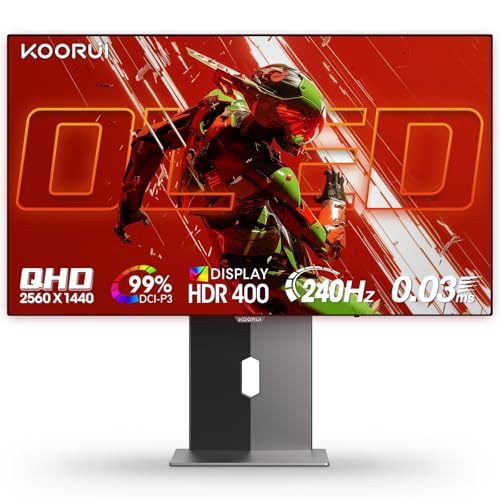
For the game surface, the KOORUI 27-inch QD-OLED at 240Hz and a 0.03ms rated response time is the current value point for a high-refresh competitive panel. Note carefully what that buys: it improves what you see and how you play. Your viewers receive 60 frames per second regardless. Refresh rate is a player benefit, not a broadcast one, and any guide that sells it as a stream-quality upgrade is confusing the two.
For the second surface — chat, OBS, a browser, your alert dashboard — a plain 60Hz or 75Hz panel is the correct choice, and spending more there is wasted. Total spend on one high-refresh panel plus one utility panel lands below two mid-tier 144Hz panels and gives you a strictly better setup for streaming.
Cooling the always-on box
Streaming duty cycle is not gaming duty cycle. A gaming session is spiky; a four-hour stream is a flat plateau at high load with a live microphone two feet from the case. That combination makes acoustics a production concern, not a comfort one — every RPM your fans add is room tone your cardioid microphone will pick up.
The Corsair iCUE H150i Elite Capellix puts a 360mm radiator and three magnetic-levitation ML120 fans against that plateau (Corsair). The benefit is not a higher clock — it is dissipating a 105W sustained load at 800–1,000 RPM instead of 1,600. Size the cooler 30–50W above your CPU's rated TDP so the fans never enter the loud part of their curve during a stream. If your case will not take a 360mm radiator, a tall air tower is the better answer than a cramped smaller AIO; see our high-TDP cooler guide.
Viable on hardware encode; thread-starved when everything wants a core
Microphone
Broadcast XLR chain
HyperX QuadCast 2
USB condenser, selectable patterns
Highest perceived-quality return per dollar on the list
Lighting
Studio key + fill
NEEWER 18" ring kit
55W, 5600K daylight
Removes webcam gain noise; fixes white balance drift
Monitor
Dual high-refresh
One 240Hz + one utility panel
240Hz, 0.03ms response
Refresh helps the player; viewers still receive 60 fps
Cooling
Custom loop
Corsair H150i 360mm AIO
360mm radiator, 3× ML120
Sustained-load acoustics next to a live microphone
Encode paths compared
Encode path
CPU overhead
Quality at 6 Mbps
Source
Notes
GPU hardware encoder
Near zero — runs on a fixed-function media block
Very good; the practical default for 1080p60
NVIDIA encode/decode support matrix
Independent of shader load, so game frame times stay flat
CPU x264 (medium/fast)
High — competes directly with the game for threads
Marginally better on hard-to-encode scenes
NVENC background
Only sensible on a second machine or a non-gaming stream
Two-PC with capture card
Zero on the gaming box
Same as whichever encoder the second box uses
NVENC background
Adds a capture card, a second OS, extra power and extra desk noise
Perf-per-dollar: where the next $200 goes
Rank your next upgrade by how many viewers will notice it.
Microphone and room treatment (~$120 + $30). The single biggest change to how professional a stream feels. Nothing else on this list comes close per dollar.
Lighting (~$60). Turns your existing webcam into a visibly better camera. Second-best return.
A second, cheap monitor (~$100). Moves chat and OBS off the game surface, which improves both your gameplay and your interaction rate.
Cooling (~$150). Only if your rig is audibly present in your VODs. Check first: listen to a VOD with the game muted.
CPU (~$250). Only if you are actually thread-starved with hardware encoding already enabled.
GPU (~$600+). Improves the game you play. Changes almost nothing about the stream your viewers receive at 6 Mbps.
Verdict matrix
Build the CPU-first rig if you are running a demanding simulation or strategy title, you already have decent audio and lighting, and your VODs show frame-time stutter with hardware encoding on and background apps closed.
Build the audio-first rig if you are starting out, or if you re-watch a VOD and the first thing you notice is the sound. This is most people, and it is the cheapest rig on the list.
Build the two-PC rig if your single machine cannot hold stable frame times with capture running after you have already moved to hardware encoding and lowered your output resolution — and you are prepared to maintain a second OS.
Change nothing if your current failure mode is dropped frames from upload instability. No component in this guide fixes a connection. Test your upload at your streaming bitrate for a full hour before you buy anything.
Bottom line
Build in this order: microphone, light, second display, cooling, CPU, GPU. That order maximizes perceived quality per dollar for a single-PC 1080p60 stream, and it is close to the exact inverse of how a headline spec sheet is arranged. A Ryzen 7 5800X with a QuadCast 2 and a light will out-perform a flagship rig with onboard audio in every metric a viewer can actually perceive.
Every performance claim above is sourced to a first-party specification or an independent test; the upgrade ordering is SpecPicks editorial synthesis based on those figures and on what a 6 Mbps 1080p60 broadcast can actually carry.
— Mike Perry
🛒 Products mentioned in this article
Amazon & eBay listings, plus full specs and alternatives on each product page.
As an Amazon Associate, SpecPicks earns from qualifying purchases; we also earn on qualifying eBay purchases via the eBay Partner Network. Prices shown were last tracked at crawl time and may vary — check the listing for the current price.
📹 Watch a review
Friendly Fire: AMD Ryzen 7 5800X CPU Review & Benchmarks vs. 5600X & 5900X — Gamers Nexus on YouTube
Frequently asked questions
Do I need the same CPU a big streamer uses?
No, and copying one is usually the most expensive mistake in this category. Headline creator rigs are specified for simultaneous editing, rendering and capture across multiple machines, often supplied by a sponsor. A single-PC stream at 1080p60 is bound by encode path and upload bitrate long before it is bound by core count, and an 8-core/16-thread part handles game plus hardware-encoded capture with headroom. Spend the difference on audio, lighting and a second display.
Is hardware encoding good enough, or do I need CPU encoding?
Modern GPU hardware encoders are good enough for the overwhelming majority of streams, and they cost almost no game performance because the encode runs on a dedicated block rather than on shader or CPU resources. CPU encoding still edges ahead on quality at low bitrates for hard-to-encode content, but it costs frames in the game you are streaming. If you are debating this, test both at your actual upload bitrate — the answer depends on your bitrate ceiling, not on which is theoretically better.
Does a USB microphone limit me later?
It limits you in exactly one way: you cannot expand to multiple mic inputs without adding an interface or mixer. For a solo creator, a good USB condenser with selectable polar patterns and onboard gain covers the whole workflow, and swapping to an XLR chain adds cost in the interface, not just the microphone. Move to XLR when you add a co-host, a physical guest chair, or an instrument. Until then, room treatment improves your sound more than a mic upgrade will.
Is a 240Hz monitor overkill for a streaming setup?
For the game surface in a competitive title, no — the refresh rate you play at is separate from the 60 fps you broadcast, and high-refresh panels help the player, not the viewer. For the second monitor running chat, OBS and a browser, it is entirely wasted money; a plain 60Hz or 75Hz panel is the correct choice there. Buy one high-refresh panel and one cheap utility panel rather than two mid-tier matched displays.
When should I move to a two-PC streaming setup?
When your single machine can no longer hold stable frame times with capture running, and you have already switched to hardware encoding and lowered your output resolution. That threshold is far higher than most creators assume. Two-PC setups add a capture card, a second OS to maintain, extra power draw and extra desk noise. If your current failure mode is dropped frames from upload instability rather than encode overhead, a second PC fixes nothing.