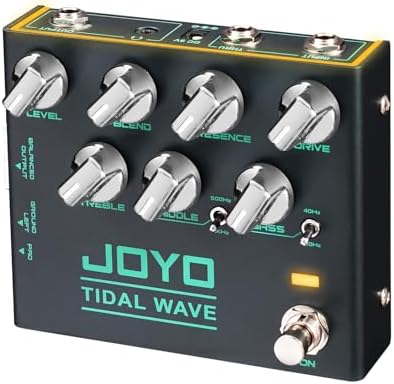
JOYO Bass Preamp & DI Guitar Pedal
Bottom line: The JOYO Bass Preamp & DI Guitar Pedal ($77.59 on Amazon as of 2026-11-21 23:17 UTC): Blend knob mixes clean signal with the drive circuit, from transparent EQ to grinding overdrive; main trade-off: control knobs have no numerical markings, so live settings are hard to recall.
As an Amazon Associate, SpecPicks earns from qualifying purchases. Full disclosure →
*Price sourced from Amazon.com. Last updated 2026-11-21. Product prices and availability are accurate as of the date/time indicated and are subject to change. Any price and availability information displayed on Amazon.com at the time of purchase will apply to the purchase of this product.
Pros & Cons
Pros
- ✓ Blend knob mixes clean signal with the drive circuit, from transparent EQ to grinding overdrive
- ✓ MID SHIFT toggles a 500Hz scoop or a 1kHz growl to cut through dense band mixes
- ✓ BASS SHIFT picks 40Hz sub rumble or 80Hz punch instead of one fixed low band
- ✓ Balanced XLR DI with cab sim feeds a PA or interface directly, no outboard DI box
- ✓ Ground Lift kills loop hum and the Pad switch handles hot active pickups
Cons
- ✗ Control knobs have no numerical markings, so live settings are hard to recall
- ✗ No battery operation; needs a 9V center-negative adapter that is not included
- ✗ Cab sim runs on the XLR out only, so the 6.35mm output stays dry
- ✗ Daisy-chained supplies can add noise; JOYO advises an isolated regulated 9V
SpecPicks Verdict
SpecPicks has no buyer-rating or benchmark data for JOYO Bass Preamp & DI Guitar Pedal, so this read rests on the manufacturer's listed specs and the current price in the retro graphics cards category (how we evaluate). Compare with similarly-priced alternatives in the retro graphics cards category before committing. On the listing's own facts, the case for it is "Blend knob mixes clean signal with the drive circuit, from transparent EQ to grinding overdrive"; the main trade-off is "Control knobs have no numerical markings, so live settings are hard to recall". If those two points fit how you will use it, put it beside one or two close alternatives in the Compare tool to confirm the price.
Common buyer scenarios for retro graphics cards of this kind: matching it to an existing build, replacing a failing part, or upgrading from a previous-generation equivalent. Check the spec table below against your current setup — particularly socket / form-factor / power-rating fields — and confirm compatibility on the retailer's listing before purchase. Prices and stock are set by the retailer and may have moved since this page was last updated.
Key Features
Quoted from the manufacturer's listing. Where it differs from the pros and cons above, those note the conditions the listing leaves out.
- BLEND CONTROL & DRIVE — CLASSIC 90'S BASS TONE WITH MODERN FLEXIBILITY: The TIDAL WAVE delivers the iconic punchy, articulate bass tone of the 90's with a dedicated Blend control that mixes your clean signal with the preamp's harmonically rich drive. Turn Blend counter-clockwise for pristine, transparent tone shaping using the 3-band EQ alone—perfect for pop, funk, and clean passages. Turn Blend clockwise to introduce the Drive circuit, adding everything from subtle warmth to aggressive, grinding overdrive ideal for rock and metal. Players describe the tone as punchy and praise the Blend for providing tight low end with just the right amount of grit.
- 3-BAND EQ WITH MID SHIFT & BASS SHIFT — PRECISE FREQUENCY CONTROL: Unlike standard 3-band EQs, the TIDAL WAVE features two toggle switches for surgical frequency control. The MID SHIFT switch toggles between 500Hz and 1kHz—cut at 500Hz to scoop the mids, or boost at 1kHz for a growly, cutting presence that slices through dense mixes. The BASS SHIFT switch toggles between 40Hz and 80Hz—select 40Hz for deep, sub-bass rumble, or 80Hz for tight, punchy low-end that sits perfectly in a band context. Combined with the Treble, Middle, and Bass knobs, you get studio-grade tonal flexibility.
- PROFESSIONAL DI & CONNECTIVITY — XLR OUT, CAB SIM & GROUND LIFT: The balanced XLR DI output connects directly to PA systems, audio interfaces, or front-of-house mixers—no external DI box required. Built-in cabinet simulation adds authentic bass speaker cabinet response to your XLR signal. A dedicated Ground Lift switch eliminates ground loop hum, while the Pad switch accommodates high-output active pickups. Note: Cab Sim is active on the XLR DI output only. The 6.35mm output passes your signal without cabinet simulation. For the quietest performance, use a regulated, isolated 9V power supply (not included).
- ROAD-READY R SERIES DESIGN WITH AMBIENT LED LIGHTING: Encased in a rugged all-metal aluminum alloy, the TIDAL WAVE features the iconic R Series ambient LED lighting with 3 modes (Sync, Always On, or Off) via a recessed switch on the underside—giving your pedalboard a sleek, professional glow. The smooth, responsive knobs and sturdy footswitch are built to withstand heavy stomping night after night. Note: The control knobs do not have numerical markings; we recommend noting your preferred settings during rehearsal for consistent live performance.
- JOYO QUALITY & AFTER-SALES CONFIDENCE: Backed by JOYO's decade-plus reputation for crafting innovative, budget-friendly gear. The TIDAL WAVE is part of the R Series, built with upgraded precision components. Important: Powered by 9V DC adapter only (center negative, not included). Rated current: <100mA. Battery operation is not supported. For the quietest performance—especially with high-gain drive circuits—use a regulated, isolated 9V power supply and avoid daisy-chaining with other pedals. Should any issues arise, please contact us through your Amazon order page.
Full Specifications
| Brand | JOYO |
|---|---|
| Color | Gray |
| Style | Bass,Preamp |
| Voltage | 9 Volts (DC) |
| Amperage | 100 Microamps |
| Model Name | JOYO TIDALWAVE |
| Model Number | Manufacturer-JOYO-R30-0010 |
| Power Source | Corded Electric |
| Compatibility | Switch |
| Controls Type | Knob |
| Signal Format | Analog |
| Connector Type | 1/4-Inch Straight |
| Item Type Name | Bass Guitar Electronics |
| Item Dimensions | 5.12 x 1.97 x 4.33 inches |
| Vibration/Rumble | Yes |
| Hardware Interface | 1/4-inch Audio |
| Included Components | Effect Pedal, User Manual |
| Audio Output Effects | Preamp |
| Manufacturer Part Number | 031-00R30-0010 |
| Item Dimensions L x W x H | 5.11"L x 4.33"W x 1.96"H |
| Full listing title | JOYO Bass Preamp & DI Guitar Pedal, Blend Control with MID SHIFT/BASS SHIFT EQ, Drive & Presence, XLR DI Out & Cab Sim, Bypass (TIDAL WAVE R-30) |
Benchmark data for other graphics cards
Ready to buy?
JOYO Bass Preamp & DI Guitar Pedal, Blend Control with MID SHIFT/BASS SHIFT EQ, Drive & Presence, XLR DI Out & Cab Sim, Bypass (TIDAL WAVE R-30) is listed on Amazon. Price, availability, shipping and returns are set by Amazon and its sellers — check the listing for current terms. SpecPicks earns a small commission on qualifying purchases — thank you for supporting independent review work.
*Price sourced from Amazon.com. Last updated 2026-11-21. Product prices and availability are accurate as of the date/time indicated and are subject to change. Any price and availability information displayed on Amazon.com at the time of purchase will apply to the purchase of this product.
More guides & deep dives from the SpecPicks archive
Browse all articles & guides →- Best 1440p Gaming GPUs in 2026
- The Complete Voodoo5 5500 AGP Driver Guide (2026 Edition)
- How to Build a Windows 98 Retro PC in 2026
- Best Retro Handhelds in 2026: Pocket, Mid-Tier and FPGA Picks
- Best Budget Gaming PC Build 2026 — ~$1,000 Parts List
- RTX 4070 Super vs RX 7800 XT — Which to Buy in 2026
- Emulation Hardware in 2026: FPGA, Software, and Cart-Reader Ecosystems
More reviews from the SpecPicks archive
Browse all reviews →- Best CPU Cooler for Ryzen 7 5800X and 5700X in 2026
- Raspberry Pi OS Moves to Linux 6.18 LTS: What the Kernel Jump Means for Pi 4 Owners
- How to run Qwen 3 14B on Arc B580
- HyperX QuadCast 2 S vs Blue Yeti for Streaming in 2026
- Best SSD for a Local LLM Model Library in 2026: Capacity vs Load Speed
- Logitech Prime Day Peripheral Deals Hit 47% Off — What Is Actually Worth Buying
- Aider vs Cline vs Cursor for AI-Assisted Coding in 2026
- OpenAI and Broadcom Unveil 'Jalapeño' Inference Chip
- Best 4K Monitor Under $400 for Console & PC Gaming 2026: SANSUI vs KOORUI vs ASUS TUF
- Best GPU for 1440p Esports in 2026: RTX 3060 12GB Tested
- AMD Ryzen Buying Guide 2026: Every Tier Compared
- Strix Halo Gaming Benchmarks: What AMD's APU Can Really Do
- ComfyUI on an RTX 3060 12GB: A 2026 Local Stable Diffusion Setup Guide
- 3dfx Voodoo2 SLI in 2026: Building a Period-Correct Windows 98 Glide Rig
- Best 1440p Monitor for the RTX 3060 in 2026: Picks That Actually Match
- PFlash on a Single RTX 3090: 10× Prefill Speedup at 128K Context vs llama.cpp
- Best Game Controllers for PC in 2026
- Linux Driver Will Expose Voltage Inputs on Raspberry Pi SBCs
- GPT-5.6 Sol vs Local Open-Weights: Why a 12GB Rig Still Earns Its Keep
- Voodoo 5 6000 in 2026: The Card That Never Shipped, Reproduced
- Best Gaming Mouse Pad for Esports FPS in 2026
- Best CPU for the RTX 3060 12GB (No Bottleneck) in 2026
- Logitech G29 / G920 Not Detected on Windows 11: Step-by-Step Driver Fix Guide (2026)
- Best Parts for a Local Speech and Vision AI Box in 2026
Earliest SpecPicks reviews
Browse full archive →- Best GPU for Llama 3.1 8B (2026)
- Best GPU for Qwen 3 14B (2026)
- Best GPU for Qwen 3 32B (2026)
- Best GPU for Llama 3.1 70B (2026)
- Best GPU for DeepSeek-R1 32B (2026)
- Best GPU for Llama 3.1 405B (2026)
- How to run Llama 3.1 8B on NVIDIA GeForce RTX 5090
- How to run Qwen 3 14B on NVIDIA GeForce RTX 5090
- How to run Qwen 3 32B on NVIDIA GeForce RTX 5090
- How to run Llama 3.1 70B on NVIDIA GeForce RTX 5090
- How to run DeepSeek-R1 32B on NVIDIA GeForce RTX 5090
- How to run Llama 3.1 8B on NVIDIA GeForce RTX 4090