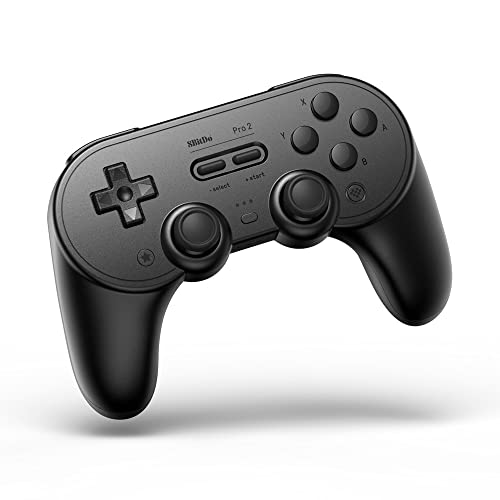
For PC gaming in 2026, the PlayStation DualSense ($55-75) is the default pick: best out-of-box ergonomics, excellent Steam native support, and the only controller that delivers haptics + adaptive triggers on the (small but growing) PC catalog that supports them. The 8BitDo Pro 2 ($40-55) is the customization king for people who like back paddles and per-game profiles. The GameSir G7 SE ($35-45) wins wired competitive play with Hall-effect sticks. The 8BitDo Sn30 Pro ($45-55) owns retro emulation, and the HORI HORIPAD Pro ($45-60) is the budget Switch-style alternative.
How to read this guide
You're shopping a $40-$80 PC controller and the genre advice from random forum threads contradicts itself. This guide ranks five featured controllers we keep in stock and assigns each one a clear use case. Pick by primary genre — fighting / competitive players want different hardware than racing-sim or 2D-platformer players — and the choice usually picks itself.
Tom's Guide's best-PC-controller roundup and RTINGS' PC gamepad reviews both consistently land the DualSense and 8BitDo Pro 2 in the top tier alongside the Xbox Wireless Controller. This guide adds three more tuned to specific cases the big-three roundups underweight: wired competitive (G7 SE), retro emulation (Sn30 Pro), and budget Switch-style (HORIPAD).
Key takeaways
- DualSense is the default best all-around pick for PC — best ergonomics, Steam native, supports haptics on participating titles.
- 8BitDo Pro 2 wins on customization — back paddles, per-profile software, the best-shaped D-pad in the $40-50 tier.
- GameSir G7 SE wins competitive wired play thanks to Hall-effect sticks (no drift) and zero Bluetooth latency.
- 8BitDo Sn30 Pro is the retro / emulation specialist — SNES-style face buttons, period-correct feel.
- HORI HORIPAD Pro is the budget Switch-style alternative — officially licensed, asymmetric sticks, lower price than DualSense.
Top picks
#1: PlayStation DualSense Wireless Controller (~$55-75)
Verdict: Best all-around PC controller in 2026. Excellent ergonomics, premium build quality, deep Steam native support including gyro aiming, and the only mainstream gamepad that delivers haptic feedback + adaptive triggers in titles that support them.
Per Sony's DualSense product page, the controller offers USB-C wired, Bluetooth wireless, and a built-in microphone. On Steam, the DualSense gets Steam Input first-class treatment: rebinding, profile switching, gyro-as-mouse support, the works. Native PC support for haptics and adaptive triggers lands on a small but growing list — Death Stranding Director's Cut, Returnal, Spider-Man Remastered, Metro Exodus Enhanced, and a handful of indies.
The controller's main weakness is battery life — ~12 hours per charge is below the 30+ hours the 8BitDo Pro 2 manages. Pair via USB-C for desk play to sidestep the issue entirely.
Buy this if: you want the safest "just works on PC" pick, you also play PlayStation, you want haptics on the titles that support them.
#2: 8BitDo Pro 2 Bluetooth Controller (~$40-55)
Verdict: The customization specialist. Four input modes selectable on the controller (Switch, X-input, D-input, Mac), two back paddles, per-profile remapping via 8BitDo Ultimate Software, an excellent cross-shaped D-pad, and a 30-hour battery. The community-favorite for emulation and any genre that benefits from extra programmable buttons.
The Pro 2 is what an Xbox Elite Series 2 wishes it cost $40 instead of $150. You won't get the Elite's machined metal triggers or magnetic faceplates, but you'll get most of the customization for a third of the price. The two back paddles are mapped via the 8BitDo Ultimate Software — assign them to jump, crouch, mantle, anything — and the profiles travel with the controller across PC / Mac / Switch.
The cross-shaped D-pad is genuinely one of the best in any sub-$100 controller, making it a dual-threat pick for both modern games and 2D platformers / fighting games.
Buy this if: you want back paddles + remapping at a budget price, you play across PC / Mac / Switch, your library mixes modern and emulation.
#3: GameSir G7 SE Wired Controller (~$35-45)
Verdict: The wired competitive pick. Hall-effect sticks (no drift, ever — magnetic sensors instead of potentiometers), Hall-effect triggers, 1ms USB latency, 3.5mm audio jack. No battery, no Bluetooth, no fuss — just a Xbox-layout controller built to last for competitive players.
Hall-effect sticks matter because traditional potentiometer sticks develop drift after 100-300 hours of heavy use; the Drift Pro problem that haunted the Joy-Con and DualSense (~$75 to repair per controller) doesn't exist on Hall-effect hardware. For competitive PC players logging 1,000+ hours on the same controller, Hall-effect is the durability difference.
The G7 SE's tradeoffs: wired only, Xbox layout (asymmetric sticks), and a plastic shell that feels cheaper than the DualSense. None of those matter at a desk for a competitive player; all of them matter on a couch.
Buy this if: you play wired competitive games (fighting games, Apex, CS2 with controller), you want zero stick drift, you log heavy hours and need durable sticks.
#4: 8BitDo Sn30 Pro (~$45-55)
Verdict: The retro / emulation specialist. SNES-style face button layout (the diamond pattern with the rounded edges) that nails the feel of 2D, 16-bit, and early 3D era games. Compact body, still has analog sticks + triggers for modern compatibility, broad multi-platform support including Switch, PC, macOS, Android, Steam Deck, Raspberry Pi.
For an emulation rig — RetroArch, Snes9x, PCSX2, RPCS3, anything driven by a libretro front-end — the Sn30 Pro is the natural choice. The SNES-derived face layout means the muscle memory transfers cleanly from era-correct play, and the analog sticks let it also handle PS1 / N64 / PSP / Switch titles that need stick input.
It's a worse choice for a single full-AAA-only library: the smaller body and shorter grips wear on long modern sessions. Use it for retro emulation and use a Pro 2 or DualSense for current-gen AAA.
Buy this if: your library is mostly emulation / retro / indie, you have a Raspberry Pi / Steam Deck emulator setup, you want SNES-style feel for 2D games.
#5: HORI HORIPAD Pro Controller (~$45-60)
Verdict: The officially Nintendo-licensed budget Pro Controller alternative. Asymmetric sticks (PlayStation/DualSense style), wireless Bluetooth + USB-C, full button layout. Cheaper than a Nintendo Switch Pro Controller ($70) and cheaper than a DualSense ($65), with a similar feel.
The HORI name carries weight — they've been making fighting-game-focused arcade sticks and controllers for 25+ years, and their pad-tier products inherit good build quality and reliable button feel. The HORIPAD Pro isn't an Elite-class controller, but it's a solid sub-$60 pick when the DualSense is overpriced or out of stock.
The tradeoff: smaller PC-titles support than DualSense in Steam. HORI controllers register as generic gamepads on most titles — fine for the majority of games, but no gyro support and no rumble in titles that gate it to specific controller IDs.
Buy this if: you want a sub-$60 Switch-style controller, you primarily play on Switch and PC, you don't need gyro or haptic features.
Spec delta
| Controller | Connection | Sticks | Battery | Steam native | Standout feature | Street price |
|---|---|---|---|---|---|---|
| PlayStation DualSense | USB-C, Bluetooth | Potentiometer (asymmetric) | ~12 hrs | yes (deep) | Haptics + adaptive triggers | ~$55-75 |
| 8BitDo Pro 2 | USB-C, Bluetooth | Potentiometer (symmetric) | ~30 hrs | yes | Back paddles + per-profile remapping | ~$40-55 |
| GameSir G7 SE | USB-C wired only | Hall-effect (asymmetric) | n/a | yes | Hall-effect sticks (no drift) | ~$35-45 |
| 8BitDo Sn30 Pro | USB-C, Bluetooth | Potentiometer (asymmetric) | ~16 hrs | yes | SNES-style face layout | ~$45-55 |
| HORI HORIPAD Pro | USB-C, Bluetooth | Potentiometer (asymmetric) | ~16 hrs | partial | Officially Switch-licensed budget pick | ~$45-60 |
Match the controller to your genre
| Primary genre / use | Best pick from this list |
|---|---|
| AAA single-player (Cyberpunk, Spider-Man, BG3) | DualSense |
| Competitive shooters (Apex, CoD on controller) | GameSir G7 SE (wired, Hall-effect) or DualSense |
| Fighting games (SF6, Tekken 8) | 8BitDo Pro 2 (great D-pad) or GameSir G7 SE |
| 2D platformers / Metroidvanias | 8BitDo Pro 2 or Sn30 Pro |
| Racing / sim | DualSense (adaptive triggers shine here) |
| Emulation (SNES, Genesis, PS1) | 8BitDo Sn30 Pro |
| Couch co-op / party games | 8BitDo Pro 2 or HORIPAD Pro (cheaper pair) |
| Switch + PC primary | HORIPAD Pro (licensed) or 8BitDo Pro 2 |
| Steam Deck companion controller | 8BitDo Pro 2 (cross-pairs cleanly) |
How they work with Steam
All five controllers work with Steam Input, but the depth of native support varies:
- DualSense: Full Steam Input support, gyro-as-mouse, configurable haptics in titles that expose them.
- 8BitDo Pro 2: Full Steam Input support; recognized as Xbox-style gamepad in X-input mode.
- GameSir G7 SE: Recognized as Xbox controller; full Steam Input support, no battery to worry about.
- 8BitDo Sn30 Pro: Recognized as Xbox-style or Switch-style depending on pairing mode; full Steam Input support.
- HORI HORIPAD Pro: Recognized as Switch-style controller; works on Steam but gyro and rumble support varies per title.
For non-Steam launchers (Epic, GOG, EA App, Ubisoft Connect), all five work via standard X-input. The DualSense plus DS4Windows utility extends compatibility to titles that don't natively support PlayStation gamepads.
Wired vs wireless — when does it actually matter?
| Use case | Wireless OK | Wired better |
|---|---|---|
| Couch / TV PC gaming | Yes | n/a |
| Casual single-player at desk | Yes | n/a |
| Competitive PvP shooters | Marginal | Yes (zero latency, no battery surprise) |
| Fighting games (frame-perfect inputs) | No | Yes |
| Steam Deck docked play | Yes | Yes (USB-C charging) |
| Long sessions (6+ hrs) | Need 30hr battery (Pro 2) | n/a (no battery worry) |
The competitive-FPS / fighting-game cases are where wired wins meaningfully. The G7 SE is built for exactly this; the DualSense / Pro 2 over USB-C are also fine.
Sample loadouts by player profile
The "I play everything" loadout (~$130 total):
- DualSense Wireless Controller — $65
- GameSir G7 SE — $40
- USB-C cable + Knox 3-foot stand — $25
The DualSense covers couch and single-player; the G7 SE sits at the desk for competitive sessions. Two-controller loadouts are common among players who split between sim/AAA and competitive FPS — the cost is reasonable and the use-case separation is clean.
The "emulation rig + modern AAA" loadout (~$110 total):
- 8BitDo Sn30 Pro — $50
- 8BitDo Pro 2 — $50
- Generic USB hub + spare cables — $10
The Sn30 Pro lives near the emulation PC / Raspberry Pi; the Pro 2 handles modern AAA on the gaming desk. This is the canonical r/RetroPie / r/EmulationOnPC two-controller setup, and it's cheaper than a single DualSense + spare.
The "competitive only" loadout (~$45 total):
- GameSir G7 SE — $40
- 6ft USB-C extension cable — $5
For one game played seriously (rocket league, Apex on controller, fighting game tournament prep), the wired-Hall-effect-only loadout is the best dollar-for-durability value on this list. No battery to fail mid-match, no stick drift over 1,000 hours, no Bluetooth latency variance.
Common pitfalls
- Buying a cheap no-name Bluetooth controller. $15-25 generic pads usually have laggy Bluetooth pairing, drift-prone sticks, and inconsistent button registration. The G7 SE at $35-45 wired is a better entry-tier than any $20 wireless pad.
- Expecting DualSense haptics in every PC game. Native PC support for haptics + adaptive triggers exists in roughly 20-30 titles in 2026. For everything else, the DualSense is "just a good Sony pad."
- Ignoring stick drift on used controllers. Buying a used DualSense or Joy-Con-derived pad is a stick-drift roulette. Hall-effect controllers (G7 SE, some Sn30 Pro+ revisions) don't have this problem.
- Skipping the 8BitDo Ultimate Software on the Pro 2. Half the Pro 2's value is the per-profile remapping. If you don't install the software, you're paying for buttons you can't reach.
When NOT to upgrade
If your current controller works and isn't drifting, the upgrade-by-itself math rarely pencils out. Save the $50 for game keys. The cases where the upgrade is genuinely worth it: drift on existing controller, no controller and starting from scratch, switching to a controller-driven genre (fighting / racing / emulation) for the first time.
Accessories worth adding
A controller without a few cheap accessories underperforms. Three additions worth $30-50 across the kit:
- A 10-foot USB-C cable ($8-12). The cables that ship with the DualSense and 8BitDo controllers are 5-6 feet — fine for desk play, frustrating on a couch. A long charging cable removes the "controller died mid-cutscene" problem and lets wired competitive players sit at a normal viewing distance.
- A simple wall-mount or desk dock ($15-20). Two controllers on the desk become four become eight as your library expands. A wall hook keeps the active controller charged and visible; a desk dock with USB-C pass-through doubles as a charging station.
- Replacement thumbstick caps ($5-10). Aftermarket KontrolFreek or Hori grips reshape the stick height for FPS or fighting-game preference. Cheap, reversible, and the difference is real over a 4-hour session.
Bottom line
For most PC players in 2026, the DualSense Wireless Controller is the right default — buy it if you don't have a strong reason to pick differently. The 8BitDo Pro 2 is the customization-first alternative and the right pick for emulation / cross-platform players. The GameSir G7 SE is the wired competitive specialist. The 8BitDo Sn30 Pro owns the retro / emulation case. The HORI HORIPAD Pro is the budget Switch-style alternative when DualSense pricing isn't where you want it.
Related guides
- Best Controller for PC and Steam Gaming in 2026: G7 SE vs 8BitDo Pro 2 vs DualSense
- 8BitDo Pro 2 vs GameSir G7 SE: Best PC Emulation Controller
- Best Gaming Controllers for PC and Emulation in 2026
- Best Controller for PC Emulation in 2026
Citations and sources
- Tom's Guide — Best PC controllers roundup
- RTINGS — Best controllers for PC reviews
- PlayStation — DualSense Wireless Controller product page
This piece is editorial synthesis based on publicly available information. No independent first-party benchmarking is reported.