

Tenda
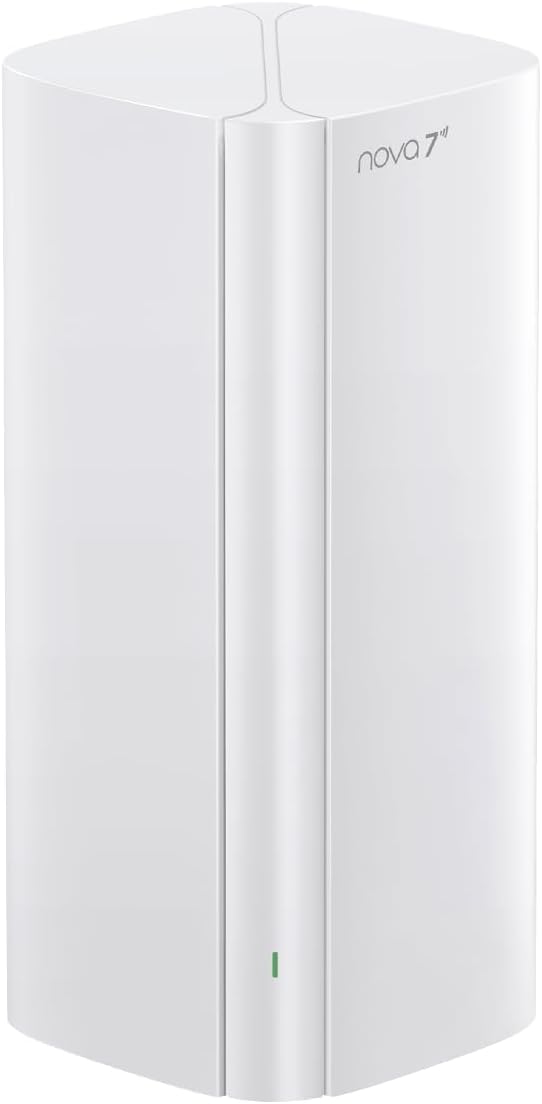
Tenda BE5100 WiFi 7 Mesh WiFi System
Bottom line: The Tenda BE5100 WiFi 7 Mesh WiFi System ($179.99 on Amazon as of 2026-11-23 11:19 UTC): Rated to cover up to 6,600 sq. ft. with the 3-node kit; main trade-off: no 6GHz band, so you miss WiFi 7's least-congested spectrum.
As an Amazon Associate, SpecPicks earns from qualifying purchases. Full disclosure →
*Price sourced from Amazon.com. Last updated 2026-11-23. Product prices and availability are accurate as of the date/time indicated and are subject to change. Any price and availability information displayed on Amazon.com at the time of purchase will apply to the purchase of this product.
Pros & Cons
Pros
- ✓ Rated to cover up to 6,600 sq. ft. with the 3-node kit
- ✓ 2.5G auto-sensing WAN/LAN port handles up to 2000Mbps broadband
- ✓ Wired Ethernet backhaul option for steadier links between nodes
- ✓ MLO combines bands for lower latency; rated for 160+ devices
- ✓ Up to 4323Mbps on 5GHz and 688Mbps on 2.4GHz
Cons
- ✗ No 6GHz band, so you miss WiFi 7's least-congested spectrum
- ✗ Not compatible with Tenda MW3 or MW6 mesh nodes you already own
- ✗ Only one 2.5G port; the other two wired ports are 1G
- ✗ Dual-band only, so MLO has two bands to combine instead of three
Manufacturer description
The Tenda ME6 Pro BE5100 WiFi 7 Mesh WiFi System is a 3-pack aimed at large apartments, duplexes and multi-floor homes. Tenda rates it to cover up to 6,600 sq. ft. Each node has 5 internal antennas and 5 independent high-power FEMs, so signal reaches the far rooms where single routers usually fall short. This is a dual-band WiFi 7 system. It is rated up to 4323Mbps on 5GHz and 688Mbps on 2.4GHz, and Tenda says that is about 60% faster than WiFi 6. Multi-Link Operation (MLO) combines both bands to cut latency and keep connections steady across 160+ devices. That helps households that stream…
SpecPicks Verdict
SpecPicks has no buyer-rating or benchmark data for Tenda BE5100 WiFi 7 Mesh WiFi System, so this read rests on the manufacturer's listed specs and the current price in the networking category (how we evaluate). Compare with similarly-priced alternatives in the networking category before committing. On the listing's own facts, the case for it is "Rated to cover up to 6,600 sq. ft. with the 3-node kit"; the main trade-off is "No 6GHz band, so you miss WiFi 7's least-congested spectrum". If those two points fit how you will use it, put it beside one or two close alternatives in the Compare tool to confirm the price.
Before ordering, check the listed dimensions, ports, power requirements and supported devices or systems in the spec table below against how you plan to use it, and confirm them on the retailer's listing. Prices and stock are set by the retailer and may have moved since this page was last updated.
Frequently Asked Questions
Does the Tenda ME6 Pro support the 6GHz band?
No. The BE5100 ME6 Pro is dual-band WiFi 7 with 2.4GHz (up to 688Mbps) and 5GHz (up to 4323Mbps). Tenda states that 6GHz is not supported on BE5100 models.
Can I add ME6 Pro units to my existing Tenda MW3 or MW6 mesh?
No. Tenda says this WiFi 7 mesh uses different technology from the MW3 and MW6 series and is not compatible with either. You would need to replace the older nodes rather than mix them.
How much area does the 3-pack cover?
Tenda rates the 3-pack for up to 6,600 sq. ft. Each node has 5 internal antennas and 5 high-power FEMs. Real coverage depends on wall materials and where you place the nodes.
Will the ME6 Pro work with my 2 Gig internet plan?
Yes. The 2.5G port detects WAN or LAN mode automatically and handles broadband up to 2000Mbps. The other two ports are 1G, so use the 2.5G port for your modem connection.
Can I connect the mesh nodes with Ethernet cables?
Yes. The system supports wired Ethernet backhaul, which links the nodes over cable instead of WiFi. That avoids wireless interference and gives more consistent speeds in large or multi-floor homes.
Key Features
Quoted from the manufacturer's listing. Where it differs from the pros and cons above, those note the conditions the listing leaves out.
- Ultra-Fast WiFi 7: Blazing Speeds for All Devices – Enjoy top-tier WiFi 7 performance with dual-band speeds up to 688Mbps (2.4GHz) and 4323Mbps (5GHz). It’s nearly 60% faster than WiFi 6, so you can easily handle 4K/8K streaming, online gaming, and multi-device connections without lag. (6GHz band not supported on BE5100 models.)
- Wired Ethernet Backhaul: Stable Mesh Coverage Everywhere – Support for wired Ethernet backhaul eliminates wireless interference, delivering faster and more reliable Mesh performance across your entire home. Even in large spaces, you’ll get consistent speeds—no more dead zones for video calls or smart home devices
- Whole-Home Coverage & High Capacity – Built with 5 internal antennas and 5 independent high-power FEMs, this Mesh WiFi system covers up to 6,600 sq. ft.—perfect for large apartments, duplexes. No more weak WiFi in far corners—every room gets reliable connectivity
- 2.5G Auto-Sensing WAN/LAN Port – Supports auto-negotiation for WAN or LAN mode, handling up to 2000Mbps broadband or high-speed NAS and gaming PC connections. Also supports wired backhaul for a faster Mesh network
- MLO for Ultra-Efficient Connectivity – Multi-Link Operation (MLO) intelligently combines multiple bands to deliver lower latency, faster throughput, and smoother connections for 160+ devices, ensuring stable performance for streaming, gaming, and multi-user households
- Smart App Control & Alexa Compatibility – Get your network up and running in minutes with the user-friendly Tenda WiFi App—no complex tech skills needed. From the app, you can manage connected devices , check real-time network status remotely, and enjoy hands-free control via Amazon Alexa for added ease
Full Specifications
| Brand | Tenda |
|---|---|
| Color | white |
| Weight | 2.5g |
| Coverage | 6600 sq.ft. |
| Frequency | 60 |
| Model Name | ME6 Pro-3 Pack |
| Antenna Type | Internal |
| Connectivity | Wireless, WiFi, 2.4GHz |
| Model Number | ME6 Pro-3 Pack |
| Compatibility | PC |
| Built-In Media | MESH wifi system |
| Control Method | App |
| Connection Type | Wired |
| Controller Type | App Control |
| Mfr Part Number | ME6 Pro 3PK |
| Number of Ports | 3 |
| Special Feature | WPS |
| Antenna Location | Indoor |
| Wi-Fi Generation | WiFi 7 |
| Security Protocol | WPA3 |
| Full listing title | Tenda BE5100 WiFi 7 Mesh WiFi System – Dual-Band Whole-Home Coverage (6,600 Sq. Ft.), 1×2.5G + 2×1G Gigabit Ports, MLO & Ethernet Backhaul for Seamless Roaming, VPN Ready- ME6 Pro (3-Pack) |
Ready to buy?
Tenda BE5100 WiFi 7 Mesh WiFi System – Dual-Band Whole-Home Coverage (6,600 Sq. Ft.), 1×2.5G + 2×1G Gigabit Ports, MLO & Ethernet Backhaul for Seamless Roaming, VPN Ready- ME6 Pro (3-Pack) is listed on Amazon. Price, availability, shipping and returns are set by Amazon and its sellers — check the listing for current terms. SpecPicks earns a small commission on qualifying purchases — thank you for supporting independent review work.
*Price sourced from Amazon.com. Last updated 2026-11-23. Product prices and availability are accurate as of the date/time indicated and are subject to change. Any price and availability information displayed on Amazon.com at the time of purchase will apply to the purchase of this product.
Related Networking



More guides & deep dives from the SpecPicks archive
Browse all articles & guides →- Best Budget Gaming PC Build 2026 — ~$1,000 Parts List
- Best 1440p Gaming GPUs in 2026
- The Complete Voodoo5 5500 AGP Driver Guide (2026 Edition)
- Best Retro Handhelds in 2026: Pocket, Mid-Tier and FPGA Picks
- Emulation Hardware in 2026: FPGA, Software, and Cart-Reader Ecosystems
- RTX 4070 Super vs RX 7800 XT — Which to Buy in 2026
- How to Build a Windows 98 Retro PC in 2026
More reviews from the SpecPicks archive
Browse all reviews →- Claude Fable 5 Tops the Intelligence Index: What Frontier Cloud AI Means for Local Rig Builders
- Best GPU for Running Llama 8B Under $300 in 2026
- Troubleshooting Local LLM Inference on Raspberry Pi 4 8GB and Pi 5: OOM, Swap, Quantization Crashes, and…
- Hobbyist Turns a Raspberry Pi and ADS-B Into a Viral Real-Time Airport Tracker
- CompactFlash to IDE Imaging for Win98: Troubleshooting Common Failures
- Qwen 3.6 27B with MTP: 2.5x Throughput on Local Hardware (Real Benchmarks)
- Logitech G920 vs HORI Overdrive for Sim Racing in 2026
- NVFP4 on RTX 50-Series: What llama.cpp's Native FP4 Support Means for Local Inference
- A 180Hz 1440p Gaming Monitor at Entry-Level Pricing — How It Stacks Against Our 4K Picks
- Best Budget SATA SSD for a Retro PC Build in 2026
- Imaging Vintage IDE Drives in 2026: A CompactFlash + USB Adapter Workflow
- Lenovo G02 Retro Handheld Reportedly Ships Preloaded With Pirated Games
- Run DeepSeek Locally on a 12GB RTX 3060: 2026 Quant Guide
- Mistral Medium 3.5 Dense Local Inference: Hardware Tiers from 24GB to 192GB
- Build a Silent Windows 98 Gaming PC With a CompactFlash IDE Drive
- GLM-5.2 Review: Running the Top Open-Weights LLM on an RTX 3060
- Best Steam Deck Docked Setup for a 4K Desk in 2026: Dock, Monitor, Storage
- Best Wired Mouse and Pad for FPS in 2026: Logitech G502 Hero and SteelSeries QcK
- Best Controller for PC Emulation and Retro Console Crossover (2026)
- Best Budget SATA SSD for a Steam Game Library in 2026
- Asus Prime Z890-P WiFi Review: Built for Core Ultra 200S
- Ollama vs llama.cpp vs vLLM — which local LLM runtime wins in 2026?
- Best Gaming SSD in 2026: 5 Picks for PS5, Steam Deck, and Custom Builds
- Ryzen AI Max+ 395 Review: Specs and What It's Really For
Earliest SpecPicks reviews
Browse full archive →- Best GPU for Llama 3.1 8B (2026)
- Best GPU for Qwen 3 14B (2026)
- Best GPU for Qwen 3 32B (2026)
- Best GPU for Llama 3.1 70B (2026)
- Best GPU for DeepSeek-R1 32B (2026)
- Best GPU for Llama 3.1 405B (2026)
- How to run Llama 3.1 8B on NVIDIA GeForce RTX 5090
- How to run Qwen 3 14B on NVIDIA GeForce RTX 5090
- How to run Qwen 3 32B on NVIDIA GeForce RTX 5090
- How to run Llama 3.1 70B on NVIDIA GeForce RTX 5090
- How to run DeepSeek-R1 32B on NVIDIA GeForce RTX 5090
- How to run Llama 3.1 8B on NVIDIA GeForce RTX 4090