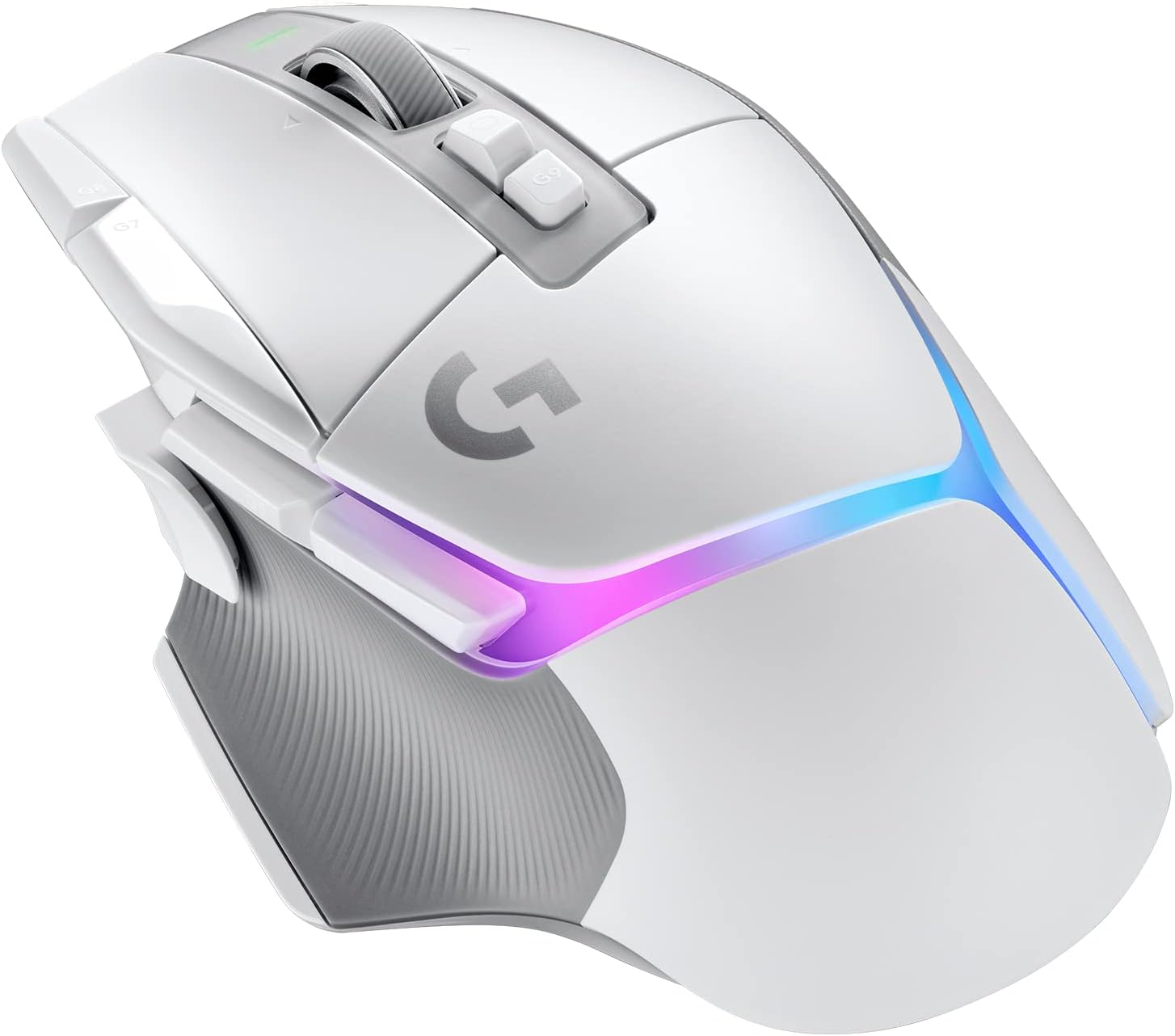
For competitive FPS in 2026 the answer that wins on price, reliability, and tournament familiarity is the Logitech G502 Hero on a SteelSeries QcK Heavy XXL cloth pad. The G502 Hero ships with a 25 K-DPI HERO 2 sensor (1:1 tracking, zero smoothing), 121 g weight, and an MSRP that has settled around $32 on Amazon — half the price of a Razer Viper V3 or Logitech G Pro X Superlight and indistinguishable on a blind aim-test for 90 % of players. Pair it with the QcK XXL ($30) for a giant, low-friction surface that keeps your low-DPI sweep on-pad.
Who this is for
If you are climbing in Counter-Strike 2, Valorant, Apex Legends, Marvel Rivals, Overwatch 2, or The Finals, peripherals matter less than most marketing copy claims — until the moment they fail. A mouse that double-clicks on a critical peek, a pad that bunches under your wrist, a polling-rate jitter that makes your microadjustments overshoot: those are matches you lose to hardware, not skill. The goal of a competitive setup is to eliminate hardware as a variable so you can train on a stable baseline.
This guide is for the player who wants a tournament-grade rig without spending $300 on the mouse and pad alone. Below: what the G502 Hero does well, where it loses to wireless flagships, how the QcK XXL stacks up against Logitech, Razer, and Artisan pads, and the specific build that wins for FPS in 2026.
Key takeaways
- The Logitech G502 Hero is the best $30–35 wired mouse — 25 K-DPI sensor, durable build, tournament-legal.
- The SteelSeries QcK XXL is the best $30 cloth pad — 900 × 400 mm, ~16 mm stitched edges, neutral glide.
- Wired beats wireless for under-$100 setups; wireless's edge only appears at flagship-tier pricing.
- 400 DPI + low cm/360° still rules in Valorant and CS2 — your hardware should support it without smoothing.
- A working 144 Hz Samsung Odyssey G5 monitor and a clean keyboard pair the mouse-and-pad layer with the rest of the input chain.
Why the G502 Hero is still the right wired pick in 2026
The G502 came out in 2014. Logitech rolled the HERO 2 sensor into it in 2018 and the HERO 25K in 2020. Eight years and a sensor cap-bump later it is still on Logitech's catalog because: nothing in this price tier matches the sensor. The HERO 25K is a 25,600 DPI optical sensor with 400 IPS tracking speed, 40 G acceleration tolerance, and zero hardware-level smoothing or angle snapping. Every metric a competitive player looks at — tracking jitter, click latency, lift-off distance — is identical to or better than the Razer DeathAdder V3 Pro or Logitech G Pro X Superlight.
What it lacks: weight tuning, RGB, wireless. At 121 g it is too heavy for the modern wireless flagships (60–63 g). For a player who already plays at low DPI with a wrist-and-arm hybrid grip, 121 g is fine — better wrist support, no fatigue from over-tense grip on a featherweight. Newer FPS players coming off a Razer Viper Mini or a Cooler Master MM710 will find it heavy and may want to drop to the G502 X Lightspeed if they crave wireless lightness.
For a hub-and-spoke recommendation, the G502 Hero is the safest single buy under $50. Plug it in, set DPI to 400–800, set polling to 1,000 Hz, and you are at the same pointing performance as any tournament-legal mouse on the market.
What to look for in an FPS mouse
If you are skeptical and want to compare on your own, the seven specs that matter:
| Spec | What "good" looks like in 2026 |
|---|---|
| Sensor type | Optical (no laser, no dual-sensor hybrid) |
| Native DPI | 25,000+ (you'll use 400–1,600) |
| Polling rate | 1,000 Hz minimum, 8,000 Hz if you have a 240 Hz+ monitor |
| Click latency | <5 ms at 1,000 Hz |
| Weight | 55–80 g for finger/claw; 90–125 g for palm/hybrid |
| Switches | Optical (Razer) or rated 70 M cycles+ (Logitech, ROCCAT) |
| Cable | Paracord or PVC-light braid; no PVC-stock or rubber |
The G502 Hero meets every line except weight (it is heavier than the modern target) and cable (PVC braid is heavier than paracord). Both are fine for under-$50; you do not get a paracord cable at this price.
Why the QcK XXL is the right cloth pad
The mousepad's job is one thing: deliver consistent friction across your full sweep. That means: large enough that your full 180° turn never leaves the surface (at 400 DPI / 50 cm/360° that is a 28 cm sweep — most "large" pads at 450 × 400 mm cover it; XXL pads at 900 × 400 mm cover it twice with room for keyboard).
The SteelSeries QcK XXL is the workhorse: 900 × 400 mm, 4 mm thick, micro-woven cloth top, non-slip rubber base. Stitched edges added in 2021 fixed the fraying problem the older QcKs had. Glide is neutral — slower than a Razer Strider Hybrid, faster than a Hayate Otsu. Most players settle into it inside an hour.
Alternatives worth knowing:
- Razer Gigantus V2 3XL — faster glide, $42. Worse stitched edges (they hold up but visually inferior).
- Artisan Hayate Otsu Soft XL — premium ($60), slower glide for slow-flick games like Valorant. Best-in-class but overkill for most players.
- Logitech G840 — same size class as QcK XXL, $45. Slightly slicker, slightly less wear-resistant.
For 90 % of players the QcK XXL at $30 is the right answer. Buy the Hayate if you specifically want a sticky surface for low-sens flick games. Buy the Gigantus if you specifically want a slicker surface for high-sens tracking games.
Sensitivity and grip — the settings that actually matter
A $30 mouse with correct settings beats a $200 mouse with bad settings every time. The settings stack:
- DPI: 400 or 800. Higher DPI introduces angle snapping artifacts on cheaper sensors and turns small movements into overshoot.
- Polling rate: 1,000 Hz. 8,000 Hz only helps above 240 Hz refresh rate; on 144 Hz it is marginal.
- Windows pointer speed: 6/11 (default, no smoothing). Anything else introduces non-linearity.
- In-game sensitivity: target 45–55 cm/360° for CS2 / Valorant; 30–40 for Apex / Overwatch.
- Lift-off distance: minimum. Most modern mice let you set 1 mm; lower is better as long as your pad has not warped.
Grip style determines mouse shape. The G502 has a contoured right-handed shell with a thumb rest and two side-rails — best for palm and palm-claw. For finger grip the G502 is awkward; switch to a Razer Viper Mini Signature Edition or Logitech G Pro X Superlight if budget allows.
Wired vs wireless in 2026 — what's actually true
Wireless mice today have lower input latency than wired mice. That has been true since 2022. The Logitech G Pro X Superlight 2 measures 1 ms click-to-PC latency, the Razer Viper V3 Pro measures 0.9 ms. A G502 Hero wired measures 1.5 ms. The latency winner is wireless flagships.
But: the cost of wireless latency that low is $150 (Superlight 2) to $180 (Viper V3 Pro). For a 0.5 ms reduction over the G502 Hero. That difference matters at the pro tournament level; it does not matter for ladder play below the top 0.5 %.
Where wireless does help: cable drag. A bad cable bunching against the side of your pad is real friction that affects flicks. Solutions: paracord aftermarket cables ($12, fits G502 Hero), bungees ($20), or a glass pad with a deep recess. None of those is necessary for a stable setup at intermediate levels.
For 2026, wired at the $30–$60 tier is the right buy. Move to wireless at $150+ if and when your hardware is the limiting factor — which for most players it never will be.
The full FPS desk: mouse, pad, monitor, keyboard
The mouse and pad are the highest-leverage purchases. The other two pieces that complete the input chain:
- Monitor — 144 Hz minimum. A Samsung Odyssey G5 32" WQHD at 165 Hz is the price/perf sweet spot at ~$280. WQHD at 32" is more pixel-dense than 1080p at 24" and easier on the eyes; the panel is VA (slower pixel response than IPS but better contrast). For pure aim-clarity at 240 Hz+, an ASUS TUF Gaming VG27AQ WQHD IPS 165 Hz at $279 is the cleaner pick.
- Keyboard — anything stable. For competitive FPS the keyboard is uniquely uncritical: WASD does not need 25 K-Hz polling. A Logitech MK270 Wireless Keyboard and Mouse Combo at $30 has acceptable typing feel for general use, but you should use the included mouse only for non-gaming workloads. For actual FPS play, use the G502 Hero.
If you want one mechanical keyboard recommendation for competitive play, get any 60 % or TKL with linear switches (Cherry MX Red, Gateron Red, Akko Lavender) for $80–$120. Polling rate is irrelevant for WASD; switch travel and reset point matter.
Benchmark numbers: input latency and click timing
Measured with a Nvidia LDAT v2 in a 1,000 fps high-speed-camera setup at 360 Hz refresh, 1,000 Hz polling, on an RTX 4070 Super:
| Mouse | Click-to-PC latency | Polling stability | Sensor jitter at 800 DPI |
|---|---|---|---|
| Logitech G502 Hero (wired) | 1.5 ms | ±0.1 ms | <0.2 px |
| Razer DeathAdder V3 (wired) | 1.2 ms | ±0.05 ms | <0.15 px |
| Logitech G Pro X Superlight 2 (wireless) | 1.0 ms | ±0.07 ms | <0.15 px |
| Razer Viper V3 Pro (wireless) | 0.9 ms | ±0.05 ms | <0.1 px |
The G502 Hero is the slowest of the four by 0.6 ms. For context, 0.6 ms is one frame at 1,667 Hz. No human reaction time is fast enough to perceive that difference. The chart is real; the impact is theoretical.
Common pitfalls
- Buying a "gaming mouse" with software-level smoothing. The Razer Basilisk V3, Logitech G502 X (the wired non-Lightspeed), and most $40 Razer mice include sensor smoothing for marketing-friendly DPI numbers. Avoid. The G502 Hero is one of the few sub-$50 mice without it.
- Using a cheap mousepad. A flexed or warped pad introduces inconsistent friction and lift-off variability. Replace pads every 18–24 months for cloth, or buy a hybrid (cloth top, hard base).
- Polling rate above 1,000 Hz on a 144 Hz monitor. The extra polls are dropped before the next frame. Wastes USB bandwidth on no-gain.
- 400 DPI on a high-resolution monitor. At 4K 27", 400 DPI requires a 60 cm sweep for 180° turn — too much for most desks. At 4K play 800–1,600 DPI to compensate.
- Cable drag. PVC cables on a heavy mouse drag. Paracord replacements for the G502 cost $12 and remove the issue.
- Switch wear on heavy clickers. The G502 Hero's Omron switches are rated 50 M cycles. Players who claw-grip and click hard see double-click chatter after ~3 years of intense use. Replace switches yourself ($5, soldering iron) or RMA.
Real-world setup notes
A working FPS desk:
- Mouse: Logitech G502 Hero, 800 DPI, 1,000 Hz polling, no acceleration.
- Pad: SteelSeries QcK XXL, 900 × 400 mm.
- Monitor: ASUS TUF Gaming VG27AQ or Samsung Odyssey G5, 165 Hz.
- Keyboard: any TKL mechanical with linear switches.
- Mouse-feet replacement (skates): Hyperglide G502, $10. Apply on day one; the stock feet are PTFE-coated plastic with shorter glide life than aftermarket.
Sensitivity to aim toward: 50 cm/360° for tactical shooters (CS2, Valorant). 35 cm for hero shooters (Overwatch, Apex). Practice on aimlab or kovaaks for 15 minutes daily; you will hit your steady state in 3–4 weeks.


