As an Amazon Associate, SpecPicks earns from qualifying purchases. Prices may vary — see the retailer for current pricing.
Under $200 in 2026, the single best PC gaming upgrade for most builders is still a modern GPU with enough VRAM to survive the next generation of texture packs. That points at a well-cooled 12 GB RTX 3060 on used or clearance channels. If your GPU is already recent, spend the $200 on storage or cooling instead — a fast SSD and a quiet cooler are the two upgrades every builder actually notices day to day. Below are five picks, each priced under $200, each targeting a different bottleneck.
Diagnose the bottleneck before you spend
This is the step most guides skip and it's the one that decides whether the $200 changes anything. Open MSI Afterburner or CapFrameX for an hour of your normal gaming session and watch three numbers: GPU utilization, per-core CPU utilization, and disk queue depth during map loads.
- GPU pinned at ~100% and frame rate low. The graphics card is the ceiling. Every dollar you spend elsewhere is wasted. Buy the RTX 3060 12GB.
- GPU utilization swinging below 90% while one CPU core sits above 80%. The CPU is the ceiling. A CPU upgrade is usually more than $200; look at RAM speed and background processes first.
- Frame rate is fine, but load times are long and map streaming stutters. Storage. The cheapest and highest-satisfaction fix on this list.
- CPU hitting 90 °C, fans loud, clocks dropping mid-session. Cooling. Get a real tower cooler and stop the throttling.
If you can't tell which bucket you're in, default to storage — an SSD upgrade improves every part of the experience and never actively hurts frame rate.
Comparison at a glance
| Pick | Best for | Key spec | Price band | Verdict |
|---|---|---|---|---|
| ZOTAC RTX 3060 12GB | GPU-limited rigs | 12 GB GDDR6, 170 W | $170-200 street | Best overall — VRAM you'll still want in 2028 |
| Crucial BX500 1TB | Storage-limited | 540 MB/s SATA, 1 TB | $55-75 | Best value — cheapest way to fix load stutter |
| Noctua NH-U12S | Thermally throttled CPUs | 158 mm tower, 22 dBA | $70-90 | Best quiet build — silent under sustained load |
| Samsung 970 EVO Plus | Stream-heavy titles | 3500 MB/s NVMe | $50-90 | Best performance — DirectStorage-ready |
| SteelSeries QcK XXL | Aim consistency | Cloth, 900×400 mm | $20-35 | Budget pick — under-appreciated esports fix |
Best Overall: ZOTAC Gaming GeForce RTX 3060 12GB — see details
Specs: GA106, 3584 CUDA cores, 12 GB GDDR6 on a 192-bit bus, 15 Gbps memory, 170 W TDP, PCIe 4.0 x16, dual 8-pin power (varies by SKU), two 90 mm fans.
Pros
- 12 GB VRAM is the practical floor for 1080p high textures through 2028.
- IceStorm 2.0 dual-fan cooler runs quiet and holds low-70s °C under sustained load.
- Runs on a 550 W system PSU per NVIDIA's official spec — no PSU replacement for most builders.
- Also serves as a viable local-LLM card for 8B-14B models at q4, which matters if you're curious about running Ollama.
Cons
- The 192-bit bus caps memory bandwidth at 360 GB/s. In ray-traced 1440p titles that shows.
- Ampere is now a two-generation-old architecture. If you can stretch to an RTX 4060 Ti 16GB, it's a real step up.
- Not future-proof for 1440p high-refresh — this is a 1080p-first card.
Analysis (200w). The RTX 3060 12GB remains the value floor for 1080p gaming because its VRAM buffer is generous for its price class. TechPowerUp's database entry shows sustained 1080p frame rates north of 100 fps in the current AAA rotation at high preset, and the Tom's Hardware GPU hierarchy still places it above every GPU under $200 for pure raster throughput. Where the card ages badly is ray tracing at 1440p — the 192-bit memory bus becomes the bottleneck before the compute does. For an 1080p 144 Hz build paired with a modest CPU like the Ryzen 7 5800X, the 3060 12GB clears 144 fps in every esports title at low settings and 90-120 fps in modern AAA at high, with headroom for background tasks. The MSI RTX 3060 Ventus 3X 12G is a similarly-priced alternative with three fans if your case ventilates better than it exhausts.
Price may vary — check current pricing before purchase.
See full details → /product/B08W8DGK3X
Best Value: Crucial BX500 1TB SATA SSD — see details
Specs: 3D TLC NAND, DRAM-less controller, up to 540 MB/s sequential read / 500 MB/s write, 2.5-inch SATA III, 5-year limited warranty.
Pros
- Massive step up from any spinning HDD — measured in orders of magnitude for game load times.
- Silent, cool, no moving parts, no vibration, no acoustic signature.
- 1 TB fits ~10-15 modern AAA games comfortably.
- Universally compatible: every gaming PC built in the last decade has a spare SATA port.
Cons
- DRAM-less. Sustained large-file writes fall off after the SLC cache exhausts (roughly the first 40-80 GB).
- SATA III caps sequential throughput at ~540 MB/s. NVMe drives are 5-7× faster on paper.
- Cable and drive-bay mounting required — not tool-free like NVMe.
Analysis (200w). The Crucial BX500 1TB is the cheapest reliable path from "my games load slowly" to "my games load fast." For someone still on a mechanical hard drive, the difference is not incremental — it's transformative. Game load screens that took 45-60 seconds fall to 8-15 seconds, and asset-streaming stutters in open-world games largely disappear because random-IO latency on any SSD is 100-500× better than a 7200 RPM disk. Where it shows its price is on large sequential workloads: cloning a Steam library or writing a 100 GB video file, the drive's SLC cache exhausts and speed drops to ~180-250 MB/s. That doesn't matter for gaming, which is bounded by random IOPS during map loads, not by sustained sequential throughput. If you already have an SSD as your OS drive and you're adding a games drive, the BX500 is the correct call. If this is your first SSD, put your OS on it too — Windows boot goes from 45 seconds to under 15.
Price may vary — check current pricing before purchase.
See full details → /product/B07YD579WM
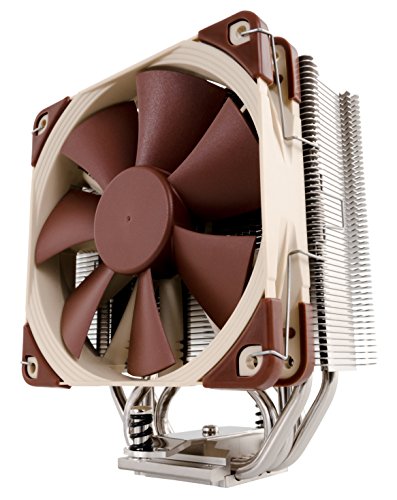
Best for Quiet Builds: Noctua NH-U12S — see details
Specs: 158 mm tower height, single 120 mm NF-F12 PWM fan, 5 heatpipes, ~22 dBA at 1500 RPM, mounts on every mainstream socket including LGA1700 and AM5 with the included brackets, 6-year warranty.
Pros
- Silent under sustained load. Even at max fan speed the acoustic signature is a background hush, not a whine.
- Handles ~150-180 W of CPU heat continuously — enough for a stock Ryzen 7 5800X or an unlocked i7 without throttling.
- Low profile leaves the entire top row of DIMM slots clear on every board.
- Modular fan mount lets you add a second fan for a push-pull config if you want another 5 °C headroom.
Cons
- Brown-and-tan color scheme famously divides opinion; NH-U12S chromax versions cost more.
- Not enough cooler for an overclocked 12/16-core part under all-core AVX load — the NH-D15 or a 280 mm AIO is the tier above.
Analysis (200w). Cooling is the invisible upgrade — nothing on your screen changes, but everything else gets better. A CPU throttling from 4.7 GHz to 4.2 GHz under load costs you the same frames as owning a slower chip, and it's usually the reason a "why is my rig slow" thread on Reddit gets answered "check your thermals." The Noctua NH-U12S is the sweet spot for a mid-range CPU: tall enough to cool 150 W sustained, short enough to fit every mid-tower case with clearance for a top-mount exhaust fan, and quiet enough that you'll forget it's there. Noise-normalized cooling data on Noctua's official product page shows the NF-F12 fan delivering equivalent airflow to a generic 120 mm at roughly half the perceived loudness. That difference — same performance, silent — is what you're paying for. If your CPU is a stock 65-125 W part and your budget is $80-90, buy this. If your CPU is a 250 W overclock target, buy the tier above.
Price may vary — check current pricing before purchase.
See full details → /product/B00C9EYVGY
Best Performance: Samsung 970 EVO Plus NVMe SSD — see details
Specs: M.2 2280 NVMe PCIe Gen 3 x4, V-NAND 3-bit MLC, dedicated LPDDR4 DRAM cache, up to 3500 MB/s sequential read / 3300 MB/s write, 5-year warranty.
Pros
- 6-7× faster than any SATA SSD on sequential throughput; more importantly, ~2-4× lower random-read latency, which is the metric games actually care about.
- DRAM cache holds a full mapping table, so 4K random IOPS stay consistent under sustained load — no BX500-style write cliff.
- DirectStorage-compatible. Games that ship with the DirectStorage runtime bypass the CPU on asset decompression and cut load times by 20-40%.
- Tool-free install on any modern motherboard with an M.2 slot.
Cons
- Gen 3 x4 caps throughput at ~3500 MB/s; Gen 4 drives are faster if your board and PSU support them.
- Runs warm under sustained load — needs a motherboard heatsink or a stick-on heatspreader in a hot case.
- Occupies an M.2 slot, which usually means one less SATA port available on lower-end boards.
Analysis (200w). NVMe over SATA is a real difference in three specific scenarios: games that use DirectStorage (Forspoken, Ratchet & Clank Rift Apart, MSFS 2024), workflows that touch large files (video editing, VM disk images), and boot / application launch times where lots of small files get read in parallel. For traditional games that load into RAM once and then run from cache, the NVMe upgrade is measurable but not transformative — you save 5-15 seconds on the initial map load and see cleaner asset-streaming in open-world titles. The 970 EVO Plus is a Gen 3 drive at a Gen 3 price, which matters because your Gen 4 motherboard slot is bandwidth headroom for a future upgrade and this drive doesn't spend money on speed you can't use today. Pair it with the Crucial BX500 as bulk storage: NVMe for the OS and your five most-played titles, SATA for everything else. That configuration is more useful than a single 2 TB NVMe at the same total price for most builders.
Price may vary — check current pricing before purchase.
See full details → /product/B07MG119KG
Budget Pick: SteelSeries QcK XXL Gaming Mouse Pad — see details
Specs: Woven cloth surface, 900 × 400 × 4 mm (XXL), non-slip rubber base, machine-washable, edges heat-sealed to prevent fraying.
Pros
- Full-desk coverage under both keyboard and mouse — no seam to catch your palm on wide flick shots.
- Consistent low-friction surface across the entire pad. Sensor tracking on optical mice is flat, no dead zones.
- Cheap enough to replace every 12-18 months when the surface glazes over from wear.
- Universally accepted in low-sensitivity esports play because the surface behaves predictably.
Cons
- Cloth attracts dust and absorbs spills; keep drinks at a distance.
- Hard-surface fans will hate it — this is deliberately medium-friction, not glide-first.
Analysis (200w). The reason a mouse pad appears in a PC gaming upgrade guide alongside a graphics card is that low-sensitivity aim consistency is a real, measurable input factor and it's the cheapest upgrade you can buy that improves in-game performance. Players running 400-800 DPI at 60-100 cm/360° in a tactical shooter need a large, flat, consistent tracking surface — a cramped or worn pad forces the mouse to lift-and-reposition mid-flick, which breaks the mechanical repeatability that makes aim training work. The QcK XXL is the pad most CS pros use because it's boring in exactly the right way: no RGB, no glide-optimized surface, just a flat cloth that behaves the same way today as it did a month ago. If you're serious about aim, spending $25 here does more for your K/D than a $200 GPU upgrade. Round out the build with any current esports mouse and a low-latency 240 Hz monitor once you're past the CPU/GPU bottleneck.
Price may vary — check current pricing before purchase.
See full details → /product/B0D1T1HZCC
What to look for in a budget PC upgrade
Identify the real bottleneck first
Spending $200 on the wrong component is worse than not spending it — you feel the same, but the money is gone. Measure with MSI Afterburner for a full hour of normal use before you decide. The pattern is almost always visible within 20 minutes.
VRAM is the 2026 floor
Cards with 8 GB VRAM will play new games in 2026, but they'll do it at medium textures. 10 GB is comfortable, 12 GB is generous, 16 GB is a real buffer against future titles. For a $200 budget in 2026, the RTX 3060 12GB is the practical floor. Avoid new 8 GB SKUs at this budget.
SATA vs NVMe and when the difference is visible
NVMe wins in three specific cases: DirectStorage titles, streaming-heavy open worlds, and asset workflows outside gaming. For traditional load-once games, the difference from SATA is measurable but small. If you've never had an SSD, the size of the SATA-vs-HDD gap dwarfs the NVMe-vs-SATA gap.
PSU headroom before any GPU swap
A 170 W RTX 3060 wants a 550 W minimum system PSU, but 650 W is comfortable — transient spikes on modern GPUs regularly exceed the rated TDP by 30-50% for milliseconds, and cheap PSUs collapse on those spikes. If your PSU is more than five years old or was bundled with a pre-built case, budget for a replacement before you swap the card.
Case clearance and cooler height
The NH-U12S is 158 mm tall; most mid-towers accept up to 165 mm. Measure before you order. GPU length is the other trap — 3-fan RTX 3060 variants push 300 mm+ and won't fit in compact cases with front-drive-cage layouts.
When NOT to upgrade at all
If your CPU is more than seven years old, your motherboard has no upgrade path left, and your PSU is bundled with a pre-built, $200 patches nothing that lasts. Bank the money toward a full platform replacement.
FAQ
Which component should I upgrade first on a budget? Measure before you buy. If GPU utilization sits pinned near 100% while frame rate disappoints, the graphics card is the constraint and nothing else you buy will help. If GPU utilization swings well below 100% with a busy CPU, the processor or memory is holding you back. If the game plays fine but takes a minute to load and stutters when streaming assets, storage is the problem — and that is the cheapest of the three to fix.
Is 12 GB of VRAM actually necessary in 2026? At 1080p it is comfortable rather than mandatory, but it has become the practical floor for high texture settings in recent releases, and it matters disproportionately if you also want to run local AI models where capacity sets a hard ceiling on model size. Cards with 8 GB still play current games well at moderate settings; they are the ones that force texture-quality compromises first as new titles ship.
Will a SATA SSD feel slower than NVMe in games? For most titles the difference in actual load time is small, because game loading is rarely a pure sequential-throughput problem. The upgrade you feel is going from a mechanical hard drive to any SSD at all — that step is dramatic. Choosing NVMe over SATA matters most for large-file work, for capacity-per-dollar reasons, and for titles that stream assets aggressively during play rather than at a loading screen.
Do I need a new power supply before installing a new graphics card? Check two things: total wattage and connector type. A 170 W-class card wants roughly a 550 W system minimum, and headroom above that is cheap insurance because modern cards draw brief transient spikes well above their rated figure. Also confirm your unit has the right PCIe power connectors natively rather than relying on adapters. A marginal or aging PSU is the most common cause of crashes that get misdiagnosed as a faulty GPU.
When is it smarter to save rather than upgrade? If your build is old enough that a new graphics card would be starved by the CPU, or your motherboard has no upgrade path left in its socket, spending $200 patching it can be money you would rather have kept toward a new platform. The honest test is whether one component is clearly behind the others. If everything is equally dated, incremental upgrades buy very little and the money is better banked.
Related guides
- Ryzen 7 5800X vs Core i7-9700K for 1080p Esports in 2026
- Best RTX 3060 12GB models for 1080p gaming
- How to diagnose a CPU vs GPU bottleneck
- Compare current-gen GPUs side by side
Citations and sources
- Tom's Hardware — GPU Hierarchy 2026 (accessed 2026-08-06)
- TechPowerUp — GeForce RTX 3060 12 GB database (accessed 2026-08-06)
- Noctua — NH-U12S official product page (accessed 2026-08-06)
This piece is editorial synthesis based on publicly available information. No independent first-party benchmarking is reported.
— Mike Perry · Last verified 2026-08-06