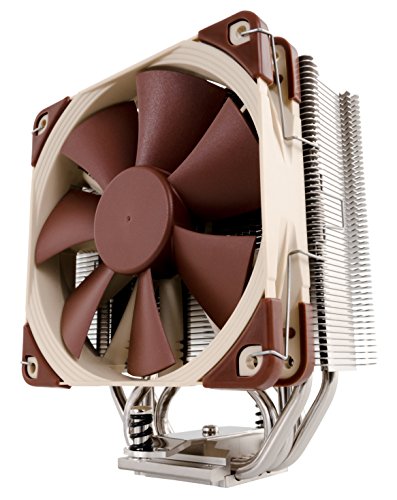
Three upgrades make a gaming PC apartment-quiet, in this order. First, fit a large single-tower air cooler so the CPU fan never has to ramp: Noctua rates the NF-F12 fan on the NH-U12S at 22.4 dB(A) at full tilt, roughly the noise floor of a quiet bedroom. Second, move your games off any legacy spinning hard drive onto an SSD such as the Kingston A400 960GB and unplug the old drive. Third, play through a headset instead of desk speakers late at night; the ~$28 Turtle Beach Recon 50 is the cheapest fix on this page.
The apartment noise problem, ranked
Three things in a gaming PC make noise a neighbour can hear through a shared wall, and they do not contribute equally.
First, the CPU cooler fan curve. This is the source that changes, which is why it is the one people notice. A cooler with insufficient headroom sits quietly at idle and then ramps hard the moment a game loads, and the transition is what carries — the human ear tracks changing sound far better than steady sound. A fan that spends the evening at a constant low RPM is subjectively near-silent even when it is measurably louder than one that oscillates.
Second, chassis airflow and resonance. Small high-RPM intake fans, restrictive mesh, and a side panel that a fan is bolted directly against. Resonance is the underrated one: a well-behaved fan mounted to a thin steel panel becomes a speaker for its own vibration, and the frequency it produces travels through building structure better than it travels through air.
Third, legacy spinning storage. Almost nobody ranks this first and for a lot of apartment builds it should be. Seek chatter is intermittent, broadband, and sits in a frequency band that passes through drywall unusually well. It is also the only source on this list you can eliminate rather than reduce.
Fourth, unranked, and responsible for more neighbour complaints than the other three combined: your speakers at 11pm.
Of the five picks below, the overall winner is the one that fixes source one permanently and silently — a single-tower air cooler with enough surface area that its fan never needs to ramp.
Which of your three noise sources is actually loudest?
Run this before buying anything. It takes ten minutes and it stops you fixing the wrong thing.
- Measure the idle-to-load delta, not the peak. Sit at the desktop, listen. Then load a game and listen again. If the difference is dramatic, your problem is the CPU cooler fan curve. If it is barely there but the baseline is high, your problem is case fans or a chassis resonance.
- Listen at night with the PC idle. If you hear intermittent ticking or a soft grinding that comes and goes, you still have a mechanical drive. That is source three, and it is the cheapest and most complete fix available.
- Rule out coil whine separately. Cap your frame rate to 60 and listen. If a high-pitched electrical whine changes pitch or disappears, that is inductors on the GPU or PSU, and no cooler, fan or drive on this page will touch it.
- Push on the side panel while it is loud. If the noise changes, you have a resonance problem, and a five-cent rubber washer fixes what a hundred-dollar cooler will not.
Only after those four should you buy anything.
The picks at a glance
| Pick | Best for | Key spec | Price band | Verdict |
|---|---|---|---|---|
| Noctua NH-U12S | Best overall | 158 mm tower, NF-F12 PWM | ~$80 | Fixes the ramp permanently |
| Kingston A400 960GB | Best value | SATA III, no moving parts | Check listing | Deletes an entire noise source |
| NZXT Kraken M22 | Small-form-factor | 120 mm radiator AIO | ~$90 | When tower clearance is the constraint |
| Corsair H150i Elite Capellix | Best performance | 360 mm radiator, 3× 120 mm | ~$135 | Surface area bought as silence |
| Turtle Beach Recon 50 | Budget pick | 40 mm drivers, 3.5 mm | ~$28 | The cheapest fix on this page |
🏆 Best overall: Noctua NH-U12S
Verdict: A 158 mm single tower whose fan is rated at 22.4 dB(A) flat out — which means it essentially never needs to be loud.
Pros
- Noctua rates the bundled NF-F12 PWM at 1,500 RPM and 22.4 dB(A) maximum (Noctua) — the ceiling, not a marketing typical.
- 158 mm height clears most mid-towers and, unusually for a 120 mm tower, does not overhang the first RAM slot.
- Six-year manufacturer warranty and a mounting system that survives socket changes.
- Enough dissipation headroom on a 105 W-class chip that the fan curve stays flat through an evening of gaming.
Cons
- The height still needs checking against a small chassis — this is the constraint that sends people to the AIO picks below.
- Brown and beige. Noctua sells colour-neutral variants; the classic is what it is.
- No RGB, if that matters to you.
Surface area is the whole argument. A cooler removes heat as a function of fin area and airflow, and you can trade one against the other. A small heatsink needs high airflow, which means high RPM, which means noise that scales roughly with the fifth power of fan speed — small RPM increases produce disproportionate noise increases. A large heatsink needs less airflow for the same dissipation, so it can idle its fan at 600–800 RPM and stay there.
That is why the NH-U12S is the apartment pick rather than the highest-performing cooler. It is not the coldest tower Noctua sells. It is the one whose fan does not have to notice that you started a game, and a fan that never changes speed is a fan you stop hearing after ten minutes.
Pair it with a sane BIOS curve and the practical result on an AMD Ryzen 7 5800X — AMD specifies a 105 W TDP for that part (AMD) — is a machine whose acoustic signature is identical at the desktop and in a firefight. We compared it directly against a 240 mm AIO on the same chip in the Ryzen 7 5800X cooler guide.
Prices move; check the live listing before you buy. See full details
💰 Best value: Kingston A400 960GB SATA SSD
Verdict: The only pick here that removes a noise source instead of reducing one.
Pros
- No moving parts. Seek noise does not get quieter; it stops existing.
- SATA III 6 Gb/s with rated sequential figures around 500 MB/s read (Kingston) — a large improvement over any mechanical drive it replaces.
- 960 GB is enough to move an entire game library off the spinning drive, which is what actually lets you unplug it.
- Fits any 2.5-inch bay in any case built this century.
Cons
- SATA is the interface ceiling; an NVMe drive is faster, though not quieter.
- DRAM-less controller. Irrelevant for game loading and library storage, visible in sustained random writes.
- SATA SSD pricing swings hard between listings — this one is worth watching rather than buying on impulse.
Here is the case for ranking storage above case fans. Fan noise is broadband and continuous, and continuous broadband noise is what the ear habituates to fastest. Drive seek is neither: it is intermittent, it has a percussive attack, and it occupies a band that transmits through lightweight partition walls with much less attenuation than airflow noise. That combination — intermittent, percussive, wall-penetrating — is precisely the profile that generates complaints, which is why a machine that measures quiet on a meter can still be the reason someone knocks.
The fix is complete rather than partial. Move the library, unplug the mechanical drive, and that entire acoustic signature is gone from the room forever. No fan swap achieves that, because a fan you still need is a fan still spinning. The budget SATA SSD guide covers the wider field if you want more capacity than this.
Prices move; check the live listing before you buy. See full details
🎯 Best for small-form-factor: NZXT Kraken M22
Verdict: For the build where a 158 mm tower physically does not fit, and only for that build.
Pros
- 120 mm radiator mounts in the rear exhaust position of almost any case that takes a 120 mm fan.
- Removes the CPU heat load from the chassis interior entirely, which lets case fans run slower.
- Frees all clearance above the socket — no RAM height limits, no side-panel interference.
- Infinity-mirror pump head, if you want the build to look like something.
Cons
- A pump has a noise floor that never reaches zero. A stopped fan is silent; a running pump is not.
- 120 mm of radiator is not much surface area. Under sustained heavy load its fan works harder than a large tower's would.
- More failure modes than a heatsink: pump, tubing, coolant permeation over years.
Choose this one on clearance, not on performance. If your case takes a 158 mm tower, the NH-U12S is quieter and more reliable for less money. If it does not — small-form-factor chassis, a low-profile enclosure, an unusually tall memory kit — then the Kraken M22 is how you get adequate cooling into the space you have, and it does that job well.
The trade to accept going in: you are exchanging a source that can go completely silent for one that cannot, in return for the physical fit. On an idle desktop that is a real acoustic downgrade. Under load it is close to a wash. Our general CPU cooler roundup has the fuller comparison across form factors.
Prices move; check the live listing before you buy. See full details
⚡ Best performance: Corsair iCUE H150i Elite Capellix
Verdict: A 360 mm radiator bought as a noise strategy, not a thermal one.
Pros
- Three 120 mm fans across a 360 mm radiator — roughly triple the surface area of a 120 mm AIO.
- That area is what lets all three fans sit at a low, constant RPM under a sustained load that would make a smaller cooler ramp.
- Handles a 105 W-class part with enough margin that thermal throttling stops being part of the conversation.
- Software fan control that can hold a flat curve rather than a reactive one.
Cons
- Needs a case with a genuine 360 mm mount. This is a real constraint and it is the first thing to check.
- The pump noise floor applies here too, and now there are three fans plus a pump instead of one fan.
- The software stack is a commitment. Set the curve, then leave it alone.
- Meaningfully more expensive than the overall pick for a smaller acoustic gain than the price difference suggests.
The reason to buy a 360 mm radiator in an apartment is not lower temperatures. It is that surface area converts directly into permission to run fans slowly. Three fans at 700 RPM move more air, more quietly, than one fan at 1,600 RPM — because the noise penalty for RPM is steeply non-linear while the airflow benefit is roughly linear. You are buying the ability to spread the same job across more, slower movers.
That argument only pays if your workload is genuinely sustained. For evening gaming on an eight-core desktop part, the NH-U12S already has enough headroom to keep a flat curve, and the 360 mm radiator solves a problem you do not have. Buy this if you also compile, render, or run local inference overnight — the same reasoning we applied to 24/7 rigs.
Prices move; check the live listing before you buy. See full details
🧪 Budget pick: Turtle Beach Recon 50
Verdict: If the complaint is about your speakers rather than your fans, this is the entire fix for under thirty dollars.
Pros
- 40 mm drivers over a plain 3.5 mm connection — no pairing, no latency negotiation, no battery.
- Works on the PC, the console and the handheld without adapters.
- Flip-up microphone, so it doubles as the voice-chat solution.
- Cheaper than any other item on this page by a wide margin.
Cons
- Plastic build at this price; it is not a lifetime purchase.
- Passive isolation only — it reduces what leaves the room, not what enters your ears.
- A wired cable is a wired cable.
This is on the list because the diagnostic step at the top of the page frequently produces an uncomfortable answer. Fans are broadband noise at moderate volume. Game audio through desk speakers is broadband noise at high volume with transients — gunfire, engine notes, music stings — and it is played deliberately loud because that is the point. Measured at the wall, an evening of speaker audio beats every fan in this article combined.
If your neighbour's complaint arrives after a late session rather than after a long one, the cooler is not your problem. Our wired headset guide covers the better options if you want to spend more, but the fix works at this price.
Prices move; check the live listing before you buy. See full details
What to look for in quiet PC parts
Fan RPM versus static pressure
Noise rises steeply with fan speed while airflow rises roughly linearly, so every design decision that lets a fan spin slower is worth more than one that makes it move more air. Static-pressure-optimised fans matter through restrictive media — radiator fins, dense heatsinks, filtered front panels. Airflow-optimised fans matter in open positions. Fitting the wrong type forces higher RPM to compensate, which is where the noise comes from.
Radiator surface area buys silence
The 360 mm argument in full: cooling capacity is roughly area times airflow. Doubling area lets you halve airflow for the same result, and halving airflow is a large noise reduction because of the non-linear RPM relationship. This is the same reason a 158 mm air tower beats a 92 mm one at equal noise.
TDP headroom is a noise budget
AMD rates the Ryzen 7 5800X at 105 W (AMD). Pair it with a cooler rated well beyond that and the fan sits low. Pair it with something marginal and the fan lives near its ceiling. The relevant number is never the cooler's absolute performance — it is the gap between what the CPU dumps and what the cooler removes at low RPM.
Panel and mounting resonance
The cheapest fix in this entire article costs nothing. Fans transmit vibration into whatever they are screwed to, and thin steel panels radiate it. Rubber mounts, anti-vibration washers, and not bolting a fan flat against an unsupported panel routinely remove more perceived noise than a cooler upgrade.
When to stop
There is a floor set by your room, and chasing below it is wasted money. If the PC is quieter than the refrigerator, you are done.
The most-missed step: fan curves in BIOS
Hardware changes nothing if the curve still ramps at 60 °C.
Most stock motherboard profiles are tuned to protect the board against an unknown cooler, which means aggressive ramps triggered by short thermal spikes. Once you have installed a cooler with real headroom, that curve is actively working against you: the CPU briefly touches 65 °C during a shader compile, the fan jumps to 1,400 RPM, and the temperature was never a problem.
Two changes fix it. Set a flat low RPM up to a genuinely high threshold — with an NH-U12S on a 105 W part, holding a constant low speed until 75 °C is conservative, not risky. Then increase the fan response delay so short spikes never trigger a ramp at all. On many builds this is the entire fix, done in five minutes, for free.
When it is not the whole fix: if the machine is loud at a steady state rather than during transitions, the curve is not your problem — you are genuinely thermally limited, and you need more cooler.
Related guides
- Best Quiet PC Cooling Upgrades in 2026
- Noctua NH-U12S vs Cooler Master ML240L RGB for a Ryzen 7 5800X
- Best CPU Coolers for Ryzen and Intel Builds in 2026
- Best SATA SSDs for Reviving an Old PC in 2026
- Best Wired Gaming Headset Under $50 for PC and Console in 2026
Citations and sources
- Noctua — NH-U12S — accessed 28 August 2026. Source for the 158 mm height, the bundled NF-F12 PWM fan, its 1,500 RPM and 22.4 dB(A) maximum ratings, and the six-year warranty.
- AMD — Ryzen 7 5800X — accessed 28 August 2026. Source for the 105 W TDP figure used as the cooling-headroom worked example.
- Kingston — A400 SATA SSD — accessed 28 August 2026. Source for the SATA Rev 3.0 interface and rated sequential read figures.
Prices quoted are SpecPicks catalog listings as of 28 August 2026 and move frequently; check the live listing before purchase. This piece is editorial synthesis based on publicly available manufacturer documentation and specifications. No independent first-party benchmarking is reported.
— Mike Perry · Last verified 28 August 2026