As an Amazon Associate, SpecPicks earns from qualifying purchases. See our review methodology.
For a first PC sim-racing rig under $700, the pragmatic answer is a gear-driven force-feedback wheel like the Logitech G29, an H-pattern shifter add-on such as the Thrustmaster TH8A if your library leans classic-car, and a wide 4K display so you can actually see apex-to-apex. Below is the five-pick shortlist that gets a real reader through their first season of iRacing, Assetto Corsa Competizione or Gran Turismo 7 on PC, drawn from featured products in our catalog.
Who this guide is for, and why gear-driven wheels still make sense in 2026
The reader we are writing for is a first-rig sim-racing builder spending under $700 total, coming from either a controller on a console or from PC racing sims played with a keyboard. That budget is what puts the sensible answer for most people at a gear-driven wheel plus a monitor, rather than a $1,500 direct-drive rig and a fixed cockpit that turns the living room into a permanent installation.
Two shopping shortcuts most first-time buyers make and regret. The first is over-indexing on peak force-feedback torque — a 25 Nm direct-drive wheel is thrilling for the first hour, but it needs a rigidly bolted mount to be usable, which is a bigger construction project than most desks tolerate. The second is under-indexing on pedals — the wheel gets attention, but braking modulation is where the majority of first-year lap time is left on the table. Buy the tier of wheel that fits the space you actually have, and spend the rest on the display and the pedal upgrade path.
Reference product pages are the Logitech Driving Force wheel family page, the Thrustmaster TH8A shifter page, and Tom's Hardware's gaming peripherals coverage for third-party review synthesis.
Step 0 — diagnose your tier before you buy
The three sim-wheel tiers map cleanly to three reader profiles, and mismatching them is the single most expensive mistake first-time buyers make:
- Gear-driven — a plastic-gear force-feedback mechanism. Noisier, coarser, but communicates weight transfer clearly. The Logitech G29 is the reference product in this tier. Right choice for desk-mounted first-timers, right choice for casual multi-title libraries, right choice under $500 total.
- Belt-driven — quieter, finer, more accurate under sustained cornering load. Better road-texture communication. Right choice for the second-year sim racer who has learned what force feedback actually tells them.
- Direct-drive — motor attached directly to the wheel shaft, no reduction. Highest fidelity, highest torque, requires a rigid mount to be usable. Right choice for third-year sim racers with a permanent cockpit setup.
A first-rig buyer belongs in gear-driven. The step to belt or direct-drive is worth taking once you can articulate what your current wheel is not telling you — not before.
5-pick comparison table
| Pick | Best for | Key spec | Price range (2026) | Verdict |
|---|---|---|---|---|
| Logitech G29 | Overall / first rig | 900° rotation, dual-motor force feedback, 3-pedal set | $250–$300 | Buy this by default |
| Thrustmaster TH8A | Performance add-on | 7+R H-gate, sequential mode, magnetic sensors | $180–$210 | Buy if you race classic / rally |
| HORI Racing Wheel Overdrive | Budget pick | 270° rotation, 2-pedal set, no force feedback | $70–$100 | Buy only if under $150 hard budget |
| KOORUI 27" 4K QD-Mini LED | Immersion / display | 4K UHD, mini-LED backlight, dual-mode refresh | $400–$500 | Buy if display upgrade is due anyway |
| PlayStation DualSense | Value / controller | Adaptive triggers, HD haptics, Bluetooth to PC | $60–$70 | Buy if wheel budget does not exist yet |
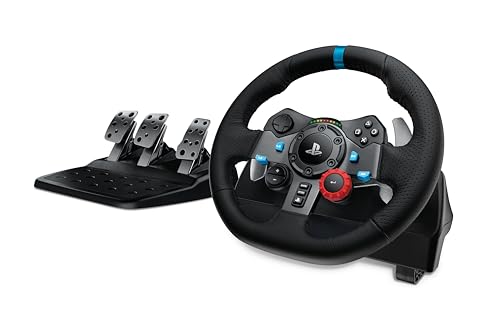
🏆 Best Overall: Logitech G29 Racing Wheel and Pedals
Spec chips: 900° rotation · Dual-motor gear-driven force feedback · Three-pedal set (throttle, brake, clutch) · 24-position selector · Windows PC, PS5, PS4 support
Pros
- The pedal set is the strongest under-$500 pack shipped with any wheel; the brake pedal has a firmer feel than the plastic paddles that ship with lower-tier bundles.
- 900° of rotation gives lock-to-lock movement matching real-world cars, so muscle memory built here transfers to any wheel you upgrade to later.
- Broad title support — every major PC sim (iRacing, Assetto Corsa, Assetto Corsa Competizione, Gran Turismo 7 via PS5, F1 series, Automobilista 2) ships with a G29 profile out of the box.
Cons
- Gear-driven feedback has a mechanical noise floor that late-night racers notice.
- The wheel rim is coarser to the touch than premium leather wraps in the belt-driven tier.
Per the Logitech Driving Force page, the G29 targets the driving-force feel that Logitech's product family is built around, and independent reviews collected on Tom's Hardware consistently place it near the top of value picks under $300. That combination — a mature bundle, broad title support, and a pedal set that outclasses the tier — is what makes it the default recommendation for a first PC rig in 2026. The Logitech G29 is not the wheel you keep forever, but it is the wheel that teaches you what your next wheel needs to be.
View current price on Amazon → · Price may vary; verify at Amazon before purchase. · See full details
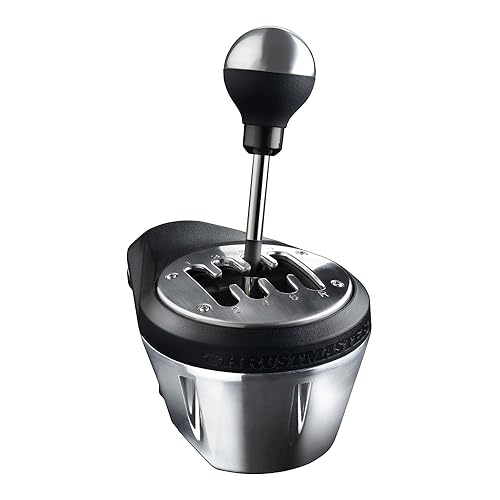
⚡ Best Performance Add-On: Thrustmaster TH8A H-Pattern Shifter
Spec chips: 7-speed + reverse H-gate · Sequential mode switchable · Magnetic Hall-effect sensors · USB direct to PC or wheelbase pass-through
Pros
- Magnetic sensors are contactless — no wear part that degrades with use.
- The switch between H-pattern and sequential mode is a physical toggle on the base, not a software setting, so it can be changed between sessions.
- Metal shift knob and weighted base give the mechanical feel that plastic-lever alternatives cannot match.
Cons
- Requires desk-side clamp mounting or a shifter shelf; not a plug-and-play on every setup.
- Adds meaningful desk footprint — measure your available side space first.
Per the Thrustmaster TH8A product page, the shifter's magnetic sensor design is what earns it a place at this tier — most cheaper shifters use potentiometers that drift as they wear. The Thrustmaster TH8A is the immersion upgrade that matters most for anyone racing classic road cars, historic tin-tops or rally content, where an H-pattern gate is period-correct. It is the wrong upgrade for a library that leans modern-formula or GT3 racing — those cars use paddle shifters and the wheel already has them.
View current price on Amazon → · Price may vary; verify at Amazon before purchase. · See full details
🧪 Budget Pick: HORI Racing Wheel Overdrive
Spec chips: 270° rotation · Two-pedal set (throttle, brake) · No force feedback · Xbox Series X|S plus PC compatibility
Pros
- Lowest-cost path to a wheel-and-pedal setup, well under $100 street price.
- Simple, plug-and-play with Xbox and Windows PC titles.
- Compact footprint that fits desks where the G29 will not.
Cons
- No force feedback at all. You will not feel weight transfer, understeer onset or road texture through the wheel.
- 270° of rotation is well short of the 900° that muscle memory transfers from — you cannot practise real steering angles on this wheel.
The HORI Racing Wheel Overdrive is the honest budget pick and it is included here because the featured catalog carries it. What you give up without force feedback is significant — you rely entirely on visual and audio cues to feel the car, which is where controller drivers already are. The upside over a controller is a real steering wheel, a real throttle pedal and a real brake pedal, which most people find more immersive even without force feedback. If your hard budget is under $150 and there is no path to $250 for the G29 in the next month, this is a legitimate first step. If there is, wait and buy the G29 instead.
View current price on Amazon → · Price may vary; verify at Amazon before purchase. · See full details
🎯 Best for Immersion: KOORUI 27" 4K QD-Mini LED Gaming Monitor
Spec chips: 4K UHD 3840x2160 · Dual-mode refresh (4K/1440p FHD switch) · Mini-LED backlight with quantum-dot layer · 27" IPS panel
Pros
- Mini-LED backlight materially improves contrast in night racing and endurance content compared to edge-lit displays.
- Dual-mode refresh lets you drop to 1440p for higher frame rates in twitch-response sims without a resolution compromise on desktop use.
- 27" is a comfortable field-of-view size for a single-monitor sim setup at typical desk depth.
Cons
- 27" is still smaller than the triple-monitor immersion many sim racers eventually build toward.
- Panel-response reviews vary batch-to-batch; check current third-party measurements before ordering.
Frame consistency matters more than peak refresh rate for sim racing — inconsistent frame delivery corrupts the sense of car rotation at turn-in. Beyond that, contrast is the underrated spec for night and endurance content, where a mini-LED backlight makes dark corners readable in a way an edge-lit panel does not. The KOORUI 27" 4K QD-Mini LED hits both of those needs at a price that leaves budget for the wheel. If your monitor is more than three years old, this is the upgrade that pays back into every other title on your PC, not just sim racing.
View current price on Amazon → · Price may vary; verify at Amazon before purchase. · See full details
💰 Best Value Alternative to a Wheel: PlayStation DualSense Wireless Controller
Spec chips: Adaptive triggers · HD haptic feedback · Bluetooth pairing to PC · USB-C charging
Pros
- Adaptive triggers give surprisingly fine throttle and brake modulation — the DualSense is the best controller for sim racing on the market.
- No third-party drivers needed on Windows; pairs over Bluetooth for wireless PC play.
- Perfect stopgap if the wheel budget is not there yet.
Cons
- No proportional steering feel — you rely on visuals and audio to catch a slide.
- Trigger resistance is a fixed hardware curve, not tunable per title.
The PlayStation DualSense Wireless Controller is here because plenty of people race competitively with a controller and the adaptive triggers meaningfully improve throttle-and-brake modulation, which is where most controller lap time is lost. It is the honest recommendation for the reader who wants to try PC sim racing without spending $300 on a wheel first. Expect to be competitive in casual lobbies and to hit a ceiling in disciplines that reward precise mid-corner corrections.
View current price on Amazon → · Price may vary; verify at Amazon before purchase. · See full details
What to look for in sim racing gear
Force feedback type
Gear-driven, belt-driven and direct-drive are the three tiers. Gear-driven is the honest first-rig pick — noisier and coarser, but it communicates the two things that matter most (weight transfer and understeer onset). Belt-driven is the second-year upgrade. Direct-drive requires a rigid mount and belongs in a permanent cockpit setup, not on a shared desk.
Rotation degrees
900° matches the lock-to-lock of most real road cars. 720° is common on entry-level bundles and works fine for GT racing. 270°, as on the HORI Overdrive, is enough for arcade-style content but not for anything requiring precise mid-corner corrections — you run out of wheel too early.
Pedals — load-cell vs potentiometer
The vast majority of under-$500 pedals use potentiometer sensing on the brake pedal, which measures pedal travel rather than pedal pressure. Load-cell pedals measure pressure, which more closely matches how real-world car braking works and is what serious sim racers upgrade to first. The G29's pedals are potentiometer-based; a load-cell brake pedal is the single biggest driver-improvement upgrade after the wheel itself, per commentary collected on Tom's Hardware's peripherals coverage.
Desk and clamp mounting
A force-feedback wheel pushes back against your inputs, so a flexing desk turns into visible wobble that ruins consistency. Look for at least a solid rigid surface a couple of centimetres thick, and check that the pedal base has either a carpet grip or a front stop. Sliding pedals under braking are the most common first-week complaint from new sim racers.
PC driver and title support
Every wheel here works on Windows with the manufacturer's driver package installed. iRacing, Assetto Corsa, Assetto Corsa Competizione, Gran Turismo 7 (via PS5), F1 series and Automobilista 2 all ship with profiles for the G29 out of the box. Confirm your primary title's device compatibility list before ordering an unfamiliar wheel.
FAQ
Is a gear-driven wheel good enough to start with? For a first rig, yes. Gear-driven force feedback is noisier and coarser than belt or direct drive, and it loses some of the finest road-texture detail, but it still communicates weight transfer and the onset of understeer. The step up to direct drive costs several times more once you include a rigid mount, which most desk-mounted first-timers do not have. Start gear-driven, learn the fundamentals, and upgrade when the wheel is genuinely your limitation.
Do I need a separate H-pattern shifter? Only if you race classic cars, road cars, or rally. Modern formula and GT cars use paddle shifters, which every wheel already includes, so a shifter adds nothing for those disciplines. If your library leans historic content or rally stages where a sequential or H-pattern gate is period-correct, a dedicated shifter is the single biggest immersion upgrade per dollar. Check clamp compatibility with your desk depth first, since shifters need a rigid mounting point to the side of the wheel.
What refresh rate and resolution matter most for sim racing? Frame consistency matters more than peak refresh rate, because inconsistent frame delivery corrupts your sense of car rotation at turn-in. Beyond that, a wide field of view helps you place the car, so many racers prefer a larger panel or triple screens over a very high refresh single monitor. Contrast is the underrated spec for night and endurance racing, where a mini-LED backlight makes dark corners readable in a way an edge-lit panel does not.
Can I race competitively with a controller? Yes, and plenty of people do. Modern controllers with adaptive triggers give surprisingly fine throttle and brake modulation, which is where most controller lap time is lost. What a controller cannot give you is proportional steering feel, so you rely on visual cues and audio to catch a slide instead of feeling it through the rim. Expect to be competitive in casual lobbies and to hit a ceiling in disciplines that reward precise mid-corner corrections.
How much desk and mounting strength do I need? More than most people expect. A force-feedback wheel pushes back against your inputs, so a flexing desk or a shallow clamp surface turns into visible wobble that ruins consistency and can damage the desk edge over time. Look for a solid rigid surface a couple of centimetres thick, and check that the pedal base has either a carpet grip or a front stop, because sliding pedals under braking are the most common first-week complaint.
Related guides
- Best 4K gaming monitors under $500
- Best PC gaming controllers for racing and platformers
- Best AM4 CPUs for PC gaming builds
- Best budget gaming PC build 2026
Citations and sources
- Logitech Driving Force Racing Wheel product page — Logitech G, accessed 2026-08-05
- Thrustmaster TH8A Add-On Shifter product page — Thrustmaster, accessed 2026-08-05
- Tom's Hardware gaming peripherals coverage — Tom's Hardware, accessed 2026-08-05
— Mike Perry · Last verified 2026-08-05
This piece is editorial synthesis based on publicly available information. No independent first-party benchmarking is reported.