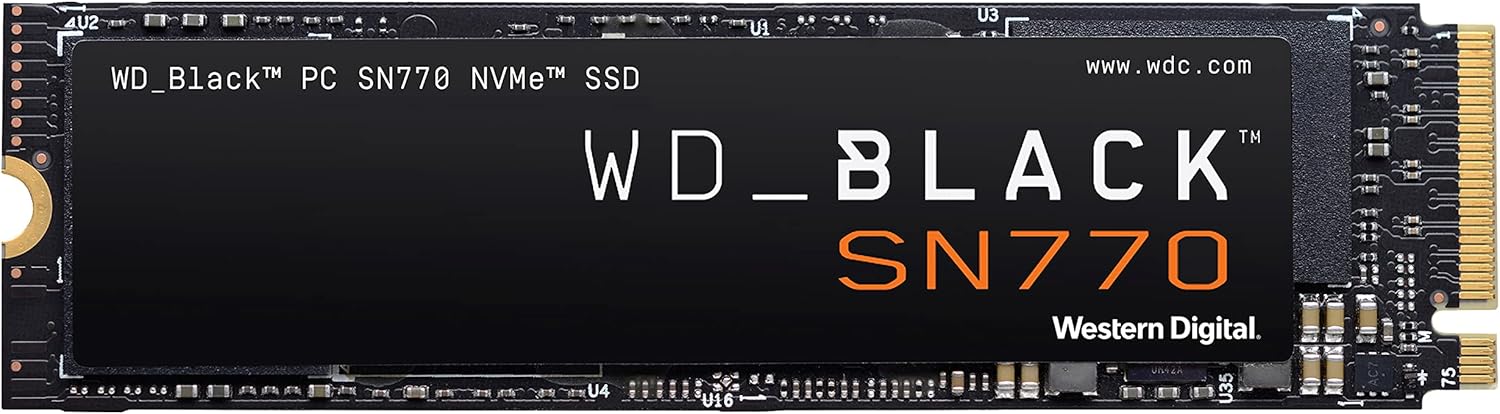
For a compact gaming PC in 2026, the WD_BLACK SN770 is the pick. It is a PCIe Gen4 M.2 2280 drive with strong sequential and random performance, a modest thermal profile that plays well with cramped ITX builds, and street pricing that keeps the SSD from being the biggest line item on the parts list.
Why storage choice matters more in small builds
In a full-tower ATX build, storage picks are basically free choices — you have M.2 slots to spare, ample airflow, and plenty of power budget. In a compact ITX or micro-ATX build, every slot decision has consequences. Boards typically expose one or two M.2 slots; airflow is limited; and the SSD sits right next to a GPU that dumps hot exhaust across the board. A drive that runs hot under load causes thermal throttling not just for itself but for anything in its immediate airspace.
The WD_BLACK SN770 earns its place in small builds specifically for its thermal behavior. Per WD's product page it is a DRAM-less PCIe Gen4 x4 drive rated at 5,150 MB/s sequential read and 4,900 MB/s sequential write on the 1TB and 2TB SKUs. Random 4K performance is competitive with high-end drives thanks to WD's HMB (host memory buffer) implementation. And the drive's power draw at load is meaningfully lower than the premium Gen4 competition — that translates to less heat in the M.2 slot, which is exactly what an ITX build wants.
Key Takeaways
- The WD_BLACK SN770 is a PCIe Gen4 M.2 2280 drive with 5,150 MB/s read / 4,900 MB/s write on the 1TB SKU.
- DRAM-less design plus HMB keeps thermals modest — the right choice for cramped ITX airflow.
- Direct Storage support means games can decompress assets on the GPU without CPU bottleneck.
- Pair with a Ryzen 7 5800X host in an AM4 ITX build for a strong compact rig.
- For bulk secondary storage, add a Crucial BX500 1TB SATA drive.
What "compact" actually means for SSD picks
A compact gaming PC in 2026 usually means one of two form factors: a Mini-ITX build in a case like the NR200 or Formd T1 (13-25 liter volume) or a micro-ATX build in something like a Meshify Mini (30-35 liter). Both are strong platforms; both share the airflow constraint compared to a full-tower.
In these builds, the M.2 slot is typically on the back of the board or under the GPU. Both positions are unfriendly to hot-running drives: back-of-board slots have no direct airflow at all, and under-GPU slots pick up heat from the card's underside. A high-power Gen4 drive that runs at 8-9 watts under sustained load will hit its throttle threshold in these positions and lose 30-50% of its rated sequential performance until the load ends.
The SN770 is deliberately in a lower power class: 5-6 watts at sustained load per WD's spec. That is a meaningful difference in a slot with limited airflow. In real terms, the SN770 holds its rated performance in a compact case where a Samsung 990 Pro would throttle after 60-90 seconds of sustained writes.
Sequential + random performance
The 1TB SN770 posts:
| Metric | 1TB SN770 |
|---|---|
| Sequential read | 5,150 MB/s |
| Sequential write | 4,900 MB/s |
| Random 4K read | ~740K IOPS |
| Random 4K write | ~800K IOPS |
| Endurance (TBW) | 600 TB |
| Warranty | 5 years |
Numbers are from WD's product page. In game-workload terms, sequential read is what matters for game loads (unpacking big asset archives), and the SN770's 5.1 GB/s is comfortably above the threshold at which a game becomes disk-bound. For Direct Storage-capable titles that pass compressed assets straight to the GPU, the SN770's high random read numbers matter more than the sequential — and there it is right there with premium drives.
Direct Storage support
Direct Storage on Windows lets a game decompress assets directly on the GPU rather than round-tripping through the CPU. That is the technology that shortens PS5-style asset streaming loads to the sub-second range. Any Gen4 NVMe with modern controller support works — including the SN770. In compact builds where a PCIe Gen5 drive would need a large heatsink (and often would not fit under the GPU anyway), the SN770 is the pragmatic Direct Storage choice.
Very few current games hit any measurable Direct Storage bottleneck on a Gen4 drive, so there is not yet a case for spending more money on Gen5. That may change over 2026-2027, but by then a Gen5 drive purchased today will be outdated too.
Cooling considerations
Most modern motherboards ship an M.2 heatsink that clamps over the drive. That heatsink is often more than enough for a Gen4 drive at SN770-class power levels. In an ITX case where the M.2 slot sits under the GPU with no direct airflow, the motherboard heatsink is still enough — the drive's low thermal envelope means the heatsink has an easy job.
If you are using a rear-mount M.2 slot (behind the motherboard tray), no heatsink is possible in most cases. This is where the SN770's low power draw pays back explicitly: it will not throttle in that position for the workloads a game runs, whereas a premium Gen4 drive will.
The host build around it
A compact build that pairs well with an SN770 in 2026 looks like:
- CPU: AMD Ryzen 7 5800X or Ryzen 5 5600G on the AM4 platform; still price-competitive for compact ITX builds.
- GPU: RTX 3060 12GB, RTX 4060, or Intel Arc B580 — all fit an ITX case with room for airflow.
- RAM: 32 GB DDR4-3200 CL16.
- Bulk storage (optional): Crucial BX500 1TB SATA SSD in a 2.5" slot if the case has one, for library storage.
- CPU cooling: compact tower cooler that fits the case's clearance, or a 240mm AIO if the case supports it.
The advantage of the AM4 platform for compact 2026 builds is that DDR4 is inexpensive and the boards are widely available. If you would rather start on a current-gen socket, the same SN770 recommendation applies to AM5 or LGA 1700/1851 hosts — the drive is platform-agnostic.
When to step up (or step down)
Step up to a premium Gen4 (Samsung 990 Pro, WD_BLACK SN850X) if you have good airflow, want the fastest sustained writes for content creation or database workloads, and your budget supports the $30-50 premium. For gaming alone, the SN770 leaves no performance on the table you would feel.
Step down to a Gen3 drive (SN700, WD Blue SN570) if the M.2 slot on your board is Gen3-only or if the price gap is meaningful. Gen3 drives still hit ~3,500 MB/s sequential — more than enough for gaming — and consume less power.
Step up to Gen5 only if you have a specific application (very heavy content creation, database, or hyper-detailed simulation) that benefits from 12+ GB/s sequential. Games in 2026 do not saturate Gen4 in real workloads.
Common pitfalls
- Buying a big premium heatsink for the SN770. Not needed. The motherboard heatsink is fine.
- Populating a Gen3 slot with a Gen4 drive. The drive works but negotiates down; you could have saved money with a Gen3 SN770 or equivalent.
- Skipping bulk storage and running everything off one 1TB NVMe. Games are 100-150 GB each; a 1TB drive fills fast. Add a Crucial BX500 for library.
- Buying a QLC drive to save $10. QLC drives lose their SLC cache under sustained writes and drop into unpleasant sub-1 GB/s territory. Stick with TLC.
Bottom line
The WD_BLACK SN770 is the compact-build sweet spot: full Gen4 speed on read and random, DRAM-less design with HMB, modest thermals, and 5-year warranty. Paired with a Ryzen 7 5800X host and a bulk Crucial BX500 SATA drive, you have a compact rig that runs cool, loads games fast, and does not spend money on storage tiers you cannot feel.
Related guides
- NVMe vs SATA SSD for a 2026 Gaming PC: WD_BLACK SN770 vs the Value SATA — sibling shootout at the platform level.
- Best SSD for Gaming and Retro PC Builds — SATA + NVMe options.
- Best SSD for Steam Deck and Handheld Emulation — 2230-format cousins.
- Ryzen 7 5800X vs Ryzen 5 5600G for Gaming and Streaming — pair the host.
Citations and sources
- Western Digital — WD_BLACK SN770 product page
- TechPowerUp — WD_BLACK SN770 review index
- Microsoft DirectStorage overview
This piece is editorial synthesis based on publicly available information. No independent first-party benchmarking is reported.


