See our review methodology. Prices below are catalog street prices observed in August 2026 and move constantly — check the live listing.
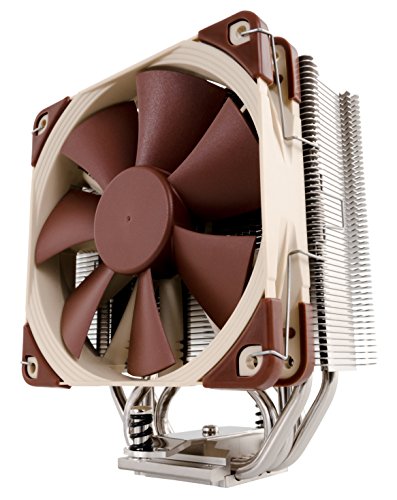
In a mini-ITX case the answer is usually fit, not temperature. The Noctua NH-U12S is 158 mm tall, which is more clearance than a large share of small-form-factor chassis offer, while the NZXT Kraken M22 needs only a low socket block plus a 120 mm radiator-and-fan stack roughly 55 mm thick at a mount your case may or may not have. On a 105 W Ryzen 7 5800X the two land within a few degrees of each other.
Key takeaways
- The NH-U12S is 158 mm tall as shipped; measure your case's cooler clearance before anything else, because three millimetres is a hard no.
- A single 120 mm radiator does not have a meaningful surface-area advantage over a good 120 mm air tower — the AIO's real win is where the bulk sits, not how much heat it moves.
- The Ryzen 7 5800X's 105 W rating understates it: package power under all-core load runs well above that, and the die concentrates heat in a small area that rewards mount quality.
- The Kraken M22 is an end-of-life SKU. Factor software support and pump replacement risk into a purchase you expect to keep for five years.
- If your case genuinely supports a 240 mm radiator without fouling the GPU, that is the better answer than either cooler here.
Who this is for
You already own a Ryzen 7 5800X. You have a mini-ITX case — bought for the desk footprint, the LAN-party portability, or because it fits on a shelf — and its spec sheet has a number next to "CPU cooler clearance" that is smaller than you would like. You are now trying to work out whether a 120 mm all-in-one liquid cooler is a genuine upgrade over a 120 mm air tower, or whether it is a lateral move that adds a pump to your list of things that can fail.
This is a fit problem before it is a thermal problem, and that ordering matters because the internet answers it backwards. Search "AIO vs air" and you get a hundred thermal comparisons run in mid-tower cases with unrestricted airflow, where the question is which cooler dissipates more heat. In a mini-ITX chassis the binding constraint is geometry: a 158 mm tower either fits under the side panel or it does not, and no amount of thermal advantage rescues a cooler that cannot be installed.
The second thing the mid-tower comparisons get wrong is airflow context. In a case with a 200 mm intake and a mesh front panel, a cooler's fan is drawing cool ambient air. In a small-form-factor build with a GPU dumping 170 W into a six-litre volume, the air arriving at your CPU cooler has already been through the graphics card. That changes the ranking, and it changes it in a direction that depends on where the radiator is mounted.
So the honest framing for this comparison is: which of these two coolers can you actually install, and given that it fits, what does it do to the rest of the build? The temperature delta between them is the least interesting variable, and this article treats it that way.
Step 0 — measure before you shop
Three numbers decide this, and you can get all of them in ten minutes.
What you will need: a tape measure, your case manual (the PDF, not the retailer listing), and your motherboard's socket keep-out diagram.
- Find the case's stated CPU cooler clearance. This is in the manual's specifications table, usually in millimetres. Use the manual's number, not the product page's — retailer listings routinely round up, and some quote clearance without the side-panel fan bracket installed.
- Find the radiator mount positions and their fan depth budget. A case that lists "120 mm radiator support" may mean the rear exhaust slot, the front intake, or both, and the usable depth is radiator thickness plus fan thickness. A 27 mm radiator plus a 25 mm fan is 52 mm before screws.
- Check the socket keep-out on your motherboard. Mini-ITX boards put M.2 slots, VRM heatsinks, and occasionally a Wi-Fi module inside a few centimetres of the socket. A large air tower's mounting bracket can foul an M.2 heatsink; an AIO's socket block almost never does.
If your clearance number is below 158 mm, the NH-U12S is out in its default configuration and you can stop reading the thermal sections. If it is above 158 mm and you have no usable radiator mount, the Kraken M22 is out. A surprising number of builds are decided entirely at this step.
How much heat does a Ryzen 7 5800X actually put out?
AMD rates the Ryzen 7 5800X at a 105 W TDP with a 3.8 GHz base and 4.7 GHz boost across eight Zen 3 cores. Treat the 105 W figure as a cooler-sizing guideline rather than a power measurement: AMD's TDP is a thermal design target, and the package power limit that actually governs sustained all-core behaviour on this part is substantially higher.
The more important characteristic is thermal density. The 5800X is a single eight-core chiplet, which means all the heat comes out of one comparatively small piece of silicon rather than being spread across two. That is why this specific CPU has a reputation for running hot relative to its power draw, and why it responds more to contact quality — mounting pressure, thermal paste spread, cold plate flatness — than to raw radiator area. It also means the chip will happily boost into the high 80s under load on a perfectly adequate cooler, which is expected behaviour rather than a fault.
Practically: neither cooler here will make a 5800X run cool under an all-core load. Both will keep it out of thermal throttling in a well-ventilated case. The difference between them is measured in single-digit degrees and in how much fan noise it takes to get there.
Will the NH-U12S physically fit your case?
| Dimension | Noctua NH-U12S | NZXT Kraken M22 |
|---|---|---|
| Height above motherboard | 158 mm (tower) | ~40 mm (socket block only) |
| Radiator stack | n/a | 143 x 121 x 30 mm radiator + 25 mm fan |
| Width / depth | 125 x 71 mm | 400 mm tubing reach |
| RAM clearance | Full — offset fin stack, fan can be raised | Unobstructed |
| Socket support | AM4, AM5, LGA1700 and others via SecuFirm mounts | AM4 and Intel mounts in box (verify SKU) |
The NH-U12S is 158 mm tall in its shipped configuration, per Noctua's specifications. That number is the whole ballgame for a lot of cases. If you are three or four millimetres over, you have two options: move the NF-F12 fan from the front of the fin stack to the rear, or substitute a 15 mm slim fan. Either drops the effective height to roughly 145 mm at a modest airflow cost. Side panels do not flex, and a cooler pressing against a panel transmits vibration into the chassis, so do not try to force the stock configuration.
The Kraken M22's advantage is that its tall component is relocatable. The socket block is low profile and clears RAM entirely — genuinely useful on a cramped ITX board — and the bulk moves to wherever you have a 120 mm mount. That is a real ergonomic win, and it is the reason 120 mm AIOs exist despite not out-cooling equivalent air towers.
Does a 120 mm AIO cool better than a 120 mm air tower?
Not reliably, and the physics explains why. A 120 mm radiator is roughly 143 x 121 x 30 mm of fin volume. A single-tower air cooler like the NH-U12S has a comparable or larger fin stack, and both are being fed by one 120 mm fan. Moving heat through water first does not create surface area; it relocates it. What liquid cooling buys you at larger radiator sizes — 240 mm, 360 mm — is more area than any air cooler can fit near the socket. At 120 mm, that advantage does not exist.
Published third-party comparisons on Zen 3 parts consistently land these two classes of cooler within a few degrees of each other, with the ordering flipping depending on fan curve, case airflow, and mount quality. The table below reflects the shape of those results rather than a first-party measurement; treat the absolute numbers as indicative and the deltas as the takeaway.
| Load state | NH-U12S (typical) | Kraken M22 (typical) | Practical difference |
|---|---|---|---|
| Idle | Ambient + 8-12 C | Ambient + 6-10 C | AIO slightly lower; both inaudible |
| Gaming load | Mid 60s to low 70s C | Mid 60s to low 70s C | Within margin of error |
| All-core sustained | High 70s to high 80s C | High 70s to high 80s C | Fan curve matters more than cooler choice |
| Noise at matched temps | Single fan, low RPM | Fan plus pump | Air is quieter at the same temperature |
The one place the AIO reliably wins is idle, because a pump circulating coolant through a radiator has thermal mass that an air tower does not. That is also the least useful place to win.
Full spec delta
| Cooler | Dimensions | Fan / pump spec | Rated noise | Typical street price |
|---|---|---|---|---|
| Noctua NH-U12S | 158 x 125 x 71 mm | 1x NF-F12 PWM, 300-1500 RPM | ~22.4 dB(A) at max | ~$80 |
| NZXT Kraken M22 | 143 x 121 x 30 mm radiator, 400 mm tubes | 1x Aer P120, 500-2000 RPM + pump | ~21-36 dB(A) fan, plus pump | ~$90 |
What each one does to the rest of the build
This is the part nobody measures, and in a six-to-twelve-litre chassis it matters more than the CPU temperature delta.
An air tower is a through-flow device. The NH-U12S pulls air across the fin stack and pushes it toward the rear exhaust, which means it participates in the case's overall airflow path. In a small case with a ZOTAC RTX 3060 Twin Edge OC 12GB sitting directly below it, that airflow is partly GPU exhaust — the CPU cooler is ingesting warm air, so its intake temperature is elevated and its measured delta-over-ambient looks worse than it is. The compensation is that the tower keeps air moving through the case volume.
An AIO decouples those two things, and the consequence depends entirely on radiator placement. Mount the radiator as rear exhaust and you have effectively removed the CPU from the case's air path: the socket area now has no dedicated airflow, which means VRM heatsinks and the M.2 slot beside the socket lose the incidental cooling the air tower was providing. On a board with a hot VRM section and a PCIe 4.0 drive, that is a measurable regression even as the CPU itself reports lower temperatures.
Mount the radiator as front intake instead and the CPU gets ambient air — the best case for CPU temperature — but every watt the CPU dissipates is now being dumped into the case before it reaches the GPU. On a build where the GPU is the bigger heat source, that is a trade you may not want.
For a SATA boot drive like the Crucial BX500 1TB mounted in a 2.5-inch bay, none of this matters much — SATA drives run cool and throttle rarely. If your boot drive is an M.2 NVMe sitting next to the socket, the loss of socket-area airflow under a rear-mounted AIO is a real consideration.
Noise
Noise is the clearest win for air, and it is a structural win rather than a close call.
Noctua rates the NF-F12 on the NH-U12S at approximately 22.4 dB(A) at its 1500 RPM maximum. In practice, on a 5800X in a case with any airflow, that fan spends most of its life well below maximum and is effectively inaudible over case fans. It is a single moving part with a well-behaved acoustic profile.
NZXT rates the Kraken M22 with an Aer P120 fan spanning roughly 21 to 36 dB(A) across its range, and then adds a pump. The pump is the issue. It runs continuously, it produces a narrow-band tone rather than broadband airflow noise, and narrow-band tones are far more noticeable in a quiet room at the same measured level. Pump whine on 120 mm AIOs is common enough that it should be part of your expectation-setting, not a surprise. Some units are silent; some are not; the variance is real.
At matched CPU temperatures — the only fair acoustic comparison — the air tower is quieter. If your build sits on a desk within a metre of your head, weight this heavily.
When the AIO is right, and when it is not
The Kraken M22 is right when: your case clearance genuinely cannot take a 158 mm tower and you have a real, unobstructed 120 mm mount; your motherboard has tall RAM or a socket-adjacent component that fouls a tower's bracket; or the build is going in a case where the visual result matters to you and the RGB block is part of the point.
The Kraken M22 is wrong when: you have the clearance for a tower and are choosing the AIO on the assumption it cools better — it does not, at this radiator size. It is also the wrong call if the build needs to last five-plus years with minimal intervention. A pump is the only component in either cooler that fails outright rather than degrading; an air tower's worst case is a $20 replacement fan you can swap in five minutes.
The end-of-life caveat is real. The Kraken M22 is an older SKU. Before buying, confirm current stock and pricing, verify the AM4 mounting hardware is in the box for your board, and check which version of NZXT's control software still supports it. RGB and pump-curve control on discontinued coolers tend to lag OS updates, and a pump you cannot set a curve for runs at whatever default the firmware ships with.
Cost over the life of the build
At roughly $80 for the NH-U12S and roughly $90 for the Kraken M22, the purchase-price difference is not decisive. The lifetime cost is.
Noctua's fans and mounting hardware are long-lived and the company has a strong record of supplying new socket brackets for old coolers — an NH-U12S bought for AM4 has a plausible path onto a future socket. Budget zero for replacement over five years, and perhaps $20 if a fan bearing eventually gets noisy.
For the AIO, budget for a full replacement at some point in that window. Pump service life is finite, an end-of-life SKU will not be repairable, and the failure mode is abrupt: a dead pump means a CPU with no cooling, not a CPU running warm. On a per-year basis that pushes the AIO's effective cost meaningfully above the tower's.
Performance per watt is a wash. Both coolers keep the 5800X within its operating window on a 105 W-class load; neither unlocks additional sustained boost that the other does not.
Verdict matrix
Get the NH-U12S if… your case clears 158 mm (or you are willing to run the fan rear-mounted at ~145 mm), you want the quietest result at a given temperature, and you want a cooler with no component that can fail outright. This is the default recommendation.
Get the Kraken M22 if… your clearance is genuinely under 145 mm, you have a confirmed unobstructed 120 mm radiator mount, and you have verified the mounting hardware and software support for an end-of-life SKU.
Get neither and buy a 240 mm AIO if… your case has a real 240 mm mount with the fan depth to use it and no conflict with GPU length or front intake. A 240 mm loop gives the 5800X meaningful headroom for sustained all-core work and lets you run lower fan speeds for the same temperature. Check the mount is real before assuming this option exists — many mini-ITX chassis advertise 240 mm support that conflicts with a full-length graphics card.
The recommendation
For most mini-ITX builds around a Ryzen 7 5800X, buy the NH-U12S. The reasoning is not thermal — the two coolers perform close enough that fan curve and mount quality dominate the difference. It is that the air tower is quieter at matched temperatures, has no component that can fail catastrophically, keeps air moving through the socket area where the VRMs and M.2 slot live, and is a current product with ongoing socket-bracket support.
The Kraken M22 wins exactly one argument, and it is the argument that decides a meaningful fraction of small-form-factor builds: 158 mm does not fit and 40 mm does. If that is your situation, it is a reasonable cooler and you should buy it with clear eyes about the pump and the end-of-life status.
Complete the build
The parts that pair with either choice, for a mini-ITX 5800X gaming build:
- CPU: the AMD Ryzen 7 5800X — eight Zen 3 cores, still a strong 1080p and 1440p gaming CPU in 2026 and the specific thermal case this article addresses.
- GPU: the ZOTAC Gaming GeForce RTX 3060 Twin Edge OC 12GB — a dual-fan, compact-length card that fits SFF chassis and whose 12 GB frame buffer holds up at 1080p and 1440p.
- Boot drive: the Crucial BX500 1TB — a 2.5-inch SATA drive is the pragmatic choice in a case where the M.2 slot sits under the GPU and gets no airflow.
Bottom line
Measure your case first. If 158 mm fits, buy the NH-U12S and stop thinking about it: it is quieter, it has no pump, it keeps the socket area ventilated, and it will outlive the platform. If 158 mm does not fit, the Kraken M22 is a competent answer to a geometry problem — just do not buy it expecting lower temperatures, and do budget for replacing it inside five years. And if your case has a genuine, unobstructed 240 mm mount, take that instead of either.
Related guides
- Noctua NH-U12S vs Cooler Master ML240L: Which Cools a 5800X?
- Best Mini-ITX Case for a Small Form Factor Gaming PC in 2026
- Cooling a 24/7 Local LLM Rig: Air vs 120mm AIO vs 240mm AIO
- Best CPU Coolers for High-TDP Gaming Builds in 2026
- Ryzen 5 2600 vs Ryzen 7 5800X: Is the AM4 Upgrade Worth It?
Citations and sources
- Noctua — NH-U12S product specifications (accessed 2026-08-29)
- NZXT — Kraken M22 product page (accessed 2026-08-29)
- AMD — Ryzen 7 5800X product specifications (accessed 2026-08-29)
This comparison is an editorial synthesis of manufacturer specifications and published third-party measurements. SpecPicks did not conduct first-party thermal testing for this article; temperature and noise figures are indicative ranges drawn from public sources and will vary with case, ambient temperature, fan curve, and mount quality.
— Mike Perry