Short answer: For most sustained workloads — code review, structured extraction, retrieval-augmented question answering, document summarization — yes. Open weights on a well-sized single-GPU rig now match what closed frontier APIs were doing four months ago, and that gap keeps closing. What that means for hardware buyers: size for the model class that already clears your quality bar today, because the same rig will run better weights every quarter.
Why a four-month lag figure changes hardware planning
For roughly two years, the local-inference argument has been the same: open weights are fine for hobby use, but if you actually need frontier capability, you pay for the API. That argument was correct in aggregate — the accuracy gap on the hardest benchmarks was real — but it obscured the specific curve underneath. The gap was not static. It was collapsing.
A fresh report circulating this quarter puts a hard number on it: on cyber-capability benchmarks specifically, open-weight releases now reach the accuracy of closed frontier models from roughly four months earlier, at a fraction of the token cost. Cyber benchmarks are useful precisely because they are hostile and non-saturated — they test reasoning under adversarial conditions, code understanding across long files, multi-step planning. If open weights close the gap there, they have closed it on everything easier.
The planning implication is direct. If frontier capability from four months ago is now free and runnable on your desk, and if quarterly releases keep that treadmill moving, then the correct hardware sizing question is not "can this run today's frontier model?" — no consumer card can — but "can this run the class of open-weight model that already clears my quality bar?" If the answer is yes, the rig gets better for free as new weights ship. If the answer is no, you buy the API this year and revisit next year.
Key Takeaways
- ~4 months — the reported open-vs-frontier capability lag on cyber-adversarial benchmarks, as of mid-2026.
- ~10-40× cost ratio in favor of open weights at scale, on a token-per-token basis versus hosted frontier APIs.
- 12GB VRAM is the practical entry point — hosts 8B-class at full precision and 13-14B-class at q4 with room for a usable context window.
- 24GB VRAM opens 32B-class models at q4 — that is the class where quality tends to saturate for most non-frontier workloads.
- 20-80 tok/s is the typical single-user generation range on a 12GB card with a 13B-class q4 model, depending on context length and system RAM speed.
What exactly closed the gap?
Three things, in roughly this order of contribution. First, training data quality. The 2024-2025 wave of open-weight releases (Llama 3, Qwen 2/3, DeepSeek v2/v3, Mistral Large 2) pushed hard on data curation — deduplication, quality filtering, targeted math and code oversampling. The frontier labs did the same, so the ceiling rose everywhere, but the marginal gain per compute-hour was much higher for open-weight teams because they were starting from a worse baseline.
Second, distillation and post-training. The open community got very good at distilling reasoning traces from strong teachers into smaller students. RLHF and DPO on carefully-authored preference datasets closed most of the "vibes" gap that made closed models feel smarter even when benchmarks were close. See Phoronix's ongoing benchmark coverage for representative numbers as new weights ship.
Third, architecture. Mixture-of-experts became the default for large open weights. A 400B-parameter MoE with 40B active parameters per token behaves, on consumer hardware with system-RAM offload, roughly like a 40B dense model — and matches or beats a 70B dense model on most benchmarks. That single trick moved the affordable ceiling up by a factor of roughly 2-3× for people who could afford a 24GB card with 128GB of system RAM.
Spec-delta: frontier API vs open-weight tiers
The following table is representative of the trade space as of mid-2026. Verify against your specific workload — these are chat/code numbers, not benchmark scores.
| Class | Example weights | VRAM at q4 | Tok/s on RTX 3060 12GB | Cost vs frontier API | Best fit |
|---|---|---|---|---|---|
| Frontier hosted API | Claude/GPT/Gemini frontier tier | n/a | n/a | baseline | absolute-best quality, vision, tool-use |
| 70B open dense | Llama 3.3 70B, Qwen 2.5 72B | ~40 GB | infeasible on 12GB | ~10× cheaper amortized | matches frontier from ~6-9 months prior |
| 32B open dense | Qwen 3 32B, Mistral Small 3.1 | ~20 GB | infeasible on 12GB | ~20× cheaper | matches frontier from ~4-6 months prior |
| 14B open dense | Qwen 3 14B, Phi-4 14B | ~9 GB | 25-45 tok/s | ~40× cheaper | daily driver for code + chat |
| 8B open dense | Llama 3.1 8B, Qwen 3 8B | ~5 GB | 40-90 tok/s | ~80× cheaper | fast retrieval augmentation, tool use |
The mid-range sweet spot for a MSI GeForce RTX 3060 Ventus 3X 12G is 13-14B at q4 or 8B at q8. Both leave enough VRAM for a 16-32k context. Above that, either drop precision, offload to system RAM, or step up to a 24GB card.
Quantization matrix — expected quality trade-offs
Community benchmarks for k-quant (llama.cpp) and AWQ schemes on modern 8-14B open weights, as of mid-2026, converge on the following pattern:
| Quant | VRAM ratio vs fp16 | Tok/s uplift vs fp16 on 12GB card | Measured quality loss |
|---|---|---|---|
| fp16 | 1.0× | 1.0× | baseline |
| q8 | ~0.5× | 1.5-2× | negligible |
| q6 | ~0.4× | 2-2.5× | small on hard reasoning |
| q5 | ~0.35× | 2.2-2.7× | small-to-medium |
| q4_k_m | ~0.28× | 2.5-3× | small on most tasks |
| q3_k_m | ~0.22× | 2.8-3.3× | noticeable on reasoning |
| q2_k | ~0.17× | 3-3.5× | significant — avoid for production |
The floor for production use is q4_k_m. Below that you start seeing broken JSON output, arithmetic errors, and hallucinated function signatures — the kind of failures that are worse than a slightly slower answer. Reserve q3 and q2 for eval-only or fit-at-all-costs scenarios.
Prefill vs generation — why long-context security analysis is prefill-bound
A common source of confusion for people sizing hardware for LLM work: chat benchmarks report tok/s, and tok/s is a generation-throughput metric. For workloads that involve reading a lot of context — reviewing a long codebase, analyzing a large log file, doing security triage over a diff — the actual latency is dominated by prefill, not by generation.
Prefill is compute-bound: it scales with input-token count and with model width. Generation is memory-bandwidth-bound: it scales with model size and with the speed of your VRAM. On a 12GB card with a 14B q4 model and 32k context, prefill might take 8-15 seconds while generation runs at a comfortable 30 tok/s. If you are optimizing hardware for long-context analysis workloads, prioritize compute (higher CUDA core count, higher clock) and PCIe bandwidth over pure VRAM speed. The RTX 3060 12GB's ~360 GB/s memory bandwidth (per the NVIDIA product page) is enough for generation up to about 14B q4; prefill on 32k is limited by the 3584 CUDA cores.
Context-length KV-cache math
KV-cache memory grows linearly with context length and quadratically with... nothing, actually — that's a common misconception. The cache scales as 2 × num_layers × num_heads × head_dim × context_length × precision, per token. For a 14B model with 40 layers and 40 heads at head_dim 128, at fp16, that is about 400KB per token — so 32k tokens is ~13GB of cache, easily larger than the model weights themselves.
At q4 KV cache (Q4_0 with a k-cache/v-cache quant), the same context drops to about 3.5GB, which fits comfortably on 12GB alongside a 14B q4 model. This is why "long context" and "big model" trade against each other on consumer VRAM. Two levers help: (1) enable k-quant or int8 KV cache in your inference runtime (llama.cpp, vLLM, and TensorRT-LLM all support this), and (2) use grouped-query attention models (most 2025+ open weights) which have fewer KV heads and much smaller caches.
Which build tier do you actually need?
Three concrete builds, each sized for a different open-weight tier. All three assume you already have a case, PSU, and OS drive.
Tier 1 — 8B-class daily driver (~$900 GPU-inclusive)
- GPU: MSI GeForce RTX 3060 Ventus 3X 12G — 12GB is the entry point for meaningful open-weight work
- CPU: AMD Ryzen 7 5700X — 8 cores, 65W, keeps the GPU fed without a beefy cooler
- Cooling: stock cooler is fine for the 5700X's 65W envelope
- Storage: Crucial BX500 1TB SATA SSD — sufficient for weight archive
- Runs 8B q8 or 14B q4 comfortably. Hobby, coding assistant, weekend projects.
Tier 2 — 14B/32B-with-offload workstation (~$1,050 GPU-inclusive)
- GPU: same RTX 3060 12GB (still the best price/GB ratio at consumer tier)
- CPU: AMD Ryzen 7 5800X — 8 cores at 105W, higher clocks help prefill
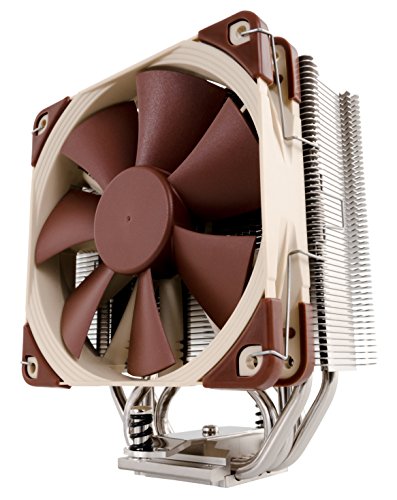
- Cooling: Noctua NH-U12S — the 5800X's 105W envelope wants better-than-stock
- Storage: 1TB SATA + a small NVMe for hot weights
- Runs 14B q4 at meaningful context and can offload a 32B q4 into system RAM at reduced throughput.
Tier 3 — 32B-native workstation (upgrade path)
Same platform (5800X + tier-2 cooling and storage) but swap to a 24GB card. This is where 32B q4 or 30B MoE runs comfortably on-card, and where the four-month lag figure starts to translate into "matches frontier from six months ago" — the class where most non-frontier workloads saturate.
Multi-GPU scaling — when a second card beats a bigger one
Layer parallelism (llama.cpp, exllamav2) splits a model across two cards. It works well when the model does not fit on a single card but does fit across two, and the inter-GPU bandwidth is not a bottleneck. Practical rules of thumb:
- Two 12GB cards effectively give you ~22GB of usable model VRAM (some overhead for KV cache duplication).
- Generation throughput is roughly gated by the slower card, not the sum.
- A single 24GB card almost always beats two 12GB cards on the same model, because you avoid the PCIe hop.
- The exception: MoE models with expert-level parallelism can genuinely benefit from two cards, because different experts can live on different GPUs and prefill can be parallelized across them.
If you already own a 12GB card and are evaluating "add a second one" vs "upgrade to 24GB," the 24GB path usually wins on latency; the two-card path wins only if you already have both cards or the used-market pricing tilts hard.
Perf-per-dollar and perf-per-watt versus API pricing
Rough amortization for a $1,100 tier-2 build running 40 hours/week of inference at 200W under load:
- Hardware depreciation over 3 years: ~$370/year
- Electricity at $0.15/kWh, 200W × 40 hrs × 52 wks: ~$62/year
- Total local cost of ownership: ~$430/year
At a hosted-API rate of roughly $1-5 per million output tokens (varies wildly by tier), $430/year buys 90M to 430M tokens. A single developer running an aggressive coding-assistant loop generates roughly 5-20M output tokens per year. So for individual use, the API is almost always cheaper on a pure-dollars basis. Local wins on: privacy, offline availability, fixed cost (no bill spike from a runaway agent loop), and — critically — the "free upgrade" property where new open weights improve the same rig.
When the API is still the right answer
Buy the API, not the rig, if any of the following are true:
- Your usage is bursty and low-volume. A few hours per week does not amortize hardware.
- You need the absolute newest capability today — vision reasoning, tool use, latest agent-flavored features.
- You have no appetite for maintaining CUDA drivers, quantization pipelines, or inference runtimes. The API has an operator.
- You need very long context (200k+) — consumer VRAM caps out well below that even with aggressive KV quantization.
Everyone else — steady daily use, privacy-sensitive workloads, existing GPU already in the rig, hard cost caps — the four-month lag figure means you can now buy hardware for the model you want to run and expect it to run frontier-equivalent capability a season or two later, at no additional cost.
Bottom line
The open-vs-frontier gap collapsed to four months on the hardest benchmarks; it is smaller than that on the easier ones. That does not mean open weights are frontier — they are not. It means the case for local inference no longer requires accepting a large quality tax. Size your hardware for the model class that clears your quality bar today, buy a 12GB card at the low end or 24GB at the mid, and let the treadmill do the rest.
Related guides
- Inkling 975B Open Weights: What a Frontier Speech Model Means for Local Rigs
- Ryzen 7 5800X vs 5700X for a Dual-Duty Gaming and Local-LLM Build
- Open WebUI on a Raspberry Pi 4, Inference on an RTX 3060
Citations and sources
- NVIDIA — GeForce RTX 3060 product page — RTX 3060 specifications: 12GB VRAM, memory bandwidth, CUDA core count (accessed July 2026).
- AMD — Ryzen desktop processors — Ryzen 7 5700X and 5800X specifications: core count, base/boost clocks, TDP (accessed July 2026).
- Phoronix — ongoing benchmark coverage for open-weight releases on consumer hardware (accessed July 2026).
This piece is editorial synthesis based on publicly available information. No independent first-party benchmarking is reported.