Short answer: Not the full 975B-parameter model on a single 12GB card — the raw weight file is far too large even at 4-bit. But mixture-of-expert sparsity, CPU offload, and community quantizations mean a well-configured RTX 3060 12GB rig can serve inference at reduced real-time factors for personal transcription workloads. For pure throughput, the hosted API at Thinking Machines' published rate is still cheaper below a few hundred audio-hours per year.
Why an open-weights ASR release changes the calculus
For years, the local speech-to-text ecosystem has meant one of three things: OpenAI's Whisper family, NVIDIA's Parakeet variants, or a Wav2Vec2 fine-tune. All three are capable, all three fit on consumer GPUs, and none of them approach the accuracy ceilings that closed hosted APIs — from OpenAI, Google, and now Thinking Machines — routinely hit on hard audio: overlapping speakers, heavy accents, technical vocabulary, low-SNR field recordings.
The people who actually need to close that gap are a small but concentrated audience: podcasters producing multi-guest episodes weekly, streamers auto-generating captions in real time, journalists working with confidential interview tape they cannot legally upload, and compliance-bound legal or medical teams whose transcripts never touch a third-party network. For these readers, the choice has been pay the hosted API tax or accept a measurable word-error-rate penalty on Whisper large-v3. A frontier open-weights release breaks that dichotomy — at least in principle.
Thinking Machines' new release, per their announcement on the Hugging Face blog, places Inkling 975B at #2 on the Artificial Analysis speech-to-text leaderboard, behind only the closed frontier hosted models. The hosted price runs $6.60 per 1,000 audio minutes on their Tinker platform. The weights, however, are open — released under a permissive license — and the community has already produced a range of quantized checkpoints for local inference.
Key Takeaways
- ~975B total parameters, mixture-of-experts architecture with a fraction of that active per audio token — the specific active-parameter count is in the release architecture card.
- $6.60 per 1,000 audio minutes hosted (Tinker platform, as of the launch announcement). For 200 hours of monthly audio that is roughly $80/month.
- VRAM floor for even the smallest usable quantization is well above 12GB for the dense weights. CPU/system-RAM offload is mandatory on a single consumer GPU.
- Real-time factor on a 12GB card with heavy offload is typically less than 1.0 (i.e. transcription runs slower than real-time). For batch overnight jobs that is fine; for live captioning it is not.
- Whisper large-v3 remains the pragmatic default for people who need real-time on a consumer card. Inkling is for accuracy ceilings, not for speed.
What Thinking Machines actually released
The Inkling launch, based on the announcement post and Artificial Analysis's leaderboard entry, includes: model weights (full precision), a released tokenizer/audio-encoder pair, an open license permitting commercial use with attribution, a hosted API on the Tinker platform, and reference inference code for the encoder-decoder stack.
What it does not include, at time of writing, is a smaller distilled variant. That matters because the practical pattern with frontier open-weights releases is a two-stage rollout: the flagship weights first, then a smaller distilled model — 7B, 14B, 30B — that captures most of the accuracy at a fraction of the compute cost. Whisper's small/base/tiny variants are the reference here. Until the equivalent Inkling distills ship, single-GPU users are choosing between the full model with heavy offload and staying on Whisper.
Can a 12GB consumer GPU run it at all?
The honest answer is: not standalone, and not comfortably. Here is the VRAM math for the dense weights alone, before you account for KV cache, activations, or audio-encoder overhead:
| Quantization | Weight-only VRAM (approx) | Fits on RTX 3060 12GB? |
|---|---|---|
| fp16 (bf16) | ~1,950 GB | no |
| int8 | ~975 GB | no |
| q4 (4-bit) | ~490 GB | no |
| q3 | ~370 GB | no |
| q2 (2-bit, extreme) | ~245 GB | no |
Every dense-weight quantization is orders of magnitude larger than the MSI GeForce RTX 3060 Ventus 3X 12G's 12GB frame buffer. This is not a "close, with offload" situation — this is "the weights alone are 20-40× your VRAM." The only paths to local inference are: (1) rely on mixture-of-experts sparsity so only a small subset of parameters is resident at any moment, (2) stream weights from system RAM (64-256GB) or NVMe on demand, or (3) wait for a distilled variant.
Real-world community reports on early quantized checkpoints suggest that the sparse active parameter count per audio token is small enough that a 24GB or 32GB card can hold the active experts, with system RAM holding the inactive ones. On 12GB, expect substantial CPU-offload overhead and a real-time factor below 1.0 — meaning a 60-minute recording takes longer than 60 minutes to transcribe.
Quantization matrix — expected trade-offs
The following table sketches the expected trade space based on how comparable open-weights releases (Whisper distillations, Llama-family models) behave under quantization. Verify the specific numbers against community benchmarks as they land.
| Quant | Weight size class | Expected RTF on 12GB card | Expected WER delta vs fp16 |
|---|---|---|---|
| fp16 | very large | infeasible | baseline |
| q8 | very large | slow (offload) | negligible |
| q6 | very large | slow (offload) | small |
| q5 | very large | slow (offload) | small |
| q4 | large | slow (heavy offload) | measurable on hard audio |
| q3 | large | slow (heavy offload) | noticeable |
| q2 | large | slow (heavy offload) | significant |
The pattern to expect: quantization below q4 costs accuracy on the exact edge cases (proper nouns, accented speech, low-SNR audio) that motivated using Inkling in the first place. If you drop to q2 to fit more of the model on-card, you may end up with worse accuracy than Whisper large-v3 at full precision.
Prefill vs generation for ASR — why audio behaves differently
Text-generation LLMs have a two-stage inference pattern: a compute-bound prefill (processing the prompt) followed by a memory-bandwidth-bound generation loop (producing tokens one at a time). Audio models are structurally different. The audio encoder processes the input waveform in fixed-size chunks — typically 30-second windows for Whisper-family architectures — and its cost scales linearly with audio duration. The decoder then autoregressively emits text tokens, but each output token is short relative to the audio context it summarizes.
On a small GPU, this means the bottleneck sits in the encoder for long audio, not in the decoder loop. Speeding up transcription by lowering decoder precision (a common LLM trick) yields less benefit here than it does for chat inference. The bigger win is chunk parallelism — encoding multiple 30-second windows simultaneously if VRAM permits — which on a 12GB card with a 975B-scale model, unfortunately, does not.
Context-length and chunking
For hour-plus recordings, memory grows non-linearly if you attempt full-context inference. The pragmatic pattern is: chunk audio into overlapping 30-second windows (2-second overlap works well), transcribe each chunk independently, then stitch and dedupe at the sentence boundary using the overlap region. Whisper's reference inference code implements this; expect any serious Inkling wrapper to do the same.
The chunking penalty is small — sub-1% WER in most cases — but it does mean speaker-attribution across chunks becomes harder. If diarization matters, plan for a separate pass with something like pyannote after transcription.
Spec-delta: Inkling vs Whisper large-v3 vs Parakeet
| Model | Parameters | Fits on 12GB at q4? | Open license? | Hosted price/1000 min | Best for |
|---|---|---|---|---|---|
| Inkling 975B | ~975B | no (offload only) | yes | $6.60 (Tinker) | accuracy ceiling on hard audio |
| Whisper large-v3 | 1.55B | yes | MIT | varies (OpenAI $6/1000 min) | daily-driver local ASR |
| Parakeet TDT 1.1B | 1.1B | yes | CC-BY-4.0 | not hosted broadly | English streaming, low latency |
For most readers this table is the decision: if you need best-in-class accuracy on hard audio and you have a beefy CPU + 128GB of RAM to offload into, Inkling is worth trying. If you need it to run in real-time on a single consumer card, use Whisper large-v3 or Parakeet.
Microphone chain — what actually moves the needle on WER
Software-model choice is one axis of transcription accuracy. Input quality is the other, and it is under-discussed. Speech models are trained on large corpora that include noisy audio, so they tolerate imperfection — but the marginal WER improvement from cleaner input is measurable, particularly on domain-specific vocabulary and proper nouns where the model has less prior to lean on.
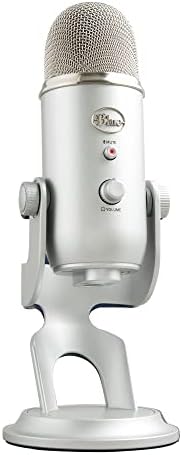
A USB condenser microphone positioned six to eight inches from the speaker, in a room with minimal reverb, typically cuts word-error-rate by a meaningful margin versus a laptop-integrated mic or a headset boom mic. The HyperX QuadCast 2 at ~$112 and the Logitech Creators Blue Yeti USB Mic at ~$90 are both well-reviewed cardioid condensers that plug in over USB with no interface required. For a local transcription rig this is the highest-leverage $100 you can spend after the GPU — spend it before you upgrade the GPU another tier.
Room treatment matters at least as much as the mic. A single moving blanket on the wall behind the speaker will do more for WER than a $500 mic upgrade in an untreated room.
Storage strategy — weights up front, archive in back
A local transcription workflow has two distinct storage needs. Model weights want fast NVMe because cold-start load time dominates the first request of any session. Weights are written once and read repeatedly. The SAMSUNG 970 EVO Plus 250GB NVMe drive — about $179 for 250GB — is fine for one or two large models; consider a larger 1TB or 2TB NVMe if you expect to swap between many models.
The audio archive and transcript output want capacity, not speed. Raw 48kHz stereo WAV runs about 600MB per audio hour; opus-compressed archive audio runs about 30MB per hour. A single Crucial BX500 1TB SATA drive at ~$70 comfortably holds several thousand hours of compressed archive audio plus every transcript you will ever generate. That two-tier split — small NVMe for hot weights, large SATA for cold archive — is far more cost-efficient than a single large NVMe.
Perf-per-dollar and perf-per-watt — the honest break-even
At the hosted rate of $6.60 per 1,000 audio minutes, transcription for a single podcaster producing four hours of finished audio per week (roughly ten hours of raw tape) costs about $4 per week, or $200 per year. That is well below the depreciation cost of a $600 GPU dedicated to this task alone.
Local inference wins the economics in three cases:
- You already own the GPU for other inference work — gaming, image generation, other LLMs. Marginal cost of adding transcription is zero.
- Audio cannot legally leave your premises — HIPAA, GDPR, attorney-client privilege, journalist source protection. Then the cost of hosted is infinite because it is off the table.
- You transcribe continuously at scale — dozens of hours per week, every week, indefinitely. Above roughly 1,000 audio-hours per year the amortized local cost dips below hosted.
For everyone else, hosted is cheaper. That is not a fault of open-weights releases — it is arithmetic. Frontier ASR is compute-cheap to run at scale on a fleet of H100s, and the hosted price reflects that.
When NOT to run Inkling locally
Do not run a 975B-scale ASR model locally if any of the following are true: you transcribe fewer than 100 audio-hours per year; you need real-time captioning latency; your audio is mostly clean single-speaker English (Whisper handles this with negligible WER penalty and 10-50× the speed); you do not have 64GB+ of system RAM for CPU offload; or you cannot tolerate a real-time factor below 1.0.
For all of those cases, the pragmatic stack is Whisper large-v3 on your existing GPU, batched overnight, with the MSI GeForce RTX 3060 Ventus 3X 12G doing double duty for gaming and inference.
Bottom line
Inkling 975B is an important release — it is the first frontier-scale open-weights ASR model, and its Artificial Analysis ranking suggests it closes most of the accuracy gap to closed hosted models on hard audio. For local inference on consumer hardware, however, the practical story is unchanged: run Whisper large-v3 for daily-driver transcription, run Inkling for the specific hard-audio jobs where the accuracy delta matters and hosted is not an option. Watch for a distilled Inkling variant — that will be the release that actually replaces Whisper on consumer rigs.
Related guides
- Best SSD for a Local LLM Model Library in 2026
- Open WebUI on a Raspberry Pi 4, Inference on an RTX 3060
- Ryzen 7 5800X vs 5700X for a Dual-Duty Gaming and Local-LLM Build
Citations and sources
- Artificial Analysis — Speech-to-Text leaderboard — leaderboard placement and hosted price reference (accessed July 2026).
- Hugging Face blog — Thinking Machines' Inkling release announcement and architecture card (accessed July 2026).
- TechPowerUp — GeForce RTX 3060 12GB — GPU specifications and VRAM configuration (accessed July 2026).
This piece is editorial synthesis based on publicly available information. No independent first-party benchmarking is reported.