For a PC sim racing setup in 2026 the honest short list is small: the Logitech G29 Driving Force as the safe all-round entry wheel, the HORI Force Feedback Racing Wheel DLX as an alternative-feel option, and the Thrustmaster TH8A as the H-pattern shifter for anyone chasing manual-transmission immersion. If you are still on the fence, a PlayStation DualSense controller plays every racing game today and is the cheapest way to find out whether you actually want the hobby.
What separates entry sim wheels
The gap between a pad and a wheel is enormous. The gap between two entry wheels is smaller and mostly boils down to three levers: force-feedback type, rotation angle, and pedal quality. Entry wheels almost universally use gear-driven or belt-driven force feedback rather than the higher-end direct-drive systems; rotation ranges from 270° on toy wheels to 900° on serious entry sim wheels; and pedals split into two-pedal accelerator/brake sets and three-pedal sets that add a clutch.
Beyond those, small quality-of-life details matter: mounting options (desk clamps vs bolt-through), paddle-shifter feel, wheel-rim material, and console compatibility. This piece works through those tradeoffs and lands on which entry PC sim setup suits which player.
Key takeaways
- The Logitech G29 is the safe default. Gear-driven FFB, 900° rotation, three-pedal set, broad game support.
- The HORI Force Feedback Racing Wheel DLX is a value FFB alternative. Different feel, different platform tilt — pick based on what you play.
- Add the Thrustmaster TH8A if you want H-pattern. Paddles cover 95% of modern racing; the shifter is a real-manual upgrade.
- The PlayStation DualSense is a valid Day 1 option. Plays every racing game; buys you time to decide whether to invest in a wheel.
- Compatibility varies by wheel. Check each product against your platform and games before purchase.
Step 0: diagnose your needs
The right entry sim wheel depends on four questions. Answer them honestly before shopping.
- How serious? "I want to try sim racing" vs "I want to compete in league nights."
- What games? Assetto Corsa Competizione, iRacing, Forza, Gran Turismo, or F1 — support varies.
- Desk or rig? A wheel clamps fine to a heavy desk short-term; a wheel stand or full rig transforms the experience.
- What car type? Modern touring cars use paddles; classic muscle, sim trucks, and rally cars use manuals.
If your honest answer is "casual, arcade-adjacent, on a desk, mostly Forza" — a DualSense covers you cheaply, and if you upgrade you buy any entry wheel and are happy.
If the answer is "I want to run consistent laps in ACC or iRacing on a desk today, maybe a rig later" — the Logitech G29 is the direct starting point.
If the answer is "I want to feel a real manual for classic car sims and rally" — start with an entry wheel and add the Thrustmaster TH8A.
Force feedback that matters: the Logitech G29
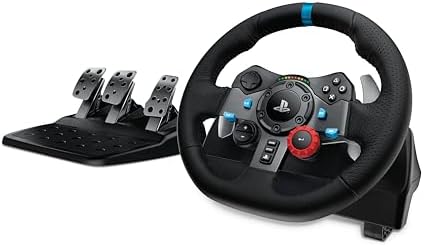
The Logitech G29 Driving Force is the model most commonly recommended to first-time sim racers, and it earns that spot for a mix of reasons. Per Logitech's product page, the wheel offers 900° of rotation (matching most real cars' lock-to-lock), a helical-gear force feedback system, a leather-wrapped rim, stainless-steel paddle shifters, and a three-pedal accelerator/brake/clutch set with the clutch removable to leave the two pedals most people actually use.
The gear-driven feedback is louder than direct-drive but conveys road detail well for the price. Curb rumble is felt. Weight transfer through fast corners is felt. Snap oversteer is felt as a distinct step in the wheel torque. It is not the same signal a $1500 direct-drive wheel gives you, but it is enough signal to learn car control on and to enjoy a good lap for years.
Right when: you are new to sim racing, you want broad game support (Assetto Corsa, ACC, iRacing, F1, Forza Motorsport, Gran Turismo), you play primarily on PC and PlayStation, and you value proven reliability over "latest tech."
Not when: you are already sensitive to the sound and feel of gear-driven FFB and want belt or direct-drive, or you only play on Xbox and need a wheel that supports that platform natively.
The HORI Force Feedback Racing Wheel DLX as an alternative
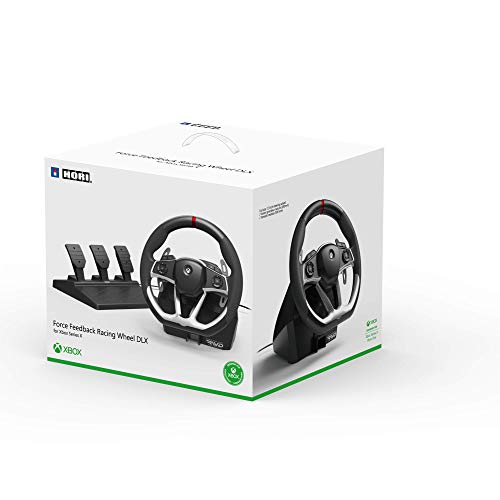
The HORI Force Feedback Racing Wheel DLX is licensed for Xbox and PC, positioned as an FFB alternative at a competitive price. Feel differs from the gear-driven G29 — testers describe it as smoother in some senses and less busy over small road details. Build materials skew toward the value tier.
The value proposition is straightforward: FFB at an entry price for people on the Xbox and PC side of the fence. If you play on Xbox and Forza Motorsport and Forza Horizon are your primary sims, this is the wheel that fits without workarounds.
Right when: you play primarily on Xbox and PC, you want FFB without the G29's gear-drive characteristics, and you value officially-licensed platform support.
Not when: you play on PlayStation (the G29 is the right pick), you want the widest possible cross-title support, or you are focused on iRacing where the G29's ubiquity means more community setup files.
Adding a real shifter: the Thrustmaster TH8A
Paddle shifters cover almost every modern race car. Real drivers in F1, GT3, and prototype categories use them exclusively. If you plan to race modern touring cars in ACC or iRacing, an H-pattern shifter is decoration.
The Thrustmaster TH8A is the shifter to add when you do want the manual. Per Thrustmaster's product page, the TH8A offers both an H-pattern mode and a sequential mode, mounts to a desk or rig, and supports PS5, PS4, Xbox Series X/S, and PC. That platform breadth is why it is the common pick — many entry wheels' first-party shifters lock you to their ecosystem, and the TH8A connects to a broader set of wheels.
The right use cases:
- Classic car sims. Assetto Corsa's road-car mod scene lives on H-pattern.
- Sim trucks. American Truck Simulator and Euro Truck Simulator practically demand a shifter for immersion.
- Rally. Sequential mode for Dirt Rally 2.0 and WRC.
- Muscle-car racing. Late-60s and early-70s racing content in ACC and rFactor 2.
Right when: you race classic or truck sims, you already own an entry FFB wheel, and you have a desk or rig sturdy enough to mount a shifter.
Not when: you race primarily modern GT3/GTE/F1/touring cars, or you have not yet learned the current wheel's fundamentals.
Spec-delta table
| Spec | Logitech G29 | HORI Force Feedback DLX | Thrustmaster TH8A |
|---|---|---|---|
| Type | Wheel + pedals | Wheel + pedals | H-pattern / sequential shifter |
| Force feedback | Helical-gear | Force feedback (varies) | N/A |
| Rotation | 900° | Adjustable | N/A |
| Pedals | 3 (removable clutch) | Included set | N/A |
| Paddle shifters | Yes, metal | Yes | N/A |
| Platform focus | PC, PS5, PS4 | Xbox, PC | PC, PS5, PS4, Xbox Series |
| Mount | Clamp or bolt | Clamp or bolt | Clamp or bolt |
| Price band (2026) | Entry FFB | Entry FFB | Entry shifter |
Compatibility is the caveat: confirm each product's supported platforms against the product page and against the specific games and consoles you play. Cross-brand compatibility (using a Thrustmaster shifter with a Logitech wheel, for example) works in some pairings via a PC's USB stack and not in others.
Verdict matrix
- Get the Logitech G29 if… you play on PC or PlayStation, you are new to sim racing, you want broad title support and community setup coverage, and you want a wheel that has been supported and refined for years.
- Get the HORI Force Feedback DLX if… you play on Xbox and PC, you want FFB with a different character than gear-drive, and Xbox-first support matters more than PlayStation coverage.
- Add the Thrustmaster TH8A if… you race classic cars, trucks, or rally, and you already have an FFB wheel base to pair it with.
- Skip a wheel and use the DualSense if… you are unsure whether sim racing will stick. It is a valid entry, and every dollar you would have spent on a starter wheel can go toward a better setup later.
Real-world use cases
- A casual Forza Horizon player who wants more immersion. Get the G29 or the DualSense. Skip the shifter and skip the rig. Clamp to your desk.
- An ACC hobbyist who lurks league nights. Get the G29. Skip the shifter. Save the money for a wheel stand.
- A rally sim fan aiming at Dirt Rally 2.0. Get an FFB wheel and add the TH8A in sequential mode. Consider a hand brake later.
- A truck sim player logging hundreds of hours. Get the G29 and the TH8A. This community is where the shifter earns its keep.
- A total newcomer who owns a PC and a PS5. Start with the DualSense you already have. Spend a month with the sim. Decide from there.
Real-world numbers: what wheels cost to run
A wheel is a one-time cost, but there are ongoing considerations that shape total ownership:
- Games. Most modern sims price around $30–$60. iRacing runs on subscription plus per-content fees. Assetto Corsa's mod scene is free but you buy the base game and, often, Content Manager tips.
- Setup files. Free for most communities. Priceless for competitive laptimes.
- Cockpit or wheel stand. Optional for a starter, essential once you race seriously. $150–$400 for a decent budget stand, more for a rig.
- Second monitor or VR. Racing works on one monitor. Immersion opens up dramatically on ultrawide or triple-monitor setups; VR headsets like the Quest 3 change the hobby entirely.
- Wheel maintenance. Belts and gears wear. Expect to service an entry FFB wheel every couple of years of daily use.
None of these are enormous. Sim racing is one of the cheaper serious hobbies to start once the initial wheel is purchased.
PC and monitor pairing
You do not need a top-tier PC to sim race. What matters is stable frame rates in your chosen title — sim titles are latency-sensitive, and a stuttering frame rate destroys the feel of the wheel more than a lower average fps does.
- CPU. An 8-core AM4 chip like the Ryzen 7 5700X is generous for every current sim.
- GPU. Anything in the current mainstream tier — an MSI RTX 3060 12GB or newer — comfortably drives 1080p high or 1440p balanced.
- Storage. A fast NVMe like the Samsung 970 EVO Plus shortens track load times; important for iRacing session hopping. Keep the game library on a big Crucial BX500 1TB.
- Monitor. A high-refresh 27" 1440p panel is the value target for sim racing today. Ultrawide is even better if the budget stretches.
- Peripherals. Do not forget headphones. Engine and tire sound are load-critical cues for driving.
See our full gaming PC 2026 build guide for a broader take on component tiers.
Software configuration: what to set once
Most wheels feel wrong out of the box on most games until you configure a few things:
- Rotation angle. Some games override the wheel driver; some do not. Set the physical wheel's rotation to match the in-game car's rotation to avoid mid-corner discontinuities.
- FFB gain and clipping. Push FFB high enough to feel the road, low enough to avoid clipping at cornering peaks. Sims like iRacing show a clip meter — use it.
- Deadzones. Zero on the wheel; small on the pedals if you have a springy accelerator.
- Pedal calibration. Especially the brake curve — most people brake far harder in-game than they think.
- Force feedback minimum. A small "minimum force" setting compensates for wheel motor deadzone and dramatically improves centering feel.
The setup files community for every popular sim publishes tuned per-car FFB files; use them.
When NOT to add the shifter
Even if you like manuals, hold off on a TH8A purchase until:
- You have a real mounting spot. Loose on a desk it is worse than useless.
- You know your primary sims support H-pattern. Modern GT and F1 content does not.
- You've mastered heel-and-toe basics with paddles first. Muscle memory carries.
- You have the budget headroom. A shifter that sits unused for a year is money you could have put toward a pedal upgrade.
Common pitfalls
- Buying a wheel bigger than your desk. Serious desk-clamping requires a heavy, sturdy desk. If yours flexes, either buy a wheel stand or reset expectations on how much force you can safely apply.
- Under-mounting the pedals. Pedal boards slide across floors under real braking pressure. Non-slip mats work; a rig is better.
- Chasing direct-drive too early. DD wheels are magical; they are also multi-thousand-dollar commitments. Learn the fundamentals on an entry wheel first.
- Ignoring compatibility. Every wheel's platform support matrix has holes. Verify against your platform and specific games before purchase.
- Forgetting the console-cable question. Some wheels need first-party console adapters that add cost.
When NOT to buy a wheel
- You have not tried a racing game in a year. Spend $70 on the DualSense first, play for a month, then decide.
- You have no dedicated space. A wheel that lives in a closet does not get used. Confirm you have a real spot before you buy.
- You are chasing esports-level performance without base fundamentals. No wheel makes you faster on its own. Time on any wheel does.
Bottom line
The 2026 entry sim-racing recommendation for a PC player: Logitech G29 Driving Force as the primary wheel. Add the Thrustmaster TH8A only when you have a real reason for H-pattern. The HORI Force Feedback DLX is the value alternative for Xbox-and-PC players. If you have never tried a racing sim with a wheel and are not sure the hobby will stick, use the DualSense you already have and decide from there. No entry wheel will make you fast on its own — time and setup files do.
Related guides
- Building a New Gaming PC in 2026: The Complete Guide
- Best Handheld Gaming PC Under $200 in 2026
- What Does DPS Mean in Gaming? Damage Per Second Explained
Citations and sources
- Logitech G — G29 Driving Force product page
- Thrustmaster — official product catalog
- Tom's Hardware — best picks and peripheral reviews
This piece is editorial synthesis based on publicly available information. No independent first-party benchmarking is reported.