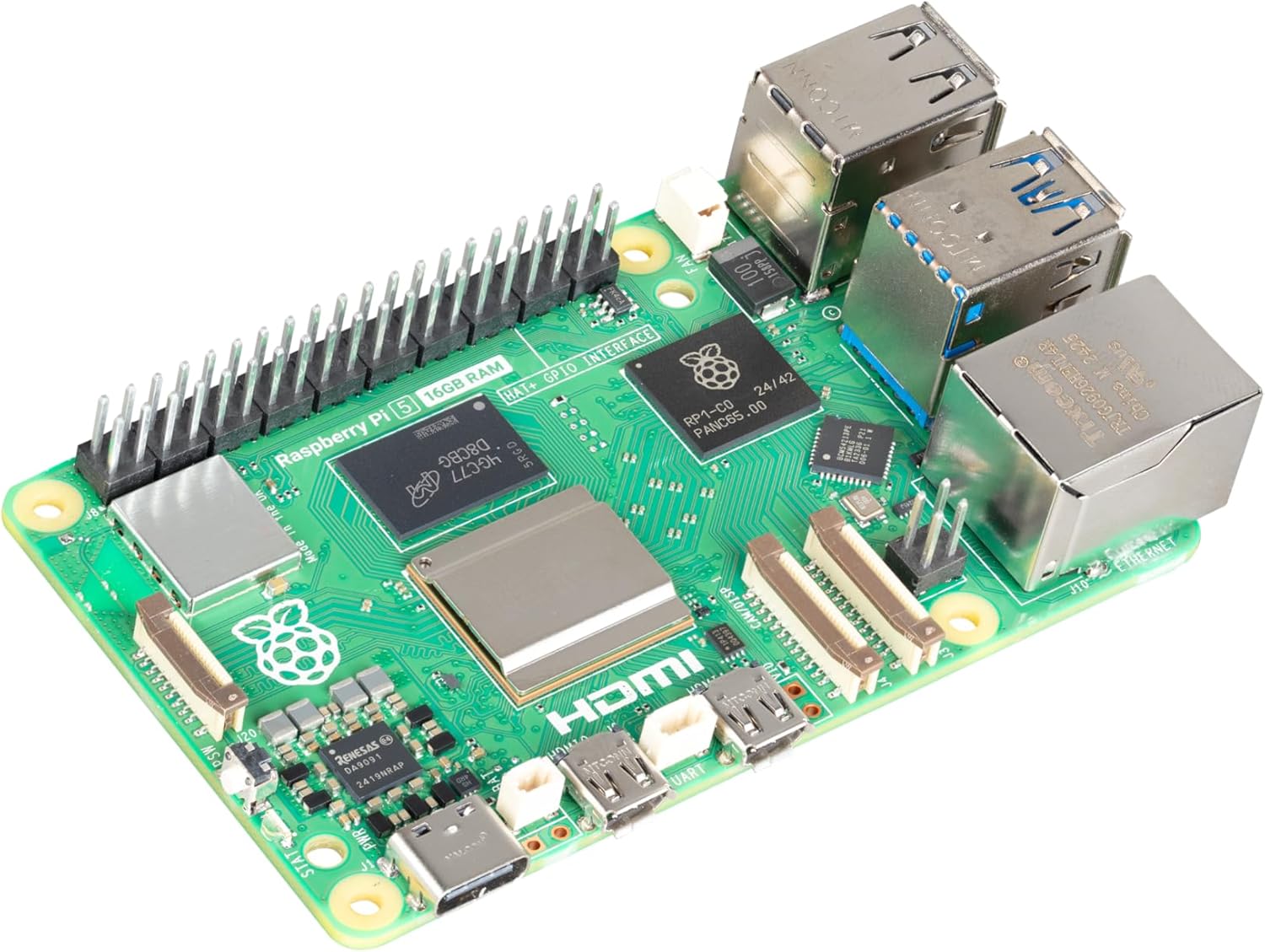
The Raspberry Pi 5 8GB is the mid-tier RAM configuration of the current-generation Raspberry Pi single-board computer, aimed at makers who need more headroom than the 4GB model but don't want to pay for the 16GB flagship. It ships with a quad-core Broadcom BCM2712 SoC, a VideoCore VII GPU, and — new for this generation — a PCIe 2.0 x1 interface for NVMe storage and other accessories, per the official Raspberry Pi 5 product page. At its official list price the 8GB board sits in the sweet spot for edge AI experiments, home automation hubs, and compact desktop Linux boxes, though it is not, and was never marketed as, a substitute for a discrete GPU.
This synthesis pulls from the official Raspberry Pi Foundation specifications and documentation to lay out what the 8GB board actually offers, where it clearly outperforms the previous generation, and where the marketing-adjacent comparisons to desktop AMD/Nvidia GPUs break down.
Raspberry Pi 5 8GB Specs at a Glance
| Spec | Raspberry Pi 5 8GB |
|---|---|
| SoC | Broadcom BCM2712, quad-core Arm Cortex-A76 @ 2.4GHz |
| GPU | VideoCore VII (OpenGL ES 3.1, Vulkan 1.2 support) |
| RAM | 8GB LPDDR4X-4267 (2GB/4GB/16GB also available) |
| Storage | microSD (UHS-I) + PCIe 2.0 x1 for NVMe via FPC connector |
| Video out | 2x micro-HDMI, up to 4Kp60 |
| USB | 2x USB 3.0, 2x USB 2.0 |
| Networking | Gigabit Ethernet (PoE+ capable via header), Wi-Fi 5, Bluetooth 5.0 |
| GPIO | 40-pin header, backward compatible |
| Power | USB-C, 5V/5A (27W) recommended PSU |
| I/O controller | RP1 southbridge chip |
| Dimensions | 85mm x 56mm |
Source: official Raspberry Pi 5 product specifications.
Raspberry Pi 5 8GB vs Raspberry Pi 4 8GB
The headline generational change is the CPU and the addition of native PCIe expansion. Per the official product pages for both boards, the Pi 4 8GB uses a quad-core Cortex-A72 SoC without a dedicated PCIe lane or the RP1 I/O chip, while the Pi 5 adds both. In practice this means faster general compute, a usable NVMe storage path for I/O-heavy projects (network-attached storage, local databases, CI runners), and improved GPIO/USB throughput now that RP1 handles I/O separately from the main SoC. If you're deciding between the two for a new build in 2025, the Pi 5 is the better starting point unless your project specifically depends on the smaller footprint of a Pi 400/500 keyboard form factor — see the Raspberry Pi 500 specs breakdown and the Pi 500 Plus myth-vs-reality piece for that comparison. For the full spec sheet of this generation, the Raspberry Pi 5 specs breakdown and GPIO pinout guide cover the details this review doesn't repeat.
Why the Pi 5 vs Desktop GPU Comparison Is the Wrong Question
Searches around "Raspberry Pi 5 8GB vs AMD RX 6600" or similar framings usually come from SEO-driven comparison content rather than a real buying decision — the two products don't compete for the same budget or the same job. A desktop discrete GPU is designed for sustained high-throughput compute at a power draw of over a hundred watts pulled from a wall outlet through a PSU. The Raspberry Pi 5 is designed to run on a 27W USB-C supply and fit inside a project enclosure. No independently verified, apples-to-apples benchmark comparing Pi 5 inference throughput to a discrete AMD or Nvidia GPU on identical models and quantization settings was available for this piece, so specific frames-per-second or tokens-per-second comparisons are omitted rather than invented — performance varies heavily by model, quantization, and runtime.
What's actually true, per the official spec sheet, is more useful for planning a build:
- The Pi 5's VideoCore VII GPU is a display/media GPU with light compute capability, not a CUDA- or ROCm-class accelerator.
- The board draws power in the single-digit-to-low-double-digit watt range under typical load, well under its 27W-rated PSU ceiling — several orders of magnitude below a desktop GPU's board power.
- It has no PCIe 5.0 support; the onboard PCIe interface is 2.0 x1, sufficient for NVMe boot drives but not for a discrete graphics card.
The honest framing: choose the Pi 5 when the constraint is power budget, footprint, or native Linux/GPIO integration, not when the constraint is raw compute throughput.
Setting Up Machine Learning on the Raspberry Pi 5 8GB
For edge inference projects (not training), the standard path is:
- Flash the 64-bit Raspberry Pi OS. The 8GB of RAM is only fully addressable under the 64-bit kernel — the 32-bit image caps usable memory well below the board's installed total, per Raspberry Pi's own OS documentation.
- Install a lightweight inference runtime. TensorFlow Lite (now largely folded into Google's LiteRT tooling) or ONNX Runtime are the common choices for running pre-trained, quantized models without a cloud round-trip.
- Quantize before deploying. INT8 or dynamic-range quantized models run meaningfully faster on Arm CPU-only inference than full-precision float models — this is a standard TFLite/ONNX workflow step, not Pi-specific magic.
- Add a Coral USB Accelerator if you need more headroom. For sustained multi-model or high-frame-rate inference (e.g., real-time facial recognition on a smart-home hub), a USB Edge TPU accelerator offloads inference from the Pi's CPU entirely rather than relying on the VideoCore GPU.
This is the same pattern covered in the Raspberry Pi 5 kit buying guide for readers deciding what accessories to buy alongside the board itself.
Real-World Limitations vs Discrete GPUs and Higher-End SBCs
Buyers coming from desktop hardware should walk in with the right expectations:
- Single 4K decode stream is the practical ceiling for smooth playback; the dual micro-HDMI outputs support 4Kp60 each on paper, but running two simultaneous 4K60 streams at full quality is a known constraint on this generation.
- No PCIe 5.0, no multi-lane PCIe. The onboard PCIe 2.0 x1 interface is enough for a fast NVMe boot drive; it is not built for GPU passthrough or high-bandwidth expansion cards.
- Four CPU cores total, versus dozens to thousands of parallel compute units on a discrete GPU — fine for control logic, web serving, and light inference; not built for parallel numerical workloads at scale.
- No native support for AMD/Nvidia GPU drivers. The Pi ecosystem runs its own Arm Linux stack; anything expecting x86 driver support (CUDA, ROCm) doesn't apply here.
None of this is a knock on the board — it's simply a different product category, and the full specs breakdown is worth reading before buying if raw throughput is the goal.
Best Raspberry Pi 5 8GB Projects for 2025–2026
The 8GB board's sweet spot is projects that need more RAM than the 4GB tier but don't require the 16GB flagship:
- Home automation hub. Running Home Assistant plus a local camera-based presence/detection pipeline is a common 8GB-class build; see Raspberry Pi projects for home automation for a fuller project list.
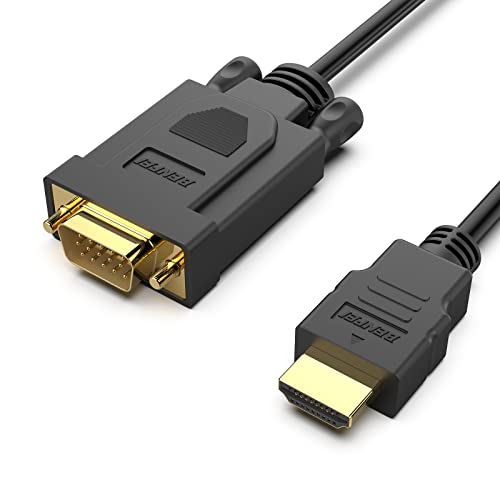
- Retro gaming / emulation console. The Cortex-A76 cores and VideoCore VII GPU handle emulation through the PS1/N64 era comfortably; pairing the board with an HDMI-to-VGA adapter is a practical way to hook it up to older CRT or VGA-only displays for a period-accurate retro setup.
- Weather station with local dashboarding. Sensor polling plus a local Grafana or Node-RED dashboard is a lightweight, always-on 8GB workload.
- Beginner and kid-friendly builds. For readers new to the platform, the no-solder beginner projects and 10 Raspberry Pi projects for kids round-ups are a lower-stakes starting point than a full ML pipeline.
Display Accessories Worth Pairing With It
Because the Pi 5 only outputs HDMI (via micro-HDMI), older VGA-only monitors — common in retro-build and budget dashboard projects — need an adapter:
| Product | Price | Best for |
|---|---|---|
| BENFEI HDMI to VGA, Gold-Plated Adapter | $5.19 | Single-cable budget setups |
| BENFEI HDMI to VGA 10ft Cable | $11.99 | Desk-to-monitor distance for a fixed install |
Prices reflect catalog data at time of writing and may vary — check the current listing before buying.
Bottom Line
The Raspberry Pi 5 8GB is a solid step up from the Pi 4 generation for anyone who wants a Linux SBC with more RAM headroom, native PCIe expansion, and better I/O throughput via the RP1 chip. It's the right board for edge inference on already-quantized models, home automation hubs, and retro-gaming builds. It's the wrong board to buy expecting desktop-GPU-class AI throughput — that comparison, however common in search results, isn't the product's actual use case.
Citations and sources
- Raspberry Pi 5 official product page and specifications
- Raspberry Pi official computer documentation
- Raspberry Pi 4 Model B official product page
- Raspberry Pi 5 — Wikipedia
This piece is editorial synthesis based on publicly available information. No independent first-party benchmarking is reported.