

Apevia
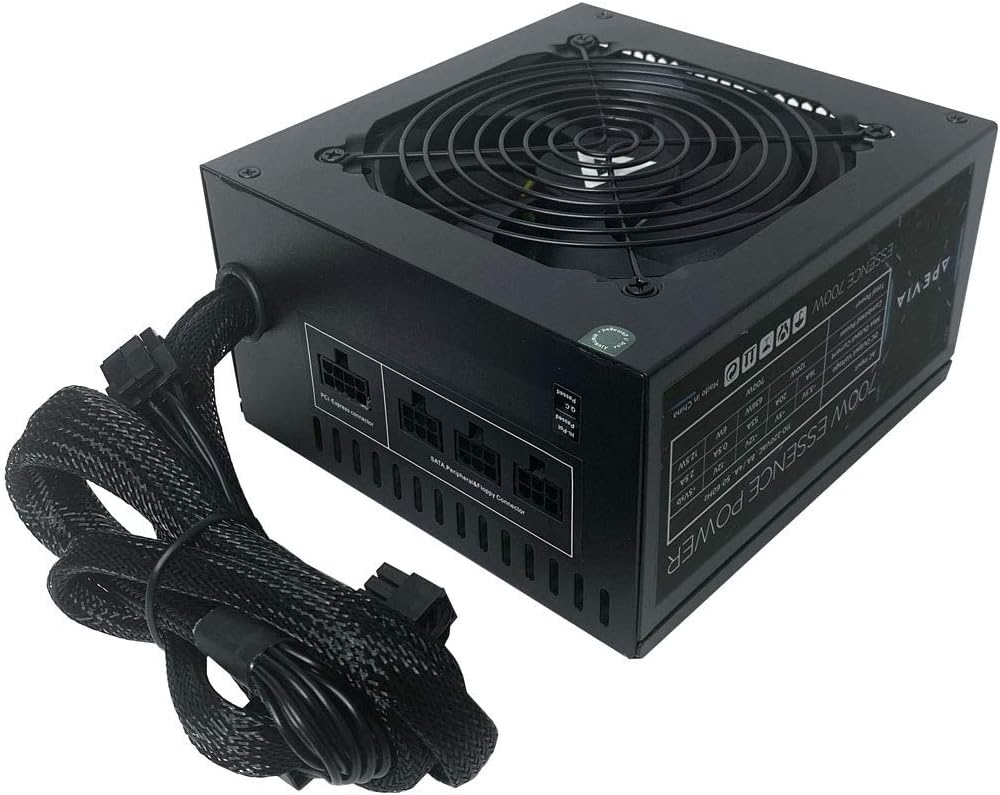
Apevia Jupiter Series 80+ Bronze Certfied 600W Power Supply
Bottom line: The Apevia Jupiter Series 80+ Bronze Certfied 600W Power Supply ($43.99 on Amazon as of 2026-10-06): 80 Plus Bronze certified 600W unit with a single +12V rail rated at 44A; main trade-off: only two PCI-E connectors, which limits dual-GPU or high-draw card builds.
As an Amazon Associate, SpecPicks earns from qualifying purchases. Full disclosure →
*Price sourced from Amazon.com. Last updated 2026-10-06. Price and availability subject to change.
Pros & Cons
Pros
- ✓ 80 Plus Bronze certified 600W unit with a single +12V rail rated at 44A
- ✓ Two 8-pin (6+2) PCI-E connectors cover most single mid-range graphics cards
- ✓ Auto thermally controlled 135mm fan adjusts its speed to reduce noise
- ✓ All cables sleeved; includes 4 SATA, 4 peripheral and 1 floppy connector
- ✓ Short-circuit, over-voltage, over-power and under-voltage protection
Cons
- ✗ Only two PCI-E connectors, which limits dual-GPU or high-draw card builds
- ✗ Bronze efficiency trails Gold-rated units under sustained load
- ✗ Built to the ATX12V 2.3 spec; no 12VHPWR connector listed
- ✗ Over-temperature protection is not listed among its safeguards
Manufacturer description
Apevia Jupiter Series power supply is 80 PLUS Bronze certified. It offers spellbinding performance for high-end PC gaming rigs and extreme systems that demand the most reliable and efficient energy source. This versatile PS supports NVIDIA SLI, as well as ATI Crossfire and Haswell. The Jupiter Series is also ideal for dual and quad Core CPUs. The thermally controlled automatic sensor regulates fan speed while reducing noise. And a powerful 135mm Black fan delivers outstanding ventilation. Model no. : atx-jp600w Max. Power: 600W Material: metal color: Black switches: additional power switch…
SpecPicks Verdict
SpecPicks scored Apevia Jupiter Series 80+ Bronze Certfied 600W Power Supply using a rating × review-volume × price-fit model applied to published specs and reviews across the power supplies category. Apevia's power supplies lineup sits within the broader category mid-tier; price and specs are the deciding factors over brand loyalty here. Judge it on the specification table and the price rather than on sentiment: check the figures that decide your use case, then put it side-by-side with two or three close alternatives in the Compare tool before clicking through.
Common buyer scenarios for power supplies of this kind: matching it to an existing build, replacing a failing part, or upgrading from a previous-generation equivalent. Check the spec table below against your current setup — particularly socket / form-factor / power-rating fields — and confirm compatibility on the retailer's listing before purchase. Prices and stock are set by the retailer and may have moved since this page was last updated.
Key Features
- Apevia Jupiter JUPITER600W 600W 80 Plus Bronze certified ATX Gaming power supply.
- Connectors: 1 x 20/24pin main power, 1 x p8(4+4p) esp 12V, 4 x SATA + 2 x 8(6+2)pin PCI-E, 4 x peripheral, 1 x floppy. Supports single 12V output for higher power usage
- Auto-thermally controlled 135mm black fan.
- Supports ATX 12V 2. 3 Version. Supports Dual/Quad Core CPUs. All sleeved cables. Output: +3. 3V@20a, +5V@20A, +12v@44a, -12V@0. 3a, +5Vsb@2. 5a
- Double forward converter design. Heavy duty protections: Short-circuit/ over-voltage/ over-power/ under-voltage protections.
Full Specifications
| Brand | Apevia |
|---|---|
| Wattage | 600 watts |
| Fan Size | 135 Millimeters |
| Model Name | JUPITER600W |
| Unit Count | 1.0 Count |
| Form Factor | ATX |
| Model Number | JUPITER600W |
| Connector Type | atx,floppy,pci-e,sata |
| Cooling Method | Air |
| Item Type Name | Apevia Jupiter Series 80+ Bronze Certfied 600W Power Supply |
| Number of Fans | 1 |
| Output Wattage | 600 Watts |
| Item Dimensions | 6.2 x 5.9 x 3.4 inches |
| Mfr Part Number | JUPITER600W |
| Compatible Devices | Personal Computer |
| Power Supply Design | Semi-Modular |
| Warranty Description | 1 year |
| Maximum Input Voltage | 230 Volts |
| Minimum Input Voltage | 115 Volts |
| Item dimensions L x W x H | 6.2 x 5.9 x 3.4 inches |
Ready to buy?
Apevia Jupiter Series 80+ Bronze Certfied 600W Power Supply is listed on Amazon. Price, availability, shipping and returns are set by Amazon and its sellers — check the listing for current terms. SpecPicks earns a small commission on qualifying purchases — thank you for supporting independent review work.
*Price sourced from Amazon.com. Last updated 2026-10-06. Price and availability subject to change.
Related Power Supplies


More guides & deep dives from the SpecPicks archive
Browse all articles & guides →- Best Retro Handhelds in 2026 — From $35 to $500
- Best 1440p Gaming GPUs in 2026
- Best Budget Gaming PC Build 2026 — ~$1,000 ($800 on Sale)
- The Complete Voodoo5 5500 AGP Driver Guide (2026 Edition)
- RTX 4070 Super vs RX 7800 XT — Which to Buy in 2026
- How to Build a Windows 98 Retro PC in 2026
- Emulation Hardware in 2026: FPGA, Software, and Cart-Reader Ecosystems
More reviews from the SpecPicks archive
Browse all reviews →- CompactFlash to IDE: Period-Correct Silent Storage for Win98 Builds
- Run a Local LLM on a Raspberry Pi 4 8GB: What Works in 2026
- Build a Jellyfin Media Server on a Raspberry Pi 4 in 2026
- Ryzen 7 5800X vs Ryzen 5 5600G for 1080p Gaming and Light Local LLM Work
- How to Archive Your Old IDE and CompactFlash Retro PC Drives in 2026
- BENGOO G9000 vs Turtle Beach Recon 50: Best Sub-$40 Wired Headset
- Build a RetroPie Handheld with the Raspberry Pi Zero W in 2026: Full BOM + Setup
- Best $1000 Gaming PC Build for 2026: Parts We'd Actually Buy
- AI-Driven Driver Hunt: Installing Vintage Sound Cards on Windows 98 With Claude
- Qwen 3.6 27B vs Gemma 4 31B Local Inference: VRAM, Tok/s, and Quality Across Quantizations
- Steam Deck: Linux's Trojan Horse for PC Gamers
- Best Workstation PC Parts on Amazon in 2026
- Sound BlasterX G6 on a Windows 98/XP Retro Gaming PC: What It Actually Does
- Raspberry Pi 5 8GB Review (2026): Still the SBC to Beat
- OpenAI Codex Now Encrypts Agent-to-Agent Instructions: The Case for Local, Auditable Agents
- IDE-to-USB and CompactFlash Adapters for Retro PCs: FIDECO vs Unitek vs Vantec
- Anthropic's Samsung Chip Talks: Why Local Inference on an RTX 3060 Still Matters
- Hobbyists Are Self-Hosting a Nintendo eShop With Ownfoil on a Raspberry Pi
- This Open-Source KVM Runs a Pentium 4 Instead of a Raspberry Pi
- Qwen 3.6 27B Quantization Showdown: BF16 vs Q8_0 vs Q4_K_M on Consumer GPUs
- Build a Retro Emulation Cabinet Brain on a Pi 4 8GB in 2026
- vLLM 0.21 Adds Intel GPU Support: What It Means for Budget AI Rigs
- Best Racing Wheel Under $300: Logitech G29 vs HORI Force Feedback
- Best SSD for a Raspberry Pi 5 Boot Drive in 2026
Earliest SpecPicks reviews
Browse full archive →- Best GPU for Llama 3.1 8B (2026)
- Best GPU for Qwen 3 14B (2026)
- Best GPU for Qwen 3 32B (2026)
- Best GPU for Llama 3.1 70B (2026)
- Best GPU for DeepSeek-R1 32B (2026)
- Best GPU for Llama 3.1 405B (2026)
- How to run Llama 3.1 8B on NVIDIA GeForce RTX 5090
- How to run Qwen 3 14B on NVIDIA GeForce RTX 5090
- How to run Qwen 3 32B on NVIDIA GeForce RTX 5090
- How to run Llama 3.1 70B on NVIDIA GeForce RTX 5090
- How to run DeepSeek-R1 32B on NVIDIA GeForce RTX 5090
- How to run Llama 3.1 8B on NVIDIA GeForce RTX 4090