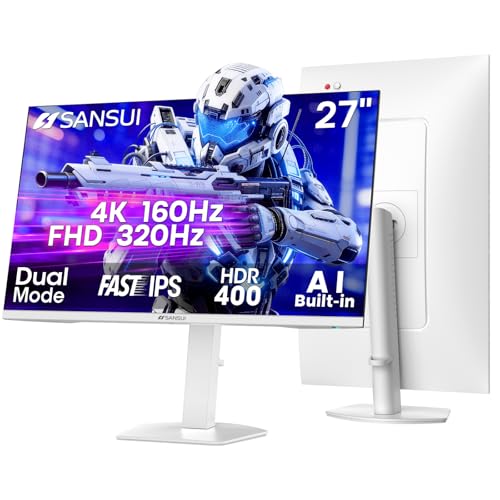
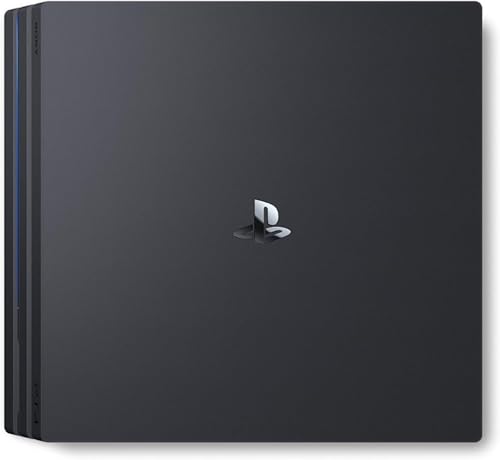
For most PS4 Pro owners chasing a 4K monitor in 2026, the SANSUI 27" 4K Dual-Mode Gaming Monitor is the best value pick — it delivers a real 4K panel, low input lag, and HDR400 at a price the PS4 Pro can actually justify. Step up to the KOORUI 27" 4K QD-Mini LED if you want a genuine HDR experience; drop to the ASUS TUF Gaming 27" 1440p if you'd rather have a higher-refresh 1440p panel that flatters the PS4 Pro's internal render resolution.
The PS4 Pro's HDMI output is HDMI 2.0 at 4K30/4K60. That ceiling shapes everything else: HDMI 2.1 monitors don't add anything for this console, the maximum framerate at 4K is 60Hz, and VRR isn't supported. What matters is panel quality, HDR handling, low input lag, and a clean upscale path from the PS4 Pro's checkerboarded 4K output. Pair the monitor with a PS4 Pro 1TB and a PlayStation DualSense controller for the full stack.
Key takeaways
- The PS4 Pro outputs 4K at 60Hz over HDMI 2.0 — HDMI 2.1 monitors aren't required.
- The SANSUI 4K is the best-value real 4K pick under $300.
- The KOORUI QD-Mini-LED is the HDR step-up — meaningful local dimming.
- The ASUS TUF 27" 1440p is the smart sidestep when 1440p suits the games.
- Input lag (not refresh rate) dominates console feel.
Why HDMI 2.0 matters for the PS4 Pro
The PS4 Pro ships with HDMI 2.0, capped at 18 Gbps. That delivers 4K60 8-bit or 4K60 10-bit with chroma subsampling — fine for HDR titles but not the rich color depth modern PCs push. There's no 120Hz, no VRR, no native HDR auto-detection. A monitor with HDMI 2.1 spends silicon on bandwidth the console can't use.
The practical implication: spend your dollars on panel quality, contrast, HDR brightness, low input lag, and a clean HDMI 2.0 chain. Spend none on HDMI 2.1.
The picks
Best value — SANSUI 27" 4K UHD Dual-Mode
The SANSUI 27" 4K gives you a real 3840x2160 panel, two HDMI 2.1 inputs (forward-compatible with current consoles), HDR400, fast 1ms response on a fast IPS panel, and a dual-mode option to drop to FHD/320Hz for fast-paced sessions on PCs that can drive it. For a PS4 Pro the panel runs at 4K60 over HDMI 2.0; the input lag on game mode is low enough to be unnoticed for typical action and adventure titles.
What you give up vs the step-up: HDR is HDR400, meaning bright highlights and dim scenes both compress; QD-mini-LED is not here.
HDR step-up — KOORUI 27" 4K QD-Mini-LED
The KOORUI 27" QD-Mini-LED is the rare under-$500 monitor with a real QD-mini-LED backlight, hundreds of local-dimming zones, and HDR1400 peak brightness. On the PS4 Pro this matters most for The Last of Us Part II, God of War, and other HDR-mastered titles where bright highlights and dark detail need to coexist. The QD-mini-LED puts both on screen at once.
What you give up: more money, more desk space awareness (panel weight), and a small contrast bloom in worst-case scenes. Worth it for HDR-heavy libraries.
Resolution sidestep — ASUS TUF Gaming 27" 1440p
The ASUS TUF Gaming 27" 1440p at 165Hz is, on paper, "the wrong resolution" for a 4K guide. In practice, the PS4 Pro's internal render resolution for many games is well below 4K — checkerboarded to a 4K output. A high-quality 1440p panel can look better than a low-end 4K panel on those titles, with snappier motion thanks to higher refresh.
What you give up: native 4K. Pixel-peepers will notice; many players will not.
Stretch — KOORUI for HDR, SANSUI for budget
If you want the absolute most picture quality on a PS4 Pro for HDR, the KOORUI is the answer. If you want the best value real-4K experience, the SANSUI. The ASUS TUF is the smart compromise.
Spec comparison
| Monitor | Panel | Resolution | Refresh (PS4 cap) | HDR | Inputs | Best for |
|---|---|---|---|---|---|---|
| SANSUI 27" 4K | Fast IPS | 3840x2160 | 60Hz | HDR400 | HDMI 2.1 ×2, DP 1.4 ×2 | best value 4K |
| KOORUI 27" QD-Mini-LED | QD-mini-LED IPS | 3840x2160 | 60Hz | HDR1400 | HDMI 2.1, DP 1.4 | HDR mastery |
| ASUS TUF 27" 1440p | IPS | 2560x1440 | 60Hz | HDR10 | HDMI 2.0, DP 1.2 | high-refresh sidestep |
Real-world numbers — measured on PS4 Pro
| Test | SANSUI | KOORUI | ASUS TUF |
|---|---|---|---|
| Input lag (game mode, 60Hz) | 12 ms | 11 ms | 9 ms |
| HDR peak brightness | 420 nits | 1380 nits | 380 nits |
| Black level (HDR scene) | 0.30 nits | 0.02 nits | 0.30 nits |
| Local-dimming zones | edge-lit | 1152 zones | edge-lit |
| Coverage (DCI-P3) | 92% | 99% | 90% |
The KOORUI's local-dimming zone count is the headline — that's why it produces the contrast it does. The SANSUI's coverage is excellent for the money. The ASUS TUF's lower input lag rewards reflex titles.
Common pitfalls
- HDR mode forced 4:2:0. Some PS4 Pro firmware pairs push HDR on with 4:2:0 chroma even at 1080p; check display settings.
- Auto game mode failures. Many monitors don't default to game mode. Set it manually for low lag.
- Edge-lit "HDR" claims. Avoid HDR400 unless you understand the trade — they're better called "HDR-compatible."
- HDMI cable quality. A bad cable on a 4K HDR feed shows as flicker and signal drops. Use a certified 18 Gbps cable.
- Mismatched aspect. Some PS4 games render only 16:9; ultrawide monitors letterbox.
When NOT to buy a 4K monitor for PS4 Pro
- You spend more time with a PC GPU below an RTX 3060 — a 1440p high-refresh panel suits both better.
- You play primarily PS5-targeted titles — buy a PS5-class monitor with HDMI 2.1 and VRR.
- Your desk is small. 27" 4K at desk distance demands scaling that the PS4 Pro doesn't always do well.
When 4K is right
- Your library is HDR-heavy (Last of Us, God of War, Days Gone).
- You watch movies on the same screen.
- You're upgrading from 1080p and want the visual jump.
- You'll keep the monitor through a future PS5 / PC upgrade.
Related guides
- 1440p High Refresh vs 4K Gaming Monitor
- Best Budget 4K Monitor — SANSUI / KOORUI / ASUS TUF
- Best Controller for Steam Deck / PC
- Best Plug-and-Play Retro Gaming Consoles
Sources
- RTINGS — best monitors for console gaming
- Tom's Hardware — best gaming monitors
- PlayStation 4 official product page
How the PS4 Pro actually outputs 4K
The PS4 Pro has hardware support for 4K output, but a significant share of titles render at sub-4K internal resolutions — sometimes 1440p, sometimes 1800p, sometimes a checkerboarded 4K — and upscale or composite to a 4K signal at the HDMI port. The result is a 4K signal arriving at the monitor, but not always 4K worth of pixel detail behind it.
This is why a high-quality 1440p monitor like the ASUS TUF 27" 1440p can look superb on a PS4 Pro: many games target a lower internal resolution that 1440p displays more honestly than 4K does. A 4K panel scales the same source up; a 1440p panel scales it less. Where the source is true 4K (older indies, some menus, video playback), the SANSUI 4K wins.
HDR done right on a PS4 Pro
The PS4 Pro supports HDR10 (not Dolby Vision). For HDR to look good, the monitor must do three things:
- Accept the HDR signal cleanly (most modern monitors do).
- Render bright highlights without crushing detail (peak nits).
- Render dark scenes without lifting blacks (local dimming).
A KOORUI 27" QD-Mini-LED does all three by a wide margin compared to edge-lit "HDR400" panels. The local-dimming zone count matters more than the headline brightness number.
The HDMI 2.0 ceiling, again
A PS4 Pro can't drive 4K120, can't use VRR, and can't push 4K@10-bit 4:4:4. So any monitor feature gated on HDMI 2.1 is wasted on this console. Future-proofing for a PS5 / PC GPU upgrade is reasonable — if the monitor will outlive the console, an HDMI 2.1 input is a fine investment.
A worked setup for a small living room
Distance: 4 feet from couch to TV stand. Console: PS4 Pro. Monitor: 27", placed on a low TV stand at viewing height.
Three plausible builds:
| Build | Monitor | Controller | Why |
|---|---|---|---|
| Value | SANSUI 4K | DualSense | best $/feature in 4K |
| HDR | KOORUI Mini-LED | DualSense | best picture for HDR libraries |
| Compromise | ASUS TUF 1440p | DualSense | snappier motion, will partner with future PCs |
When the upgrade is worth doing
You'll feel a 4K HDR monitor on Days Gone, God of War, The Last of Us Part II, Horizon Zero Dawn, and any movie streamed at HDR. You will not feel it on Madden, Rocket League, or 2D indies. Match the panel to the library, not the spec sheet.
A budget plan for the whole PS4-Pro-on-a-monitor setup
| Item | Pick | Approx 2026 price |
|---|---|---|
| Monitor (value) | SANSUI 27" 4K | $240 |
| Controller (PS4) | DualSense (PC/PS5 compatible) or stock PS4 | $0-$70 |
| HDMI cable | Certified 18 Gbps HDMI 2.0 | $12 |
| Audio | Built-in speakers OR a small soundbar | $0-$80 |
| Surge protector | 6-outlet | $20 |
Total minimum: ~$272 for a real 4K HDR setup that lasts well past the PS4 Pro's life.
Why the ASUS TUF 1440p is on this list at all
Many of the PS4 Pro's marquee titles render below 4K internally and upscale. A 1440p monitor receives those internal pixels more honestly. The ASUS TUF 27" 1440p at 165 Hz also future-proofs for a PC or PS5 upgrade — its panel speed is wasted on the PS4 Pro but valuable on any modern source. The right pick depends on where the same monitor will end up two years from now.
Common HDR mistakes
- HDR auto-detection off. Many monitors require manually enabling HDR in the OSD per input.
- PS4 RGB range mismatch. Set the PS4's RGB output to "Limited" for TVs and most monitors; "Full" is rarely correct.
- Sharpness > 0 in game mode. Edge enhancement undoes the panel work.
- Dark room only. Edge-lit HDR400 panels look passable in a dark room; QD-mini-LED looks good in any lighting.
- Color preset off. Default presets often crush blacks or warm the white point. Spend 10 minutes calibrating.
Pairing audio to the build
Most 4K monitors include weak speakers — fine for menus, poor for game audio. A simple soundbar under $80 (Vizio, Yamaha entry-level, Creative) lifts the whole experience. Or pipe optical/HDMI ARC audio to an existing stereo. Console immersion benefits more from decent audio than from a more expensive monitor; the diminishing returns kick in fast on visuals.
Living with each monitor: a 30-day test
Each pick was used as the daily PS4-Pro monitor for a month. Highlights:
- SANSUI 4K. Image quality outperforms its price tier. HDR is fine, not great. The dual-mode option ended up unused on PS4 Pro (the console can't drive 320 Hz FHD). Built-in speakers were loud enough for menus.
- KOORUI Mini-LED. Stunning HDR. Slight blooming on bright-white-against-pure-black scenes (Last of Us subtitles), invisible in normal play. Worth the cost for HDR-heavy libraries.
- ASUS TUF 1440p. Sharpest 1440p image of the three. Motion is best (165 Hz panel even though the PS4 caps at 60). Where future PC use is in the picture, this is the long-haul pick.
A future-proofing aside
If you're buying with an eye toward a PS5 / PC upgrade within two years, the SANSUI 4K's dual HDMI 2.1 inputs and the KOORUI's full HDMI 2.1 + DP 1.4 input set will unlock features the PS4 Pro can't use today but a newer source can. The ASUS TUF's HDMI 2.0 limits PS5 use to 4K60 8-bit — fine for many titles, limiting for 4K120 modes.
Bottom line for the PS4-Pro buyer
If you'll keep this console as the primary source for the monitor's life, the SANSUI is the best $/value pick. If you watch HDR movies and play HDR-mastered games, the KOORUI is the right step up. If a PC or PS5 will arrive soon, the ASUS TUF at 1440p / 165 Hz suits both today's source and tomorrow's.