
Sapphire
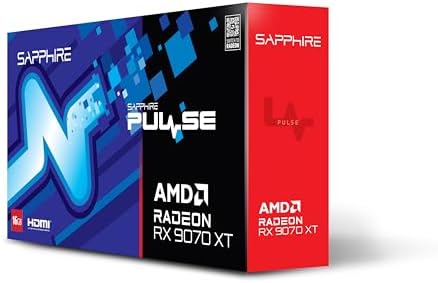
Sapphire Pulse AMD Radeon™ RX 9070 XT Gaming 16GB Dual HDMI/Dual DP
Bottom line: The Sapphire Pulse AMD Radeon™ RX 9070 XT Gaming 16GB Dual HDMI/Dual DP ($1,326.56 on Amazon as of 2026-11-21 23:14 UTC): 16GB GDDR6 on a 256-bit bus gives headroom for high-res textures and mods; main trade-off: listing omits board power, card length and PSU needs; verify fit first.
As an Amazon Associate, SpecPicks earns from qualifying purchases. Full disclosure →
Complete builds that use this part: 1440p Gaming PC Build 2026: Cost, Parts, FPS (GPU) · Build Your Own Gaming PC in 2026: The 5 Components That Actually Matter (GPU (AMD)) · Gaming PC Build 2026: The Reddit-Consensus Parts List (GPU) — see the full parts list for the rest of the build.
This part is in 1440p Gaming PC Build 2026: Cost, Parts, FPS: $2,324.06 for 7 of 8 parts, with a same-hardware in-stock listing in place of this one (Motherboard not included — no current Amazon price; GPU: in-stock ASRock Radeon RX 9070 XT substitute for the named Sapphire Pulse RX 9070 XT 16GB), at Amazon prices checked or later (price may vary). 🛒 Add the 7 priced parts to Amazon cart
*Price sourced from Amazon.com. Last updated 2026-11-21. Product prices and availability are accurate as of the date/time indicated and are subject to change. Any price and availability information displayed on Amazon.com at the time of purchase will apply to the purchase of this product.
Pros & Cons
Pros
- ✓ 16GB GDDR6 on a 256-bit bus gives headroom for high-res textures and mods
- ✓ Full RX 9070 XT chip with 64 RDNA 4 compute units
- ✓ FSR 4 AI upscaling lifts frame rates in games that support it
- ✓ Dual HDMI plus dual DisplayPort for four-display or TV setups
- ✓ AMD Adrenalin Edition software for driver updates and tuning
Cons
- ✗ Listing omits board power, card length and PSU needs; verify fit first
- ✗ Uses GDDR6 rather than the newer GDDR7 standard
- ✗ FSR 4 only helps in titles that have added support
- ✗ No CUDA, so some AI and creative apps favor NVIDIA cards
Manufacturer description
The Sapphire Pulse AMD Radeon RX 9070 XT is a 16GB graphics card for gamers who want current-generation AMD hardware without paying for a premium trim. It uses AMD's RDNA 4 architecture with 64 compute units, so you get the full RX 9070 XT chip in Sapphire's straightforward Pulse design. Memory is a strong point. The card carries 16 GB of GDDR6 on a 256-bit memory bus, which gives you room for high-resolution texture packs, heavily modded games and demanding titles that push past 8GB or 12GB cards. AMD FidelityFX Super Resolution 4 adds AI-based upscaling, so games that support it can render…
SpecPicks Verdict
SpecPicks scored Sapphire Pulse AMD Radeon™ RX 9070 XT Gaming 16GB Dual HDMI/Dual DP using a rating × review-volume × price-fit model applied to our editorial and benchmark analysis across the graphics cards category. Compare with similarly-priced alternatives in the graphics cards category before committing. On the listing's own facts, the case for it is "16GB GDDR6 on a 256-bit bus gives headroom for high-res textures and mods"; the main trade-off is "Listing omits board power, card length and PSU needs; verify fit first". If those two points fit how you will use it, put it beside one or two close alternatives in the Compare tool to confirm the price.
Common buyer scenarios for graphics cards of this kind: matching it to an existing build, replacing a failing part, or upgrading from a previous-generation equivalent. Check the spec table below against your current setup — particularly socket / form-factor / power-rating fields — and confirm compatibility on the retailer's listing before purchase. Prices and stock are set by the retailer and may have moved since this page was last updated.
Frequently Asked Questions
How much VRAM does the Sapphire Pulse RX 9070 XT have?
It has 16 GB of GDDR6 memory on a 256-bit memory bus.
What architecture and how many compute units does this card use?
It is built on AMD's RDNA 4 architecture and has 64 compute units, which is the full RX 9070 XT configuration.
Does the Sapphire Pulse RX 9070 XT support FSR 4?
Yes. It supports AMD FidelityFX Super Resolution 4 with AI upscaling. The upscaler only works in games that have added FSR 4 support.
How many monitors can I connect to this graphics card?
It has dual HDMI and dual DisplayPort outputs, for four display connections in total. Check the manufacturer's specifications for the supported resolution and refresh rate on each port.
What power supply and case size do I need for this card?
The product listing doesn't state board power, card length or the recommended PSU wattage. Check Sapphire's official product page for the dimensions, power connectors and PSU recommendation before you buy.
Video review
AMD Radeon RX 9070 XT GPU Review & Benchmarks vs. 5070 Ti, 5070, 7900 XT (Sapphire Pulse) — Gamers Nexus on YouTube
Key Features
Quoted from the manufacturer's listing. Where it differs from the pros and cons above, those note the conditions the listing leaves out.
- AMD Software: Adrenalin Edition application
- 16 GB of GDDR6 on 256-bit Memory Bus
- AMD FidelityFX Super Resolution 4 with AI Upscaling
- AMD RDNA 4 Architecture
- RX9070XT
- 64 Compute Units
Full Specifications
| Brand | Sapphire |
|---|---|
| Model | 11348-03-20G |
| UnitCount | 1 |
| ReleaseDate | 2025-01-23T00:00:01Z |
| Manufacturer | Sapphire |
| ItemPartNumber | 11348-03-20G |
Performance Data
View gaming FPS, AI inference throughput, and synthetic scores for the Radeon RX 9070 XT — the core hardware component in this product. Benchmarks sourced from TechPowerUp, PassMark, and the r/LocalLLaMA community.
Which local LLMs fit in 16 GB?
16 GB holds a 20–27B model at Q4 with a modest context window; 30B-class weights need 24 GB.
- ✅ 7–9B models (Llama 3.1 8B, Qwen 3 8B) — fits at Q4
- ✅ 12–14B models (Qwen 3 14B, Phi-4) — fits at Q4
- ❌ 20–27B models (Gemma 3 27B, Mistral Small) — needs 20 GB+
- ❌ 30–35B models (Qwen 3 32B, QwQ 32B) — needs 24 GB+
- ❌ 70B models (Llama 3.3 70B, Qwen 2.5 72B) — needs 48 GB+
Across 16 community runs from 12 sources, the Radeon RX 9070 XT generates a median 101.3 tok/s on 7–9B models at Q4 (per llama.cpp GitHub ROCm perf discussion #15021).
Benchmark data for other graphics cards
Ready to buy?
Sapphire Pulse AMD Radeon™ RX 9070 XT Gaming 16GB Dual HDMI/Dual DP is listed on Amazon. Price, availability, shipping and returns are set by Amazon and its sellers — check the listing for current terms. SpecPicks earns a small commission on qualifying purchases — thank you for supporting independent review work.
*Price sourced from Amazon.com. Last updated 2026-11-21. Product prices and availability are accurate as of the date/time indicated and are subject to change. Any price and availability information displayed on Amazon.com at the time of purchase will apply to the purchase of this product.
Read our analysis
SpecPicks coverage that features this Graphics Card.
Related Graphics Cards


Sapphire Pulse AMD Radeon™ RX 9070 XT Gaming… head-to-head
Side-by-side specs, prices, and a pick for each matchup — no tab-switching.
More guides & deep dives from the SpecPicks archive
Browse all articles & guides →- Best Budget Gaming PC Build 2026 — ~$1,000 Parts List
- How to Build a Windows 98 Retro PC in 2026
- The Complete Voodoo5 5500 AGP Driver Guide (2026 Edition)
- Best Retro Handhelds in 2026: Pocket, Mid-Tier and FPGA Picks
- Best 1440p Gaming GPUs in 2026
- RTX 4070 Super vs RX 7800 XT — Which to Buy in 2026
- Emulation Hardware in 2026: FPGA, Software, and Cart-Reader Ecosystems
More reviews from the SpecPicks archive
Browse all reviews →- CUDA 13.3 and the RTX 3060: What Changes for Local LLM Inference
- Raspberry Pi OS Gets a Desktop Refresh: What Changes for Pi 4 Users
- Mistral Medium 3.5 Dense Local Inference: Hardware Tiers from 24GB to 192GB
- Intel-Scaler vLLM 0.21.0: What the New Release Changes for Intel GPU Inference
- vLLM vs llama.cpp for Single-User Chat on a 12GB GPU (2026)
- GameSir G7 SE vs 8BitDo Pro 2 vs DualSense for PC
- DeepSeek Hits the US Entity List: What It Means for Local Inference
- Best PC Gaming Gear for Console Players Making the Switch in 2026
- Bigme Color E-Ink Monitor: 60 FPS and 4096 Colors Explained
- How Running Out of VRAM Affects Your FPS
- DwarfStar Distributed Inference: Splitting a Single LLM Across a Home LAN of Mismatched GPUs
- Best Raspberry Pi Starter Kits for Beginners (2026)
- Irtysh 32-Core CPU: Is the 30+ FPS Witcher 3 Claim Real?
- Building a Period-Correct 2001 GeForce 3 Windows 98 SE Rig — With a CompactFlash Boot Drive
- NotebookLM Now Runs Code: Self-Hosting the Same Idea on a 12GB GPU
- KOORUI 27" 4K vs Samsung Odyssey 4K for Console + PC Gaming
- How to run Qwen 3 14B on NVIDIA GeForce RTX 3090
- Building a Local LLM Workstation on a Raspberry Pi 5 + Ryzen 7 5800X Hybrid
- CRT vs LCD for Retro Gaming: Which Wins in 2026?
- Why a Red Hat Engineer Ditched ARM64 for AMD Ryzen (Linux AI Builds)
- CompactFlash Imaging for Retro PCs: A CF133 + IDE Workflow
- Sound Blaster Audigy FX in a Period-Correct Win98 Gaming Build
- Samsung 870 EVO vs Crucial BX500: Best Budget SATA SSD for a Secondary or Retro Build in 2026
- Thinking Machines Drops Inkling, a 975B Open Model Leading US Labs
Earliest SpecPicks reviews
Browse full archive →- Best GPU for Llama 3.1 8B (2026)
- Best GPU for Qwen 3 14B (2026)
- Best GPU for Qwen 3 32B (2026)
- Best GPU for Llama 3.1 70B (2026)
- Best GPU for DeepSeek-R1 32B (2026)
- Best GPU for Llama 3.1 405B (2026)
- How to run Llama 3.1 8B on NVIDIA GeForce RTX 5090
- How to run Qwen 3 14B on NVIDIA GeForce RTX 5090
- How to run Qwen 3 32B on NVIDIA GeForce RTX 5090
- How to run Llama 3.1 70B on NVIDIA GeForce RTX 5090
- How to run DeepSeek-R1 32B on NVIDIA GeForce RTX 5090
- How to run Llama 3.1 8B on NVIDIA GeForce RTX 4090