
Pixio
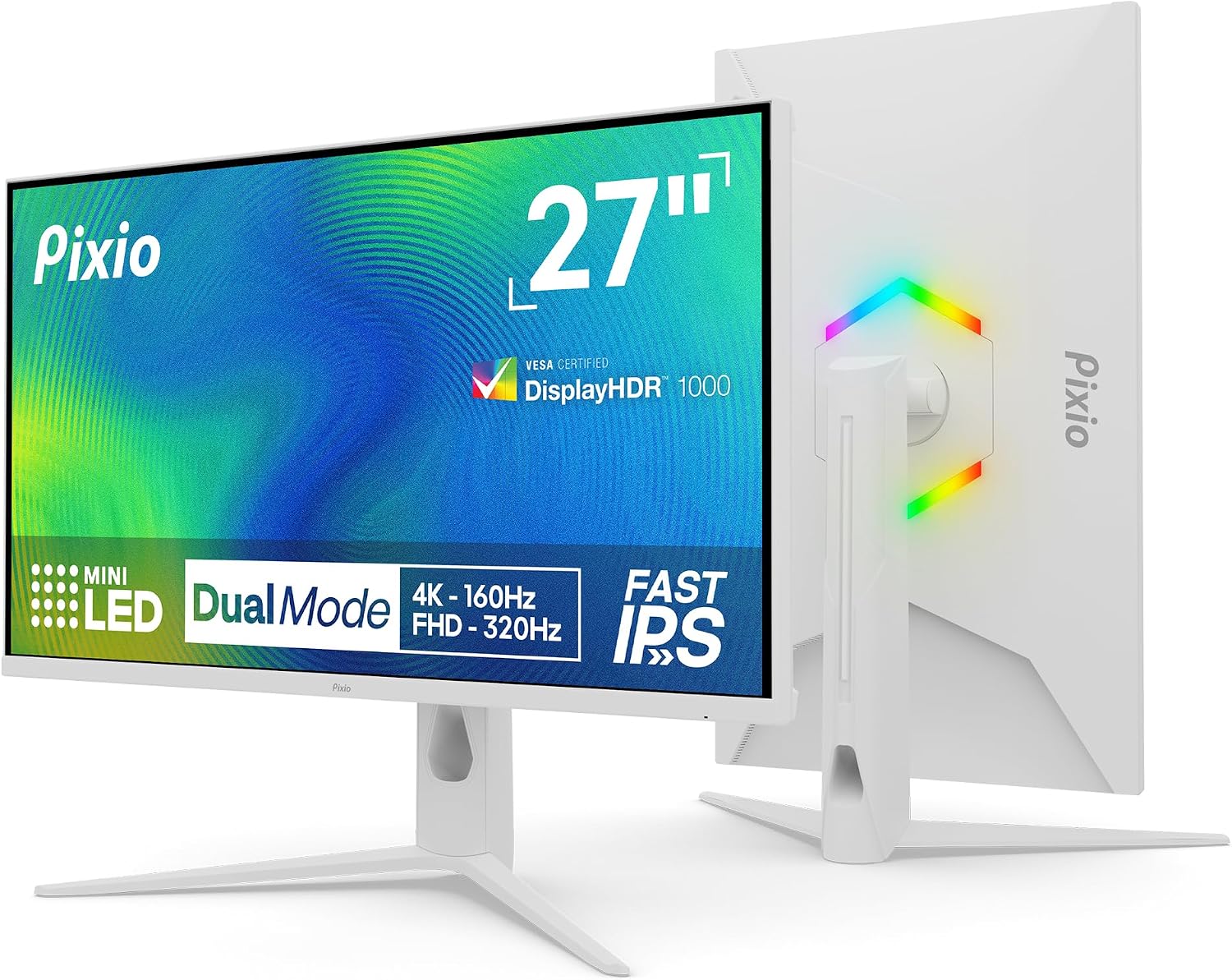
Pixio PX27UM Mini LED White 27 inch Dual Mode UHD 4K 160Hz/FHD 1920x1080 320Hz Fast IPS Panel 1ms GTG Response Time Gaming Monitor with Adaptive Sync HDR and Fully Adjustable Stand
Bottom line: The Pixio PX27UM Mini LED White 27 inch Dual Mode UHD 4K 160Hz/FHD ($399.99 on Amazon as of 2026-11-20 17:19 UTC): Dual mode: 4K UHD at 160Hz or 1080p at 320Hz with one setting change; main trade-off: 1080p at 320Hz on a 27-inch panel looks noticeably softer than native 4K. Another in-stock pick with the same 27" 4K 160Hz+ Mini LED monitor: the KOORUI 27" 4K QD-Mini LED Gaming Monitor, $399.99 on Amazon as of (price may vary).
As an Amazon Associate, SpecPicks earns from qualifying purchases. Full disclosure →
*Price sourced from Amazon.com. Last updated 2026-11-20. Product prices and availability are accurate as of the date/time indicated and are subject to change. Any price and availability information displayed on Amazon.com at the time of purchase will apply to the purchase of this product.
Pros & Cons
Pros
- ✓ Dual mode: 4K UHD at 160Hz or 1080p at 320Hz with one setting change
- ✓ 1152 local dimming zones on the Mini LED backlight for stronger HDR contrast
- ✓ Fast IPS panel with 1ms GTG response time to curb ghosting and motion blur
- ✓ All four inputs (2x DP 1.4, 2x HDMI 2.1) support 4K@160Hz and 1080p@320Hz
- ✓ Stand adjusts for height, tilt, swivel and pivot, including portrait use
Cons
- ✗ 1080p at 320Hz on a 27-inch panel looks noticeably softer than native 4K
- ✗ Holding 4K at 160Hz in modern games needs a high-end GPU
- ✗ Mini LED zone dimming can bloom around bright objects on dark backgrounds
- ✗ Listing gives no peak brightness figure or HDR certification tier
Manufacturer description
The Pixio PX27UM is a 27-inch Mini LED gaming monitor in a white finish that lets you choose between sharpness and speed. Its Fast IPS panel runs at 4K UHD up to 160Hz. One setting switches it to 1920x1080 at 320Hz for competitive shooters where every frame counts. Behind the panel, 1152 local dimming zones control the Mini LED backlight. Bright highlights can push hard while dark areas stay dark, which is a clear step up from edge-lit IPS for HDR content. A 1ms GTG response time keeps fast motion clean, and Adaptive Sync matches the refresh rate to your GPU's frame output to cut tearing and…
SpecPicks Verdict
SpecPicks has no buyer-rating or benchmark data for Pixio PX27UM Mini LED White 27 inch Dual Mode UHD 4K 160Hz/FHD…, so this read rests on the manufacturer's listed specs and the current price in the gaming monitors category (how we evaluate). Compare with similarly-priced alternatives in the gaming monitors category before committing. On the listing's own facts, the case for it is "Dual mode: 4K UHD at 160Hz or 1080p at 320Hz with one setting change"; the main trade-off is "1080p at 320Hz on a 27-inch panel looks noticeably softer than native 4K". If those two points fit how you will use it, put it beside one or two close alternatives in the Compare tool to confirm the price.
Before ordering, check the listed dimensions, load rating and mounting or device compatibility in the spec table below against how you plan to use it, and confirm them on the retailer's listing. Prices and stock are set by the retailer and may have moved since this page was last updated.
Frequently Asked Questions
Can I connect a game console to the Pixio PX27UM?
Yes. It has two HDMI 2.1 ports, and each supports 4K up to 160Hz and 1080p up to 320Hz with Adaptive Sync. The refresh rate you actually get depends on what your console can output.
How do I switch between 4K 160Hz and 1080p 320Hz?
The dual mode is a monitor setting. Change it to swap between 4K UHD at 160Hz and 1920x1080 at 320Hz. Check Pixio's manual for the exact menu path.
How many local dimming zones does the PX27UM have?
The Mini LED backlight has 1152 local dimming zones. They let the panel brighten highlights while keeping darker parts of the image dim, which helps HDR content.
Does the Pixio PX27UM support FreeSync or G-Sync?
Pixio lists Adaptive Sync on both DisplayPort 1.4 and HDMI 2.1 at either refresh mode. The listing does not name a specific FreeSync or G-Sync certification, so check Pixio's product page if you need one.
Can the stand rotate the monitor to portrait orientation?
Yes. The stand supports pivot for portrait orientation, along with height adjustment, tilt and swivel.
Key Features
Quoted from the manufacturer's listing. Where it differs from the pros and cons above, those note the conditions the listing leaves out.
- 27" Mini LED Fast IPS Panel - Enjoy the vivid colors and quick response time of fast IPS but at a much brigther lighting. This mini-LED panel is equipped with 1152 local dimming zones to make sure it can output at very high brightness levels
- Dual Mode 4K@160Hz or 1080p@320Hz - Enjoy the best of both worlds. With the change of a setting, swap from 4K resolution at 160Hz refresh rate to 1080p resolution at a blazing 320Hz refresh rate. There is no compromise. Take both benefits.
- 1ms GTG Response Time - Eliminate ghosting and blurring with the 1ms GTG response time of our monitor. Experience lightning-fast response times for a competitive edge in gaming and a smooth and immersive viewing experience for all types of content.
- Adaptive Sync - Matches the refresh rate of the monitor to the frame rate of the GPU, eliminating screen tearing and stuttering for a smooth and seamless gaming experience.
- Adjustable Stand - Tailor your viewing experience with the fully adjustable stand, featuring height adjustment, tilt, swivel, and pivot options. Find your perfect ergonomic position for hours of comfortable gaming.
- Supports both HDMI and DisplayPort - There are 2 ports for DP1.4 and HDMI2.1 each. Both ports support 4K@160Hz and 1080p@320Hz with Adaptive Sync. This assures maximum compatibility for PC desktops, laptops, consoles, or any device that supports DisplayPort or HDMI.
Full Specifications
| Brand | Pixio |
|---|---|
| Color | White |
| Voltage | 24 volts |
| Brightness | 500 cd |
| Model Name | PX27UMW |
| Resolution | 4K UHD 2160p FHD 1080p |
| Color Gamut | 150 |
| Screen Size | 27 inches |
| Aspect Ratio | 16:9 |
| Display Type | LED |
| Model Number | PX27UMW |
| Refresh Rate | 160 hertz |
| Adaptive Sync | FreeSync |
| Compatibility | PC |
| Response Time | 1 milliseconds |
| Screen Finish | Matte |
| Viewing Angle | 178 degrees |
| Contrast Ratio | 1000:1 |
| Native Resolution | 3840x2160 |
| Power Consumption | 54 watts |
Ready to buy?
Pixio PX27UM Mini LED White 27 inch Dual Mode UHD 4K 160Hz/FHD 1920x1080 320Hz Fast IPS Panel 1ms GTG Response Time Gaming Monitor with Adaptive Sync HDR and Fully Adjustable Stand is listed on Amazon. Price, availability, shipping and returns are set by Amazon and its sellers — check the listing for current terms. SpecPicks earns a small commission on qualifying purchases — thank you for supporting independent review work.
*Price sourced from Amazon.com. Last updated 2026-11-20. Product prices and availability are accurate as of the date/time indicated and are subject to change. Any price and availability information displayed on Amazon.com at the time of purchase will apply to the purchase of this product.
Related Gaming Monitors


More guides & deep dives from the SpecPicks archive
Browse all articles & guides →- How to Build a Windows 98 Retro PC in 2026
- The Complete Voodoo5 5500 AGP Driver Guide (2026 Edition)
- RTX 4070 Super vs RX 7800 XT — Which to Buy in 2026
- Best Budget Gaming PC Build 2026 — ~$1,000 Parts List
- Best 1440p Gaming GPUs in 2026
- Emulation Hardware in 2026: FPGA, Software, and Cart-Reader Ecosystems
- Best Retro Handhelds in 2026: Pocket, Mid-Tier and FPGA Picks
More reviews from the SpecPicks archive
Browse all reviews →- Imaging Vintage Hard Drives in 2026: SATA/IDE-to-USB Adapters Compared (FIDECO vs Unitek vs Vantec)
- Best 4K Monitor for PS5 in 2026 (Without Overpaying)
- CompactFlash to IDE Adapter Won't Boot on Windows 98: Troubleshooting Guide 2026
- Build a Raspberry Pi Zero W Cyberdeck in 2026: BOM + Wiring Guide
- Ryzen 7 5800X vs i7-9700K: Better Home Workstation in 2026?
- Best GPU for Running Llama 3.1 8B Locally on a Budget (2026)
- Best Local LLM for Coding Agents on a 24GB GPU (Late 2026)
- CompactFlash as a Boot Disk: A Silent, Reliable Drive for Your Win98 Retro Rig
- Build a Wireless Fingerprint Door Lock on a Raspberry Pi Zero W
- Claude Sonnet 5 Costs ~$2.29/Task: When an RTX 3060 Rig Breaks Even
- How Creative Killed Aureal: The 1999 Patent War, Audigy's Lineage, and Why Consumer PC Audio Stagnated for…
- AOOSTAR MACO 6850H as a Proxmox 9 Home Server
- Best GPU for 1440p 144Hz Esports in 2026: RTX 3060 Ventus Sweet Spot
- Playnix RX 9060 XT 16GB: A Steam Machine Rival at €1,140
- Period-Correct 1999 LAN Rig: Pentium III, Voodoo3 3000, Sound Blaster
- Kimi K2.7 Code Is 12x Cheaper Than GPT-5.5 — Run It Local?
- Best Gaming SSD for PC Builds in 2026: 5 Picks Tested
- Ex-Sega Engineer Builds a 'Super-Realistic' CRT Emulator
- Aider vs Cline vs Continue.dev on a Local RTX 3060 (2026)
- Best Controller for Retro Emulation on PC: 8BitDo, GameSir, DualSense
- Raspberry Pi 5 Kit: What's Actually Worth Buying in 2025
- Raspberry Pi 5 Local LLM Server: Best Models for 8GB RAM in 2026
- Local AI Server Build 2026: RAM, VRAM and NVMe for 13B+ Models
- AMD Radeon RX 9070 GRE Review: Thoroughly Midrange
Earliest SpecPicks reviews
Browse full archive →- Best GPU for Llama 3.1 8B (2026)
- Best GPU for Qwen 3 14B (2026)
- Best GPU for Qwen 3 32B (2026)
- Best GPU for Llama 3.1 70B (2026)
- Best GPU for DeepSeek-R1 32B (2026)
- Best GPU for Llama 3.1 405B (2026)
- How to run Llama 3.1 8B on NVIDIA GeForce RTX 5090
- How to run Qwen 3 14B on NVIDIA GeForce RTX 5090
- How to run Qwen 3 32B on NVIDIA GeForce RTX 5090
- How to run Llama 3.1 70B on NVIDIA GeForce RTX 5090
- How to run DeepSeek-R1 32B on NVIDIA GeForce RTX 5090
- How to run Llama 3.1 8B on NVIDIA GeForce RTX 4090